
On this page
Start here
Quick answer
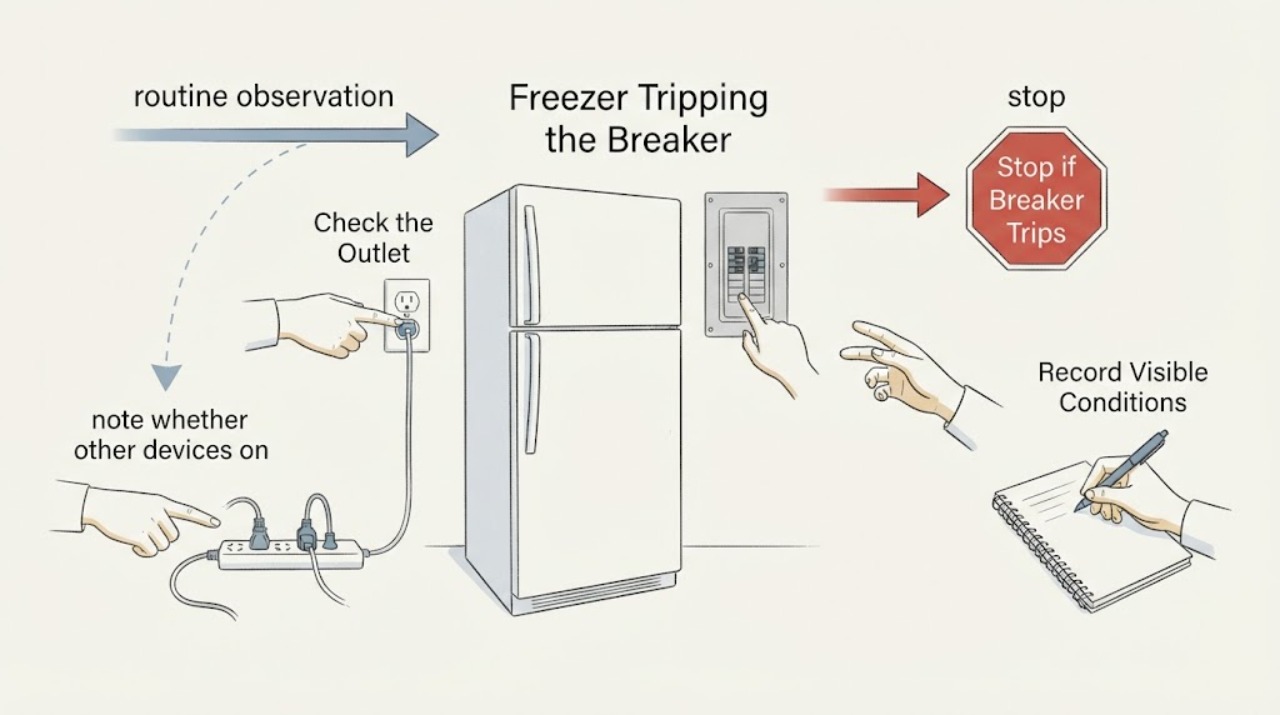
Do not keep resetting the breaker to make a Smeg freezer run. First note exactly when it trips: as soon as power is applied, when cooling starts, during a defrost or ice-making event, or only when other appliances share the circuit. Smeg identifies an overloaded circuit, a faulty appliance, and a ground fault as possible causes, and specifically says a suspected ground fault with burning smells or a discolored socket requires leaving the breaker off and calling an electrician. A freezer that has been wet must not be touched while still connected to power. If there is water near electrical parts, smoke, sparking, heat damage, a damaged cord, or repeated trips, isolate the appliance only from a dry, safe position and arrange qualified service.
Work through in order
Diagnostic checks
Use only checks that match the exact appliance or system and its official guide.
-
Check 1
Stop resetting the breaker and inspect the dry, visible area around the freezer, plug, outlet, cord, floor, and rear clearance without moving a built-in unit. If water reaches electrical parts, the cord or outlet is damaged, there is smoke, sparking, a burning smell, or heat discoloration, leave the breaker off.
Expected result: Wet electrical equipment, a damaged cord or outlet, smoke, sparks, burning odor, heat marks, or repeated immediate trips are present.
Next step: Keep the appliance isolated and arrange qualified electrical or appliance service. Do not touch a wet plugged-in appliance, pull out a built-in freezer, or open a cover.
Why this matters
Why: This is an electrical or fire-risk condition, not a normal compressor start. Repeated restoration of power can worsen a short or ground fault.
-
Check 2
With the freezer left disconnected, note whether other devices on the same circuit also lost power and whether the trip occurred when another high-load device was running. Check only the user-accessible panel label and breaker position; do not increase the rating or alter wiring.
Expected result: The breaker trips only when several devices share the circuit, or it trips with the freezer alone.
Next step: Reduce the circuit load without using an extension cord and have an electrician assess the circuit if the problem persists. If the freezer alone causes the trip, leave it off and arrange appliance service.
Why this matters
Why: A shared-load pattern supports a circuit-capacity or wiring investigation. A freezer-only pattern keeps the appliance, its cord, outlet, or dedicated connection in scope.
-
Check 3
Record the exact event when the trip happened without deliberately reproducing it: immediately at plug-in or reset, when the freezer began cooling, after a door opening, during a displayed cycle, or after an alarm. Use the model label and manual to identify whether the unit is No-Frost and whether it has an automatic ice maker.
Expected result: The trip has a repeatable timing pattern, or the model features cannot be confirmed from the label and manual.
Next step: Keep the breaker off and provide the timing, model code, and any display message to qualified service. Do not run extra cycles to identify the event.
Why this matters
Why: Timing is a useful service clue but is not proof of a failed compressor, defrost heater, fan, or ice-maker circuit. Smeg says the exact product code should be used to retrieve model-specific documentation.
-
Check 4
If the trip was associated with cooling starting, report whether the freezer had been operating normally before the event, whether it made an unusual sound or heat, and whether the breaker trips immediately again. Do not touch the compressor, start device, fan, or wiring.
Expected result: The breaker trips at each cooling start, the freezer was unusually hot or noisy, or the trip happened only once after a long outage.
Next step: Leave the freezer disconnected if the trip repeats or any heat or odor is present. Arrange service and protect food; do not substitute a larger breaker or repeatedly reset the existing one.
Why this matters
Why: A repeated start-related trip suggests a fault under load or a supply issue, while a one-time event after an outage does not identify a failed part. Smeg lists unusual noise, heat, reduced efficiency, and a faulty appliance as useful clues, but diagnosis remains professional work.
-
Check 5
If the trip coincided with defrost behavior, inspect only the user-visible display, alarm, frost condition, and floor for water after the appliance is isolated and safe. For a model with an automatic ice maker, note whether the event coincided with ice production or a visible water leak, without opening the rear or loosening a water connection.
Expected result: The trip follows a defrost or ice-making event, water is present, or the model has no such feature.
Next step: Keep power off, close any safe accessible water shutoff on a connected ice-maker model, and arrange service. Do not run a manual defrost cycle, remove panels, or test a water valve.
Why this matters
Why: The event points the technician toward the relevant operating path, but a freezer's exact hardware varies by model. A wet appliance or water near electrical parts raises shock and fire risk.
-
Check 6
Prepare a service record: model and product code, breaker type if known, exact trip timing, other devices on the circuit, recent move or cleaning, water or frost, unusual noise or heat, display alarms, and food temperature. A video of the already-observed event can be useful only if recorded from a safe distance and without another test.
Expected result: The breaker remains off, the freezer cannot be safely isolated at the appliance, or the same fault cannot be explained by circuit load or an external wet condition.
Next step: Use qualified service or an electrician as appropriate. Keep the freezer off until the cause is checked; do not provide a replacement part request based on timing alone.
Why this matters
Why: The remaining possibilities include an appliance fault, connection issue, or circuit fault that needs instruments and model-specific access. The record lets service distinguish a circuit event from a freezer event.
Use your observations
Decision map
Find the observation that best matches what you see, then follow the next safe action.
-
PATH 01Next step
What you see
The breaker trips immediately when the freezer is connected or power is restored.
Do this next
Leave the breaker off and arrange electrical or appliance service. Do not change the breaker rating, use an extension cord, or repeatedly reset it.
Why this path and its safety boundary
Why it matters: The supply path, cord, outlet, or an appliance fault is in scope before any cooling-cycle diagnosis.
-
PATH 02Next step
What you see
The trip happens when the compressor or normal cooling operation begins and repeats with the freezer alone.
Do this next
Keep the freezer off, record the pattern and any unusual noise or heat, and arrange qualified service.
Why this path and its safety boundary
Why it matters: A fault under operating load or the freezer's dedicated connection is possible; timing alone cannot identify the part.
-
PATH 03Next step
What you see
The trip follows a displayed defrost event, water on the floor, or a freezer that has become wet.
Do this next
Do not touch wet plugged-in equipment. Keep power off and have the freezer inspected before use; do not remove panels or force a defrost procedure.
Why this path and its safety boundary
Why it matters: Moisture or a defrost-related electrical path may be involved.
-
PATH 04Next step
What you see
The exact model has an automatic ice maker and the trip aligns with ice production or a visible water connection leak.
Do this next
Close an accessible supply valve only if it can be reached safely without moving the freezer, keep power off, and arrange model-specific service.
Why this path and its safety boundary
Why it matters: The optional water and ice-making path is a useful service clue, separate from a generic compressor event.
-
PATH 05Next step
What you see
Other appliances trip the same circuit, or the breaker trips only when several loads run together.
Do this next
Have an electrician assess the circuit. Do not move the freezer to another circuit with an extension cord as a workaround.
Why this path and its safety boundary
Why it matters: An overloaded circuit or building wiring issue is possible.
-
PATH 06Next step
What you see
There is a burning smell, discolored socket, smoke, sparking, heat damage, a damaged cord, or repeated trips after reset.
Do this next
Leave the breaker off, keep away from wet or damaged electrical parts, and arrange qualified electrical service. Leave the area and use local emergency help for smoke or fire.
Why this path and its safety boundary
Why it matters: Treat the situation as a suspected ground fault or fire-risk condition.
Helpful context
Understand the symptom
The timing of the trip is the useful clue
A trip at plug-in or immediately after reset points first to the supply path or an appliance fault. A trip that occurs when cooling starts is a different pattern from one that occurs during a documented defrost or ice-making event. These observations narrow the handoff; they do not prove which component failed. Smeg's product range varies, so use the product code and matching manual before assuming that a freezer has an ice maker, a manual defrost path, or a particular control sequence.
Keep the freezer protected while it is off
Keep the door closed as much as possible and move food only if it can be kept safely cold. Do not run the freezer from an extension cord or defeat a protective device. If the appliance or floor has been wet, follow electrical safety guidance and obtain a professional inspection before restoring power.
Safety boundary
Stop conditions
- Do not reset the breaker repeatedly, install a larger breaker, bypass a protective device, or use an extension cord as a workaround.
- Stop for water near the plug, outlet, wiring, or appliance base; do not touch a wet appliance while it remains connected to power.
- Stop for a burning smell, smoke, sparks, a discolored socket, melted material, a damaged cord, or an unstable built-in installation.
- Do not remove covers, handle compressor or defrost wiring, test live voltage, open a sealed refrigeration system, or move a built-in freezer alone.
Only after diagnosis
Potential parts
- compressor start or power component
Only consider this after a qualified diagnosis confirms a repeated trip during compressor start and identifies the relevant component.
Confirm the exact Smeg product code and service documentation; do not infer fit from timing alone. - defrost system component
Only consider this when the exact model has the relevant defrost system and a technician links the trip to that circuit.
No-Frost and manual-defrost designs differ; confirm the product code and diagnosis before ordering. - ice-maker water or electrical component
Only consider this if the exact freezer has an automatic ice maker and service confirms a fault in its water or electrical path.
Verify the model feature and fitment with Smeg or qualified service.
When checks do not resolve it
Need a professional?
Arrange qualified Smeg appliance service when the freezer alone trips the breaker, the trip repeats at cooling or a model-specific cycle, the appliance is wet, an automatic ice-maker path leaks, or any odor, smoke, spark, heat damage, or damaged cord is present. Use an electrician when the circuit, outlet, breaker, or other loads are implicated.
Have this ready
- The complete Smeg model and product code
- Whether the breaker trips at plug-in, cooling start, a displayed cycle, or after another appliance starts
- Whether the freezer is built in, No-Frost, or equipped with an automatic ice maker
- Any water, frost, alarm, unusual sound, heat, burning odor, smoke, spark, or socket discoloration
- The other devices on the circuit and the last safe breaker observation
Common questions
FAQ
Why does my Smeg freezer trip the breaker immediately?
An immediate trip can involve the outlet, cord, circuit, or a freezer fault. Leave the breaker off and arrange qualified service rather than changing the breaker or repeatedly restoring power.
What if the Smeg freezer trips only when the compressor starts?
Record the timing and any unusual sound or heat, then keep the freezer off if the event repeats. Timing helps a technician but does not identify a compressor or start component by itself.
Can a Smeg No-Frost defrost cycle cause a breaker trip?
A trip that aligns with a documented cycle is a useful service clue, not a safe reason to test the cycle again. Keep power off and use the model manual and qualified service to inspect the relevant system.
What should I do if water is near the Smeg freezer plug?
Do not touch the wet plugged-in appliance. Keep the breaker off and obtain professional inspection; disconnect only if it can be done from a dry, safe position without reaching through water.
Should I keep resetting the breaker to save the food?
No. Repeated resets can increase electrical risk. Keep the door closed, move food only to a safe cold location, and arrange electrical or appliance service based on whether the circuit or freezer is implicated.
Read the exact guide
Official sources
- Download ManualsSmeg USA · Smeg product-code lookup for model-specific user manuals
- Freezers Stainless steel FZU18LXSmeg USA · Smeg FZU18LX freezer features, built-in installation, No-Frost cooling, inverter compressor, alarms, and automatic ice maker
- CPSC Urges Flood Victims to Take Steps to Prevent CO Poisoning, Electrocution, Explosion and FiresU.S. Consumer Product Safety Commission · Electrical safety around wet appliances and professional inspection after water exposure
- My SMEG appliance keeps tripping the electricsSmeg UK Support · Smeg appliance breaker trips, overloaded circuits, faulty components, ground-fault warnings, and service guidance
Community feedback
Share a repair observation
Share a plain-text repair observation. Accepted observations are published automatically; this page may take a moment to update.