
On this page
Start here
Quick answer
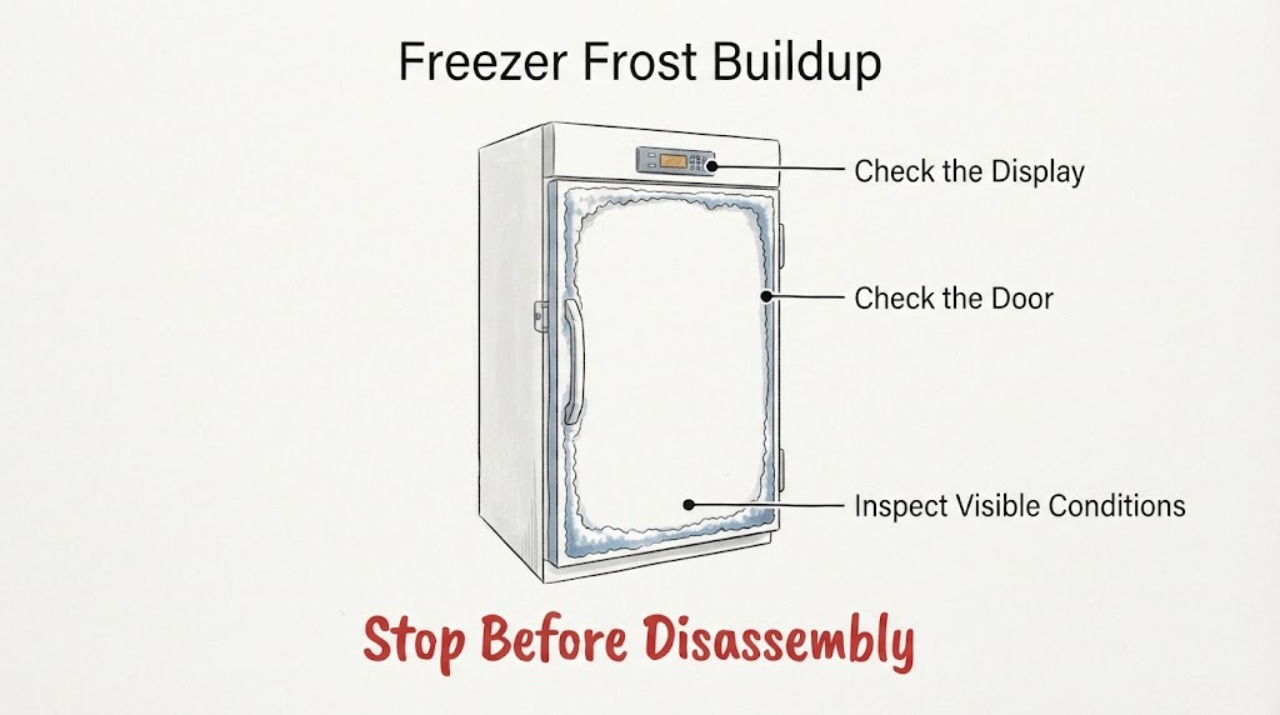
First identify the exact Smeg model and whether its freezer is No Frost, low-frost, or manual-defrost. A No Frost model is designed to prevent routine ice formation, while some Smeg refrigerator-freezers have a static freezer that must be defrosted manually. For either type, check for a door that is not sealing, blocked airflow, frequent or prolonged door opening, and warm or uncovered food adding moisture. If the model is manual-defrost, switch it off and let the ice melt naturally according to its manual; never chip ice, use a sharp tool, use a heat gun or hair dryer, or remove an interior panel. If thick frost returns quickly on a No Frost model, the frost is behind a panel, cooling is poor, or food has thawed, stop using the appliance and arrange qualified service.
Work through in order
Diagnostic checks
Use only checks that match the exact appliance or system and its official guide.
-
Check 1
Read the model code from the appliance label and look it up in Smeg's manual-download page; compare the exact manual and product description for the words No Frost, automatic defrost, static freezer, or manual defrost.
Expected result: The appliance is identified as No Frost or automatic defrost, or the manual explicitly says the freezer is manual-defrost.
Next step: Use the matching branch below. Do not apply a procedure from a different Smeg model.
Why this matters
Why: The defrost method and the significance of frost depend on this model-specific classification; a manual-defrost compartment may need periodic melting, while thick frost on a No Frost compartment is an abnormal clue.
-
Check 2
With the door open only briefly, map where the frost is: a light, even coating; a band around the door opening; a patch on the rear wall; or a solid mass that blocks a drawer or vent. Note whether it returns soon after melting or appears mainly after humid weather or frequent use.
Expected result: Frost is concentrated at the door edge, localized to one area, or thick enough to obstruct storage or airflow rather than being an occasional light coating.
Next step: Photograph the pattern and continue with the seal and airflow checks; on a No Frost model, arrange service if frost is behind an inaccessible panel or rapidly returns.
Why this matters
Why: A door-edge pattern points toward humid air entering through the seal or alignment; a rear-wall or vent pattern can restrict airflow or indicate a hidden cooling/defrost issue. Smeg notes that occasional freezer frost can be normal, but excessive ice has identifiable operating causes.
-
Check 3
Inspect the entire door gasket and the cabinet contact surface with the appliance idle: wipe away food residue or ice with a soft, damp cloth, then close the door normally and look for a continuous contact all around the perimeter.
Expected result: The gasket is dirty, torn, warped, loose, or visibly leaves a gap; alternatively, it is clean and contacts the cabinet evenly.
Next step: If cleaning restores a continuous contact, monitor the frost pattern. If the gasket is damaged, the door is misaligned, or a gap remains, stop short of disassembly and request a model-specific seal or door adjustment from qualified service.
Why this matters
Why: A dirty or damaged seal allows humid room air to enter and can produce frost at the door edge and longer compressor operation. A uniform seal makes the gasket a less likely primary cause.
-
Check 4
Check the internal and external ventilation openings without removing covers: move packages away from the rear wall and identified vents, avoid packing food tightly against the liner, and confirm the appliance has the clearances specified by its model manual.
Expected result: Packages or frost block an internal outlet, or the back and built-in ventilation path is obstructed; otherwise the paths are clear.
Next step: Rearrange only the food and removable storage items that the manual permits, then observe whether cooling and frost stop worsening. Do not remove a panel to reach hidden ice; persistent blockage or poor cooling needs service.
Why this matters
Why: Blocked circulation or cabinet ventilation can create warm zones and make the compressor run longer, allowing more moisture to freeze. Smeg specifically warns to keep ventilation openings clear.
-
Check 5
Review the temperature display or thermostat and the recent usage pattern against the exact Smeg manual: note any temperature alarm, unusually warm room, long door openings, frequent loading, or hot and uncovered food placed in the freezer.
Expected result: The setting is warmer than intended, a temperature alarm is active, or moisture-heavy usage coincides with the frost; or none of those conditions is present.
Next step: Correct only the user settings and loading practices described by the manual, keep food sealed, and make one controlled observation. If the alarm remains, food will not stay frozen, or the compressor runs continuously with heavy frost, stop and call service.
Why this matters
Why: A warmer setting, added warm food, and repeated humid-air entry can increase condensation and ice. A temperature alarm or poor freezing despite ordinary loading is evidence that the problem may be more than routine frost.
-
Check 6
For a confirmed manual-defrost freezer, prepare a safe natural defrost: protect the frozen food in an insulated cooler, unplug the appliance as directed by the manual, leave the freezer open, place absorbent towels to contain meltwater, and wait for the ice to melt on its own.
Expected result: The ice melts without forcing it, water can be contained, and the liner and power cord remain undamaged; or the ice will not release without force, water approaches electrical parts, or a liner is damaged.
Next step: Wipe the compartment dry, restore operation only according to the exact manual, and protect food until the freezer is reliably cold. If safe melting cannot be completed, stop and arrange service.
Why this matters
Why: A manual freezer can be cleared without attacking the liner or refrigerant circuit. Smeg's manual says not to use sharp objects, electrical appliances, sprays, steam, or other mechanical means to accelerate defrosting.
-
Check 7
After a permitted defrost and restart, make one short follow-up check of the door seal, clear vents, temperature indication, and frost recurrence without opening the door repeatedly.
Expected result: The freezer returns to normal operation and frost does not quickly reform, or frost and temperature problems return quickly.
Next step: Use the stable result as the end of user troubleshooting. For rapid recurrence, poor cooling, unusual alarm, or ice hidden behind a panel, leave the unit off if safety is uncertain and book qualified service rather than repeating defrosts.
Why this matters
Why: A stable result supports moisture entry, loading, or accumulated manual frost as the cause. Rapid recurrence—especially on a No Frost model—raises concern for the automatic defrost, fan, drain, control, or sealed cooling system.
Use your observations
Decision map
Find the observation that best matches what you see, then follow the next safe action.
-
PATH 01Next step
What you see
The exact model is No Frost or automatic-defrost.
Do this next
Check the door seal, loading, airflow, and temperature/alarm observations. If thick frost returns or is behind a panel, stop user troubleshooting and arrange qualified service.
Why this path and its safety boundary
Why it matters: Routine thick frost is not expected.
-
PATH 02Next step
What you see
The exact model has a static manual-defrost freezer.
Do this next
Use the manual's natural-melt procedure with food protected and power disconnected; never force the ice off.
Why this path and its safety boundary
Why it matters: Some frost can be expected, and Smeg's example manual calls for defrosting when the frost or ice exceeds 2 cm.
-
PATH 03Next step
What you see
Frost is concentrated around the door perimeter and the gasket is dirty or fails to contact.
Do this next
Clean and dry the gasket and check closure. Persistent gaps, damage, or misalignment require a model-specific service visit.
Why this path and its safety boundary
Why it matters: Humid air is likely entering at the seal.
-
PATH 04Next step
What you see
Packages, ice, or the cabinet installation blocks a vent.
Do this next
Clear only accessible obstructions allowed by the manual and do not remove panels. Escalate if the obstruction is hidden or cooling remains poor.
Why this path and its safety boundary
Why it matters: Air circulation or heat rejection may be restricted.
-
PATH 05Next step
What you see
Frost returns rapidly after a safe defrost on a No Frost model, or it is hidden behind a panel.
Do this next
Stop repeated defrost attempts and request qualified appliance service with the model code, photos, alarm details, and frost pattern.
Why this path and its safety boundary
Why it matters: An automatic defrost, fan, drain, control, or sealed-system problem is possible.
-
PATH 06Next step
What you see
Food is partly or completely thawed, or the freezer cannot maintain freezing temperature.
Do this next
Minimize door opening, move food to a reliably cold freezer or cooler, follow local food-safety guidance, and arrange service; do not refreeze food that has thawed unless a qualified food-safety source says it is safe.
Why this path and its safety boundary
Why it matters: This is a food-safety and cooling failure, not merely a cosmetic frost issue.
-
PATH 07Next step
What you see
Meltwater approaches electrical parts, the liner is punctured, the cord or plug is damaged, or there is smoke, burning odor, or repeated tripping.
Do this next
Stop, keep hands and power connections dry, disconnect power only if it can be done safely, and use qualified service or an electrician as appropriate.
Why this path and its safety boundary
Why it matters: Continuing to operate or defrost the appliance can create shock, fire, or refrigerant risk.
Helpful context
Understand the symptom
Why the model type matters
Frost is not diagnosed the same way on every Smeg freezer. A No Frost product such as the FZU30LX is specified as preventing ice formation, and the FAB32 product page describes automatic defrosting. By contrast, the FAB28 product page identifies a static freezer with manual defrosting. Treat these as examples of model variation, not as a claim about every Smeg appliance; use the model code and its exact manual before choosing a defrost procedure.
Food safety while you inspect
Open the door as little as possible and move frozen food to an insulated cooler or another working freezer before a manual defrost. Smeg's manual says food must be consumed as soon as possible once defrosted and should not be refrozen after it has partly or completely thawed. If you cannot establish that food stayed safely frozen, follow local food-safety guidance instead of tasting it or guessing.
Safety boundary
Stop conditions
- Do not chip, pry, or scrape ice with a knife, screwdriver, metal scraper, or other sharp tool.
- Do not use a heat gun, hair dryer, steam cleaner, spray, or an unapproved mechanical method to accelerate defrosting.
- Do not remove an interior panel or attempt to access the fan, heater, drain, control, or refrigerant circuit.
- Stop immediately for water near electrical connections, a damaged liner or cord, smoke, burning odor, arcing, repeated breaker trips, or an uncertain food-safety condition.
Only after diagnosis
Potential parts
- door gasket
Consider this only if cleaning and a closure check show a torn, warped, loose, or persistently leaking gasket.
Confirm the complete Smeg model code and fitment in the exact manufacturer documentation before ordering. - automatic defrost component
This is relevant only when a confirmed No Frost model develops rapid recurring or hidden frost after the door and airflow checks are satisfactory; diagnosis and replacement are for qualified service.
Do not infer a heater, sensor, or control part from symptoms alone; the exact model and service diagnosis determine compatibility. - evaporator fan or airflow component
Consider this only if a qualified diagnosis finds restricted or absent airflow after accessible loading and ventilation checks are clear.
Verify the model-specific part and have electrical or panel work performed by qualified service.
When checks do not resolve it
Need a professional?
Call qualified Smeg service when a gasket or door cannot seal, frost is behind an inaccessible panel, frost returns quickly on a No Frost model, the temperature alarm or poor freezing persists, the compressor runs continuously with heavy frost, or any electrical, water, liner, smoke, or refrigerant concern is present. Do not remove panels, puncture the liner or refrigerant tubing, test live wiring, or attempt sealed-system or defrost-component repair.
Have this ready
- Provide the exact model code, whether the freezer is No Frost or manual-defrost, a photo of the frost pattern, current temperature or alarm indication, when the frost returns, and whether food has thawed.
Common questions
FAQ
Is some frost normal in a Smeg freezer?
It depends on the model. Smeg describes occasional frost as normal in a manual-defrost example, while its No Frost products are designed to prevent ice formation. Identify the exact model before deciding whether frost is expected.
Can I remove Smeg freezer frost with a knife or hair dryer?
No. Smeg's manual warns against sharp objects and electrical appliances or other unapproved methods for accelerating defrosting. Let ice melt naturally using the exact manual's procedure.
Why does frost form around the Smeg freezer door?
A dirty, damaged, warped, or poorly closing gasket can admit humid air; frequent or prolonged door opening can do the same. Clean and inspect the seal without disassembling it, then escalate persistent gaps or damage.
Should I manually defrost a Smeg No Frost freezer?
Routine manual defrosting is not the normal remedy for a confirmed No Frost model. Check the seal, loading, accessible airflow, and alarms; rapid or hidden frost needs qualified service rather than panel removal.
What should I do with food that thawed during defrosting?
Protect frozen food in a working freezer or insulated cooler before defrosting. Smeg's manual says food should be consumed as soon as possible once defrosted and not refrozen after partial or complete thawing; when safety is uncertain, follow local food-safety guidance.
Read the exact guide
Official sources
- Emerald GreenFreestanding refrigerator FAB28URDEG3 SmegSmeg USA · Smeg refrigerator-freezer with static freezer and manual freezer defrost
- Freezers Stainless steel FZU30LX | Smegusa.comSmeg USA · Smeg freezer product specifications and No Frost behavior
- Download ManualsSmeg USA · Use the product code on the appliance label to retrieve the model-specific manual
- User manual (EN) (PDF)Smeg · Smeg manual-defrost freezer guidance, ventilation, door sealing, food handling, and safety limits
- WhiteFreestanding refrigerator FAB32ULWH3 SmegSmeg USA · Smeg refrigerator-freezer with No Frost freezer compartment and automatic defrost
Community feedback
Share a repair observation
Share a plain-text repair observation. Accepted observations are published automatically; this page may take a moment to update.