
On this page
Start here
Quick answer
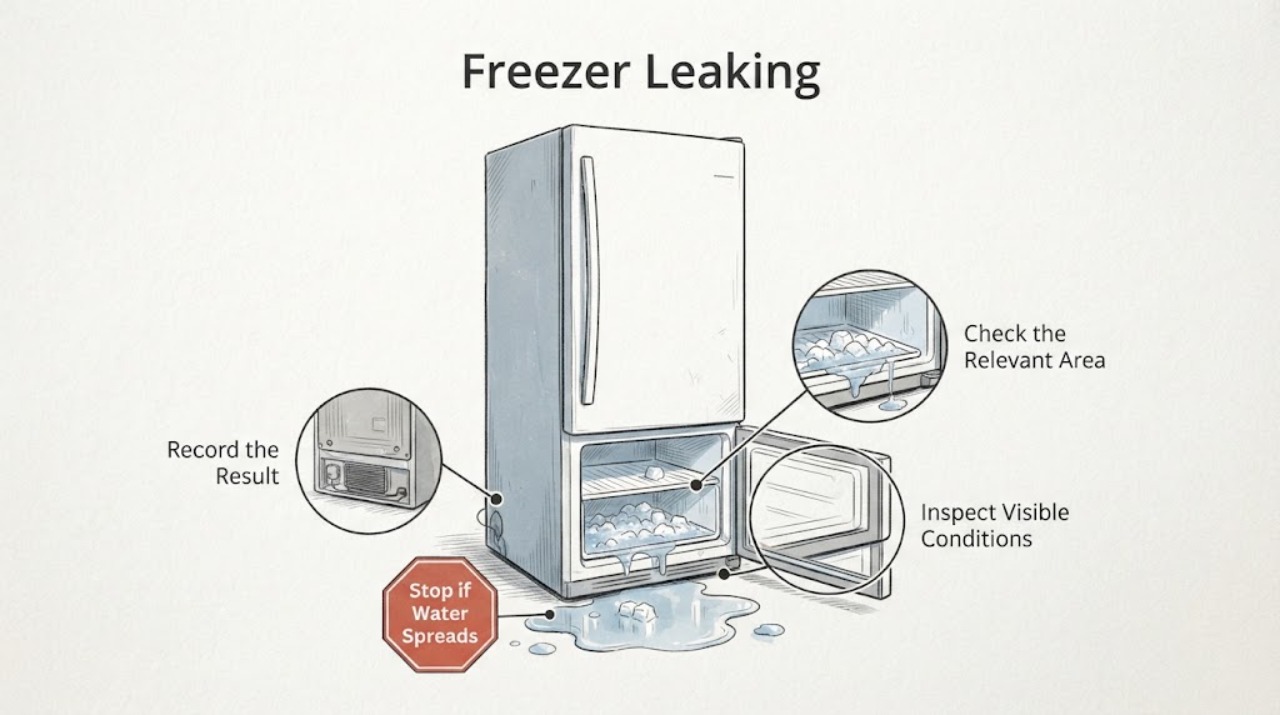
Start by stopping the leak and identifying where the water begins. A wet interior or frost around the door can point to humid air entering through a door that is not sealing; Smeg also identifies the door gasket and a restricted condensation drain as checks. A puddle below or behind the appliance can instead come from a drain path, drip tray, or, on models equipped with one, the automatic ice-maker water circuit. Do not move a built-in freezer or work around wet electrical parts. If water is near the plug or wiring, the leak is active, the cord is damaged, the freezer is warming, or there is smoke, sparking, or a burning smell, stop and use a qualified service path.
Work through in order
Diagnostic checks
Use only checks that match the exact appliance or system and its official guide.
-
Check 1
Stop operation and contain only the water that is safely reachable. Look for active flow, a spreading pool, water touching the plug or wiring, a damaged cord, smoke, sparks, or a burning smell. If it is a plumbed model, close the accessible water shutoff without moving the freezer.
Expected result: The water is active, reaches an electrical area, or is accompanied by smoke, sparks, burning odor, a damaged cord, or an unstable appliance.
Next step: Stop using the freezer. Leave the area if smoke or fire is present, and use local emergency help when necessary. Otherwise arrange qualified appliance service; do not pull out a built-in unit or open electrical covers.
Why this matters
Why: This is a safety or flood condition, not a routine adjustment. Electrical shock, fire, cabinet damage, and food loss can worsen if the appliance is run or repeatedly reset.
-
Check 2
Trace the first visible wet point with the freezer still in place. Check the inside bottom and drawer fronts, the door perimeter, the floor directly below, and only the visible rear or lower area. Wipe surrounding surfaces first, then observe which area becomes wet again.
Expected result: Moisture returns inside or around the door, below the cabinet, at a visible rear tray, or at a visible ice-maker tube or fitting.
Next step: Follow the matching branch below. Do not remove rear covers or loosen fittings simply to search for the source.
Why this matters
Why: The first wet point separates a seal or condensation path from a drain/tray path and from an optional water-supply path. Water can travel along a shelf or cabinet before reaching the floor.
-
Check 3
Inspect the door gasket and closure from the outside. Look for a torn, twisted, deformed, or detached section; a drawer or package holding the door open; frost on the sealing surface; or a door that no longer closes evenly. Remove only an obvious obstruction while the appliance remains stable.
Expected result: The gasket is damaged or the door cannot close evenly; or frost and condensation are concentrated around the opening.
Next step: If the gasket is damaged or the door remains misaligned, stop using the freezer and request service. If the seal is intact, close the door fully, keep packages clear, and monitor for renewed moisture without forcing the door or using a heat gun.
Why this matters
Why: Warm humid air can enter through a poor seal or an open door, producing condensation and frost that later melts and escapes. Smeg says a damaged, deformed, or broken gasket requires a service visit.
-
Check 4
Check for a visible condensation or defrost drain opening inside the cabinet only if the model manual identifies one. Confirm that it is not covered by food, ice, or a removable plug. Do not poke into the passage or pour boiling water, chemicals, or hot-air from an electrical appliance into it.
Expected result: The drain opening is obstructed, frozen, or water returns after it is wiped; or the model is a No-Frost design with ice behind an internal panel.
Next step: Use only the defrost and cleaning procedure in the exact Smeg manual for the model. If the passage is inaccessible, the leak returns, or ice is behind a panel, stop and arrange qualified service rather than dismantling the cabinet.
Why this matters
Why: A restricted route can let melt or condensation water collect and escape at an unintended point. A No-Frost internal ice or drain fault is beyond a safe external check.
-
Check 5
Determine whether this exact freezer has an automatic ice maker or a water connection by checking its label and model manual. On a connected model, inspect only the visible tubing and connection for a wet joint, split tube, or water that appears after ice production; close the accessible supply valve if it can be reached safely.
Expected result: The model has no water feature; or the leak is clearly at a visible ice-maker tube or fitting; or the source cannot be seen without moving the appliance or removing a cover.
Next step: For a confirmed visible tube or fitting leak, keep the water supply closed and arrange service. If the source is hidden, do not pull out the built-in appliance or loosen the connection yourself; use the model-specific manual and a qualified technician.
Why this matters
Why: Not every Smeg freezer has the same water hardware. The FZU18LX product page identifies an automatic ice maker using filtered water, so a model with that feature has an additional possible leak path. An unseen fitting or built-in connection needs a controlled repair inspection.
-
Check 6
Check recent events and operating condition without disassembling anything: a power interruption, manual defrost, appliance move, door left open, heavy frost, or a high-temperature alarm. Protect food from thawing and note the model code, alarm message, location of the water, and whether the leak changes when the ice maker is not making ice.
Expected result: The leak followed a defrost or outage, the freezer is warming, food is softening, an alarm remains active, or water returns despite a clear seal and visible drain.
Next step: Keep the freezer closed as much as possible, follow the exact Smeg manual for food and defrost guidance, and arrange service when temperature recovery or leakage is not normal. Do not keep testing a wet or warming appliance.
Why this matters
Why: Meltwater and food-safety risk take priority over further diagnosis. A persistent leak with normal external checks may involve an internal drain, tray, sensor, or water connection that requires model-specific service.
Use your observations
Decision map
Find the observation that best matches what you see, then follow the next safe action.
-
PATH 01Next step
What you see
Water or frost is concentrated around the door opening and the gasket is torn, deformed, or cannot seal.
Do this next
Stop using the freezer and arrange service for the gasket or hinge/alignment issue. Do not force the door or attempt to reshape a damaged seal.
Why this path and its safety boundary
Why it matters: Treat the seal or door alignment as the leading path; remove only an obvious package obstruction.
-
PATH 02Next step
What you see
The gasket is intact, but moisture or ice is inside near a documented drain opening.
Do this next
Follow the exact model manual for a safe clean or defrost procedure. Escalate if the route is hidden, frozen behind a panel, or the leak returns.
Why this path and its safety boundary
Why it matters: A condensation or defrost route may be restricted.
-
PATH 03Next step
What you see
Water appears below or behind the cabinet and the freezer is a built-in installation.
Do this next
Dry the safe area and arrange qualified service. Do not slide or tilt a built-in freezer alone and do not remove rear covers.
Why this path and its safety boundary
Why it matters: A tray, drain route, or hidden connection may be involved, but the visible floor water does not identify the failed part.
-
PATH 04Next step
What you see
The exact model has an automatic ice maker or water connection and moisture starts at a visible tube or fitting.
Do this next
Close the accessible supply valve if safe, leave the appliance in place, and request service for the connection. Do not loosen pressurized fittings.
Why this path and its safety boundary
Why it matters: The water circuit is a plausible source, separate from condensation.
-
PATH 05Next step
What you see
The freezer is warming, food is thawing, an alarm remains active, or water continues after safe external checks.
Do this next
Keep the door closed, move food only to a safe cold location, and arrange service. Record the model code and temperature or alarm observations.
Why this path and its safety boundary
Why it matters: Food safety and appliance protection take priority over continued troubleshooting.
-
PATH 06Next step
What you see
Water reaches electrical parts, the cord is damaged, or there is smoke, sparking, or a burning smell.
Do this next
Do not touch wet electrical parts or repeatedly restore power. Leave the area for smoke or fire and use local emergency help when necessary; otherwise use qualified appliance service.
Why this path and its safety boundary
Why it matters: This is an immediate stop condition.
Helpful context
Understand the symptom
Make the situation safe first
Turn off the freezer controls if they are safely reachable. If the floor is wet, keep clear of the plug and other electrical equipment. Only disconnect the appliance from a dry, safe position; never reach through water. If it is a plumbed model and the water shutoff is accessible without pulling the appliance, close that valve. Move food only when it is safe to do so and keep it cold while the cause is investigated.
Why the leak location matters
Water at the front or inside the cabinet often follows a door-seal, condensation, frost, or drain path. Water under the rear of the unit can involve a tray or drain route. A leak that starts at an ice-maker tube or fitting is a water-supply problem. Smeg's product information shows that features vary: the FZU18LX, for example, is a built-in No-Frost freezer with an automatic ice maker, while the manual lookup page directs owners to use the product code on the appliance label.
Safety boundary
Stop conditions
- Stop immediately if water is near the plug, outlet, wiring, or other electrical equipment; disconnect only from a dry, safe position.
- Stop if there is smoke, sparking, a burning smell, a damaged cord, an unstable cabinet, or an active spreading pool.
- Stop if the freezer is warming or food is thawing; protect food safely and do not continue test runs.
- Do not move a built-in freezer alone, remove electrical or rear covers, loosen water fittings, handle refrigerant, or use hot air and sharp tools to clear hidden ice.
Only after diagnosis
Potential parts
- freezer door gasket
Only consider this if the gasket is torn, deformed, detached, or cannot seal after visible obstructions are removed.
Confirm the exact Smeg product code and the manufacturer's fit information before ordering. - condensation drain or drip-tray assembly
Only consider this after water is traced to the drain or tray path and the model manual or technician confirms the failed component.
Drain and tray designs vary by model; confirm the product code and service documentation. - ice-maker water inlet or tubing
Only consider this when the exact model has a water-fed ice maker and a qualified inspection identifies a leaking tube, valve, or fitting.
Verify that the model has the water feature and confirm fitment from Smeg or a qualified technician.
When checks do not resolve it
Need a professional?
Arrange qualified Smeg service when the gasket is damaged, the door will not seal, the leak returns after safe external checks, the drain or tray is hidden, the freezer is built in, an ice-maker connection leaks, or temperature and alarm problems accompany the water.
Have this ready
- The full model and product code from the appliance label
- Where the water first appeared and whether it returns
- Whether the appliance is built in and whether it has an automatic ice maker or water connection
- Recent defrost, power interruption, move, door-closure issue, frost, alarm, or food-temperature change
- Photos of the safe visible area, gasket, and any visible tube or fitting without removing covers
Common questions
FAQ
Why is my Smeg freezer leaking water from the front?
Check the door gasket, door closure, frost around the opening, and any visible interior drain path. A damaged seal can admit humid air; a restricted condensation route can let water collect and escape at the front. If the leak returns or the gasket is damaged, arrange service.
Can I clear a Smeg freezer drain myself?
Only perform a drain or defrost step that the exact model manual explicitly permits. Do not use sharp tools, boiling water, chemicals, or hot air, and do not remove internal panels. A hidden or repeatedly blocked route needs qualified service.
Could the Smeg freezer ice maker be leaking?
It is possible only on a model equipped with an automatic ice maker and water connection. Confirm the model first, look only at visible tubing or fittings, close the accessible water supply if safe, and arrange service for a confirmed connection leak.
Should I unplug a leaking freezer?
If the floor and your hands are dry and the plug can be reached without touching water, disconnecting may be appropriate. Never reach through water or touch wet electrical parts; if the area is unsafe, leave it isolated and call qualified service.
What information should I give Smeg service?
Provide the model or product code, the first wet location, whether water is still flowing, recent defrost or power events, door-seal and frost observations, any alarm, and whether the unit has an ice maker or water connection.
Read the exact guide
Official sources
- Why is my SMEG fridge frosting up?Smeg UK Support · Smeg refrigeration moisture, frost, door gasket, and condensation-drain guidance
- Download ManualsSmeg USA · Smeg product-code and language lookup for model-specific user manuals
- Freezers Stainless steel FZU18LXSmeg USA · Smeg FZU18LX freezer features, No-Frost system, built-in installation, and automatic ice maker
- How can I arrange an engineer visit?Smeg UK Support · Smeg large-appliance support and approved-engineer guidance
Community feedback
Share a repair observation
Share a plain-text repair observation. Accepted observations are published automatically; this page may take a moment to update.