
On this page
Start here
Quick answer
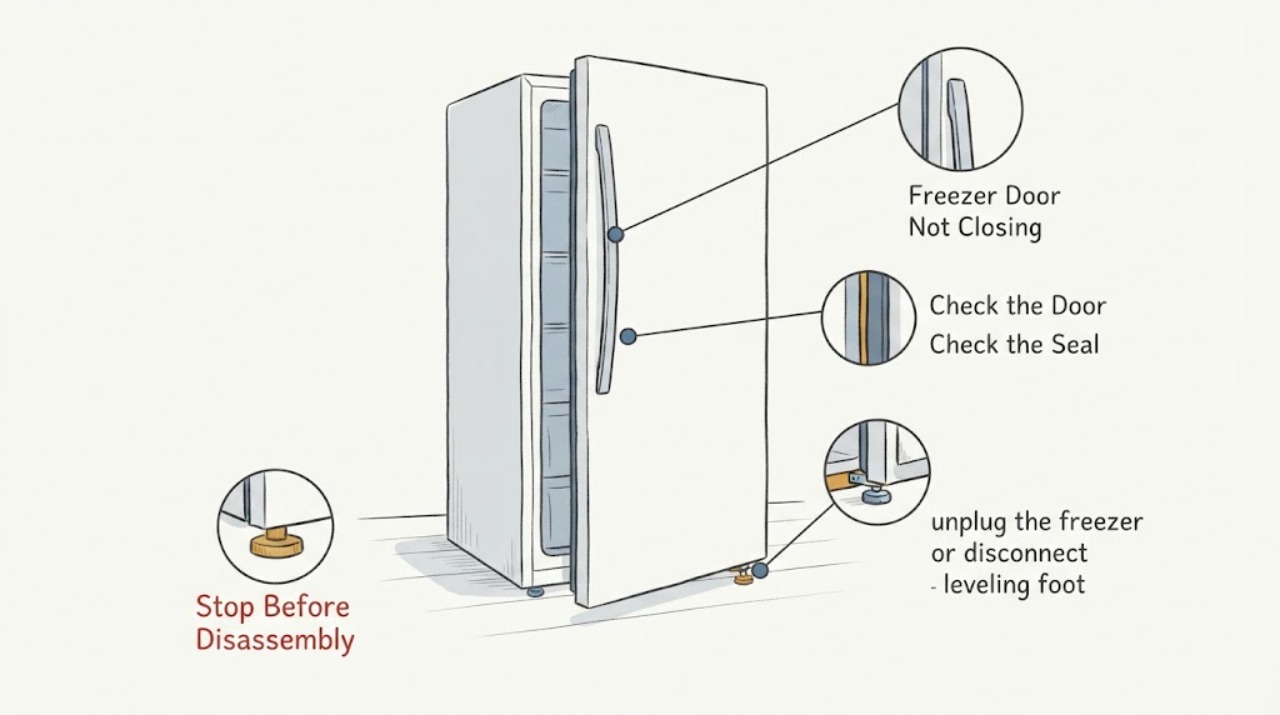
Do not keep forcing a Smeg freezer door that will not close. First remove any drawer, basket, food package, or shipping material that projects into the door path. Then inspect the gasket and the cabinet edge for frost, dirt, a fold, a gap, or a damaged section. With the appliance unplugged before cleaning or defrosting, clear only soft, accessible frost using the method allowed by the model manual; never use a heat gun, open flame, knife, or other sharp tool. Check whether the cabinet rocks or the door is visibly sagging, but do not remove the door or adjust hinge hardware unless the Smeg instructions for the exact model say how. A door that still will not seal leaves the freezer warming and can compromise food, so transfer food to safe cold storage, keep the door closed, and arrange qualified service.
Work through in order
Diagnostic checks
Use only checks that match the exact appliance or system and its official guide.
-
Check 1
Stop forcing the door and inspect the opening from the front. Remove only a plainly visible food package, drawer, basket, shelf edge, or remaining shipping material that projects into the door path; do not pull hard on a jammed drawer or lean on the door.
Expected result: The door closes freely after one obstruction is removed, or it still stops at the same point with no obvious obstruction.
Next step: If the obstruction is not plainly accessible, leave the door closed as far as it safely goes and continue with an unpowered visual inspection; do not disassemble the cabinet.
Why this matters
Why: A repeatable stop at the same location points to a remaining package, drawer position, frost ridge, seal, hinge, or alignment issue rather than a need for more closing force.
-
Check 2
Inspect the freezer door gasket, mating cabinet surface, and corners for frost, ice, food residue, a fold, a section pulled from its channel, tearing, hardening, or a visible gap. Wipe only accessible dirt with a soft cloth appropriate for the model; do not use abrasive chemicals or a sharp object.
Expected result: The gasket is dirty or folded, frost is lifting it away from the frame, the gasket is damaged or displaced, or the seal looks continuous and seated.
Next step: Clean and reseat only what the owner manual permits. If the gasket is torn, permanently deformed, or cannot sit evenly, keep the freezer closed and arrange service or an exact-model seal replacement.
Why this matters
Why: Smeg lists a soiled, worn, broken, or improperly seated seal as a cause of poor sealing. Frost at the door edge can also prevent the gasket from meeting the cabinet evenly.
-
Check 3
If frost is blocking the edge, unplug the freezer or disconnect its mains supply before cleaning or defrosting, and protect the floor from meltwater. Use only the defrosting method specified for the exact model; never use a heat gun, open flame, knife, screwdriver, or other sharp tool to accelerate or chip away frost.
Expected result: The frost softens and the door edge becomes clear without damage, or the ice is thick, returns quickly, or appears to surround a panel, sensor, or internal duct.
Next step: Dry the area and inspect the gasket after the approved defrost. If frost returns, the seal remains open, or water reaches electrical parts, keep the appliance off and arrange qualified service.
Why this matters
Why: A clear edge may remove the immediate obstruction, but recurring or inaccessible frost can indicate a seal, door alignment, drainage, or cooling-system issue. Smeg warns against mechanical or unapproved defrosting methods and electrical cleaning hazards.
-
Check 4
Check the cabinet position without moving a loaded freezer: observe whether it rocks, leans, or has a visible gap that changes from top to bottom when the door is gently brought toward the frame. Confirm that nearby cabinetry or a wall is not blocking the door swing.
Expected result: The cabinet rocks or the floor is visibly uneven, the door is blocked by surrounding installation, or the cabinet is stable with adequate clearance.
Next step: For a freestanding unit, use only the manual's safe foot-leveling procedure and do not tip a loaded appliance. For a built-in unit or persistent lean, arrange installer or appliance service rather than forcing the door.
Why this matters
Why: Smeg's manual identifies an uneven floor and insufficient installation position as alignment concerns. A stable cabinet with clear surroundings shifts attention to the door seal, hinge, or door panel.
-
Check 5
Look at the door from the hinge side and handle side for sagging, a shifted panel, a loose-looking hinge cover, or a gap that is wider at one corner. Do not remove hinge covers, door panels, or fasteners unless the exact Smeg manual explicitly provides that procedure.
Expected result: The door is visibly sagging or damaged, a hinge appears displaced, or the door and hinges look straight but the gasket still does not contact evenly.
Next step: Keep the door supported by its normal position, avoid lifting or twisting it, and request qualified service for hinge, panel, or cabinet alignment work.
Why this matters
Why: A sagging or damaged door can prevent the gasket from closing even after packages and frost are removed. The Smeg product documentation describes door and hinge configurations as model-dependent, so a generic adjustment may worsen alignment.
-
Check 6
After the freezer is cool, clean, and safely unpowered if cleaning was required, perform a gentle gasket contact check using a thin sheet of paper at several points around the closed edge. Do not pull hard, slam the door, or treat one successful point as proof that the whole seal is sound.
Expected result: The sheet has similar light resistance around the perimeter, or it slides out easily at one or more corners or along a continuous section.
Next step: If contact is uneven or the door springs open, keep the appliance out of service and arrange a model-specific seal and alignment inspection; do not order a gasket without confirming the model.
Why this matters
Why: Uneven contact suggests a gasket seating, door alignment, or hinge problem. A seemingly even contact check does not rule out a damaged gasket or an internal condition that causes frost.
-
Check 7
Protect the food and prepare a service handoff. Record the model, whether the problem began after moving or loading, the obstruction or frost location, gasket condition, cabinet position, door gap, and any temperature alarm or unusual noise; do not keep opening the freezer to retest it.
Expected result: The freezer remains sealed after a permitted low-risk correction, or the gap, frost, damage, or food-temperature concern remains.
Next step: If the door still will not close or food temperature is uncertain, move food to safe cold storage, keep the freezer closed, and arrange qualified appliance service.
Why this matters
Why: A door that cannot seal is not only a convenience problem: continued air leakage can warm the compartment and increase frost or food-safety risk. Persistent misalignment or seal damage needs a qualified decision about repair.
Use your observations
Decision map
Find the observation that best matches what you see, then follow the next safe action.
-
PATH 01Next step
What you see
A package, drawer, basket, or shipping material visibly blocks the door.
Do this next
Remove only the plainly accessible obstruction, reposition the load without overpacking, and check the gasket edge. Stop if the obstruction is jammed or the door is damaged.
-
PATH 02Next step
What you see
Frost or ice is lifting the gasket or blocking the door edge.
Do this next
Disconnect power before cleaning or defrosting and use only the model-approved method. Never use a heat gun, open flame, knife, or sharp tool; request service if the frost returns or is inaccessible.
-
PATH 03Next step
What you see
The gasket is dirty, folded, displaced, torn, hard, or visibly separated from the frame.
Do this next
Clean or reseat only as the exact manual permits. Keep the freezer closed and arrange service for a damaged or persistently open seal; confirm model fit before any replacement.
-
PATH 04Next step
What you see
The cabinet rocks, leans, lacks clearance, or the door is visibly sagging.
Do this next
Do not force or lift the door. Use only the manual's safe leveling guidance for an unloaded freestanding unit; otherwise arrange qualified appliance or installation service.
-
PATH 05Next step
What you see
The door remains open after the load, frost, gasket, and position checks, or frozen food has softened and its safety is uncertain.
Do this next
Keep the freezer closed and out of service, move food to safe cold storage, and request qualified service. Follow local food-safety guidance for any questionable food.
Helpful context
Understand the symptom
Work from the least invasive cause
A door can appear to be a hinge problem when a drawer or package is actually holding it open. Frost or a gasket that has moved out of its channel can create the same gap. Smeg's own troubleshooting guidance separates blocked packages and an uneven floor from seal and door-ajar conditions, so the order of checks matters: inspect the load and edges first, then the seal, then the cabinet position and hardware.
Protect food while the seal is open
An open or leaking freezer door allows cold air to escape and can raise the temperature of stored food. Keep the door shut as much as possible while arranging service. If food has softened, thawed, or its temperature history is unknown, use local food-safety guidance rather than tasting it to decide whether it is safe.
Only after diagnosis
Potential parts
- freezer door gasket
Only consider this part if the existing seal is torn, permanently deformed, or cannot be cleaned and seated evenly after the door path is clear.
Confirm the complete Smeg model and the manufacturer's fit information before ordering; a gasket for another model may not seal. - door hinge hardware
Only consider hinge service or hardware after a qualified inspection finds sagging, displaced hardware, or a door alignment fault.
Do not infer fit from appearance; confirm the exact model and service instructions.
When checks do not resolve it
Need a professional?
Keep the freezer closed and arrange qualified service if the door cannot seal, the gasket or hinge is damaged, the cabinet is unstable, frost returns quickly, water reaches electrical parts, or food safety is uncertain. Stop immediately and disconnect power only from a safe, dry location if there is a damaged cord, smoke, burning odor, or electrical hazard.
Common questions
FAQ
Why will my Smeg freezer door not close after I loaded it?
Check for a drawer, basket, food package, or shipping material protruding into the door path. Then inspect the gasket and edge for frost, dirt, folds, or damage. Smeg also lists an uneven cabinet or floor as a possible cause.
Can I use a heat gun or knife to remove frost from the Smeg freezer door?
No. Unplug before cleaning or defrosting and follow the exact model manual. Do not use a heat gun, flame, knife, screwdriver, or other sharp tool to accelerate defrosting or chip ice.
What should I do with food if the freezer door will not seal?
Keep the door closed as much as possible and move food to safe cold storage if the compartment has warmed or the temperature history is uncertain. Follow local food-safety guidance rather than tasting questionable food.
Read the exact guide
Official sources
- Instruction ManualSmeg · Smeg CB300U refrigerator and freezer manual; door obstruction, seal, cleaning, defrosting, leveling, installation, and service safety
- CB300U RefrigeratorSmeg USA · Smeg CB300U refrigerator with freezer; product configuration, door, hinge, installation, and no-frost context
- KOELKASTEN EN VRIEZERSSmeg Belgium · Smeg refrigerators and freezers FAQ; freezer-compartment door frost and closure guidance
Community feedback
Share a repair observation
Share a plain-text repair observation. Accepted observations are published automatically; this page may take a moment to update.