
On this page
Start here
Quick answer
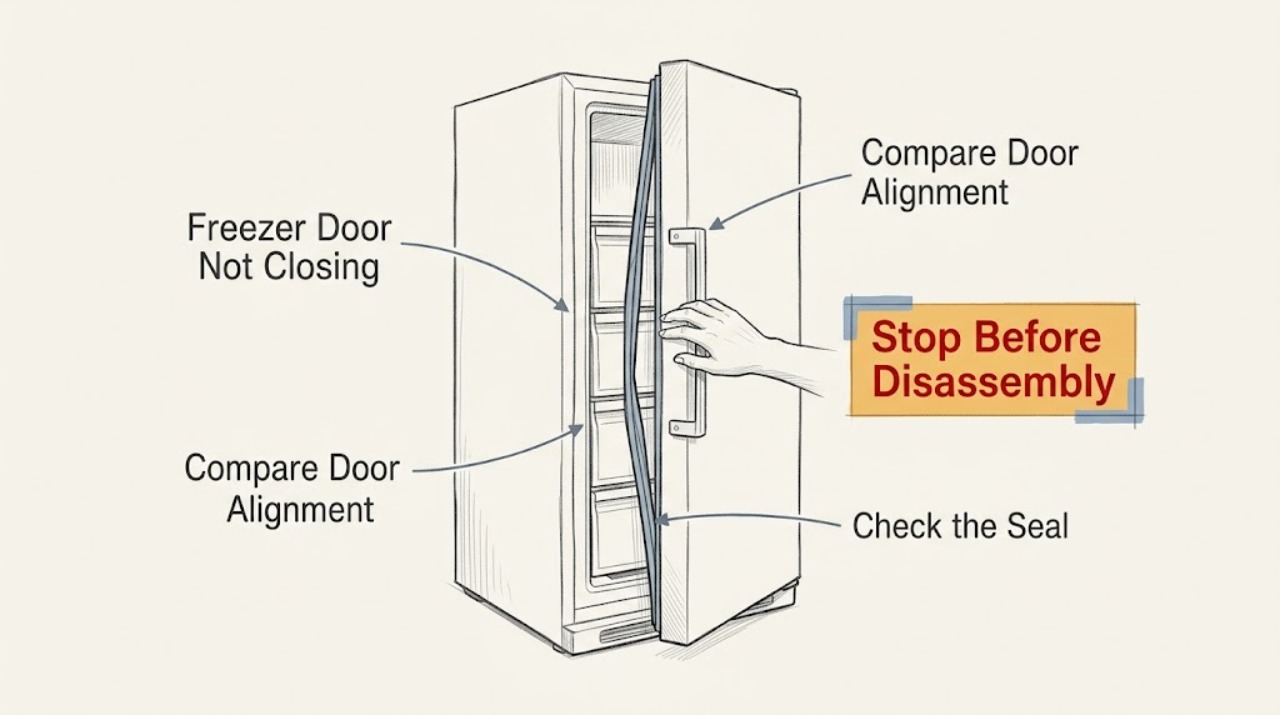
A freezer door that will not close is usually being held open by a package, shelf, basket, drawer, frost, a dirty or displaced gasket, or an out-of-level cabinet. Remove only obvious obstructions, reseat storage parts, and inspect the cool door seal. A paper test should have noticeable tension around the closed seal; an easy pull or visible gap means warm air can enter and create more frost. Keep the door closed as much as possible to protect food, and use the model manual for defrosting and leveling. Do not force the door, use sharp tools or direct heat to remove ice, adjust a hinge or remove the door without model instructions, or continue using the freezer when the gasket, glass, cabinet, hinge, or cooling system is seriously damaged.
Work through in order
Diagnostic checks
Use only checks that match the exact appliance or system and its official guide.
-
Check 1
Identify the freezer style and keep the door or lid supported by its normal hinges or slides. From a safe position, note whether the problem is a hard obstruction, a spring-back gap, a drawer that stops short, heavy frost, a sagging door, a torn seal, cracked glass, or severe cabinet damage.
Expected result: The door is blocked by an item or frost, or it is free of obstructions but remains visibly misaligned or damaged.
Next step: Remove only loose, obvious obstructions and continue with the seal and alignment checks. Keep the freezer closed and arrange service for structural damage or a door that cannot be safely supported.
Stop if: Do not force the door, place fingers in a closing hinge or rail, or attempt door removal when the door is heavy, unstable, cracked, or severely deformed.
Why this matters
Why: The first outcome supports a user-accessible organization or frost path. A free but sagging, damaged, or severely misaligned door points to hinge, rail, cabinet, or service work.
-
Check 2
With the door open, check packages, bins, shelves, baskets, drawer rails, and any shipping material that could project into the frame. Push each storage part fully into its normal position and rearrange food so no package presses against the door or rear wall.
Expected result: A package, bin, basket, rail, or shipping piece was stopping closure, or the storage area is correctly seated but the door still stops or springs open.
Next step: Close the door gently after correcting the obstruction and verify an even seal. If it still cannot close, continue to frost and gasket checks rather than adding pressure.
Stop if: Do not remove a drawer or shelf by force, overload the compartment, or reach into a moving rail or hinge.
Why this matters
Why: A small package corner or out-of-position basket can prevent the gasket from contacting the frame. If storage is seated and clear, the cause is more likely frost, gasket, level, hinge, or alignment.
-
Check 3
Inspect the entire gasket and frame while the door is clean and cool. Wipe away crumbs or ice with a soft damp cloth, check that the gasket is seated in its channel, and place a single sheet of paper between the gasket and frame at several points before closing the door gently and pulling the paper.
Expected result: The paper has noticeable resistance around the seal, or it pulls out easily at one or more points; the gasket is dirty, folded, displaced, torn, brittle, or warped.
Next step: Clean and reseat an intact gasket according to the manual, then repeat the test. If it remains loose or damaged, keep the door closed as much as possible and arrange service.
Stop if: Do not stretch, glue, cut, heat, or substitute a gasket, and do not close the door on hands or objects other than the brief paper check.
Why this matters
Why: Even tension suggests contact at that location. Easy release, a visible gap, or damaged rubber allows warm air and moisture in and can cause frost; a loose gasket may be reseated only as the manual permits, while a torn or brittle gasket needs service or the model-correct replacement.
-
Check 4
Look for frost or ice along the gasket, frame, rails, back wall, or hinge side. If the buildup is light and the manual allows it, remove only loose surface frost with a soft cloth; for heavy or hard buildup, follow the model's defrost procedure and protect food before the door is left open.
Expected result: Frost is physically holding the door open, or the door is clear but frost returns quickly or appears on one edge after closure.
Next step: Correct the obstruction or use only the approved defrost process. If frost returns, the seal fails, or the source is behind a panel, arrange qualified service; do not use direct heat or sharp tools.
Stop if: Do not chip ice, pour hot water near electrical parts, use a heat gun or hair dryer, or continue operation with the door held open by heavy frost.
Why this matters
Why: Warm moist air entering through a gap can create frost, and frost can then prevent full closure. Rapid return after a clear door and good seal suggests a gasket, alignment, drainage, or cooling-system issue.
-
Check 5
Check whether the cabinet is level and whether the door, drawer, hinge side, and frame sit evenly. Compare the gap at the top and bottom and look for a sagging door, a bent hinge, damaged rail, cabinet twist, or insufficient clearance from a nearby wall; use leveling instructions only from the exact manual.
Expected result: The freezer is visibly out of level or the door gap is uneven, or the cabinet is level but the hinge, rail, frame, or door is bent or loose.
Next step: Apply only the manual's user-level leveling adjustment if the freezer is stable and the adjustment is clearly provided. Otherwise keep the door closed and arrange service for hinges, rails, frame, cabinet, or door alignment.
Stop if: Do not remove the door, loosen hinge hardware, tip the freezer, or attempt cabinet straightening without model-specific instructions and appropriate support.
Why this matters
Why: An out-of-level cabinet can prevent a door from sealing correctly. A bent or loose structural part is not corrected safely by forcing the door or making an unapproved adjustment.
-
Check 6
Protect the frozen food while testing closure. Close the door after each safe correction, avoid unnecessary openings, and use an appliance thermometer or the food's condition to assess whether contents warmed. If the door stayed open for an unknown period or food thawed, follow official food-safety guidance rather than relying on odor or taste.
Expected result: The door now closes with an even seal and food remains frozen, or the door remains open and food is soft, thawed, warm, or contaminated by water or damage.
Next step: Transfer food to safe cold storage if needed, discard items that official guidance identifies as unsafe, and arrange service if the door cannot remain sealed. Do not keep reopening the freezer to inspect it.
Stop if: Do not taste questionable food, handle food contaminated by floodwater, or leave the freezer operating unattended with a major open gap.
Why this matters
Why: A full freezer stays cold longer when closed, but thawed food safety depends on temperature and ice crystals, not smell alone. An open door that cannot seal is both a repair issue and a food-safety issue.
-
Check 7
If the door still will not close after clear storage, approved frost removal, seal cleaning, and the manual's safe alignment check, record the freezer style, model, location of the gap, gasket test result, frost pattern, temperature, and any hinge, rail, glass, cabinet, or cooling symptom. Arrange qualified appliance service.
Expected result: The fault persists or returns quickly, or the door closes evenly and the freezer maintains a safe temperature without damage.
Next step: Keep the door closed and arrange service for the persistent or structural outcome. For a resolved condition, monitor the seal and frost without forcing the door or changing unapproved settings.
Stop if: Stop user troubleshooting for a cracked door or glass, severe deformation, exposed insulation or wiring, water near electrical parts, or any need to open the sealed cooling system.
Why this matters
Why: A persistent closure fault can involve a hinge, rail, door, gasket fit, cabinet, defrost system, or cooling issue that cannot be confirmed from outside. A stable seal after a simple correction is a resolved obstruction or maintenance condition.
Use your observations
Decision map
Find the observation that best matches what you see, then follow the next safe action.
-
PATH 01Safety boundary
What you see
A package, basket, shelf, drawer rail, or shipping material is physically blocking the door.
Do this next
Remove or reseat the loose item, rearrange food, and close the door gently to verify an even seal.
Why this path and its safety boundary
Safety stop: Continue with the gasket, frost, level, and alignment checks.
-
PATH 02Safety boundary
What you see
The gasket is dirty or displaced but intact, and the frame is not damaged.
Do this next
Clean and reseat it only as the exact manual permits, then repeat the paper test around the full perimeter.
Why this path and its safety boundary
Safety stop: A torn, brittle, warped, or persistently loose gasket requires qualified service or a model-correct replacement.
-
PATH 03Safety boundary
What you see
Frost or ice is holding the door open or preventing a drawer from reaching its stop.
Do this next
Follow the exact manual's safe defrost procedure; do not chip, force, or directly heat the ice.
Why this path and its safety boundary
Safety stop: Look for air leakage, level, hinge, rail, or cabinet problems instead of repeating defrosting.
-
PATH 04Safety boundary
What you see
The paper pulls out easily or light is visible around the closed seal.
Do this next
Treat the freezer as not sealed; correct an intact displaced gasket only per the manual and arrange service for damage or persistent gaps.
Why this path and its safety boundary
Safety stop: A consistent seal shifts attention to obstruction, leveling, hinge/rail alignment, or a different cooling problem.
-
PATH 05Safety boundary
What you see
The cabinet is out of level but stable and the manual provides a user-level adjustment.
Do this next
Make only the documented adjustment and recheck closure without forcing the door.
Why this path and its safety boundary
Safety stop: A bent hinge, rail, frame, cabinet, or unstable appliance requires qualified service.
-
PATH 06Safety boundary
What you see
Food warmed, thawed, or was exposed to contamination while the freezer door stayed open.
Do this next
Keep the door closed, check temperature or ice crystals, and follow FoodSafety.gov discard and refreeze guidance; never taste food to judge safety.
Why this path and its safety boundary
Safety stop: Continue protecting the closed freezer while the door repair is completed.
-
PATH 07Safety boundary
What you see
The door remains open after safe obstruction, frost, seal, and model-specific leveling checks, or structural damage is visible.
Do this next
Stop user troubleshooting, minimize openings, and arrange qualified appliance service.
Why this path and its safety boundary
Safety stop: Monitor the restored seal and frost pattern during normal use.
Helpful context
Understand the symptom
Start with the door identity: an upright hinged door, a chest-freezer lid, or a pull-out freezer drawer can use different hinges, rails, and seals. The same first checks apply—nothing in the way, shelves and baskets seated, gasket clean and attached, and cabinet level—but the exact manual controls any adjustment or defrost procedure.
A door left ajar lets warm, moist air in. That can produce frost that then holds the door open, lengthens compressor run time, and raises the food-temperature risk. Avoid chisels, knives, heat guns, hair dryers, or forcing the door against ice; arrange an approved defrost or service visit when frost is heavy or the source is not user-accessible.
If food has warmed while the door was open, do not taste it to decide whether it is safe. Keep the door closed while you arrange the repair, check an appliance thermometer if available, and follow official food-safety guidance for ice crystals, temperature, and discarding thawed perishables.
When checks do not resolve it
Need a professional?
Provide the freezer style, model, location of the gap, paper-test result around the seal, frost pattern, storage obstruction found, leveling or alignment observations, temperature reading, and whether food thawed or the unit was exposed to water.
Have this ready
- Have the model information, photos of the gasket and gap if safe, the time the door stopped sealing, any defrost or leveling step performed from the manual, and food-temperature observations ready for the service provider.
Common questions
FAQ
Why will my freezer door not close?
Check for a package, bin, shelf, basket, drawer rail, shipping material, frost, dirty or displaced gasket, out-of-level cabinet, or hinge and frame misalignment. Correct only obvious user-accessible issues and use the model manual for leveling or defrosting. A damaged or persistently misaligned door needs service.
How do I check a freezer door gasket?
Clean the cool gasket, make sure it is seated, then close the door on a sheet of paper at several points around the perimeter. Noticeable resistance is expected; an easy pull or visible gap indicates a poor seal. Do not stretch, glue, heat, or cut the gasket.
Can frost stop a freezer door from closing?
Yes. Frost can physically block the door and can also indicate warm moist air entering through a gap. Follow the exact manual's defrost procedure for heavy buildup. Never chip ice or use direct heat, and arrange service if frost returns quickly.
Is it normal for a freezer door to resist opening right after closing?
A brief change in pressure can make a properly sealed door feel resistant, but it should still close fully and maintain an even seal. If the door springs open, leaves a gap, or develops frost, check storage, gasket, and alignment rather than assuming pressure is the cause.
What should I do with food if the freezer door stayed open?
Keep the door closed and check an appliance thermometer or whether food still has ice crystals. Follow FoodSafety.gov guidance and never taste food to decide whether it is safe. Discard food that the official chart identifies as unsafe, especially if it thawed or was contaminated.
When should a freezer door that will not close be serviced?
Arrange service for a torn or brittle gasket, returning frost, bent hinge or rail, cracked glass, severe cabinet deformation, an unstable appliance, a persistent gap after safe checks, or any work requiring door removal or sealed-system access. Keep the door closed as much as possible while waiting.
Read the exact guide
Official sources
- Samsung refrigerator or freezer doors will not closeSamsung Support · Official manufacturer guidance used for general closure decisions; brand and model-specific instructions control.
- Door is Not Sealing - Forming Frost - Upright FreezerWhirlpool Product Help · Official upright-freezer guidance used for the paper test and seal decision; chest and drawer models may differ.
- Food Safety During Power OutageFoodSafety.gov · Government food-safety guidance relevant when a freezer door remains open and frozen food may have warmed.
- Frost forms in the Samsung freezer, refrigerator, or ice bucketSamsung Support · Official manufacturer guidance used for the frost mechanism and seal-cleaning branch; exact model controls defrost steps.
- Checking for Items Preventing Door or Lid ClosureWhirlpool Product Help · Official general freezer guidance used for obstruction, frost, leveling, and damaged-seal branches; exact model instructions control.
Community feedback
Share a repair observation
Share a plain-text repair observation. Accepted observations are published automatically; this page may take a moment to update.