
On this page
Start here
Quick answer
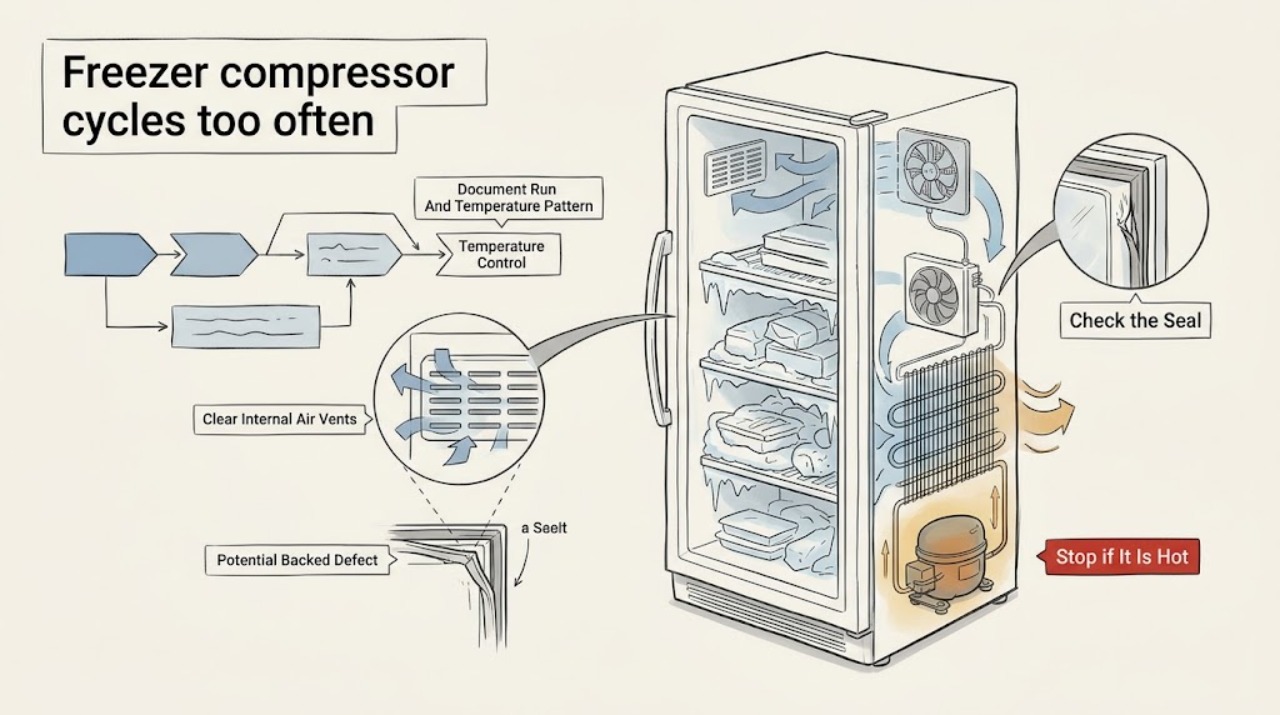
A freezer compressor may run longer or cycle frequently when restricted airflow prevents the cabinet from reaching its set temperature. Check the user-accessible air vents for packages, heavy frost, or an overpacked compartment; inspect the door gasket and closure; confirm that a temporary Fast Freeze or similar mode is not active; and check the exterior clearance or condenser area only as the exact model manual permits. Whirlpool says overpacking can cover the evaporator fan and block airflow, frost can obstruct the evaporator area, and dirty condenser coils can weaken cooling. GE notes that frequent door opening or a lid left open can make a compressor run continuously while temperature recovers. A new installation, warm room, large load, or recent door opening can also lengthen a run without proving a failure. Do not chip ice with a sharp tool, remove sealed panels, handle refrigerant, test a live compressor circuit, or keep operating a freezer that is hot, leaking, electrically damaged, or unable to hold food-safe temperature. If vents are clear and the compressor still cycles unusually often, or frost returns quickly, arrange qualified appliance service.
Work through in order
Diagnostic checks
Use only checks that match the exact appliance or system and its official guide.
-
Check 1
Record whether the compressor runs continuously, starts and stops at short intervals, or runs longer only after a warm start, large load, frequent door opening, or a temperature change; note the cabinet temperature using the appliance's normal display or a suitable thermometer.
Expected result: Record a normal recovery after a recent load/opening, a temperature that remains warm while the compressor runs, frequent starts with little cooling, or no reliable temperature reading.
Next step: Keep the door closed and continue with external/internal-accessible airflow checks. Do not cycle power repeatedly or select parts from run time alone.
Stop if: Stop using the freezer and protect food as appropriate if it is warming, leaking, smells electrical, has a hot cord or cabinet, or trips a breaker.
Why this matters
Why: Recovery after a known warm event can be normal. A warm cabinet despite prolonged running, frequent restarts, or cooling that varies by area makes airflow, door sealing, defrost, fan, control, or sealed-system diagnosis more likely.
-
Check 2
With the freezer door or lid open briefly, locate the marked air vents and evaporator-fan area, then move packages away from them without removing covers or forcing frozen items against the wall.
Expected result: Record clear vents, packages covering a vent or fan cover, an overpacked compartment, airflow that differs sharply between shelves, or a fan area blocked by frost.
Next step: Rearrange only movable food to restore the manual-specified clearance. If frost blocks the fan or returns quickly, leave the freezer closed and arrange qualified service or follow only the exact manual's safe defrost procedure.
Stop if: Do not chip ice with a knife or sharp tool, pour hot water into the cabinet, remove evaporator covers, or touch a fan while energized.
Why this matters
Why: Covered vents or an overpacked compartment can restrict circulation and make the compressor work harder. Frost at the fan or evaporator area can block airflow and may indicate a defrost or door-seal problem rather than a simple package arrangement.
-
Check 3
Inspect the visible door or lid gasket and closing surfaces for a fold, gap, debris, ice, or a package preventing closure; verify that the door closes evenly without lifting or slamming it.
Expected result: Record a continuous clean seal, a visible gap or fold, ice/debris on the gasket, a package obstruction, or a door that does not align or latch.
Next step: Clear only a movable package or surface debris and clean the gasket according to the manual. Arrange service for a torn gasket, hinge/alignment fault, cabinet damage, or persistent frost.
Stop if: Do not pry the gasket, bend hinges, remove panels, or keep the freezer operating if the door cannot seal or food temperature is unsafe.
Why this matters
Why: A leaky seal admits warm moist air, increasing compressor load and frost that can restrict internal airflow. A door that will not align may require hinge or cabinet service rather than more temperature adjustment.
-
Check 4
Check the temperature control and any Fast Freeze or similar temporary mode against the exact owner manual; note whether the mode was enabled after adding unfrozen food or whether the control was set colder than usual.
Expected result: Record normal setting, temporary Fast Freeze active, a recent large load, a control changed colder, or a control/display that does not respond normally.
Next step: Return a temporary mode to the normal setting only as the manual directs after recovery. If the setting will not change or the compressor pattern remains abnormal, arrange appliance service.
Stop if: Do not remove a control panel, short a thermostat, or repeatedly toggle settings to force compressor operation.
Why this matters
Why: A temporary fast-freeze mode can intentionally run the compressor continuously or more often, and a large warm load can require recovery. A nonresponsive or unexplained control points toward a control or sensor issue.
-
Check 5
With power disconnected only if the manual requires it, inspect the accessible exterior grille, condenser area, and clearance around the freezer for dust, lint, blocked openings, or heat sources; do not remove panels or assume coils are accessible.
Expected result: Record clear airflow and manual-approved access, dust at an accessible grille/coil, blocked clearance, a warm room or nearby heat source, or a sealed/enclosed condenser area.
Next step: Clear only external obstructions and clean an accessible area exactly as the manual permits. Arrange service for an enclosed, heavily fouled, damaged, or inaccessible condenser/fan area.
Stop if: Do not vacuum near exposed wiring, remove covers, touch the compressor or fan, or use water/chemicals near electrical parts.
Why this matters
Why: Restricted exterior heat rejection can make the compressor run longer, but many freezers enclose the condenser in the cabinet and should not be opened. A clear exterior with continued abnormal cycling shifts suspicion to internal airflow, control, fan, or sealed-system service.
-
Check 6
Prepare a service handoff with the exact model, freezer type, compressor run pattern, temperature, recent load or door events, vent/frost findings, gasket result, setting/mode, exterior clearance, and any noise, leak, frost, heat, or breaker symptom.
Expected result: Confirm that only package rearrangement, gasket/closure observation, manual-authorized setting changes, and safe external cleaning were performed; no refrigerant, compressor, fan, wiring, or sealed-panel work was attempted.
Next step: Arrange qualified appliance service for persistent frequent cycling, rapid frost return, poor cooling, an inaccessible airflow path, or any component requiring panels or live testing.
Stop if: Stop all homeowner work when diagnosis requires opening the cabinet, handling refrigerant, testing energized circuits, or touching the compressor/fan/defrost assembly.
Why this matters
Why: The record helps a technician separate restricted internal airflow, door infiltration, normal recovery/fast-freeze operation, condenser heat-rejection limits, defrost/fan faults, controls, and sealed-system issues.
Use your observations
Decision map
Find the observation that best matches what you see, then follow the next safe action.
-
PATH 01Next step
What you see
The freezer recently started, received a large warm load, had frequent door opening, or has Fast Freeze active, and temperature is recovering without frost, leak, or hazard signs.
Do this next
Keep the door closed, restore normal settings when the exact manual says to do so, and reassess temperature. Arrange service if the pattern does not settle or cooling remains poor.
-
PATH 02Next step
What you see
Packages cover vents, the compartment is overpacked, airflow is uneven, or frost blocks the evaporator-fan/vent area while the compressor runs frequently.
Do this next
Restore only the manual-specified clearance and avoid sharp-tool defrosting. Arrange service for heavy or recurring frost, a blocked fan, or persistent cycling.
-
PATH 03Next step
What you see
The gasket has a gap, fold, ice, tear, or debris, or the door/lid cannot close evenly while the freezer runs often.
Do this next
Clear movable obstructions and clean the gasket as directed. Arrange service for torn seals, hinge/cabinet alignment, or continued cycling after the seal is restored.
-
PATH 04Next step
What you see
The accessible exterior grille or condenser area is dusty or blocked, clearance is restricted, or the freezer sits in unusually warm surroundings.
Do this next
Clear the exterior and clean only manual-approved accessible areas with power precautions. Arrange service for enclosed, damaged, or inaccessible condenser/fan conditions.
-
PATH 05Next step
What you see
Airways, door seal, settings, and accessible exterior are sound, but the freezer remains warm, cycles rapidly, frosts repeatedly, makes abnormal noise, leaks, overheats, or trips a breaker.
Do this next
Keep the freezer closed or off as appropriate to the hazard and arrange qualified appliance service. Do not open the sealed system or test live components.
Helpful context
Understand the symptom
A longer run is not always a failed compressor
A freezer may run more after a warm start, a large load, frequent door opening, or unusually warm room conditions. GE explains that an upright or chest freezer can run continuously until its temperature returns to normal after frequent opening or a lid left open. The assigned airflow condition matters because an obstructed vent, fan, frost layer, or condenser path can prevent that recovery. Compare the running pattern with the cabinet temperature and the cause that preceded it before assuming the compressor itself is failing.
Internal airflow is the first restricted path to check
Whirlpool says overpacking can cover the evaporator fan and block airflow, and it recommends keeping vents and fans clear. A freezer can therefore have a running compressor while cold air is trapped in one area or cannot circulate through the cabinet. Clear only movable packages from marked vents and avoid pressing food against the back wall or fan cover. If frost is thick or returns quickly, do not dismantle the freezer; auto-defrost or evaporator service may be required.
Exterior heat rejection also needs room
A freezer must release heat through its condenser area or cabinet design. Whirlpool notes that dirty condenser coils can weaken cooling, while some chest and upright freezers enclose coils in the walls and do not provide user access. Check the manual before cleaning any exterior coil or grille, and do not remove panels to reach a fan or sealed system. A restricted exterior path can make the compressor run more, but it cannot be confirmed by run time alone.
Door sealing and settings can mimic airflow failure
A door that does not seal allows warm, moist air into the cabinet, adding load to the compressor and promoting frost that further restricts airflow. Whirlpool recommends checking that freezer doors create a tight seal. Also check that a temporary Fast Freeze mode is not active and that the control has not been set colder than needed. These observations narrow the problem; they do not authorize refrigerant, thermostat, or compressor work.
Safety boundary
Stop conditions
- Stop using the freezer and obtain service for a burning odor, smoke, hot or damaged cord/cabinet, leak near electricity, repeated breaker trip, unusual compressor noise, flood damage, or temperature that cannot safely preserve food.
- Do not chip frost with a knife or sharp tool, pour hot water into the cabinet, touch an energized fan, open sealed panels, handle refrigerant, bypass a control, or test live compressor circuits.
- Do not block vents, run with a door that cannot seal, remove condenser covers, use chemicals near electrical parts, or keep resetting the appliance when the compressor stops abnormally.
Only after diagnosis
Potential parts
- freezer door gasket
Consider this only when inspection confirms a torn, hardened, distorted, or nonsealing gasket after packages and surface debris are cleared.
Confirm the exact freezer model, gasket profile, magnetic insert, and installation instructions before selection. - evaporator or condenser fan assembly
Consider this only after qualified diagnosis confirms a fan that is obstructed, noisy, not running, or failing to circulate/reject heat after safe airflow checks.
Confirm the exact model, fan motor, blade, connector, mounting, and manufacturer-approved fit before selection or installation. - defrost system component
Consider this only when qualified diagnosis links recurring evaporator frost and blocked airflow to a failed defrost component rather than door or loading conditions.
Confirm the exact model, defrost component type, electrical rating, mounting, sensor location, and manufacturer fit before selection. - compressor start device or compressor assembly
Consider this only after qualified refrigeration diagnosis rules out airflow, door, frost, controls, and fan causes and confirms a starting, compressor, or sealed-system fault.
Confirm the exact model, refrigerant system, electrical requirements, start-device match, and licensed installation requirements before selection.
When checks do not resolve it
Need a professional?
Arrange qualified appliance service when the compressor cycles unusually often after internal vents, gasket, settings, and accessible exterior airflow are checked; when temperature remains warm, frost returns quickly, a fan is blocked or noisy, a door cannot seal, the condenser is enclosed or inaccessible, or diagnosis requires panels, refrigerant, compressor, defrost, wiring, or live testing. Stop immediately for a hot cord or cabinet, burning odor, smoke, leak near electricity, repeated breaker trip, or unsafe food temperature.
Have this ready
- Provide the exact model, freezer type, compressor pattern, temperature, recent door/load events, Fast Freeze state, vent/frost and gasket findings, exterior clearance, and any noise, leak, odor, heat, or breaker symptom.
Common questions
FAQ
Why is my freezer compressor cycling too often?
Restricted internal vents, overpacking, frost, a leaky door gasket, blocked exterior airflow, a temporary fast-freeze mode, a warm start, or a cooling-system fault can all increase compressor workload. Start with vents, door seal, settings, and safe exterior checks; persistent cycling needs qualified service.
Can blocked freezer vents make the compressor run more?
Yes. Whirlpool says overpacking can cover the evaporator fan and block airflow, and that all air vents and fans should remain clear. Move only packages that block marked vents; do not remove fan covers or chip ice, and arrange service for heavy or recurring frost.
Is it normal for a freezer compressor to run continuously?
It can run continuously during recovery after frequent door opening, a warm start, or certain temporary modes. GE describes continuous operation until normal temperature returns after frequent opening or a lid left open. If temperature does not recover or the pattern persists, use the airflow and service checks.
Should I clean the condenser coils on my freezer?
Only if the exact manual identifies an accessible condenser area and provides a safe cleaning procedure. Whirlpool notes that some chest and upright freezers enclose coils in their walls and do not provide user access. Do not remove panels or touch electrical components to reach them.
When should I call for a freezer that cycles frequently?
Arrange service when the freezer remains warm, frost returns quickly, airflow and door sealing are sound, the compressor makes abnormal noise, a fan is blocked or failing, the cabinet leaks or overheats, or a breaker trips. Stop immediately for smoke, burning odor, electrical danger, flood damage, or unsafe food temperature.
Read the exact guide
Official sources
- Upright Freezer Use & Care GuideWhirlpool Corporation · Whirlpool upright-freezer manual used for general run-pattern and airflow interpretation; exact freezer manual controls.
- Upright & Chest Freezer - Effects of Opening Door or Lid FrequentlyGE Appliances · GE freezer guidance used for general recovery-pattern interpretation; exact model instructions govern.
- What to Do If Your Freezer Is Not FreezingWhirlpool · Whirlpool freezer guidance used for general airflow and compressor-load triage; exact model instructions govern.
Community feedback
Share a repair observation
Share a plain-text repair observation. Accepted observations are published automatically; this page may take a moment to update.