
On this page
Start here
Quick answer
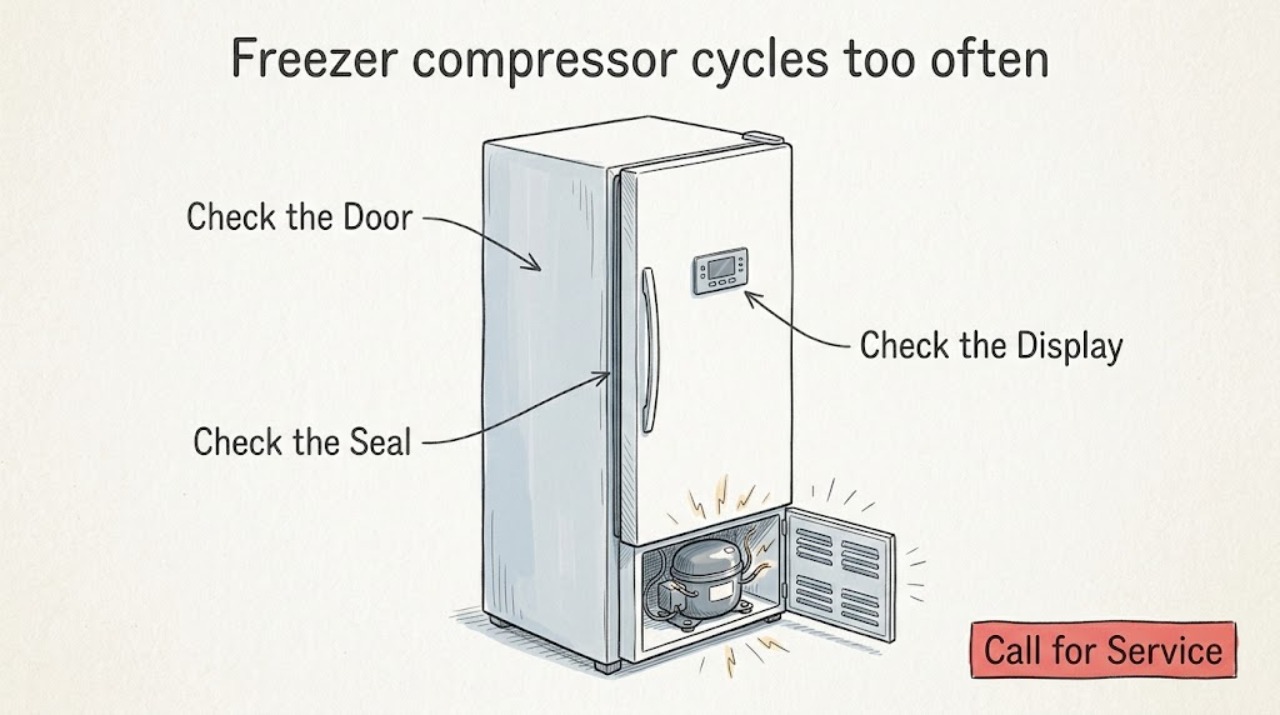
A freezer may run for a long stretch after a warm load, frequent door opening, a warm room, or a colder-than-needed setting. First watch the start-and-stop pattern from outside, then check the visible door seal, loose package placement, control setting, frost, room conditions, and any unusual heat, noise, or odor. Do not open the cabinet or touch the compressor, refrigerant tubing, or electrical parts. If the pattern persists with a normal load and a door that closes fully, arrange appliance service; stop using it and seek urgent help for smoke, burning odor, repeated electrical trips, excessive heat, or food whose safety is uncertain.
Work through in order
Diagnostic checks
Use only checks that match the exact appliance or system and its official guide.
-
Check 1
From a safe position, listen for the cooling sound to start and stop and note the approximate run length, pause length, and whether the pattern changes after a door opening or recent loading. Do not repeatedly open the door just to test it.
Expected result: The freezer runs longer after a warm load or a long opening, then settles into a less frequent pattern; or it starts and stops frequently even when the load and door use are unchanged.
Next step: Write down the pattern and move to the external seal, load, setting, and environment checks below. Give the timing notes to the service professional if the pattern persists.
Stop if: Stop observing if you notice smoke, a burning odor, repeated electrical trips, sparking, or heat that makes it unsafe to remain nearby.
Why this matters
Why: A temporary response points toward heat entering the compartment or a recovery period. Persistent frequent cycling with no trigger is a reason to have the temperature-control and sealed cooling system assessed rather than guessing at a part.
-
Check 2
Look around the closed door or lid from the outside for a visible gap, torn or folded gasket, frost concentrated along one edge, debris, or a loose package that could keep the door from sitting flush. Only move a loose package if it can be done without forcing the door or reaching into a hazardous area.
Expected result: The seal looks continuous and the door sits flush; or there is a visible gap, damaged gasket, frost line, or package interference.
Next step: Remove only the plainly visible obstruction, close the door normally, and observe whether the pattern improves. A torn, hardened, loose, or still-gapped gasket needs model-specific service or replacement assessment.
Stop if: Stop if the door binds, the gasket is loose enough to detach, the appliance becomes unstable, or correcting the obstruction would require tools, force, or panel access.
Why this matters
Why: A closure problem lets warmer, moist air enter and can make the compressor run longer while also producing frost. A visibly sound closure shifts attention to the setting, load, room, and professional diagnosis.
-
Check 3
Read the control position and any visible temperature display or alert without changing settings as a diagnostic experiment. Note whether a large amount of unfrozen food was added recently and whether packages are packed against the door or visibly block internal air openings.
Expected result: The control is set unusually cold, the display shows a warm-temperature warning, or a recent large load is still recovering; or the load and setting have been stable with no warning.
Next step: Record the setting and alert, keep the door closed while the unit recovers, and follow the model manual before making any setting change. If the setting and load are normal yet cycling continues, arrange service.
Stop if: Stop if a display shows a critical alarm, food is warming rapidly, or you are tempted to remove covers, alter wiring, or repeatedly reset the appliance.
Why this matters
Why: Whirlpool's manufacturer guidance says a colder setting can increase run time and that a large warm load can take hours to stabilize. A stable load and setting with ongoing cycling makes a simple recovery explanation less likely, but it does not identify an internal component by itself.
-
Check 4
From outside the appliance, note whether the room is unusually hot, whether the freezer is next to a heat source, and whether visible frost or ice is building around the door area. Also note new clicking, buzzing, rattling, or a change in the normal cooling sound without touching moving or hot components.
Expected result: The room or nearby area is unusually warm, frost is concentrated at the closure, or the sound is materially different; or the surroundings and sound are normal.
Next step: Record the location, timing, and visible pattern. Keep vents and the surrounding area unobstructed only where this is already safely accessible; do not move the appliance or clean behind it. Request a professional inspection when the abnormal pattern remains.
Stop if: Stop immediately for excessive cabinet heat, smoke, burning odor, a damaged cord, water near electrical equipment, or a sound accompanied by repeated electrical trips.
Why this matters
Why: Warm surroundings increase the cooling demand, while frost at the closure supports an air-leak clue. A new abnormal sound with persistent cycling can indicate a condition requiring a technician, but sound alone cannot identify the failed part.
-
Check 5
Check the food condition without tasting questionable food: note whether packages remain hard-frozen, show ice crystals, or have visibly thawed, and note whether an appliance display or thermometer reading is present without trying to make a precise electrical measurement.
Expected result: Food is solidly frozen and the issue is mainly a run-time complaint; or food has thawed, the temperature is unknown, or the unit has not maintained freezing.
Next step: Keep the door closed, document when the change was noticed, and follow current local food-safety guidance for thawed food. Give the service professional the food condition and the cycle log.
Stop if: Stop handling questionable food and escalate the food-safety decision if temperature history is unknown; stop appliance troubleshooting for smoke, burning odor, excessive heat, or any electrical hazard.
Why this matters
Why: A run-time complaint with food staying frozen is different from a cooling failure. Thawing or unknown temperature creates a food-safety decision as well as an appliance-service decision; appearance or smell alone cannot establish that food is safe.
Use your observations
Decision map
Find the observation that best matches what you see, then follow the next safe action.
-
PATH 01Next step
What you see
The longer run followed a warm load, long door opening, or unusually warm room and then settled.
Do this next
Monitor the pattern with the door closed as much as practical and record any repeat. Do not declare a compressor failure from one recovery period.
-
PATH 02Next step
What you see
A package, debris, damaged gasket, or visible frost pattern prevents a normal flush closure.
Do this next
Remove only a loose visible obstruction without force. If the gasket remains damaged or the door still gaps, arrange model-specific appliance service.
-
PATH 03Next step
What you see
The load, control setting, closure, and surroundings are normal but frequent cycling persists or the freezer does not hold frozen food.
Do this next
Stop treating the symptom as a part-ordering decision and book an appliance technician. Provide the cycle log, setting, food condition, closure observations, and any sound or frost notes.
-
PATH 04Next step
What you see
There is smoke, a burning smell, excessive heat, a damaged cord, repeated electrical tripping, or another immediate hazard.
Do this next
Keep people away, stop operating the freezer, and seek appropriate emergency or qualified electrical/appliance assistance. Do not open panels or attempt a live test.
-
PATH 05Next step
What you see
Food has thawed or its temperature history is uncertain.
Do this next
Keep the freezer closed and use current government or local food-safety guidance for the food decision; do not taste food to test safety. Arrange appliance service separately.
Helpful context
Understand the symptom
What counts as too often
The sound you hear is the sealed cooling system starting and stopping, but a longer run is not automatically a failed compressor. A recent load of unfrozen food, a long door opening, a warm room, or a control set colder than necessary can all extend run time. The useful distinction is whether the freezer returns to a stable pattern after those conditions end, or whether it repeatedly starts and stops with no obvious change in load, closure, or surroundings. Keep the door closed as much as practical while you observe it.
Keep the check external
This guide is for safe observations only. Do not remove panels, reach behind the appliance, handle refrigerant tubing, make electrical measurements, or repeatedly cycle power to force a result. If the cabinet is abnormally hot, smells of burning, smokes, trips a protective device, or makes the area unsafe, keep clear and arrange professional help.
Only after diagnosis
Potential parts
- freezer temperature control
Consider this category only if model-specific service diagnosis links persistent cycling to the temperature-control system after load, closure, and environment checks are normal.
Confirm the exact freezer model and manufacturer fit information before ordering; a cycle complaint alone does not establish compatibility or failure. - freezer condenser coil brush
Consider this category only if the model's instructions and a professional assessment identify an externally accessible, serviceable condenser area that needs approved cleaning.
Do not remove panels or reach behind the appliance to use a brush; confirm the model's access and safety instructions first. - freezer door gasket
This category is relevant only when the visible seal is torn, hardened, loose, or unable to close flush after plainly visible obstructions are removed.
Match the exact freezer model and door configuration; appearance alone is not enough to confirm fit.
When checks do not resolve it
Need a professional?
Call an appliance technician when frequent cycling persists after safe external checks, the freezer cannot maintain frozen food, the gasket remains visibly damaged, or abnormal noise accompanies the pattern.
Have this ready
- Approximate run and pause pattern
- Control position and any visible alert
- Recent loading or long-door-opening history
- Door-seal, frost, room-condition, noise, and odor observations
- Whether food stayed frozen, thawed, or has an uncertain temperature history
Common questions
FAQ
Is it normal for a freezer compressor to run for a long time?
It can be normal after a warm load, a long door opening, or warmer surroundings. The more useful question is whether the freezer settles into its prior pattern and keeps food frozen once those conditions end.
Can a door gasket make the compressor cycle too often?
Yes. A visible gap, damaged gasket, frost along the closure, or package interference can let warmer air in and increase cooling demand. Check from outside and arrange service if the seal remains damaged or will not close flush.
Should I replace the compressor or a control based on cycling alone?
No. Cycling alone does not identify a failed part. Record the pattern and safe external observations first; a technician should diagnose the control, airflow, electrical, or sealed-system cause before a part is selected.
What if food has thawed while the freezer was cycling?
Keep the door closed, do not taste questionable food, and follow current food-safety guidance for thawed food or an unknown temperature history. The food decision and the appliance-service decision should be handled separately.
Read the exact guide
Official sources
- Motor or Compressor Runs Too Much - Upright FreezerWhirlpool Product Help · Manufacturer troubleshooting guidance for Whirlpool upright freezers; use as general context only when the reader's model differs.
- Door is Not Sealing - Forming Frost - Upright FreezerWhirlpool Product Help · Manufacturer troubleshooting guidance for Whirlpool upright freezers; use as general context only when the reader's model differs.
Community feedback
Share a repair observation
Share a plain-text repair observation. Accepted observations are published automatically; this page may take a moment to update.