
On this page
Start here
Quick answer
A freezer compressor running often can be normal, but a dirty, torn, wrinkled, or poorly seated door gasket lets cold air escape and warm moist air enter, making the appliance run longer and encouraging frost. First confirm that the door closes fully and the gasket contacts the cabinet evenly all around. Clean the gasket and frame, remove packages or baskets that hold the door open, and check for frost that may block the seal or airflow. Also consider recent warm food loads, frequent or long openings, a hot room, blocked vents, dirty condenser coils where the manual permits cleaning, or a light that stays on. If the freezer cannot hold its manual-specified temperature, the gasket will not seal after safe cleaning and adjustment, frost returns quickly, or the compressor stays on after these checks, arrange appliance service; do not open the sealed refrigeration system or handle refrigerant.
Before you begin
Safety first
- The homeowner scope is limited to visual door and gasket checks, safe cleaning, moving obstructions, manual-directed defrost or temperature observation, and manual-approved external care. Do not remove panels, reach into fans or wiring, chip ice, use improvised heat, probe the sealed system, add refrigerant, bypass controls, or force a door or gasket.
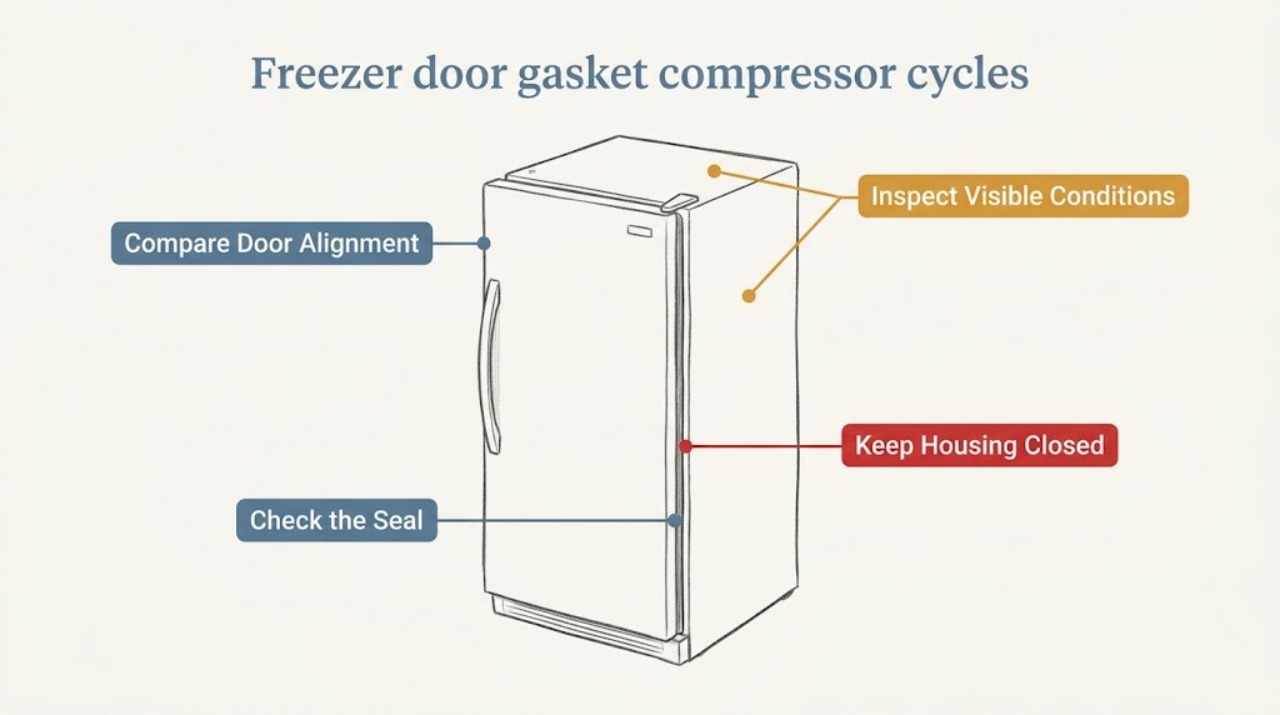
Work through in order
Diagnostic checks
Use only checks that match the exact appliance or system and its official guide.
-
Check 1
With the freezer closed, inspect the door or drawer from the hinge side around the entire perimeter. Confirm that the door reaches the cabinet, the gaps look even, and the gasket is seated in its groove; remove any shipping material, food package, shelf, or basket that prevents closure.
Expected result: The door is visibly ajar, the gasket misses the frame on one side, the gap is uneven, or a package or basket blocks closure; alternatively, the gasket contacts evenly and the door closes fully.
Next step: Reposition only the obstructing contents or basket and observe the next normal cooling period. If the door is misaligned or will not close evenly, use the model manual or arrange service rather than forcing it.
Stop if: Stop if the hinge, liner, door, or gasket retainer is bent, loose, cracked, or requires disassembly to correct.
Why this matters
Why: An uneven contact pattern or obstruction can admit warm air and explain longer compressor operation; an even seal makes other runtime or cooling causes more relevant.
-
Check 2
Inspect the gasket and the mating cabinet surface for food residue, ice, tears, cracks, brittleness, pulled-out sections, or wrinkles. If the manual permits, clean the gasket and frame with warm soapy water and dry them; do not stretch, cut, glue, or lubricate the seal unless the manual specifically says to.
Expected result: Debris prevents contact, the gasket is merely out of its retainer, the seal is damaged or permanently deformed, or it is clean and intact.
Next step: Reseat only a section that the manual identifies as user-adjustable. For damage or persistent deformation, record the model and arrange a matching gasket replacement or service; recheck cooling after a safe correction.
Stop if: Stop if cleaning would wet controls, the gasket retainer is damaged, ice is bonded to the liner, or correction would require removing the door or an internal panel.
Why this matters
Why: A dirty or displaced seal may improve after a safe clean or reseating; a torn, cracked, or persistently deformed gasket cannot make a reliable airtight seal and may be the reason for excess runtime and frost.
-
Check 3
Look for frost or ice along the door opening, rear wall, vents, shelves, and packages, and check whether food or containers block freezer air vents. Follow the exact manual for a full or partial defrost; never use a sharp tool or an improvised heat source to remove ice.
Expected result: Frost is concentrated along the gasket, a thick layer blocks an air path, packages touch the door or rear wall, or there is little frost and airflow appears unobstructed.
Next step: Clear only movable packages and use the manual's defrost procedure if needed. If frost returns soon after a confirmed seal correction or the fan is inaccessible or abnormal, arrange appliance service.
Stop if: Stop for a damaged liner, exposed wiring, water near electrical parts, a fan that requires panel removal, or ice that cannot be safely cleared by the manual procedure.
Why this matters
Why: Edge frost supports warm-air leakage at the seal, while accumulated frost or blocked vents can restrict airflow and make the freezer work harder; little frost shifts attention to temperature, usage, or mechanical causes.
-
Check 4
Review recent use and surroundings: frequent or long door openings, a large warm food load, an unusually hot or humid room, an empty freezer, or the freezer positioned near a heat source. Check the appliance display or a suitable thermometer against the temperature range in the owner's manual without changing settings repeatedly.
Expected result: Runtime increased after a warm load, frequent opening, hot room, or temperature change, or the freezer does not reach or hold the manual-specified temperature after normal use resumes.
Next step: Close the door promptly, allow the appliance to recover, and monitor temperature as the manual directs. Arrange service if temperature remains out of range, food is softening, or runtime does not settle after the temporary condition ends.
Stop if: Stop if the temperature rises rapidly, food safety is in doubt, an alarm persists, or the appliance shows a fault requiring model-specific service.
Why this matters
Why: Temporary heat or moisture loads can lengthen recovery; failure to hold the specified temperature after the door seal and usage are normal indicates a cooling, control, airflow, or defrost issue rather than proving the gasket is at fault.
-
Check 5
If the manual allows user cleaning, check from the outside that the freezer has the specified clearance and that accessible condenser areas are not visibly clogged with dust. Confirm that an interior light turns off when the door closes if the model has one; disconnect power only as the manual instructs before any cleaning.
Expected result: Air circulation is restricted, condenser surfaces are dirty on a model that requires cleaning, the interior light stays on, or these conditions look normal.
Next step: Clean only the accessible areas and method specified by the manual, restore clearance, and observe operation. If the compressor still runs excessively or cooling is weak, arrange qualified appliance service.
Stop if: Do not remove protective panels, touch wiring, probe the refrigeration circuit, or clean a coil location that the manual does not identify as user-accessible.
Why this matters
Why: Restricted heat transfer or a light left on can add heat and increase runtime; normal external conditions make a gasket, airflow, defrost, control, fan, or sealed-system diagnosis more likely.
Use your observations
Decision map
Find the observation that best matches what you see, then follow the next safe action.
-
PATH 01Safety boundary
What you see
The gasket is torn, cracked, permanently deformed, pulled out of its retainer, or not touching the cabinet evenly, and frost or warm-air leakage is present.
Do this next
Use the exact model manual to determine whether the seal can be reseated; otherwise arrange a matching gasket replacement or appliance service, then verify that the door closes evenly.
Why this path and its safety boundary
Safety stop: Do not glue, cut, stretch, or force the gasket or order a generic seal from the symptom alone.
-
PATH 02Safety boundary
What you see
The gasket is clean and intact, but a package, basket, drawer, ice, or misalignment prevents the door from closing fully.
Do this next
Remove or reposition only the accessible obstruction and follow the model instructions for basket or door adjustment; observe whether the seal and temperature recover.
Why this path and its safety boundary
Safety stop: Stop if adjustment needs hinge or door disassembly, the liner is damaged, or the door remains uneven after safe repositioning.
-
PATH 03Safety boundary
What you see
A thick frost layer or frost concentrated around the door edge returns after a manual-directed defrost or after a confirmed obstruction is removed.
Do this next
Arrange appliance service to assess the gasket, door alignment, airflow, defrost system, and controls; recurring frost is not proof that another gasket will fix the cause.
Why this path and its safety boundary
Safety stop: Do not chip the ice, apply improvised heat, or remove interior panels to reach a fan or defrost component.
-
PATH 04Safety boundary
What you see
The door seal is even and the freezer has normal loading and room conditions, but the unit cannot hold its specified temperature or the compressor continues excessive operation.
Do this next
Arrange qualified appliance diagnosis for airflow, fan, defrost, control, or sealed-refrigeration faults and provide the temperature trend and runtime pattern.
Why this path and its safety boundary
Safety stop: Do not open the sealed system, add refrigerant, bypass a control, or work on electrical components yourself.
-
PATH 05Safety boundary
What you see
Runtime rose immediately after frequent openings, a large warm load, or unusually hot or humid conditions, and the freezer returns to its manual-specified temperature after recovery.
Do this next
Minimize door-open time, let warm food cool as the manual permits, keep packages from blocking the door or vents, and monitor rather than replacing the gasket immediately.
Why this path and its safety boundary
Safety stop: Escalate if food remains too warm, the door does not seal, or the compressor does not settle after the temporary condition ends.
-
PATH 06Safety boundary
What you see
An external condenser area is clogged, clearance is restricted, or the interior light remains on with the door closed, while the gasket appears sound.
Do this next
Correct only the manual-approved clearance or cleaning issue and verify light operation. If runtime remains excessive, arrange service for the underlying appliance fault.
Why this path and its safety boundary
Safety stop: Do not remove panels or reach into fans, wiring, or the sealed refrigeration circuit.
Helpful context
Understand the symptom
Separate normal runtime from a leaking door seal
Freezer compressors are designed to run much of the time, so sound alone does not prove a fault. A door gasket becomes a stronger suspect when the door does not touch the frame evenly, the seal is dirty or damaged, frost forms near the door edge, or the freezer temperature rises. Check the door and gasket first, then look at other causes such as warm food, frequent opening, blocked airflow, room conditions, or condenser cleanliness.
Frost is both a clue and a new obstruction
Warm humid air entering through a poor seal can freeze on the cabinet and food. As frost accumulates, it can obstruct airflow and make temperature control harder, which increases runtime and can prevent the gasket from contacting the frame. Follow the appliance manual for defrosting; do not chip ice with a sharp tool or heat the cabinet with an improvised source.
Use the exact model manual for anything beyond cleaning
Door construction, gasket retention, fan access, condenser location, and defrost procedures differ by freezer. Manufacturer guidance supports cleaning and visual checks, but a replacement gasket must match the appliance and fit correctly. If the gasket and user-accessible conditions are corrected but the freezer still cannot hold its specified temperature, the cause may be a fan, control, defrost, or sealed-system issue that needs a technician.
Only after diagnosis
Potential parts
- freezer door gasket
Consider this category only after the existing seal is confirmed damaged, permanently deformed, or unable to contact the cabinet evenly and the exact model is identified.
Match the complete appliance model, door or drawer configuration, gasket profile, retainer, and installation instructions; a generic-looking seal may not close or seal correctly. - freezer door hinge or closure hardware
Consider this category only when a qualified technician or model manual confirms that hinge, slide, leveling, or closure hardware is preventing even gasket contact.
Confirm the exact model, door orientation, hinge or slide position, and fastener or adjustment design before selecting a part; do not use a hardware change to compensate for a damaged liner. - freezer airflow or defrost component
Consider this category only after a qualified appliance diagnosis finds persistent frost, blocked airflow, a fan problem, or a defrost fault after the door seal and loading checks are normal.
Selection depends on the exact model, electrical specifications, control design, and sealed-system layout; do not infer a component from compressor runtime alone.
When checks do not resolve it
Need a professional?
Escalate for a torn or deformed gasket, uneven door contact, recurring frost, warm food, persistent temperature alarm, abnormal fan or light, excessive runtime after normal conditions return, or any diagnosis involving electrical, defrost, refrigerant, or sealed-system work.
Safety scope: The homeowner scope is limited to visual door and gasket checks, safe cleaning, moving obstructions, manual-directed defrost or temperature observation, and manual-approved external care. Do not remove panels, reach into fans or wiring, chip ice, use improvised heat, probe the sealed system, add refrigerant, bypass controls, or force a door or gasket.
Have this ready
- Provide the freezer make and model if available, door or drawer type, gasket condition and contact pattern, frost location, temperature reading and trend, recent warm loads or frequent openings, room conditions, visible airflow or clearance issues, compressor runtime pattern, and any alarm or unusual sound.
Common questions
FAQ
Can a bad freezer door gasket make the compressor run too often?
Yes. A dirty, torn, wrinkled, or poorly seated gasket can let cold air escape and warm moist air enter, increasing runtime and frost. Check even contact around the closed door, clean the seal if the manual permits, and replace it only with an exact model-matched part if damage is confirmed.
Is it normal for a freezer compressor to run most of the time?
It can be normal for freezer compressors to run much of the time, especially after a warm load, frequent openings, or hot room conditions. Concern rises when the freezer cannot hold its specified temperature, frost returns, or runtime stays excessive after normal conditions and the door seal are corrected.
How do I check a freezer door gasket?
Look around the closed door for even contact, gaps, food or ice blocking closure, a gasket seated in its groove, and cuts or deformation. Clean accessible residue with the method in the manual. Do not force the gasket or remove the door unless the model instructions specifically allow it.
Why is there frost around the freezer door?
Warm humid air can enter through frequent openings, a blocked door, or a gasket that is not sealing evenly; accumulated frost can then obstruct airflow and worsen cooling. Correct safe obstructions and follow the exact manual for defrosting, then arrange service if frost returns quickly.
When should I call for freezer repair?
Call when the gasket cannot seal, the door remains misaligned, frost returns after a manual-directed defrost, the freezer cannot hold its specified temperature, food is softening, or the compressor remains excessive after safe checks. Internal fans, defrost controls, electrical work, refrigerant, and sealed-system repairs require qualified service.
Read the exact guide
Official sources
- Refrigerator or Freezer - Normal Run TimeGE Appliances · GE Appliances consumer guidance; exact temperatures, controls, and service procedures vary by model.
- How to Avoid Frost Build UpWhirlpool · Whirlpool freezer care guidance; use the exact model manual for defrost and component procedures.
- RefrigeratorsENERGY STAR · ENERGY STAR consumer refrigerator and freezer efficiency guidance; the appliance manual controls model-specific maintenance.
- Bottom Freezer Refrigerator - Freezer Drawer Not Sealing ProperlyGE Appliances · GE bottom-freezer consumer guidance; door construction and adjustment differ by model.
Community feedback
Share a repair observation
Share a plain-text repair observation. Accepted observations are published automatically; this page may take a moment to update.