
On this page
Start here
Quick answer
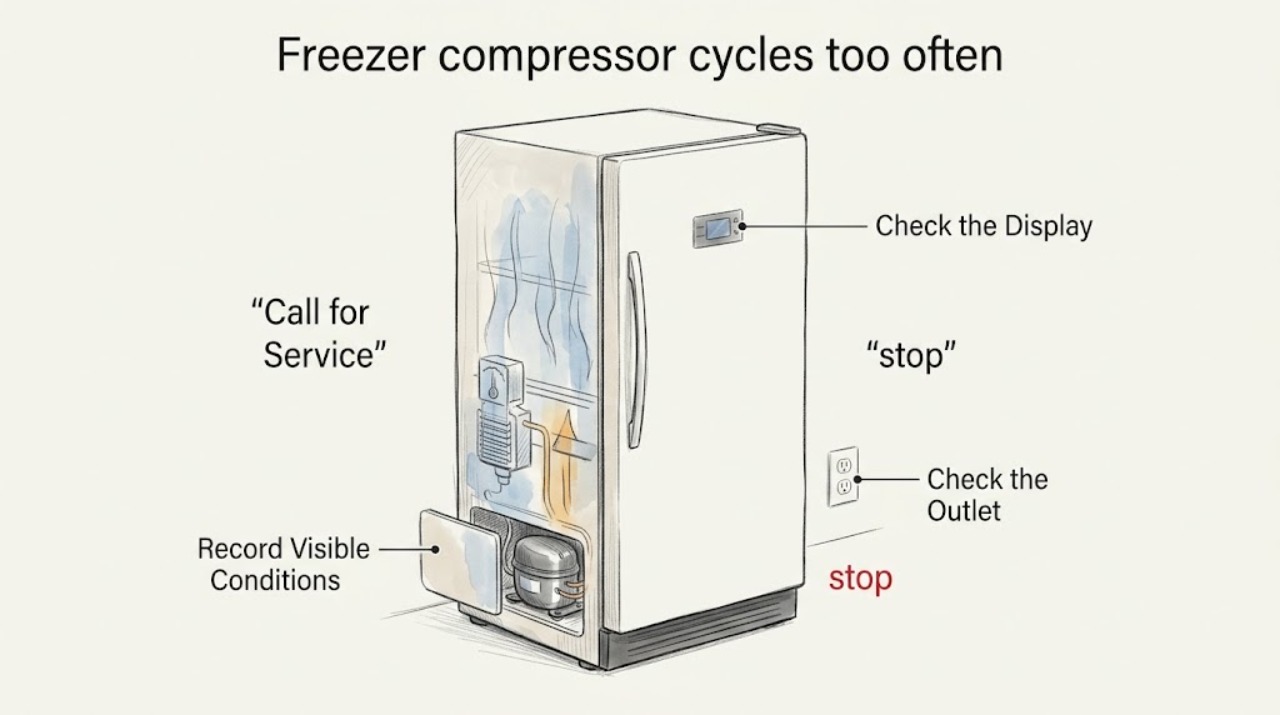
First determine whether the freezer is truly short cycling or simply running more often because of a warm room, recent loading, frequent door openings, a loose gasket, or a heavy frost load. A compressor that starts, stops after only a brief run, and repeats while the freezer is still warm is more concerning than normal cycles that run long enough to restore temperature. Check the temperature setting, door seal, visible frost or blocked interior vents, clearance around accessible condenser areas, and whether warm food was recently added; do not remove panels or touch the compressor. Whirlpool lists the thermostat, start relay, start capacitor, defrost timer, dirty condenser coils, gasket, and frost or vent problems among possible freezer causes, while Haier and Zanussi explain that hot food, door openings, room temperature, and ventilation can increase normal compressor run time. Keep the door closed and protect food while monitoring temperature. If the compressor only hums or clicks, becomes very hot, the freezer is not holding temperature, frost is heavy, a breaker trips, or rapid starts and stops continue after the basic checks, unplug it only from a safe position and arrange qualified appliance service. Do not replace a relay, add refrigerant, test live wiring, or repeatedly power-cycle the freezer by guesswork.
Before you begin
Safety first
- Homeowner checks should remain limited to temperature and timing records, door and gasket inspection, accessible vents and clearance, model-approved cleaning or defrosting, and safe visual checks. A qualified technician should test the start device, compressor, controls, fans, defrost system, condenser, and sealed system without unsafe live or refrigerant work.
Work through in order
Diagnostic checks
Use only checks that match the exact appliance or system and its official guide.
-
Check 1
Stop and unplug the freezer from a safe, dry position if the plug or outlet is hot or discolored, a breaker trips, there is smoke, burning odor, arcing, refrigerant-like hissing with a leak, or the compressor is dangerously hot; do not touch the compressor or restart it.
Expected result: There is no electrical, burning, leak, or extreme-heat warning, or one of those warnings is present.
Next step: For smoke or fire, leave and use emergency help. For electrical or leak symptoms, keep the appliance off and arrange qualified appliance or electrical service. If no danger sign is present, continue with the door closed and external checks.
Why this matters
Why: Rapid cycling may be a cooling fault, but electrical heat, smoke, fire, or a leaking sealed system requires immediate hazard control rather than more observations.
-
Check 2
For one observation period, record whether the compressor runs for a normal cooling interval or stops after a brief start, how long the pause lasts, whether the cabinet temperature is rising, and whether a hum, click, or overload-like stop repeats.
Expected result: The freezer runs for long periods after a warm load, cycles normally while maintaining temperature, or starts and stops rapidly while remaining warm.
Next step: Keep the door closed and avoid repeated power cycling. If the rapid pattern continues or temperature rises, keep the freezer off and arrange service; do not diagnose the compressor by sound alone.
Why this matters
Why: Warm food, door openings, and room conditions can increase normal run time. Brief repeated starts with poor cooling are more consistent with a start, control, airflow, or sealed-system fault than ordinary demand.
-
Check 3
Check the temperature control or display against the owner instructions and note whether a colder setting was recently selected, a fast-freeze mode is active, an alarm appears, or the control behaves intermittently; do not remove the control panel.
Expected result: The setting is colder than intended, fast-freeze is active, an alarm or code appears, the control is damaged, or settings are normal while rapid cycling persists.
Next step: Return only to the model-approved normal setting and allow one stabilization period with the door closed. If the control is damaged, an alarm remains, or cycling continues, arrange qualified service rather than replacing the thermostat by guesswork.
Why this matters
Why: A demanding setting or control issue can increase compressor operation, while a normal setting with repeated rapid starts shifts attention toward temperature sensing, start circuitry, airflow, or cooling performance.
-
Check 4
Inspect the door, gasket, latch, hinges, and cabinet opening without tools; remove only a package that prevents closure and check the gasket around the entire perimeter for dirt, gaps, tears, or areas that do not contact the cabinet.
Expected result: The door is not closing, a package blocks it, the gasket is dirty or damaged, condensation or frost appears at the edge, or the seal is continuous and the door closes normally.
Next step: Remove the obstruction and clean the gasket only as the owner instructions permit. Arrange gasket or appliance service for a damaged seal, misalignment, or persistent cycling; do not bend hinges or force the door shut.
Why this matters
Why: Warm air leaking through a poor seal can keep the compressor running or cycling as it tries to restore temperature. A sound seal makes heat-load, airflow, control, start, and sealed-system causes more relevant.
-
Check 5
Check accessible condenser areas and clearance around the freezer, and make sure the front, rear, or side air paths are not blocked by dust, storage, or a wall; do not remove covers or insulation if the coils are enclosed.
Expected result: Dust is visible, airflow space is blocked, the freezer is in a very hot room, the condenser is enclosed, or accessible areas appear clear and adequately ventilated.
Next step: Restore only the clearances and cleaning permitted by the owner manual. If the compressor remains hot, cycling is rapid, or the freezer cannot hold temperature, keep it off and arrange qualified service.
Why this matters
Why: Poor heat rejection can make the compressor work harder and more often. Enclosed coils and normal external airflow do not rule out an internal fan, control, or sealed-system issue.
-
Check 6
Inspect accessible interior vents and frost without tools, and note whether food blocks an air path, frost covers a wall or vent, or the freezer is otherwise clear; do not chip ice, use heat or flame, or remove evaporator covers.
Expected result: Vents are blocked, frost is thick or rapidly returning, the door was left open, or the interior is clear with no unusual frost.
Next step: Rearrange only loose packages and follow the model-approved defrost procedure if appropriate. If frost rapidly returns, the freezer warms, or cycling continues, arrange service instead of disassembling the evaporator area.
Why this matters
Why: Blocked airflow or a defrost problem can make the freezer struggle to reach temperature and cause abnormal compressor operation. Clear interior conditions keep controls, condenser, start components, and sealed-system faults in consideration.
-
Check 7
Gather the exact freezer model, type (chest, upright, or refrigerator-freezer), temperature reading, cycle timing, compressor and fan sounds, door and frost findings, room conditions, recent loading or outage, and any alarm or breaker event.
Expected result: Rapid starts continue while warm, the compressor clicks and stops, temperature does not stabilize, food is thawing, or the problem persists after the accessible checks.
Next step: Give the record to a qualified appliance technician and request diagnosis of start circuitry, controls, fans, defrost system, condenser, and sealed system as applicable. Protect or relocate food if temperature is rising.
Why this matters
Why: A start relay or overload, thermostat or control, fan or airflow issue, defrost fault, or sealed-system/compressor problem may be involved. The symptom pattern cannot prove which part is defective.
Use your observations
Decision map
Find the observation that best matches what you see, then follow the next safe action.
-
PATH 01Next step
What you see
The compressor runs longer after warm food, frequent door openings, hot room conditions, or a lightly loaded freezer, then stabilizes and maintains temperature.
Do this next
Allow food to cool before loading, keep the door closed, restore ventilation, and monitor temperature. Arrange service if rapid starts, poor cooling, unusual noise, or continuous operation persists after conditions normalize.
Why this path and its safety boundary
Why it matters: Increased cooling demand is more likely than a failed compressor or start device.
-
PATH 02Next step
What you see
The compressor starts, clicks or hums briefly, stops, and repeats while the freezer remains warm or an alarm appears.
Do this next
Keep the freezer off if the pattern persists and arrange qualified appliance service. Do not replace a start device, test live terminals, or repeatedly power-cycle it.
Why this path and its safety boundary
Why it matters: A start relay, overload, control, compressor, electrical supply, or sealed-system problem is more likely than normal thermostat cycling.
-
PATH 03Next step
What you see
The door seal has a gap, frost forms around the opening, vents are blocked, or heavy frost covers the interior wall or airflow path.
Do this next
Correct a loose package or clean a reachable seal, and use only the model-approved defrost procedure. Request service for a damaged gasket, recurring frost, poor cooling, or continued cycling.
Why this path and its safety boundary
Why it matters: Warm-air infiltration, blocked cabinet airflow, or a defrost issue is more likely and can cause the compressor to run or cycle abnormally.
-
PATH 04Next step
What you see
The door seals, interior vents, accessible condenser area, and temperature setting are normal, but the compressor cycles rapidly or the freezer cannot maintain temperature.
Do this next
Keep the freezer closed or move food to safe cold storage and arrange qualified appliance diagnosis. Do not open the compressor compartment or add refrigerant.
Why this path and its safety boundary
Why it matters: An internal fan, thermostat or control, start component, compressor overload, or sealed-system fault remains possible; external checks have not identified the cause.
-
PATH 05Next step
What you see
The compressor is extremely hot, the plug or outlet is hot or discolored, a breaker trips, smoke or burning odor appears, or a refrigerant-like leak or strong hissing is visible or audible.
Do this next
Disconnect only from a safe position, leave the appliance off, keep people away from a leak or fire, and arrange qualified appliance or electrical service; use emergency help for active fire.
Why this path and its safety boundary
Why it matters: An electrical, fire, mechanical, or sealed-system hazard outweighs ordinary freezer troubleshooting.
Helpful context
Understand the symptom
Frequent operation is not always short cycling
A freezer can run for a substantial part of an hour, especially after warm food is loaded, during hot weather, or after repeated door openings. Short cycling is a different pattern: the compressor starts and stops after a brief run before the cabinet reaches its set temperature, then repeats. Note run duration, pause duration, cabinet temperature, and whether the freezer is maintaining safe cold before deciding that a compressor is failing.
Check heat entering the cabinet
A door that does not close, a dirty or damaged gasket, a crowded shelf pressing the door, frequent openings, or warm food can keep the temperature control calling for cooling. Check the entire gasket perimeter and door alignment without removing panels. Keep the door closed while observing; do not use a damaged seal as a reason to keep cycling the compressor.
Inspect airflow and frost only from accessible areas
Dirty accessible condenser areas, a freezer pushed tightly against a wall, blocked interior vents, or thick frost can make cooling harder. Whirlpool notes that dirty coils can make a freezer operate more loudly or frequently and that frost can block vents and coils. Some chest and upright freezer coils are enclosed, so do not remove insulation or panels to reach them.
The sound and timing change the diagnosis
A normal hum followed by a controlled stop can be a temperature-control cycle. Repeated click-hum-click, a compressor that starts then stops quickly, a hot compressor shell, or a restart attempt after a short pause can involve a start relay, capacitor, overload, control, or sealed-system problem. Sound alone cannot identify the component; preserve the pattern for a technician.
Frost patterns can point away from the compressor
Heavy frost on a wall or around vents can restrict airflow and force longer or abnormal operation. A defrost timer, heater, sensor, or door-seal problem may be involved. Do not chip ice with a sharp tool, use an open flame, or disassemble a frost-covered cabinet; use only the model-approved defrost procedure and seek service if frost rapidly returns.
Protect food and the electrical boundary
Keep the door closed and move food to another safe cold-storage location if the freezer is warming. Never open the compressor compartment, test live voltage, change refrigerant, replace a start device, or repeatedly unplug and reconnect to force a restart. A qualified servicer can determine whether the fault is control, airflow, start circuitry, or the sealed system.
Safety boundary
Stop conditions
- Stop immediately for smoke, fire, burning odor, arcing, a hot or discolored plug or outlet, a repeated breaker trip, or an extremely hot compressor; disconnect only from a safe position and use emergency help for active fire.
- Keep the freezer off and arrange qualified appliance service for rapid click-hum-stop cycles with poor cooling, an alarm, food thawing, a visible refrigerant leak, or a compressor that cannot restart normally.
- Do not open the compressor or control compartment, test live wiring, replace a relay or capacitor by guesswork, add refrigerant, bypass an overload, chip ice with sharp tools, or use an open flame to defrost.
- Arrange service when cycling remains abnormal after one safe temperature, door-seal, load, frost, clearance, and accessible-coil check, or when a concealed coil, fan, defrost, control, or sealed-system fault is suspected.
Only after diagnosis
Potential parts
- freezer door gasket
Consider replacement only when the gasket is torn, deformed, or fails to contact the cabinet around the full perimeter; frequent compressor cycling alone does not prove a seal failure.
Match the exact freezer model, gasket profile, magnetic arrangement, door orientation, and installation instructions; do not force a misaligned door. - freezer thermostat or electronic control
Consider only after testing confirms inaccurate temperature sensing or control output after door, frost, load, and airflow causes are ruled out.
Match the exact model, control type, sensor arrangement, connectors, and approved diagnostic procedure; do not change settings or wiring by guesswork. - freezer compressor start device
Consider only when a qualified technician confirms a failed start relay, overload, capacitor, or related device from a start-stop or click-hum symptom; the compressor itself may be involved.
Match the exact compressor and freezer model, start-device specifications, connector, and wiring; live electrical and sealed-system work requires qualified service. - freezer evaporator or condenser fan
Consider only after testing confirms a failed fan or airflow component causing poor cooling, frost, noise, or abnormal compressor operation.
Match the exact model, fan location, blade, motor, connector, airflow direction, and approved access procedure; do not reach near moving blades or energized parts.
When checks do not resolve it
Need a professional?
Safety scope: Homeowner checks should remain limited to temperature and timing records, door and gasket inspection, accessible vents and clearance, model-approved cleaning or defrosting, and safe visual checks. A qualified technician should test the start device, compressor, controls, fans, defrost system, condenser, and sealed system without unsafe live or refrigerant work.
Common questions
FAQ
How do I know whether a freezer is short cycling?
Record the run and pause pattern. A compressor that starts and stops after a brief run while the freezer remains warm is more concerning than normal longer cycles after warm food, frequent door openings, or hot room conditions.
Can a bad door gasket make the compressor run too often?
Yes. A gasket gap lets warm air enter, so the compressor may work harder or cycle more often to restore temperature. Check the complete seal perimeter and arrange service if it is torn, deformed, or misaligned.
Should I replace the compressor start relay when it clicks and stops?
Not without testing. A start relay, overload, capacitor, control, compressor, or electrical supply can produce similar click-hum-stop behavior. Keep the freezer off if cooling is poor and have a qualified technician identify the cause.
Is a freezer running much of the time always a failure?
No. Run time can increase after warm food is loaded, during hot weather, with frequent door openings, or in a lightly loaded freezer. It is concerning when the freezer cannot hold temperature, the compressor repeatedly starts and stops rapidly, or abnormal heat, noise, odor, or electrical symptoms appear.
Read the exact guide
Official sources
- Haier - Freezer Running All the TimeHaier Appliances · Haier explains that modern freezers may run much of the time and identifies hot or large loads, light loading, door openings, and hot or humid conditions as factors affecting run time.
- Why Is My Fridge Compressor Running Continuously?Zanussi · Zanussi distinguishes normal compressor cycles from persistent operation and lists temperature, door, load, room, and ventilation checks before authorized service.
- 7 Freezer Problems & How to Help Fix ThemWhirlpool · Whirlpool discusses frequent or continuous compressor operation, door seals, frost and blocked vents, dirty or enclosed coils, start components, temperature controls, and professional inspection.
Community feedback
Share a repair observation
Share a plain-text repair observation. Accepted observations are published automatically; this page may take a moment to update.