
On this page
Start here
Quick answer
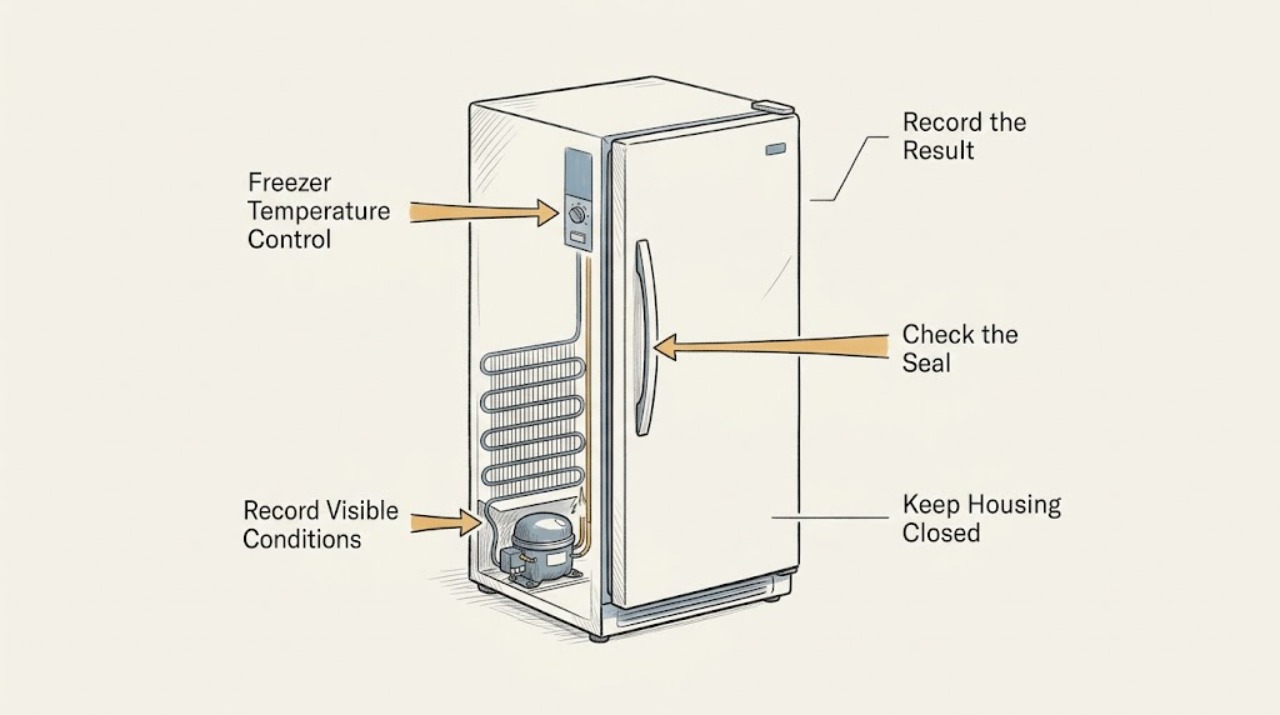
A freezer compressor is designed to run for much of the time and cycle as needed, so frequent operation is not automatically a fault. First verify the actual freezer temperature with a suitable appliance thermometer and compare it with the manufacturer's recommended setting; a setting that is too cold, a recently loaded freezer, frequent door openings, a warm room, a poor door seal, blocked vents or dirty accessible condenser surfaces can all lengthen run time. Check only the control, closure, gasket, airflow and visible frost from outside or inside the normal compartment. If the freezer cannot hold the set temperature, the compressor rapidly starts and stops, heavy frost returns, the control or wiring is damaged, or the unit becomes unusually hot or noisy, stop experimenting and arrange qualified appliance service. Do not open the sealed refrigeration system, handle live wiring, bypass the temperature control or scrape ice with a sharp tool.
Work through in order
Diagnostic checks
Use only checks that match the exact appliance or system and its official guide.
-
Check 1
Place an appliance thermometer in the normal freezer compartment without blocking a vent, and record the temperature and the control setting over a stable observation period described by the owner's manual. Do not move the control to its coldest position as a test or rely only on the compressor sound.
Expected result: The temperature is at the manufacturer's target and stable, warmer than target, colder than needed, or fluctuates widely while the compressor cycles.
Next step: If the setting is outside the manual's normal range, return it to the recommended user setting once and allow the appliance to stabilize before judging the symptom again. If the temperature remains abnormal, arrange appliance service instead of making repeated adjustments.
Stop if: Stop if the control is loose, cracked, wet, electrically damaged or requires panel removal, or if food is thawing and the freezer cannot maintain a safe temperature.
Why this matters
Why: A stable target temperature can make frequent operation normal. A warm or fluctuating cabinet means the compressor may be responding to heat gain or may not be removing heat effectively; an unnecessarily cold setting can also lengthen run time.
-
Check 2
Inspect the door or lid closure from the outside and examine the entire accessible gasket perimeter for gaps, tears, hardened sections, distortion, frost lines or packages holding it open. Close the door normally and confirm that it stays shut; do not pry the gasket out or use heat to reshape it.
Expected result: The seal is continuous and the door closes evenly, or a gap, damaged gasket, frost obstruction or package prevents a complete closure.
Next step: Rearrange packages or remove a harmless obstruction so the door can close normally. If the gasket is damaged, distorted or still leaks after a normal closure, keep the door closed and arrange a model-specific gasket or appliance assessment.
Stop if: Stop for a cracked liner, exposed wiring, a door that is dropping or cannot stay shut, severe frost binding the door, or any need to disassemble the door or gasket.
Why this matters
Why: A poor seal lets warm air enter and can make the compressor run longer or more frequently. A sound seal shifts attention toward temperature setting, load, ambient conditions, airflow, frost or a cooling fault.
-
Check 3
Record recent operating conditions: a large amount of unfrozen food, frequent or extended openings, a hot or humid room, a recent installation or power interruption, and clearance around the freezer. Confirm that the exterior has the clearance specified by the manual and that accessible ventilation is not blocked; do not move a heavy unit while it is energized.
Expected result: The long cycles began after a warm load, repeated openings, hot room conditions, installation or outage, or they occur without any such change.
Next step: Keep the door closed as much as practical, restore only the manual-specified clearance and observe the appliance through a normal recovery period. If it does not regain and hold the target temperature, arrange service rather than repeatedly changing the control.
Stop if: Stop if the room has unsafe heat, the cabinet is unstable, the power cord or outlet is damaged, or moving the appliance would expose wiring or require unsafe lifting.
Why this matters
Why: Temporary heat gain or restricted room airflow can explain extended recovery. A persistent change without a load or ambient explanation raises the likelihood of a gasket, frost, airflow, condenser, temperature-control or sealed-system issue.
-
Check 4
Look inside the compartment for blocked air passages and unusual frost on the walls or around accessible vents, and listen once during a normal cycle for steady humming versus repeated clicking, buzzing or a start-then-stop pattern. Do not chip ice, remove an evaporator cover, or reach behind a fan guard.
Expected result: Airflow is open and frost is light, vents are blocked, frost is thick or returns quickly, or the compressor starts and stops with abnormal clicking or noise.
Next step: Move only packages that are visibly blocking normal vents. Follow the owner's manual for any complete user defrost procedure; if the model is automatic, frost returns rapidly, or abnormal sounds continue, arrange qualified appliance service.
Stop if: Stop if ice is bonded to a panel, the liner is cracking, water reaches electrical parts, the compressor repeatedly clicks without starting, smoke or burning odor appears, or a check requires opening a panel.
Why this matters
Why: Blocked vents or heavy frost can impair airflow and make the freezer work harder. Repeated frost suggests a defrost or airflow problem, while abnormal start sounds can involve the start circuit or compressor; none can be identified safely from sound alone.
-
Check 5
If the model manual identifies accessible condenser coils or an approved exterior cleaning method, inspect for visible dust and clean only as directed with the freezer disconnected and stable. If the condenser is enclosed or inaccessible, do not remove panels; instead record cabinet temperature, run behavior, frost pattern and sounds for the service call.
Expected result: Accessible surfaces are clean, visibly dusty, enclosed by the cabinet, or cleaning does not change the temperature or run behavior.
Next step: Use the model manual and stop at the boundary of accessible maintenance. Arrange qualified service for persistent long cycles, abnormal temperature, rapid frost, repeated clicks or any internal or sealed-system diagnosis.
Stop if: Stop for exposed terminals, a damaged cord, wet components, a hot or burning cabinet, a condenser that is inaccessible, or any need to use live electrical testing, refrigerant tools or panel removal.
Why this matters
Why: Dust on an accessible condenser can reduce heat transfer and increase run time, but many freezers have enclosed condensers and cannot be serviced from the outside. No improvement after an approved cleaning keeps control, airflow, defrost, fan, start or sealed-system causes in consideration.
Use your observations
Decision map
Find the observation that best matches what you see, then follow the next safe action.
-
PATH 01Next step
What you see
The freezer reaches and holds the manufacturer's target temperature, the door seals, and the compressor runs steadily without abnormal clicks, frost or heat.
Do this next
Treat the run time as potentially normal. Keep the recommended setting, maintain clearance and minimize door openings; arrange service only if the behavior changes or the temperature no longer holds.
-
PATH 02Next step
What you see
The compressor runs much more after a large unfrozen load, frequent openings, a power interruption or unusually warm room, while the temperature gradually returns to target.
Do this next
Keep the door closed and allow normal recovery under the manual's conditions. If the freezer cannot regain or hold the target after recovery, investigate the seal, frost and airflow and arrange service.
-
PATH 03Next step
What you see
The freezer is warmer than target and the door gasket leaks, vents are blocked, frost is heavy or the exterior airflow is restricted.
Do this next
Correct only the accessible obstruction or manual-approved clearance issue. Use the manual for defrosting or cleaning limits; recurring frost, a damaged gasket or persistent warm temperature needs qualified diagnosis.
-
PATH 04Next step
What you see
The compressor rapidly clicks or starts and stops, the temperature keeps rising, the control is damaged, or the cabinet becomes unusually hot or smells of burning.
Do this next
Stop repeated cycling and arrange qualified appliance service. Do not bypass the temperature control, open the sealed system, perform live electrical tests or keep running the freezer if a burning or electrical hazard is present.
Helpful context
Understand the symptom
Judge the complaint by temperature stability, not by counting every start. Freezer compressors are built to run much of the time, and a warm room, a large load, frequent openings or a recent power interruption can keep the compressor on longer while the cabinet recovers. A freezer that reaches and holds its intended temperature may be operating normally even when the sound is noticeable.
The temperature control is only one part of the cooling loop. Warm air entering through a door that does not close or seal, blocked internal vents, heavy frost, poor clearance or dirty accessible condenser surfaces can make the control call for cooling more often. Make observations without removing panels, and use the owner's manual because chest, upright and refrigerator-freezer designs differ.
Do not mistake a compressor that runs often for permission to repair its sealed system. Refrigerant, compressor, start components, defrost components and internal controls require model-specific diagnosis. A control that never satisfies, repeated clicking or short starts, heavy frost that quickly returns, or food that is not staying frozen is a service clue, not a reason to bypass a thermostat or keep cycling power.
Safety boundary
Stop conditions
- Stop immediately for smoke, burning odor, arcing, a hot or damaged cord, exposed wiring, water near electrical parts or repeated breaker trips.
- Do not open the sealed refrigeration system, handle refrigerant, bypass the temperature control, defeat a safety device, chip ice with a sharp tool or remove panels for live testing.
- Stop repeated resets or starts when the compressor clicks, stalls, overheats or the freezer temperature continues rising.
Only after diagnosis
Potential parts
- freezer temperature control or sensor
Only consider this category after a qualified technician confirms that the control or sensor is failing to regulate the compressor and rules out temperature setting, air leakage, frost and airflow causes.
Confirm the exact appliance model, control type, sensor specification, connectors and manufacturer fit information before selecting a replacement. - freezer door gasket
Only consider this category when the full gasket perimeter fails to seal or is damaged and the door or liner is otherwise correctly aligned.
Confirm the exact freezer model, door or lid configuration, gasket profile and installation method before ordering. - defrost or airflow component
Only consider this category after recurring frost or blocked airflow is confirmed and a technician identifies a defrost, fan or related component fault.
Confirm the model-specific component, electrical rating, connector, mounting and manufacturer-approved fit before selecting a part.
When checks do not resolve it
Need a professional?
Arrange qualified appliance service when the freezer cannot hold the recommended temperature, cycles with repeated clicking or short starts, develops heavy recurring frost, or continues running excessively after seal, load, setting and airflow checks., Use the model owner's manual for defrosting, condenser access, controls and any permitted reset. Do not infer a part fault from sound alone or order a thermostat, relay, fan or defrost component without model-specific diagnosis., Stop using the appliance and disconnect it only if this can be done safely for smoke, burning odor, damaged cord or outlet, exposed wiring, arcing, refrigerant-like damage or a cabinet that is dangerously hot; arrange qualified service., Protect food by moving it to a known-working freezer if the compartment is warming, while avoiding repeated door opening and unsafe handling of a damaged appliance.
Common questions
FAQ
Is it normal for a freezer compressor to run most of the time?
Often, yes. Freezer compressors are designed to run much of the time, especially during warm room conditions, recovery after loading, or frequent door openings. Judge the pattern with the actual freezer temperature: if it reaches and holds the manufacturer's target without abnormal noise or frost, frequent operation may be normal.
Can a temperature control set too cold make a freezer run too often?
Yes. A colder-than-needed setting increases the cooling demand and can lengthen run time. Return the control to the setting recommended by the owner's manual once, allow the freezer to stabilize, and arrange service if the temperature remains abnormal.
How can a bad freezer door seal affect compressor cycling?
A gap or damaged gasket lets warm air enter, so the freezer must remove that extra heat and may run longer or more frequently. Check the entire accessible perimeter and package clearance; replace a confirmed damaged gasket only after its exact model fit is verified.
Why does heavy frost make the freezer compressor run more?
Frost can obstruct vents and coils, reducing airflow and making it harder to maintain the set temperature. Follow the model manual for an approved defrost procedure, but recurring frost or a freezer that remains warm needs qualified diagnosis of the defrost and airflow system.
When should frequent freezer cycling be treated as a repair issue?
Arrange service when the freezer cannot hold its target temperature, the compressor rapidly clicks or starts and stops, heavy frost returns, the control or wiring is damaged, the cabinet becomes unusually hot, or accessible setting, seal, load and airflow checks do not explain the run time.
Read the exact guide
Official sources
- 7 freezer problems & how to troubleshoot themWhirlpool · Whirlpool manufacturer troubleshooting for freezer noise, frost, compressor overrun, gaskets, defrost components, thermostat and professional limits
- Refrigerator or Freezer - Normal Run TimeGE Appliances · GE manufacturer guidance on normal compressor run time and effects of temperature, loading, door openings, gaskets, vents, condenser coils and interior light
- FreezersENERGY STAR · ENERGY STAR freezer usage guidance on recommended temperature, ambient conditions, clearance, airtight door seals and minimizing openings
- Motor or Compressor Runs Too Much - Chest FreezerWhirlpool Product Help · Whirlpool manufacturer troubleshooting for freezer compressor run time, controls, load, ambient temperature, lid closure and service escalation
Community feedback
Share a repair observation
Share a plain-text repair observation. Accepted observations are published automatically; this page may take a moment to update.