
On this page
Start here
Quick answer
A warm freezer cabinet is often normal heat rejection, especially while the compressor is running; some chest freezers use the cabinet as a condenser and upright models may warm the case to prevent sweating. The important distinction is whether the food and measured interior temperature stay cold. If the interior is warm while the compressor starts and stops unusually often or runs nearly continuously, check the temperature setting, recent loading or door openings, gasket closure, blocked vents, room conditions, clearance, and any accessible condenser area. Make only external, model-directed checks. If the interior remains warm after one stabilization period, the compressor clicks without starting, or food is thawing, stop testing and arrange qualified appliance service.
Before you begin
Safety first
- This article covers temperature observation, external setting and usage review, visible gasket and airflow checks, manual-directed placement review, and one stabilization reassessment. A technician must handle electrical diagnosis, internal panels, sealed refrigeration, refrigerant, compressor, start components, defrost controls, and inaccessible fans or coils.
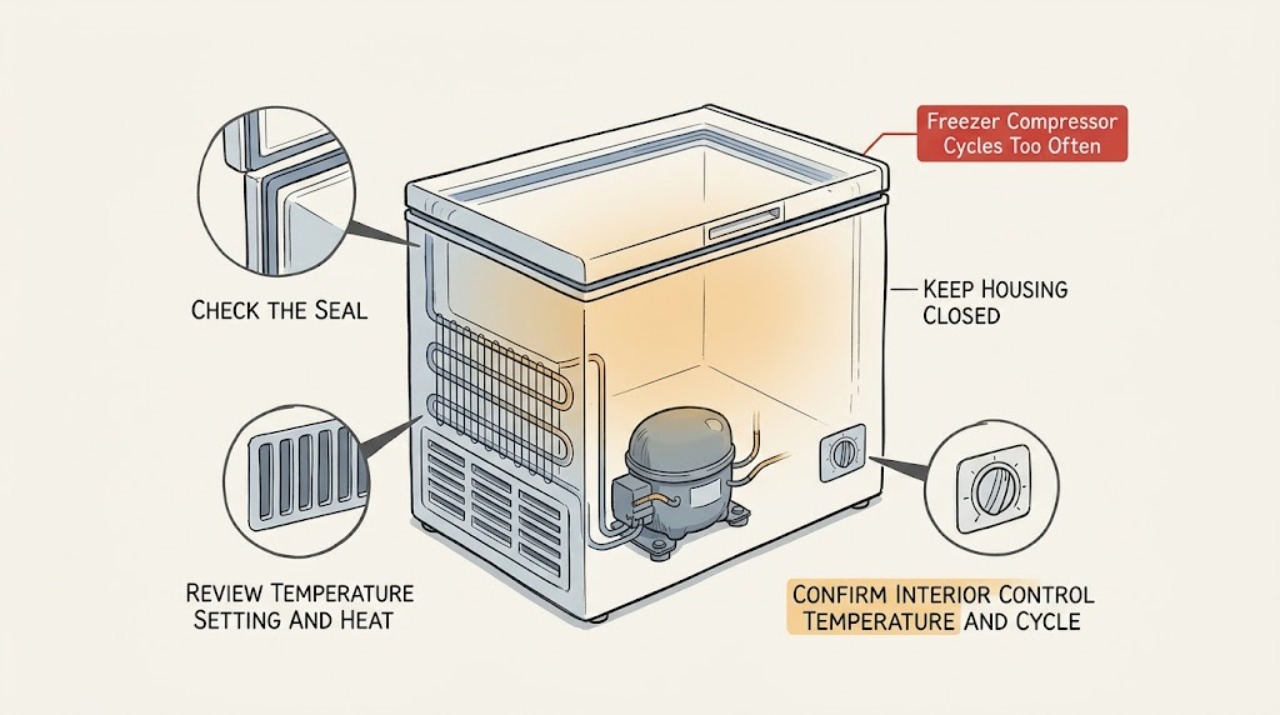
Work through in order
Diagnostic checks
Use only checks that match the exact appliance or system and its official guide.
-
Check 1
Check the temperature between frozen packages with an appliance thermometer, note whether food is still hard, and observe the freezer for one normal period without repeatedly opening it. Record whether the compressor is off and on normally, running for a long stretch, or making short starts and stops.
Expected result: The interior is in the normal frozen range and food remains hard; the interior is warmer than expected; the compressor runs much of the time; or it clicks, stops, and retries without cooling recovery.
Next step: Keep the door or lid closed and continue with the matching external check. If food is thawing, the temperature is rising, or the compressor repeatedly clicks without starting, stop testing and arrange appliance service; do not touch the compressor or electrical terminals.
Stop if: Stop immediately for a burning odor, smoke, damaged cord, arcing, uncontrolled heat, or water near electrical parts.
Why this matters
Why: A stable cold interior makes a warm outer cabinet more likely to be normal heat rejection. A warm interior with extended running means the system is not recovering temperature. Repeated clicking or failed starts raises concern for a start, control, or compressor fault and cannot be identified safely by sound alone.
-
Check 2
Review the temperature control and what changed before the symptom: first installation, recent power loss, a large amount of unfrozen food, a door or lid left open, frequent openings, or an unusually warm room. Return the control only to the setting specified by the owner's manual; do not use the coldest setting as a shortcut.
Expected result: The freezer is newly installed or recovering from power loss, a warm load was recently added, the room is hot, the door was open, or the setting is already manual-recommended and the interior is still warm.
Next step: Close the freezer, avoid adding more warm food, minimize openings, and allow the manual's stabilization time before reassessing. If the interior cannot recover, proceed to seal, airflow, and service checks rather than making repeated control changes.
Stop if: Do not put hot food into the freezer, defeat an alarm, or keep changing the control while food temperature is rising.
Why this matters
Why: These conditions can temporarily extend compressor run time while the freezer removes added heat. If none applies, or the freezer remains warm after the manufacturer's stabilization period, a simple heat-load explanation is less likely.
-
Check 3
Inspect the entire door or lid gasket and the mating cabinet surface. Remove only visible debris, wipe the gasket with warm soapy water as directed by the manufacturer, and close the door or lid without packages touching the seal. Check that a thin sheet of paper has consistent resistance around the seal rather than sliding freely at one area.
Expected result: The gasket is dirty, torn, deformed, loose, or has a gap; a package prevents closure; frost follows one edge; or the seal closes evenly with no visible gap.
Next step: Rearrange packages and monitor one stabilization period after cleaning. If the gasket is torn or will not seal, keep the freezer closed and arrange model-specific service or a correctly identified gasket; do not glue, stretch, or heat-form it.
Stop if: Stop if the door or lid is warped, hinges are unsafe, frost prevents closure, or correcting the seal would require removing panels or forcing hardware.
Why this matters
Why: A damaged or poorly sealing gasket lets warm, humid air enter, which can warm the cabinet and extend or repeat compressor operation. A clear, even seal makes an air leak less likely, although it does not rule out an internal cooling fault.
-
Check 4
With the freezer closed between checks, inspect visible interior air vents, shelves, baskets, and the evaporator cover for blocked openings or heavy frost. Leave space around packages and keep food from pressing against vents. Do not chip ice or remove the interior cover.
Expected result: Packages block a vent, the compartment is packed tightly, frost forms a thick blanket or prevents the door from closing, or vents and the visible interior are clear.
Next step: Move only the items obstructing airflow and follow the owner's manual for any permitted defrost procedure. If heavy frost returns, a cover is iced over, or the freezer stays warm after airflow is restored, arrange service instead of using sharp tools or improvised heat.
Stop if: Do not puncture ice, scrape the liner, use an open flame, or remove an evaporator or electrical cover.
Why this matters
Why: Blocked vents and excessive frost can restrict cold-air movement, reduce effective cooling, and make the compressor run longer while the cabinet stays warm. A clear airflow path makes this explanation less likely and shifts attention to placement or a mechanical diagnosis.
-
Check 5
Compare the freezer's location with its installation instructions. Confirm that the room is ventilated, the freezer is not in a closet or against a heat source, and the specified clearance around the top, sides, and back is available. If the model has an accessible condenser grille or coil, inspect it for lint and clean it only as the manual permits, with power disconnected before any approved external cleaning.
Expected result: Clearance is restricted, the room is unusually hot or poorly ventilated, an accessible grille is visibly clogged, or the installation and accessible heat-rejection area are clear.
Next step: Restore the manual-required clearance and ventilation, then allow the freezer to stabilize before reassessing. Do not remove panels or clean a wrapped condenser that is not user-accessible; call for service if heat, food warming, or abnormal cycling continues.
Stop if: Do not move a loaded freezer alone, touch hot or moving components, or disconnect wiring, panels, or refrigeration tubing.
Why this matters
Why: Restricted airflow or high ambient heat makes heat rejection harder and can warm the outer case while extending compressor operation. A clear, correctly installed unit with a warm interior is less likely to be fixed by moving it and needs service diagnosis.
-
Check 6
After one stabilization period with the door or lid closed and external corrections complete, recheck the food or thermometer and note the compressor pattern. Record the control setting, room conditions, frost or gasket findings, and any alarm or clicking before contacting service.
Expected result: The interior returns to a safe frozen temperature and the compressor settles into normal cycling; the exterior remains warm but the interior is stable; or the interior remains warm with long running, short cycling, repeated clicking, or an alarm.
Next step: Monitor only when the interior is stable and food remains frozen. Otherwise keep the freezer closed, protect food as appropriate, and arrange qualified appliance service with the recorded observations; do not order a compressor or refrigerant part from symptoms alone.
Stop if: Stop and seek prompt service for food thawing, a high-temperature alarm that will not clear, repeated clicking, smoke, burning odor, a damaged cord, or an excessively hot component.
Why this matters
Why: Recovery with a stable interior supports a temporary heat-load, seal, airflow, or installation cause; a warm exterior alone is not a fault. Failure to recover means an internal control, fan, start device, compressor, defrost, or sealed-system diagnosis may be needed.
Use your observations
Decision map
Find the observation that best matches what you see, then follow the next safe action.
-
PATH 01Next step
What you see
The cabinet feels warm, but the food remains hard, the measured interior is stable, and the compressor turns off and on as needed.
Do this next
Keep the specified clearance and monitor the interior temperature. Seek service if the interior later warms, the cycle becomes abnormal, or the case develops an odor, smoke, or damaging heat.
Why this path and its safety boundary
Why it matters: Normal heat rejection is more likely than a cooling failure; chest models may use the case as a condenser and upright models may warm the case to limit sweating.
-
PATH 02Next step
What you see
The freezer became warm after installation, power loss, a large warm load, an open door or lid, frequent openings, or unusually hot room conditions.
Do this next
Close the freezer, avoid additional warm food and unnecessary openings, follow the manual's stabilization time, and reassess food temperature. If it does not recover, follow the service branch.
Why this path and its safety boundary
Why it matters: Added heat and air exchange can make the compressor run for an extended period before the set temperature returns.
-
PATH 03Next step
What you see
A gasket has a gap or damage, a package prevents closure, frost blocks a vent, or food is packed against the airflow path.
Do this next
Correct only the visible obstruction or clean the gasket, use the manual for any defrost instruction, and monitor once. Arrange service for a torn gasket, returning frost, or continued warming.
Why this path and its safety boundary
Why it matters: Warm-air infiltration or restricted circulation is more likely than a compressor-only failure, but recurring frost or a persistent warm interior can indicate a defrost or control issue.
-
PATH 04Next step
What you see
The freezer is in a hot or poorly ventilated location, has less clearance than the manual requires, or has an accessible dirty grille.
Do this next
Restore the manual-required location and clearance, clean only an accessible area by the manual's method, and allow stabilization. Do not open panels if the condition persists.
Why this path and its safety boundary
Why it matters: The unit may be unable to reject heat efficiently, which can make the case warmer and extend compressor operation.
-
PATH 05Safety boundary
What you see
The interior remains warm after external checks and stabilization, or the compressor repeatedly clicks, fails to start, starts and stops unusually quickly, or runs without cooling recovery.
Do this next
Keep the door or lid closed, protect food, and arrange qualified appliance service. Provide the model, measured temperature, cycle pattern, alarm history, gasket and frost observations, and room conditions.
Why this path and its safety boundary
Why it matters: A start device, temperature control or sensor, fan, defrost fault, compressor, or sealed refrigeration problem is possible, but the symptom does not identify a safe user-replaceable part.
Safety stop: Do not test live electrical parts, handle the compressor, open the refrigerant circuit, bypass controls, or keep cycling power to force a start.
Helpful context
Understand the symptom
Warm outside does not automatically mean the freezer is failing
The refrigeration system removes heat from inside and rejects it to the room. GE notes that chest-freezer condenser surfaces can be wrapped around the case, while upright cases can include anti-sweat heaters; either design may feel warm or even hot. Judge the symptom by the food or a thermometer between frozen packages, not by cabinet temperature alone. A warm case with a stable cold interior can be normal, while a warming interior changes the priority to cooling diagnosis.
Interpret compressor behavior with the temperature result
Freezer compressors may run much of the time, and hot rooms, a large warm load, frequent openings, or an empty freezer can extend the run. More concerning is a freezer that remains warm despite extended operation, repeatedly clicks and stops, or has brief starts with no recovery. Do not assume the compressor itself is the failed part from sound or cabinet warmth; the pattern can also follow a seal, airflow, control, start device, or sealed-system problem.
Use only external checks before requesting service
A homeowner can record temperature, confirm the control setting, check that the door or lid closes, clear visible food from vents, and compare the installation with the owner's manual. Do not remove electrical covers, handle a hot compressor, open the refrigerant circuit, or force a defrost or control repair. If food is softening or the temperature is rising, protect the food and arrange service rather than repeatedly restarting the freezer.
Safety boundary
Stop conditions
- Do not open electrical covers, test live voltage, handle a hot or moving compressor, bypass a control, or open the sealed refrigerant system.
- Do not chip frost, puncture the liner, use an open flame or improvised heat, or remove an evaporator cover; follow only the freezer manual's permitted defrost method.
- Stop using the freezer for active cooling diagnosis and arrange prompt service if food is thawing, the interior temperature is rising, a high-temperature alarm persists, or the compressor repeatedly clicks without starting.
- Disconnect power only by the normal plug or breaker when safe and necessary for an approved external cleaning step; stop for smoke, burning odor, arcing, a damaged cord, water near electrical parts, or an excessively hot component.
- Do not select a compressor, relay, fan, sensor, gasket, or refrigerant-related part from symptoms alone; model-specific fit and professional diagnosis are required.
Only after diagnosis
Potential parts
- Freezer door or lid gasket
Consider this category only when inspection shows a torn, deformed, loose, or non-sealing gasket and the exact model identifies it as the repair.
Confirm the freezer model, door or lid design, gasket profile, and manufacturer's fit information before ordering. - Condenser or evaporator fan motor
Consider this category only after a qualified diagnosis finds that a model-equipped fan is not moving air and airflow or placement checks are not the cause.
Confirm whether the freezer uses that fan, the exact model, connector, voltage, and service procedure; do not reach into a moving fan. - Temperature sensor or control
Consider this category only when measured temperature and cycle behavior support a control or sensor fault after the gasket, load, airflow, and placement checks.
Confirm the exact model, control revision, sensor type, wiring, and manufacturer's service information before ordering. - Compressor start device or overload
Consider this category only when a qualified technician confirms repeated clicking or failed compressor starts are caused by the start device rather than the compressor or control.
This is an electrical service part; confirm the exact model and have a qualified technician verify compatibility and safe installation. - Sealed-system or compressor service
Consider this category only when the freezer stays warm despite correct airflow, closure, placement, and controls and a qualified technician confirms a sealed-system or compressor fault.
Do not order refrigerant or compressor components from symptoms alone; model, refrigerant, warranty, and licensed service requirements must be confirmed.
When checks do not resolve it
Need a professional?
Arrange qualified appliance service when the freezer interior remains warm after one stabilization period and the gasket, airflow, setting, load, placement, and accessible external areas are reasonable; when the compressor clicks, fails to start, cycles abnormally, or runs without cooling recovery; or when a defrost, fan, control, start-device, compressor, or sealed-system diagnosis is needed. Seek prompt help for thawing food, a persistent high-temperature alarm, smoke, burning odor, arcing, a damaged cord, water near electrical parts, or an excessively hot component.
Safety scope: This article covers temperature observation, external setting and usage review, visible gasket and airflow checks, manual-directed placement review, and one stabilization reassessment. A technician must handle electrical diagnosis, internal panels, sealed refrigeration, refrigerant, compressor, start components, defrost controls, and inaccessible fans or coils.
Common questions
FAQ
Is a warm freezer cabinet normal?
Often, yes. Chest-freezer condenser surfaces may be wrapped around the case, and upright models may warm the case to reduce sweating. A warm outside with hard frozen food and a stable interior can be normal. A warm interior, rising food temperature, or abnormal compressor behavior needs troubleshooting and possibly service.
Does a freezer compressor normally run much of the time?
It can. GE says freezer compressors may run 80% to 90% of the time, with hot conditions, warm food loads, door openings, gasket problems, blocked vents, and condenser conditions changing run time. The key concern is an interior that stays warm or a compressor that repeatedly clicks and fails to recover temperature.
What should I check first when the freezer is warm inside?
Measure food or package temperature, then check the setting and recent heat load, door or lid closure, gasket, visible frost, blocked vents, room conditions, and required clearance. Keep the freezer closed while it stabilizes. If it remains warm after one stabilization period, arrange service rather than repeatedly changing the control.
Can a bad door gasket make the compressor cycle too often?
Yes. A dirty, torn, poorly fitted, or obstructed gasket can let warm air enter and make the freezer work longer or more often. Clean only as directed, remove visible obstructions, and replace a model-identified gasket through the manual or qualified service if it will not seal.
Should I clean the condenser when the freezer cabinet is warm?
First determine whether the model has an accessible condenser or grille and follow its owner's manual. Keep the specified clearance and ventilation. Some chest freezers use the case as the condenser, so there may be no user-accessible coil to clean. Do not remove panels or reach near moving or hot components.
When should I call for freezer service?
Call when the interior stays warm after the setting, load, gasket, airflow, placement, and stabilization checks; when the compressor clicks, fails to start, cycles abnormally, or runs without cooling recovery; or when frost, a fan, control, start device, compressor, or sealed-system diagnosis is needed. Seek prompt help for thawing food, smoke, burning odor, arcing, a damaged cord, water near electrical parts, or an excessively hot component.
Read the exact guide
Official sources
- Refrigerator or Freezer - Normal Run TimeGE Appliances · Official GE general refrigeration support guidance; exact appliance manual controls model-specific operation.
- Motor or Compressor Runs Too Much - Chest FreezerWhirlpool Corporation · Official Whirlpool chest-freezer guidance; apply only the chest-freezer portions relevant to the appliance and follow the model manual.
- Upright & Chest Freezer - Temperature ControlGE Appliances · Official GE upright and chest freezer temperature guidance; the owner's manual controls model-specific settings and alarms.
- Upright & Chest Freezer - Exterior Case WarmGE Appliances · Official GE support guidance for upright and chest freezer case warmth; model-specific installation instructions control clearance.
- Freezer - Not Freezing or Not CoolingFrigidaire · Official Frigidaire support article for freezers and refrigerator-freezer compartments; model manual controls exact procedures.
- Freezer Runs Too MuchFrigidaire · Official Frigidaire freezer support guidance for a unit that runs too much; model manual controls the exact setting and recovery time.
- Upright & Chest Freezer - Installation and LocationGE Appliances · Official GE installation guidance for upright and chest freezers; use the individual model manual for final dimensions.
Community feedback
Share a repair observation
Share a plain-text repair observation. Accepted observations are published automatically; this page may take a moment to update.