
On this page
Start here
Quick answer
A freezer compressor running much of the time is not automatically a failure: manufacturers note that many compressors run about 80% to 90% of the time, and a newly loaded, recently restarted, hot-room, or frequently opened freezer may run nearly continuously while it recovers. If the freezer is warm or the runtime changed, first check the temperature setting, recent warm food, door or lid closure, gasket, airflow, frost, and room conditions. Then locate the condenser coils only as the owner's manual permits. If the coils are external and accessible, disconnect power before gently vacuuming dust without bending fins or tubing; if the coils are built into the walls, do not disassemble the cabinet. Persistent long runtime, repeated rapid starts, poor cooling, heavy frost, unusual clicking, or a compressor or fan that will not start needs a qualified appliance technician.
Before you begin
Safety first
- This article supports reading temperature, checking user settings and seals, inspecting vents and accessible coils, and cleaning an accessible condenser only as the manual permits with power disconnected. It does not authorize cabinet removal, sealed-system or refrigerant work, live electrical testing, compressor-start repair, or control bypasses.
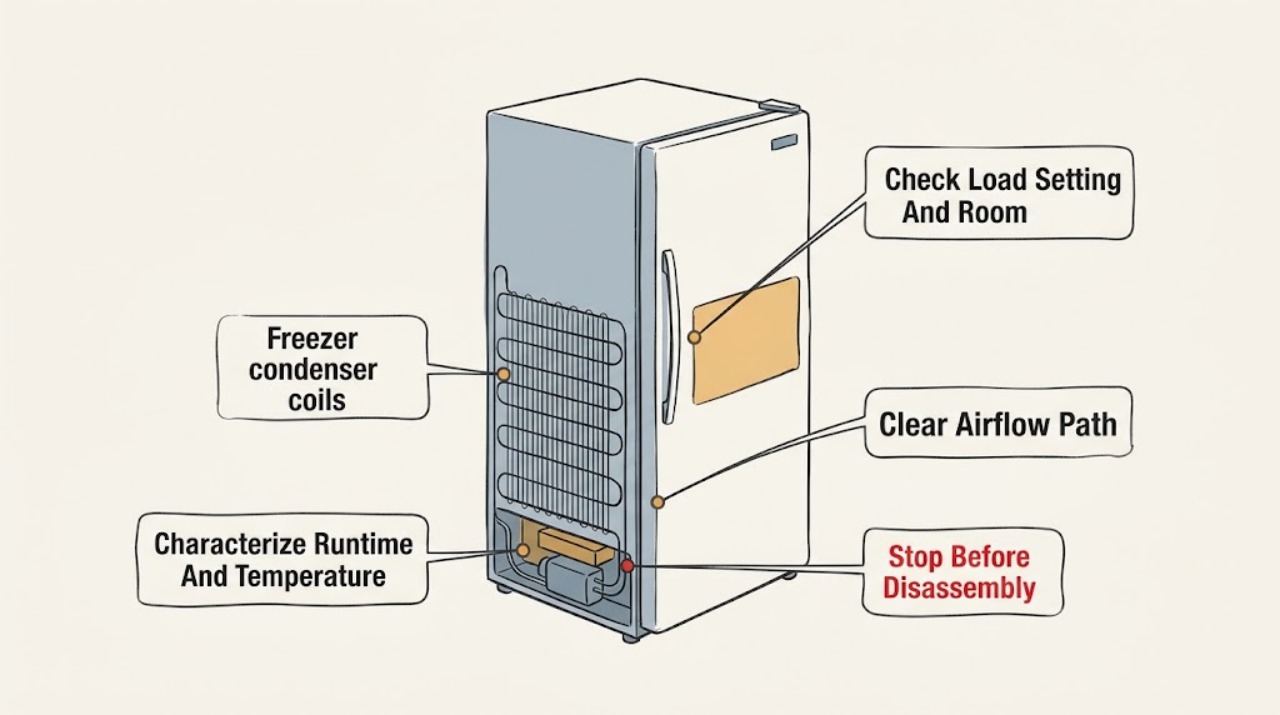
Work through in order
Diagnostic checks
Use only checks that match the exact appliance or system and its official guide.
-
Check 1
Record the freezer temperature with a suitable appliance thermometer or the model's display, note the control setting, and observe whether the compressor runs in long stretches, starts and stops rapidly, or stays off while the freezer warms.
Expected result: Record whether the freezer is at its target, warmer than expected, recently restarted, newly loaded, or in a hot room; also note whether the compressor is running continuously, cycling periodically, or making repeated clicks without starting.
Next step: Use the result to choose the load-and-seal, coil, frost-and-airflow, or service branch; do not repeatedly power-cycle a compressor that is clicking or failing to start.
Stop if: Do not remove electrical covers, test live terminals, bypass the thermostat, or touch the compressor or fan while energized.
Why this matters
Why: A cold freezer with long but stable runs can be normal, since manufacturers describe substantial normal runtime. A warm freezer with continuous operation means the unit is not recovering its temperature; rapid starts, repeated clicks, or no start shifts attention toward a control, start, fan, or refrigeration fault rather than coil dust alone.
-
Check 2
Check only the user controls and surroundings: confirm the temperature setting against the owner's manual, look for a large recent load of warm food, frequent or prolonged door/lid opening, a heat source or unusually hot room, and packages blocking the lid, door, or internal air path.
Expected result: Record whether the freezer was recently restarted or loaded, whether the setting was changed colder, whether warm air enters through use or a blocked closure, and whether the ambient location is outside the model's stated operating conditions.
Next step: Correct only an obvious user-setting or obstruction issue, close the door or lid promptly, and allow the model-specific stabilization period before judging the cycle; do not keep changing the control back and forth.
Stop if: Do not place hot food in the freezer to test it, move a heavy unit by its refrigerant lines, or use an extension-cord workaround for a damaged power cord.
Why this matters
Why: Each of these adds heat that the compressor must remove and can extend runtime without a coil failure. A freezer that returns to its target after the load and usage normalize is less suggestive of a failed compressor; a persistently warm cabinet despite normal loading needs further diagnosis.
-
Check 3
With the freezer closed and powered normally, inspect the door or lid gasket around its full perimeter for dirt, gaps, tears, warping, or poor contact; inside, check that vents and the evaporator-air path are not blocked by packages or heavy frost.
Expected result: Record whether the gasket seals evenly, whether a sheet of paper slides out with little resistance where the model's manual permits that check, whether the door or lid is prevented from closing, and whether frost is covering the back wall or vents.
Next step: Clean a dirty gasket with the method in the manual and remove only movable items blocking closure or vents; if the gasket is damaged, frost returns, or the freezer remains warm, arrange service.
Stop if: Do not chip frost with a knife, use an unauthorized heat source near plastic or wiring, remove an evaporator cover, or keep running the freezer with water entering electrical areas.
Why this matters
Why: A leaking seal or blocked airflow lets heat in or prevents cold air from circulating, so the compressor can run longer. Persistent or rapidly returning frost can indicate a defrost or airflow fault and is not fixed by cleaning external condenser coils.
-
Check 4
Find the condenser location in the owner's manual before moving the appliance. If the coils are external and the manual permits cleaning, disconnect power, use a soft brush or vacuum to remove dust from the grille and coil surface, avoid fins and tubing, replace any grille, and restore power only after the area is secure.
Expected result: Record whether the coils were actually accessible, heavily coated with dust or pet hair, already clean, or enclosed in the cabinet walls; note whether airflow around the unit was obstructed.
Next step: If the coil was dirty, allow the freezer to stabilize under the manual's instructions and compare temperature and runtime; if it was inaccessible, stop at the observation rather than dismantling the cabinet.
Stop if: Do not clean while energized, bend condenser tubing or fins, disturb water lines, remove sealed-system panels, or use compressed air in a way that drives debris into the appliance.
Why this matters
Why: Dust on accessible external coils can reduce cooling efficiency and contribute to long runtime. An inaccessible built-in condenser is not a user-cleaning target, and a clean accessible coil makes gasket, frost, fan, control, or sealed-system causes more important.
-
Check 5
After one permitted setting or cleaning change and the model-specific stabilization period, compare the freezer temperature, compressor pattern, and any sound with the initial record; observe from outside whether a fan runs normally and whether the compressor starts without repeated clicking.
Expected result: Record whether temperature returns to target and the runtime settles, remains warm with a long run, becomes a repeated short-cycle or click-no-start pattern, or develops a loud fan/compressor noise, heavy frost, or visible oil or wiring damage.
Next step: Arrange qualified appliance service with the temperature, runtime pattern, coil accessibility and condition, gasket/frost findings, and sounds; protect food using a safe alternate cold-storage plan if temperature is not maintained.
Stop if: Do not open the sealed system, add refrigerant, replace a compressor relay, test capacitors, or continue operating a unit with damaged wiring, burning odor, or a compressor that repeatedly fails to start.
Why this matters
Why: Improvement after a documented load, seal, airflow, or coil correction supports that factor as a contributor. No improvement or a start, fan, frost, oil, wiring, or sealed-system symptom means the problem is beyond a safe coil-cleaning check.
Use your observations
Decision map
Find the observation that best matches what you see, then follow the next safe action.
-
PATH 01Safety boundary
What you see
The freezer reaches its target temperature, the compressor runs for long stretches without alarming sounds, and the unit is newly loaded, recently restarted, lightly loaded, frequently opened, or in a hot environment.
Do this next
Normalize the load and door or lid use, keep the setting at the model's recommended range, and recheck after the manual's stabilization period.
Why this path and its safety boundary
Why it matters: The runtime may be normal heat-recovery behavior rather than a condenser-coil failure; the compressor is responding to heat entering or remaining in the cabinet.
Safety stop: Escalate if the freezer cannot hold temperature after conditions normalize or if clicking, burning odor, or abnormal noise appears.
-
PATH 02Safety boundary
What you see
The freezer is warm or runs longer than before, the model has external accessible condenser coils, and the coils are visibly coated with dust or pet hair while the gasket and airflow are otherwise sound.
Do this next
Disconnect power and clean only as the owner's manual permits, then allow stabilization and compare the temperature and runtime; arrange service if there is no improvement.
Why this path and its safety boundary
Why it matters: Restricted heat rejection is a plausible contributor, but cleaning does not rule out a fan, control, frost, or sealed-system problem.
Safety stop: Do not clean built-in coils by opening the cabinet or disturb fins, tubing, wiring, or water connections.
-
PATH 03Safety boundary
What you see
The freezer runs long and stays warm while the gasket leaks, the door or lid cannot close fully, vents are blocked, or frost repeatedly covers the interior air path.
Do this next
Correct only a cleanable gasket or movable obstruction using the manual; arrange appliance service for a damaged seal, recurring frost, fan issue, or persistent warm temperature.
Why this path and its safety boundary
Why it matters: Heat leakage, restricted airflow, or a defrost issue is more likely than condenser dust alone; external coil cleaning will not correct an evaporator frost or seal fault.
Safety stop: Do not chip frost with sharp tools, remove evaporator covers, or keep the freezer loaded if food temperature is unsafe.
-
PATH 04Safety boundary
What you see
The compressor starts and stops rapidly, clicks without starting, runs continuously while the freezer remains warm after normal conditions and a permitted coil check, or shows abnormal electrical, fan, oil, or burning signs.
Do this next
Stop user diagnosis and arrange qualified appliance service; give the technician the runtime record, temperature, coil accessibility, frost, gasket, and sound observations.
Why this path and its safety boundary
Why it matters: This pattern makes a start device, control, condenser or evaporator fan, airflow, refrigerant circuit, or compressor problem more likely than a simple dirty coil.
Safety stop: Do not bypass controls, test live electrical parts, replace a start device or compressor, open the sealed system, add refrigerant, or repeatedly reset power to force a start.
Helpful context
Understand the symptom
Separate normal runtime from a cooling problem
A freezer is a heat-removal appliance, so the compressor can run for a large share of the day. A long run after startup, a power interruption, a large load of unfrozen food, frequent opening, or hot ambient conditions can be expected while the cabinet returns to its target. The more useful question is whether the freezer reaches and holds its target temperature, and whether the pattern is long runs, repeated rapid starts, or a compressor that never starts.
Condenser coils are not the same on every freezer
Some refrigerator-freezer combinations have external condenser coils that collect dust and can be cleaned according to the manual. Many standalone chest and upright freezers have condenser coils built into the cabinet walls, so there is no user-accessible coil to vacuum. Do not remove covers or probe the sealed refrigeration system to reach an inaccessible condenser.
Use temperature and airflow evidence before buying parts
A dirty coil can reduce heat rejection, but a warm freezer with long runtime can also result from a leaking gasket, blocked vents, frost around the evaporator, a control setting, room temperature, or a refrigeration-system fault. Cleaning an accessible coil is a maintenance step, not proof that the compressor, fan, thermostat, or sealed system needs replacement.
Safety boundary
Stop conditions
- Disconnect power before any permitted coil cleaning and follow the owner's manual; do not work on energized wiring, fans, compressor terminals, or controls.
- Do not dismantle the cabinet to reach built-in condenser coils, open the sealed refrigeration system, add refrigerant, or test or replace compressor-start components as a homeowner repair.
- Do not chip frost with a knife, bend fins or tubing, disturb water lines, or use heat or chemicals not approved by the manual.
- Stop and arrange service for repeated clicking or failed starts, burning odor, damaged wiring, oil residue, abnormal fan or compressor noise, persistent frost, or a freezer that remains warm.
- If the freezer cannot hold a safe food temperature, move perishable food to suitable cold storage while arranging service; do not rely on a long-running compressor to prove food is safe.
Only after diagnosis
Potential parts
- freezer door or lid gasket
Consider this category only if the full perimeter inspection finds a torn, warped, poorly fitted, or persistently leaking gasket and cleaning or closure correction does not restore a seal.
Confirm the freezer model, door or lid configuration, and manufacturer's fit information before ordering; do not infer fit from dimensions or appearance. - condenser fan assembly
Consider this category only after a technician confirms that the model has an external condenser fan and that a failed fan, rather than a coil, control, wiring, or sealed-system issue, is causing the runtime problem.
Confirm the exact model, fan voltage, connector, mounting, and airflow design through the service documentation; do not substitute a visually similar fan. - condenser coil cleaning brush
Use this category only when the owner's manual identifies an external user-accessible condenser and the coil is visibly dusty; it is not for built-in coils or a sealed-system fault.
Choose a soft tool that will not bend fins or tubing and follow the model manual; a tool cannot make an inaccessible condenser serviceable.
When checks do not resolve it
Need a professional?
Arrange qualified appliance service when an accessible coil is clean but the freezer remains warm or the compressor runs continuously, when the coils are built into the cabinet and inaccessible, when rapid cycling or clicking occurs, when a fan or compressor sounds abnormal, when frost returns, when the gasket is damaged, or when diagnosis would require electrical, sealed-system, refrigerant, or compressor work.
Safety scope: This article supports reading temperature, checking user settings and seals, inspecting vents and accessible coils, and cleaning an accessible condenser only as the manual permits with power disconnected. It does not authorize cabinet removal, sealed-system or refrigerant work, live electrical testing, compressor-start repair, or control bypasses.
Common questions
FAQ
Is it normal for a freezer compressor to run most of the time?
Often, yes. GE says freezer compressors are designed to run about 80% to 90% of the time, and hot rooms, recent warm food, frequent opening, or recovery after power loss can extend runtime. Judge the pattern with the freezer temperature and the model's manual, not sound or runtime alone.
Can dirty condenser coils make a freezer run too often?
They can contribute when the freezer has external accessible coils and the model's guidance calls for cleaning. Some standalone chest and upright freezers have coils built into the walls, so dirty accessible coils are not the cause and the cabinet should not be opened to reach them.
How should I clean accessible condenser coils?
Follow the owner's manual, disconnect power first, and use only the permitted soft brush or vacuum method. Avoid bending fins or tubing, disturbing water lines, or removing panels not identified for user maintenance. If the coils are inaccessible, stop and arrange service for persistent cooling problems.
What does rapid compressor cycling or repeated clicking mean?
Rapid starts, repeated clicking without a normal start, or a warm freezer despite normal load, seal, airflow, and permitted coil checks are not explained by coil dust alone. Stop at the observation and have a qualified appliance technician check the control, start components, fans, compressor, and sealed refrigeration system.
Read the exact guide
Official sources
- How and When to Safely Clean the Condenser CoilsWhirlpool · Whirlpool refrigerator condenser guidance used for general coil-cleaning safety; freezer and combination-appliance manuals control the exact location and procedure.
- Freezer Runs Too MuchFrigidaire · Frigidaire freezer guidance; settings, stabilization time, and gasket procedures vary by model.
- Upright & Chest Freezer - Effects of Opening Door or Lid FrequentlyGE Appliances · GE Appliances guidance for upright and chest freezers; use the specific model's manual for operating limits.
- Motor or Compressor Runs Too Much - Chest FreezerWhirlpool · Whirlpool chest-freezer guidance; the model manual controls settings and applicable run-time expectations for a specific unit.
- Refrigerator or Freezer - Normal Run TimeGE Appliances · GE Appliances general freezer guidance; exact temperature and cleaning instructions depend on the freezer model and owner's manual.
- Freezer Troubleshooting: Possible SolutionsMaytag · Maytag freezer guidance used for general freezer diagnostics; exact controls and access depend on the model.
- How to Use the Controls (Chest and Upright Freezer)Maytag · Maytag chest and upright freezer control guidance; exact scale and target depend on the model.
Community feedback
Share a repair observation
Share a plain-text repair observation. Accepted observations are published automatically; this page may take a moment to update.