
On this page
Start here
Quick answer
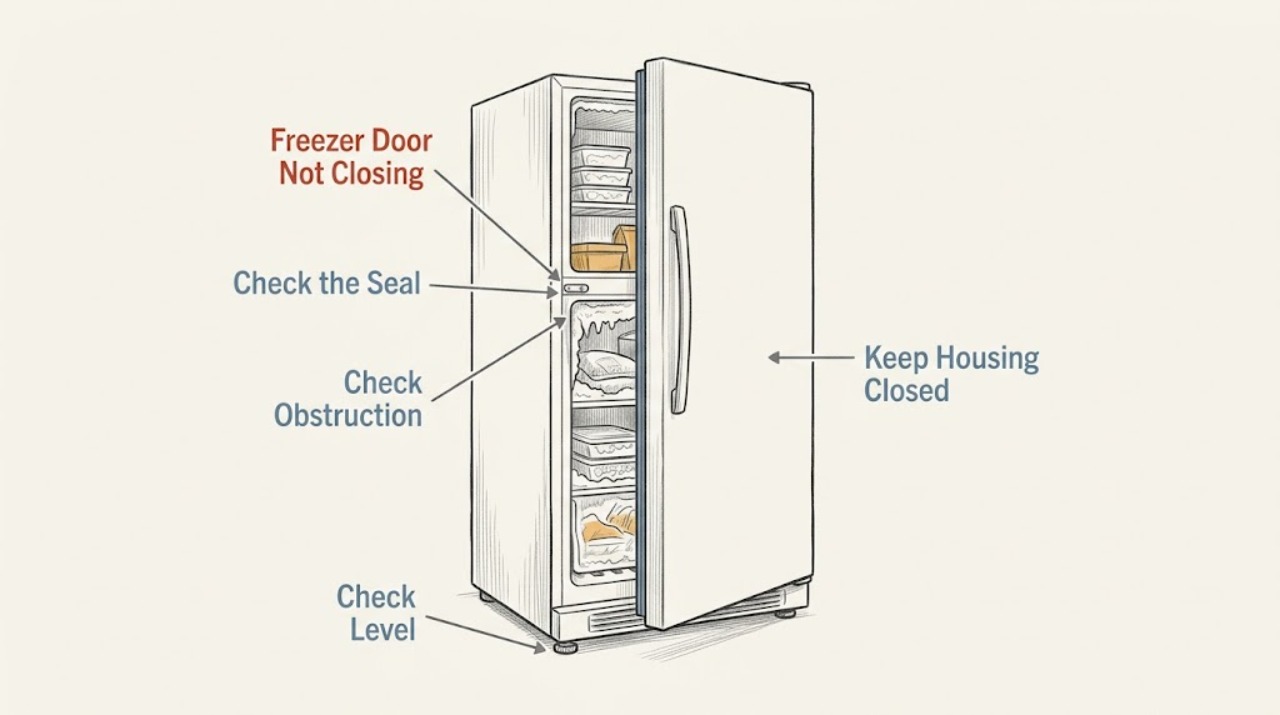
If a Beko freezer door is not closing, first remove only a plainly visible package, shelf, basket, or frost ridge that prevents the door from reaching the cabinet. Then inspect the gasket for a gap, crack, tear, dirt, or a section pulled away from the door, and check from the outside whether the appliance is standing level. Heavy frost can also hold the door open and reduce cooling; use the exact Beko manual for any defrost procedure and never chip ice with a sharp tool. Keep the door closed as much as possible while checking, and arrange qualified appliance service for a damaged gasket or hinge, a door that stays misaligned after a safe obstruction check, water or ice near electrical parts, or a freezer that cannot maintain temperature.
Before you begin
Safety first
- External observation and normal handling only; no forced closure, door or hinge removal, lifting or tipping, sharp-tool defrosting, panel removal, live electrical testing, or component replacement from appearance alone.
Work through in order
Diagnostic checks
Use only checks that match the exact appliance or system and its official guide.
-
Check 1
Open the Beko freezer only as far as needed and inspect the door or lid edge, shelves, baskets, and packages for anything protruding into the closing path. Move only a light, plainly visible item without forcing the door or disturbing frozen food unnecessarily.
Expected result: The door closes after one item is relocated, a shelf or basket is out of position, a frost ridge blocks the edge, or nothing visible obstructs the path.
Next step: Close the door normally once and check the full perimeter for a gap. If the obstruction cannot be moved safely or the door remains misaligned, keep it closed as far as possible and arrange service.
Stop if: Stop for a heavy load, unstable shelf, sharp ice, a door that could fall, or any need to force the door.
Why this matters
Why: A physical obstruction explains the immediate failure to close. If the door still leaves a gap with a clear path, the gasket, level, hinge, or cabinet alignment needs separate evaluation.
-
Check 2
With the door closed normally, inspect the gasket around the entire perimeter from the outside for dirt, a gap against the cabinet, a crack, a tear, or a section pulled away from the door. Wipe only an accessible intact surface with a soft cloth and warm water; do not pry out the gasket.
Expected result: The gasket contacts evenly, has removable surface dirt, has a persistent gap, or is loose, cracked, or torn.
Next step: Clean an intact accessible gasket gently and close the door once to recheck contact. If the gap or damage remains, photograph it and request an authorized or qualified appliance assessment rather than fitting an unverified replacement.
Stop if: Stop if the gasket is sharp, the door is unstable, cleaning would wet electrical parts, or repair requires removing the seal or door.
Why this matters
Why: An intact clean gasket can seal normally, while a persistent gap or damaged gasket allows warm air into the freezer and can cause frost. A visual check cannot confirm hinge or cabinet alignment behind the seal.
-
Check 3
From the front and side, observe whether the Beko freezer rocks, leans, or has an uneven gap that changes when the cabinet is gently touched. Do not tilt or move a loaded appliance; use a level only where it can be placed safely without reaching behind the unit.
Expected result: The appliance is stable and level, visibly leans, rocks on the floor, or cannot be assessed without moving it.
Next step: If it is visibly unstable, unload and level it only according to the model instructions and only when safe; otherwise arrange service. Recheck the door once after a safe correction, and escalate if the gap remains.
Stop if: Stop if leveling needs lifting, sliding, tipping, removing panels, reaching behind the appliance, or working near a strained cord.
Why this matters
Why: Beko notes that an unbalanced appliance can prevent a door from closing correctly. A stable cabinet makes level-related misalignment less likely but does not clear a hinge, gasket, or cabinet fault.
-
Check 4
Inspect the door edge and visible interior walls for frost or ice that prevents the gasket from contacting the cabinet. Identify whether the appliance is marked as no-frost or requires manual defrost, but do not chip, scrape, pierce, or heat the ice.
Expected result: There is no obstructing frost, a light removable frost pattern is visible, heavy ice holds the door open, or the frost pattern is unclear.
Next step: Use the exact Beko manual for a safe defrost procedure if the model requires it. If ice is heavy, recurring, near electrical parts, or the manual is unavailable, keep the door closed as far as possible and request service.
Stop if: Stop for sharp ice, water near controls or wiring, a damaged liner, or any temptation to accelerate defrost with a blade, flame, or heater.
Why this matters
Why: Beko explains that frost can prevent the freezer door from closing and can reduce performance. Heavy or recurring frost can also signal a seal or defrost issue that an external check cannot identify.
-
Check 5
Close the door normally and observe whether the upper and lower corners meet the cabinet evenly, whether the door alarm stops, and whether the gap returns when the handle is released. Do not repeatedly slam, lift, or hang weight on the door.
Expected result: The alarm stops and the seal remains even, the alarm continues or a gap reappears, or one corner sits higher than the other.
Next step: If the gap returns after the safe checks, stop using the door repeatedly and arrange model-specific appliance service. Record which corner separates and whether frost or warming is present.
Stop if: Stop for hinge movement, grinding, a door that may detach, a damaged handle, or any need to remove hardware.
Why this matters
Why: A stable seal supports a simple obstruction or cleaning correction. A returning gap, persistent alarm, or uneven corner points toward alignment, hinge, gasket, or cabinet work rather than a control setting.
-
Check 6
If the door closes but the freezer is warming, record the appliance thermometer reading if available and note whether the door was open, the appliance was recently loaded, or power was interrupted. Keep the door closed while the condition is assessed.
Expected result: The freezer reaches its expected setting after the door issue is corrected, remains warm, shows a high-temperature alarm, or food is beginning to thaw.
Next step: Follow the model manual and current food-safety guidance, limit door openings, and arrange service if the measured temperature remains warm or food is thawing. Do not diagnose a compressor, sensor, or refrigerant fault from the temperature alone.
Stop if: Stop using the appliance for any electrical hazard, leak, burning smell, repeated protective trip, or condition that could contaminate or spoil food.
Why this matters
Why: A door gap can explain warm air and frost, but continued warming after closure indicates a separate cooling or control issue may remain. The exact temperature and timeline are more useful than touch alone.
Use your observations
Decision map
Find the observation that best matches what you see, then follow the next safe action.
-
PATH 01Next step
What you see
A package, basket, shelf, or removable frost ridge visibly prevents the door from reaching the cabinet.
Do this next
Relocate only the light visible obstruction, close the door once, and inspect the perimeter. Use service if the obstruction cannot be removed safely or the gap remains.
Why this path and its safety boundary
Why it matters: The immediate closure problem is an accessible obstruction rather than proof of a failed hinge or gasket.
-
PATH 02Next step
What you see
The gasket has a persistent gap, crack, tear, loose section, or uneven contact after gentle cleaning.
Do this next
Keep the door closed as far as possible, photograph the damage, and request authorized or qualified appliance service. Do not remove the gasket or order by appearance alone.
Why this path and its safety boundary
Why it matters: Warm air can enter and frost can grow; a seal replacement or door adjustment must match the exact model.
-
PATH 03Next step
What you see
The freezer rocks, leans, or has a corner gap that remains with a clear closing path and intact gasket.
Do this next
Do not lift or tip a loaded appliance. Follow the model guide only for a safe level check; arrange service if adjustment would require moving the cabinet or removing hardware.
Why this path and its safety boundary
Why it matters: Level, hinge, or cabinet alignment is more likely than a loose package.
-
PATH 04Next step
What you see
Ice prevents the gasket from contacting the cabinet or holds the door open.
Do this next
Use the exact Beko manual for defrosting. Do not pierce, scrape, or heat the ice; request service when frost is heavy, recurring, near electrical parts, or the procedure is uncertain.
Why this path and its safety boundary
Why it matters: Frost can be the direct obstruction and can also reflect repeated warm-air entry or a model-specific defrost condition.
-
PATH 05Next step
What you see
The door closes evenly after safe checks but the freezer temperature remains high or food begins to thaw.
Do this next
Limit door openings, record the measured temperature and timeline, protect the food, and arrange qualified appliance service if cooling does not recover.
Why this path and its safety boundary
Why it matters: The door problem may have exposed a separate cooling, control, or temperature-recovery issue.
-
PATH 06Next step
What you see
The door, hinge, cord, liner, or nearby electrical area is damaged, wet, hot, sparking, or unsafe to inspect.
Do this next
Stop using the appliance when safe, keep people away from the hazard, and request prompt qualified appliance service. Do not force the door or open panels.
Why this path and its safety boundary
Why it matters: The condition exceeds safe external troubleshooting and may involve injury, electrical, or refrigerant risk.
Helpful context
Understand the symptom
A door problem is often an alignment problem
A freezer door can remain open because a stored item, basket, shelf, frost ridge, or gasket is in the way. It can also sit out of alignment when the appliance or floor is not level. A door that appears closed but leaves a gap has the same consequence: warm, humid air can enter, frost can grow, and the freezer may run longer without holding its target temperature. Find the physical reason before considering any replacement part.
Check from the outside first
Keep fingers clear of hinges and do not force the door against ice or a hard obstruction. Do not remove hinge covers, loosen hardware, drill, heat the freezer, or use a knife or other sharp object on frost. If a defrost is needed, follow the exact manual for the model and keep water away from electrical components.
What each finding means
A visible package or frost ridge is a user-accessible obstruction. A dirty but intact gasket may be cleaned gently. A torn gasket, bent hinge, cabinet movement, or persistent gap is a fit or hardware problem that needs model-specific service. If the door closes but the freezer is still warm, move to a temperature and frost investigation rather than assuming the door was the only cause.
Record the exact model before ordering anything
Photograph the door gap, gasket, hinge side, obstruction, frost pattern, and appliance position. Record the model and serial information from the product label and whether the door alarm changes when the door is pressed closed. Beko's support material directs users to the model manual for exact instructions, so do not assume a seal or hinge from another model will fit.
Safety boundary
Stop conditions
- The door or hinge is unstable, damaged, or could detach, or the handle would need force.
- There is water near an outlet or control, a hot or damaged cord, smoke, burning smell, sparks, or repeated power trips.
- Heavy or sharp ice blocks the door, the liner is damaged, or defrosting would require a blade, flame, heater, or piercing.
- The freezer cannot maintain temperature, food is thawing, or the open-door alarm persists after the door appears closed.
- Inspection or adjustment would require lifting, tipping, sliding a loaded appliance, removing hardware, opening panels, or live testing.
When checks do not resolve it
Need a professional?
Call a qualified appliance professional when an accessible obstruction or gentle gasket cleaning does not restore a continuous seal, or immediately for hinge damage, persistent frost, food warming, electrical hazards, or suspected cooling-system faults.
Safety scope: External observation and normal handling only; no forced closure, door or hinge removal, lifting or tipping, sharp-tool defrosting, panel removal, live electrical testing, or component replacement from appearance alone.
Common questions
FAQ
Why will my Beko freezer door not close?
Check for a package, shelf, basket, frost ridge, uneven appliance, or gasket gap. Beko treats these as different possibilities. Remove only a plainly visible obstruction, inspect the seal, and use the model manual for any defrost or leveling procedure.
Can frost stop a Beko freezer door from closing?
Yes. Beko states that ice in the freezer compartment can prevent the door from closing. Do not chip or pierce it; follow the exact model manual for defrosting and request service for heavy, recurring, or electrically unsafe frost.
How do I check whether the freezer gasket is the problem?
Look around the closed door for a continuous contact pattern, gaps, cracks, tears, dirt, or a section pulled away. Clean only an intact accessible surface gently with a soft cloth and warm water. A persistent gap or damaged gasket needs model-specific service.
Should I adjust or replace the Beko freezer door myself?
Do not remove the door or hinge or move a loaded freezer to correct alignment. Check the model manual for a safe level observation, document the gap and model information, and use qualified service for hardware, cabinet, or gasket work.
Read the exact guide
Official sources
- How to fix a freezer that's not freezingBeko · Official Beko freezer guidance used for the cooling impact of an open door and frost; it does not identify a failed component.
- Help Center ResultBeko · Brand-level Beko freezer support; exact ambient, alarm, and manual-defrost behavior depends on the model.
- How to fix a freezer that is not cold enoughBeko · Official Beko freezer troubleshooting guidance used for the temperature consequences of a door that does not seal; model-specific defrost instructions remain controlling.
- How to fix a refrigerator door that won't shutBeko · Official Beko daily-use guidance that explicitly discusses ice in the freezer compartment; exact door and hinge details vary by model.
Community feedback
Share a repair observation
Share a plain-text repair observation. Accepted observations are published automatically; this page may take a moment to update.