
On this page
Start here
Quick answer
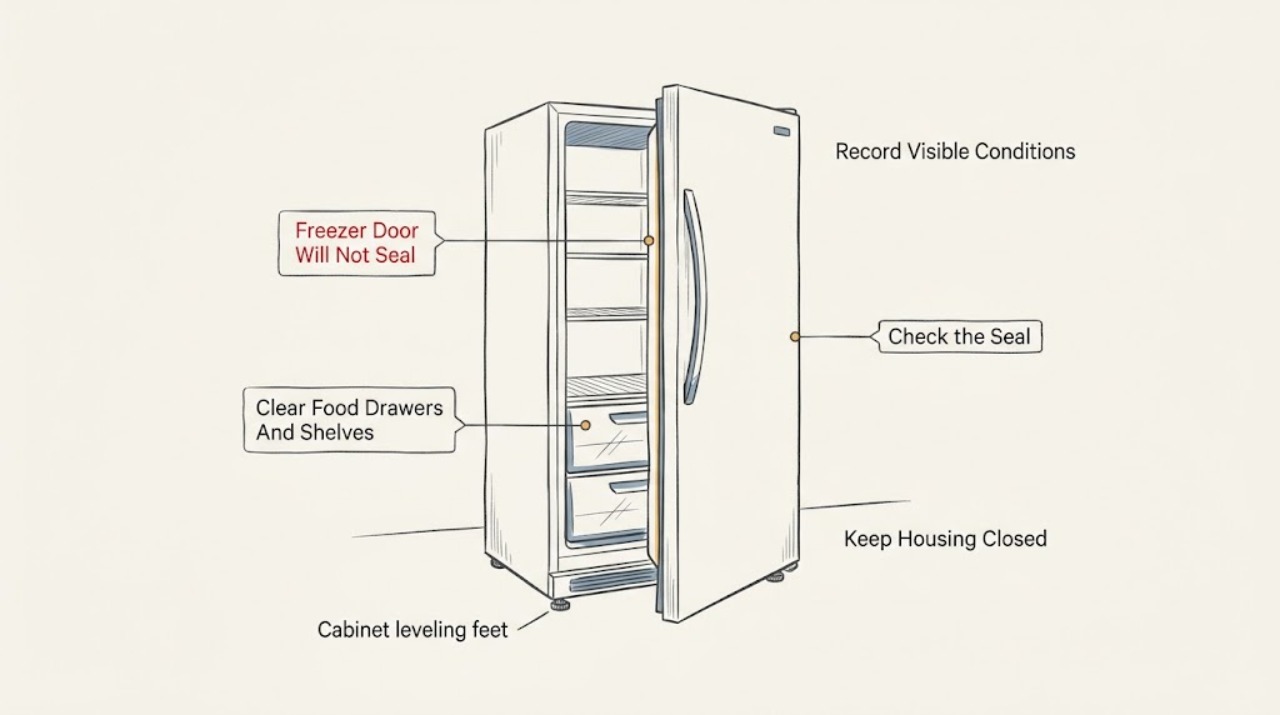
An LG freezer door that will not seal is commonly blocked by a food package or drawer, affected by a misplaced shelf, dirty or loose gasket, door misalignment, or an unlevel cabinet. Start by removing anything that protrudes into the door path, confirming drawers and shelves are seated, and cleaning the gasket with a warm damp cloth before drying it. Press a loose gasket back into its groove only if it is visibly detached and the model instructions permit it. Check the door and cabinet alignment from a safe position, but leave hinge adjustment, a torn gasket, a bent door, and internal repairs to qualified service. A persistent gap lets warm moist air in, causing frost and longer compressor operation; arrange service if the seal remains open, the freezer warms, or the door or gasket is damaged.
Before you begin
Safety first
- Do not remove doors or hinges, pry the gasket, scrape ice with sharp tools, puncture the liner, apply uncontrolled heat, open sealed-system or electrical covers, or select a gasket or hinge without model-specific confirmation.
Work through in order
Diagnostic checks
Use only checks that match the exact appliance or system and its official guide.
-
Check 1
From the front, close the LG freezer door gently and observe the gap around all four sides, the door-alarm or temperature display if present, frost near the opening, and whether the door springs back open. Record the exact model and whether this is a standalone freezer, bottom freezer drawer, or top-freezer compartment.
Expected result: The gap is at one corner, the whole gasket stands away, the door is held open by frost, the alarm continues, the door rubs a drawer, or the freezer is warming.
Next step: Keep the door closed while performing the low-risk obstruction and gasket checks, and move food to another frozen location if temperature is rising. Arrange service for a persistent alarm, warming freezer, or door that cannot close without force.
Stop if: Do not force the door, chip ice with a sharp object, or continue opening it repeatedly when frozen food is at risk.
Why this matters
Why: A localized gap favors an obstruction, gasket seating, alignment, or leveling issue; frost, an alarm, or rising temperature adds a food-preservation and cooling concern. The appliance style determines which LG instructions apply.
-
Check 2
With the door open briefly, remove packages that protrude beyond the shelf or drawer edge and check that bins, shelves, baskets, and freezer drawers are fully seated in their tracks. Look for a reversed drawer, a container caught at the hinge side, or a bag trapped in the gasket path.
Expected result: The door closes and the gasket contacts the cabinet after an item is moved, a drawer or shelf was out of position, or the door still stops before the gasket contacts.
Next step: Leave food below the door and drawer edges and reinstall interior parts according to the LG model manual. If the door still cannot close freely, continue with gasket inspection and arrange service if alignment or hardware appears damaged.
Stop if: Do not overload the door, force a drawer against ice, or bend shelves, rails, or door parts.
Why this matters
Why: Improvement after rearranging or reseating an interior part confirms an obstruction or assembly problem rather than a failed gasket. Continued interference points to an alignment, damaged interior part, or door problem.
-
Check 3
Inspect the entire LG freezer gasket for food residue, hardened debris, folds, cracks, gaps, or a section pulled out of its groove. Clean accessible residue with a warm damp cloth and mild detergent as the model instructions permit, dry the gasket and cabinet contact surface, and press only a visibly loose section back into its groove without stretching it.
Expected result: The gasket is dirty but intact, a loose section reseats and contacts the cabinet, the magnet does not hold one area, or the gasket is torn, hardened, deformed, or still leaves a gap.
Next step: Close the door gently and recheck the contact after cleaning. Arrange LG or qualified appliance service for a damaged gasket, a section that will not stay in its groove, or a continuing gap.
Stop if: Do not use solvents, abrasive tools, excessive heat, adhesive, or a stretched gasket to force a seal.
Why this matters
Why: Debris can weaken gasket adhesion, and a loose section can prevent a seal. A torn, deformed, or non-magnetic gasket is a replacement diagnosis, not a cleaning issue.
-
Check 4
From a safe position, compare the freezer door edges with the cabinet, look for sag or rubbing, and check whether the LG appliance rocks or sits visibly out of level. Do not remove the door or use tools on hinges or leveling hardware unless the exact model manual and your skill level make that adjustment appropriate.
Expected result: The door sits low on one side, the cabinet rocks, the gap changes when the appliance is leveled, or the door and cabinet appear aligned but the seal still fails.
Next step: Keep the appliance stable and arrange qualified service for hinge, door, cabinet, or leveling correction when the simple checks do not restore contact. Do not assume a generic adjustment direction applies to every LG model.
Stop if: Do not tip the appliance, lift the door, remove hinge hardware, or operate with an unstable cabinet.
Why this matters
Why: LG notes that installation and leveling affect gasket contact. A sagging door, damaged hinge, or persistent alignment error can require adjustment or part replacement beyond a homeowner seal check.
-
Check 5
After the door path and gasket are clear, inspect for frost or ice that prevents the gasket from contacting the cabinet and note whether the compressor runs unusually long, the freezer alarm sounds, or food is softening. Follow only the exact LG model's defrost instructions; do not scrape near hidden cooling parts.
Expected result: Frost is localized at the gap, frost quickly returns after a clear seal, the freezer temperature recovers normally, or cooling remains weak despite a closed door.
Next step: Protect food and arrange appliance service when frost blocks the seal, returns quickly, the freezer does not recover, or an alarm persists. Do not disassemble the evaporator area or choose a defrost component from the symptom alone.
Stop if: Do not chip ice with a knife, apply uncontrolled heat, puncture the liner, or keep operating if water reaches electrical parts or food is no longer safely frozen.
Why this matters
Why: Frost at a door gap supports warm-air entry from a poor seal. Rapid frost return or weak cooling after the door closes may indicate a defrost, fan, sensor, or sealed-system problem rather than a door-only issue.
-
Check 6
Document the model, door style, gap location, obstruction found, gasket condition, drawer or shelf position, cabinet level, frost pattern, alarm or temperature behavior, and which safe correction changed the seal. Recheck the closed door without pulling hard on it.
Expected result: The gasket contacts evenly and stays closed, only one load arrangement caused the gap, the gap remains, or the freezer warms or runs continuously.
Next step: Continue normal use only when the door seals evenly and temperature is stable. Otherwise arrange qualified LG appliance service and provide the observations and photos; do not order a part from the gap alone.
Stop if: Stop using the appliance if the door cannot seal, food is warming rapidly, there is exposed wiring, burning odor, refrigerant damage, or water near electrical components.
Why this matters
Why: A stable seal after removing an obstruction supports a simple loading or assembly cause. A remaining gap or cooling symptom favors gasket, hinge, alignment, defrost, or sealed-system diagnosis.
Use your observations
Decision map
Find the observation that best matches what you see, then follow the next safe action.
-
PATH 01Next step
What you see
The door seals evenly after a package, drawer, shelf, bin, bag, or other obstruction is removed or reseated.
Do this next
Keep packages below the door path, confirm drawers and shelves remain correctly seated, and monitor for frost or a returning gap.
Why this path and its safety boundary
Why it matters: The failed seal was most likely caused by loading or interior assembly, not a replacement gasket.
-
PATH 02Next step
What you see
The gasket has residue or a section out of its groove, and cleaning or gentle reseating restores contact around the door.
Do this next
Dry the gasket and cabinet contact surface, close the door gently, and arrange service if the section loosens again or any damage is visible.
Why this path and its safety boundary
Why it matters: Poor adhesion or gasket seating was likely preventing the magnetic seal from closing the gap.
-
PATH 03Next step
What you see
The gasket is cracked, hardened, deformed, or detached; the door sags or rubs; or the appliance is visibly unlevel and the gap remains after clearing the door path.
Do this next
Keep the freezer closed as much as possible and arrange qualified LG appliance service for model-specific adjustment or replacement diagnosis.
Why this path and its safety boundary
Why it matters: A gasket, hinge, door, drawer, or leveling problem is more likely than a surface-cleaning issue.
-
PATH 04Next step
What you see
Frost blocks the contact area, frost returns quickly after the gasket seals, the door alarm persists, or the freezer remains warm or runs unusually long.
Do this next
Protect frozen food and arrange appliance service; use only the exact LG model's defrost instructions and do not remove internal covers.
Why this path and its safety boundary
Why it matters: Warm-air entry may have caused the frost, but a recurring frost or cooling symptom can indicate a defrost, fan, sensor, or sealed-system fault.
-
PATH 05Next step
What you see
Water reaches the outlet or wiring, the cord is damaged, there is a burning odor or smoke, refrigerant tubing is punctured, or the cabinet is unstable.
Do this next
Keep clear, disconnect power only if it can be done without touching wet electrical equipment, protect the food, and contact qualified appliance service; use local emergency guidance for immediate danger.
Why this path and its safety boundary
Why it matters: This is an electrical, fire, refrigerant, or injury boundary, not a door-seal adjustment.
Helpful context
Understand the symptom
A freezer door can look closed while a small gap remains at one corner. The useful distinction is whether something blocks the door, the gasket cannot adhere, the door or cabinet is out of alignment, or the freezer is building frost that prevents closure. LG's guides are written across refrigerator families, so use the exact model manual for drawer layout and alignment details.
A poor seal allows warm air into the freezer, which can create frost and make the appliance run longer. Keep the door closed as much as possible while checking it, protect frozen food if the compartment is warming, and do not force a frozen or misaligned door.
Only after diagnosis
Potential parts
- LG freezer door gasket
Consider this category only if the gasket remains cracked, hardened, deformed, detached, or unable to seal after the door path and contact surface are clean and a qualified diagnosis confirms replacement.
Gasket profile, attachment, and door style vary by exact LG model; confirm model-specific fit before ordering. - LG freezer hinge or door-alignment hardware
Consider this category only if service inspection confirms a sagging, rubbing, or misaligned door is caused by hinge or alignment hardware rather than loading or leveling.
Confirm the exact model, door configuration, hardware position, and professional fitment before selecting a component. - LG freezer drawer rail or defrost-system component
Consider this category only when a qualified diagnosis finds a damaged drawer rail that blocks closure or a defrost component causing recurring frost after the gasket seals.
Rails, heaters, sensors, and controls are model-specific; do not choose a part from a door gap or frost symptom alone.
When checks do not resolve it
Need a professional?
Arrange qualified LG appliance service when the freezer door still will not seal after clearing obstructions and cleaning or gently reseating an intact gasket, when the gasket is damaged, the door sags or rubs, the cabinet is unstable, frost returns quickly, an alarm persists, or the freezer warms or runs unusually long. Stop for smoke, burning odor, damaged wiring, water near electrical parts, refrigerant damage, or a rapidly warming freezer.
Safety scope: Do not remove doors or hinges, pry the gasket, scrape ice with sharp tools, puncture the liner, apply uncontrolled heat, open sealed-system or electrical covers, or select a gasket or hinge without model-specific confirmation.
Have this ready
- Provide the exact LG model, door or drawer style, gap location, photos of the gasket and frost, obstruction and assembly checks, level or alignment observations, alarm or temperature behavior, and the result of each safe correction.
Common questions
FAQ
Why will my LG freezer door not seal?
Check for protruding food, a misplaced shelf or drawer, debris on the gasket, a loose gasket section, frost at the contact area, door misalignment, or an unlevel cabinet. Clear and clean the accessible areas first; a damaged gasket or persistent gap needs qualified service.
Can I press an LG freezer gasket back into place?
If a section is visibly loose but intact, LG says to press it back into the door groove. Do not stretch, glue, heat excessively, or force a gasket that is cracked or deformed; arrange service for a damaged seal.
Can a freezer drawer stop an LG door from sealing?
Yes. Packages, shelves, bins, and a drawer that is reversed or not fully seated can stop the door before the gasket contacts the cabinet. Rearrange food and reinstall interior parts according to the exact model manual.
Why is frost forming around my LG freezer door?
A small door gap lets warm moist air enter and can create frost around the opening. If the gasket is clean and the door closes evenly but frost returns quickly, a defrost or cooling issue may also be involved and needs service.
When should I call for LG freezer door service?
Arrange service when the door still will not seal after clearing obstructions and cleaning an intact gasket, when the gasket is damaged, the door sags, frost returns, an alarm persists, or the freezer warms or runs continuously. Stop for smoke, burning odor, damaged wiring, water near electrical parts, refrigerant damage, or rapid warming.
Read the exact guide
Official sources
- LG Refrigerator - How to Fix a French Door That Won’t Close or Open ProperlyLG USA Support · LG freezer-door closure, drawer and shelf placement, gasket condition, alignment, leveling, and service guidance
- Care and MaintenanceLG · LG refrigerator/freezer door gasket, warm-air entry, frost, and longer-running compressor troubleshooting
- [LG Refrigerator] Refrigerator Door Seal IssuesLG USA Support · LG door-seal debris, loose gasket, food clearance, shelf placement, and appliance positioning
- LG Refrigerator - Troubleshooting a Refrigerator Door Not Closing ProperlyLG USA Support · LG refrigerator and freezer door closure, food or shelf obstruction, gasket cleaning, gasket seating, and leveling guidance
Community feedback
Share a repair observation
Share a plain-text repair observation. Accepted observations are published automatically; this page may take a moment to update.