
On this page
Start here
Quick answer
A Frigidaire freezer door that will not seal is usually being held open by an item, dirty or distorted gasket, frost at the frame, a sagging or misaligned door, or a cabinet that is not level. First remove only obvious closure obstructions, clean and inspect the gasket, and use a paper or bill test around the full perimeter. Check the exact manual before adjusting feet, hinges, or a chest lid; do not force the door, stretch the gasket, or remove hinge hardware as a guess. A gap that remains after a clean, unobstructed closure, a warped door or cabinet, repeated frost, a door-ajar alarm, or food warming needs qualified appliance service. Keep the freezer closed as much as possible while diagnosing, because warm humid air can cause frost and unstable temperature.
Before you begin
Safety first
- This article covers ordinary-access inspection, cleaning, closure-obstruction removal, perimeter seal observation, and only model-documented user adjustments. A technician must handle hinge or slider alignment, hidden frost, defrost parts, electrical testing, panel removal, cabinet repair, and cooling-system work.
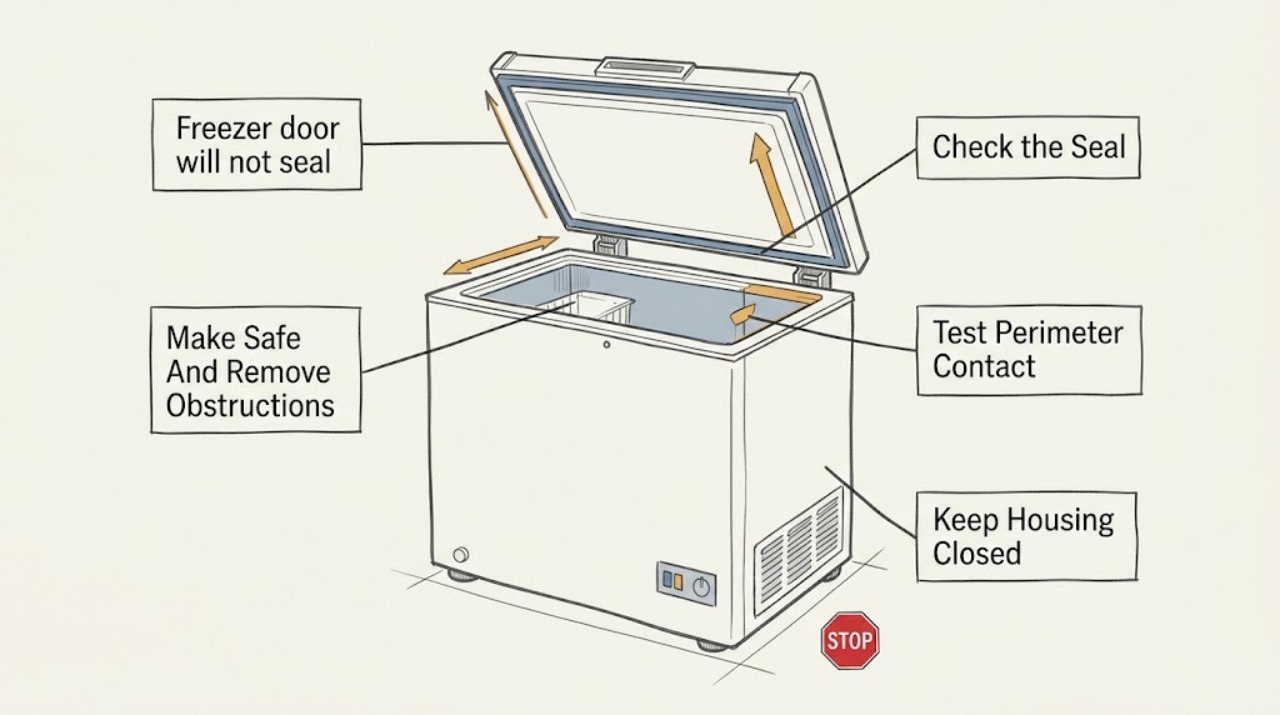
Work through in order
Diagnostic checks
Use only checks that match the exact appliance or system and its official guide.
-
Check 1
Keep the door or lid closed while collecting the exact model number. Open it once and inspect the front edge, baskets, shelves, packages, ice, and any shipping material for something that protrudes into the closing path; remove only a loose obstruction that does not require force.
Expected result: The door closes fully after an item, basket, shelf, frost ridge, or packing piece is moved, or a gap remains even with a clear closing path.
Next step: Close the door gently and check the seal around all sides. If it still springs open or leaves a gap, continue with the gasket and alignment checks.
Stop if: Do not force the door or lid, push a heavy package against the seal, pull out a stuck basket, or move a loaded freezer alone.
Why this matters
Why: A closure obstruction can mimic a failed gasket. A remaining gap moves attention to the gasket, alignment, level, hinge, or cabinet rather than more rearranging.
-
Check 2
With the door open, wipe the gasket and the matching cabinet surface with warm soapy water and dry them. Inspect the full seal for dirt, a twist, tear, flattened section, hard spot, pulled corner, or frost that prevents contact.
Expected result: The gasket is dirty but flexible and contacts the frame, or it has a visible tear, permanent distortion, corner gap, or frost ridge.
Next step: Close the clean door and repeat a perimeter seal test. If the gasket remains damaged or distorted, record the model and arrange a model-matched replacement or service assessment.
Stop if: Do not cut, glue, stretch, heat, pry, or substitute the gasket, and do not use solvents or abrasive cleaners on the seal.
Why this matters
Why: Frigidaire says a dirty or badly fitting gasket can create an air leak, while frost or a warped seal can prevent a proper closure. Cleaning may restore contact only when the seal itself is intact.
-
Check 3
Place a sheet of paper or a bill between the gasket and cabinet at several points, close the door normally, and pull gently. Repeat around the top, hinge side, latch side, and bottom without lifting or twisting the door.
Expected result: There is similar resistance around the perimeter, or the paper slides out easily at one corner or along a section while the rest grips.
Next step: Mark the weak location, photograph the gap, and compare it with frost or condensation. If the weak area remains after cleaning and removing obstructions, request service rather than forcing a gasket adjustment.
Stop if: Do not pull hard enough to deform the gasket, clamp the door, or use the paper test as a reason to loosen hinges or remove panels.
Why this matters
Why: Frigidaire uses this test to identify weak gasket contact. A localized loose section suggests a gasket or alignment issue; even resistance does not rule out a door that is warped, blocked, or not closing square.
-
Check 4
Inspect the door frame, liner, accessible vents, and nearby food placement for frost or an item blocking air movement or the closing path. Compare the frost location with the paper-test gap and keep the door open only for this brief inspection.
Expected result: Frost is concentrated beside a weak seal or blocks the frame, vents are covered, the freezer is overfilled at the door, or there is little frost but the door still will not contact.
Next step: Remove only loose items or surface frost that the exact manual permits. If frost is thick, returns quickly, or lies behind a cover, arrange service for the defrost and door system.
Stop if: Do not chip frost, remove an evaporator cover, block or bend vents, or use heat near plastic, wiring, the liner, or the gasket.
Why this matters
Why: Frigidaire links a non-sealing door with unstable temperature and says frost can prevent proper closure or reduce airflow. A clear frame with a persistent gap makes alignment, level, hinge, or cabinet shape more likely.
-
Check 5
From a stable position, observe whether the cabinet rocks, the door sits lower on one side, a chest lid wraps at one corner, or a gap changes as the door moves. Consult the exact manual before touching leveling feet or any alignment control.
Expected result: The cabinet is unstable or tilted, the door or drawer sags, the gap is localized near a hinge or corner, or the unit appears level and square but the seal still fails.
Next step: If the manual gives a user-leveling step, make only the documented small adjustment with the freezer unloaded as needed, then retest closure. Otherwise provide the gap location and model number to a technician.
Stop if: Do not loosen hinge fasteners, lift the door, tilt a loaded appliance, pry the cabinet, or make a leveling adjustment that could destabilize the freezer.
Why this matters
Why: Level, hinge, slider, or lid-shape problems can prevent a good gasket contact. A square cabinet and persistent gap make a damaged gasket, door, or cabinet more likely; sound appearance alone does not prove alignment.
-
Check 6
After one clean, unobstructed closure, monitor the freezer without repeated openings. Note whether the door stays shut, the seal remains in contact, frost or moisture returns at one edge, a door-ajar alarm remains active, or the freezer temperature becomes unstable.
Expected result: The door stays shut and the freezer remains cold, or the door opens or gaps again, frost returns, an alarm persists, or food is warming.
Next step: Keep the door closed and arrange qualified service for recurrence, warming, persistent alarm, or any gap that remains after the safe checks. Preserve the model number and photos of the weak section.
Stop if: Stop using the freezer if food is warming, the door cannot remain shut, water reaches electrical parts, or a damaged liner, cord, or gasket creates another hazard.
Why this matters
Why: Stable closure and temperature support a surface obstruction or dirty-gasket cause. Recurrence indicates unresolved seal, alignment, cabinet, frost, airflow, or control trouble and should not be covered by repeated cleaning.
Use your observations
Decision map
Find the observation that best matches what you see, then follow the next safe action.
-
PATH 01Safety boundary
What you see
The gap disappears after a package, basket, packing piece, frost ridge, dirt, or loose item is removed and the clean gasket grips around the perimeter.
Do this next
Keep the load below the closing path, keep the gasket and frame clean, and monitor the next normal cooling period for frost or temperature change.
Why this path and its safety boundary
Why it matters: A closure obstruction or dirty sealing surface is more likely than a failed door assembly.
Safety stop: Stop if the gap returns, the gasket tears, or the freezer cannot hold cold despite a clear closing path.
-
PATH 02Safety boundary
What you see
The paper test is loose at one or more points after cleaning, or the gasket is torn, flattened, twisted, pulled away, or permanently distorted.
Do this next
Arrange service or obtain the exact model's documented gasket procedure; provide the model, gap location, photos, and frost pattern before ordering a part.
Why this path and its safety boundary
Why it matters: The gasket is not making a reliable air seal. A model-matched seal may be needed, but a hinge or cabinet problem can also cause a new gasket to fail.
Safety stop: Do not stretch, glue, heat, cut, or install a generic gasket as a test.
-
PATH 03Safety boundary
What you see
Frost blocks the frame or vents, frost returns quickly near the door, food blocks air paths, or the freezer is warming while the door appears nearly closed.
Do this next
Follow only the exact manual's defrost or load guidance and arrange service for thick, hidden, or recurring frost, poor cooling, or a door that still cannot close.
Why this path and its safety boundary
Why it matters: Warm-air entry, poor closure, blocked airflow, or a defrost problem is more likely than a simple surface-cleaning issue. Frost itself may keep the door from sealing.
Safety stop: Do not chip ice, heat the liner, remove an evaporator cover, or keep operating while food is thawing.
-
PATH 04Safety boundary
What you see
The closing path is clear and the gasket is clean, but the door sags, the cabinet rocks, the gap is concentrated at a hinge or corner, or a chest lid does not conform at one corner.
Do this next
Use only model-documented leveling guidance or arrange appliance service for alignment and cabinet inspection. Do not make an unsupported hinge adjustment.
Why this path and its safety boundary
Why it matters: Leveling, hinge, slider, door shape, or cabinet alignment is more likely. This can make an otherwise good gasket appear defective.
Safety stop: Do not lift the door, loosen hinges, pry the cabinet, tilt a loaded freezer, or operate with a visibly unstable appliance.
-
PATH 05Safety boundary
What you see
The door remains open or unsealed after safe checks, a door-ajar alarm persists, frost or condensation continues, the freezer runs excessively, or food is warming.
Do this next
Keep the door closed, protect food according to its condition, stop further disassembly, and arrange qualified appliance service with the model and observations.
Why this path and its safety boundary
Why it matters: The appliance has an unresolved seal, alignment, frost, airflow, control, or cooling issue. Repeatedly pressing the door closed can worsen damage and does not restore a reliable seal.
Safety stop: Stop use for a loose or damaged door, water near wiring, damaged cord, burning odor, smoke, or any unstable cabinet.
Helpful context
Understand the symptom
Find the gap before replacing the gasket
A door may look closed while one corner is held away from the cabinet. Frigidaire recommends checking the seal around the entire perimeter with a paper or bill and cleaning the gasket with warm soapy water. A package, basket, shelf, frost ridge, or shipping material can create the same gap. The exact freezer type matters: an upright door, a chest lid, and a bottom drawer do not use the same alignment or adjustment method.
Treat frost as both a symptom and a possible obstruction
Warm room air entering through a weak seal can create frost at the door opening, and that frost can then prevent the door from closing. Frigidaire also notes that blocked vents or poor placement can worsen frost. Remove only loose items or surface frost allowed by the manual; do not chip ice with a sharp tool or heat a gasket or liner. If frost is thick or returns quickly, the cause may be more than the door surface.
Alignment and cabinet level are model-specific work
A hinge, slider, leveling foot, or chest-lid shape can affect where the gasket meets the frame. Frigidaire's support material gives different guidance for a flexible chest lid and for freezer doors, while other adjustments depend on the model. Observe the gap and provide the model number to service rather than loosening hinges or forcing the cabinet into alignment.
Safety boundary
Stop conditions
- Stop for a loose or damaged door, unstable cabinet, damaged cord, smoke, burning odor, water near wiring, persistent alarm, or food warming beyond safe storage.
- Do not force the door or lid, lift a door, tilt a loaded freezer, pry the cabinet, or loosen hinge or slider hardware as a test.
- Do not cut, glue, stretch, heat, or scrape the gasket, and do not install a generic seal before the exact model and cause are confirmed.
- Do not chip frost with a knife, ice pick, screwdriver, or other sharp tool; do not use a heat gun, flame, or electrical device near a wet freezer.
- Do not remove an evaporator cover, bypass a door switch or control, test live wiring, or work on a defrost or sealed cooling component.
- Stop after the safe obstruction, cleaning, seal, frost, and alignment checks when the door still will not seal or the freezer is warming; arrange qualified appliance service.
Only after diagnosis
Potential parts
- freezer door or lid gasket
Consider this category only when the exact model's gasket is torn, permanently distorted, or fails the perimeter contact test after cleaning and closure obstructions are removed.
Confirm the exact Frigidaire model, freezer type, seal profile, mounting method, and manufacturer's fit information before ordering. - door hinge or slider hardware
Consider this category only when service confirms sag, binding, damaged hinge or slider hardware, or alignment movement as the cause of the seal gap.
Confirm the exact model, door or drawer design, hardware position, and manufacturer's fit information; do not replace hardware based on a visual match alone. - door alignment or leveling component
Consider this category only if model-specific inspection confirms a damaged leveling foot, adjustment component, or cabinet support that prevents the door or lid from seating.
Confirm the exact model, load support, adjustment range, and manufacturer's fit information; do not destabilize the appliance to test a part.
When checks do not resolve it
Need a professional?
Arrange qualified appliance service when a clean and unobstructed Frigidaire freezer door still leaves a paper-test gap, the gasket is torn or permanently distorted, the door sags, the cabinet is unstable, the lid or drawer needs hinge or slider adjustment, frost returns quickly, a door-ajar alarm persists, or the freezer is warming or running excessively. Use the exact model manual for any documented user adjustment; hidden frost, defrost faults, wiring, panel removal, and cabinet or cooling-system work require a technician.
Safety scope: This article covers ordinary-access inspection, cleaning, closure-obstruction removal, perimeter seal observation, and only model-documented user adjustments. A technician must handle hinge or slider alignment, hidden frost, defrost parts, electrical testing, panel removal, cabinet repair, and cooling-system work.
Common questions
FAQ
How can I tell whether my Frigidaire freezer gasket is sealing?
Place paper or a bill at several points between the clean gasket and cabinet, close the door normally, and pull gently. Frigidaire says you should feel resistance. A loose section after cleaning points to a gasket or alignment problem; an even test does not excuse a door that still springs open or leaves a visible gap.
Why does frost form around my Frigidaire freezer door?
A warped or dirty gasket, a door that is slightly open, frost at the frame, blocked airflow, or an item preventing closure can let warm humid air enter. Frigidaire says that air exchange forms frost and recommends checking closure, the gasket, and vents. Thick or recurring frost needs service rather than sharp-tool removal.
Should I heat a Frigidaire gasket to reshape it?
Do not heat, stretch, glue, cut, or pry the gasket. Clean it with the method in the support guidance and check the exact manual. If it remains distorted or the gap is localized, arrange a model-specific gasket and alignment assessment.
Can an overloaded Frigidaire freezer keep the door from sealing?
Yes. A package, basket, shelf, ice ridge, or packing piece can hold the door or lid away from the frame. Remove only a loose obstruction, then repeat the perimeter seal check. Do not force the door or move a loaded appliance to reach the rear.
When should I replace a Frigidaire freezer door gasket?
Replace it only after the exact model and cause are confirmed. A torn or permanently distorted gasket that fails the perimeter test can justify replacement, but a sagging door, unlevel cabinet, frost, or damaged hinge can make a new gasket fail too.
Read the exact guide
Official sources
- Refrigerators / Freezer - Frost Build UpFrigidaire · Direct Frigidaire frost guidance used to explain why frost can interfere with a freezer door seal.
- Door is Not Sealing - Forming Frost - Upright FreezerWhirlpool · Official freezer manufacturer reference for general seal-check logic; the exact Frigidaire model manual controls.
- Refrigerator Door IssuesFrigidaire · Direct Frigidaire closure guidance applied to the freezer-door symptom where the same door and gasket checks are visible.
- Freezer Runs Too MuchFrigidaire · Used to explain why an unsealed door can create secondary runtime and temperature symptoms.
- What can I do if the lid on my freezer won’t close?Frigidaire · Direct Frigidaire guidance for chest-lid corner fit; not a universal instruction for upright doors or drawers.
- Customer CareFrigidaire · Official Frigidaire support index used to direct model-specific manual and service follow-up.
- Freezer - Not Freezing or Not CoolingFrigidaire · Direct Frigidaire support guidance for freezer door sealing and its effect on temperature; exact model instructions control.
Community feedback
Share a repair observation
Share a plain-text repair observation. Accepted observations are published automatically; this page may take a moment to update.