
On this page
Start here
Quick answer
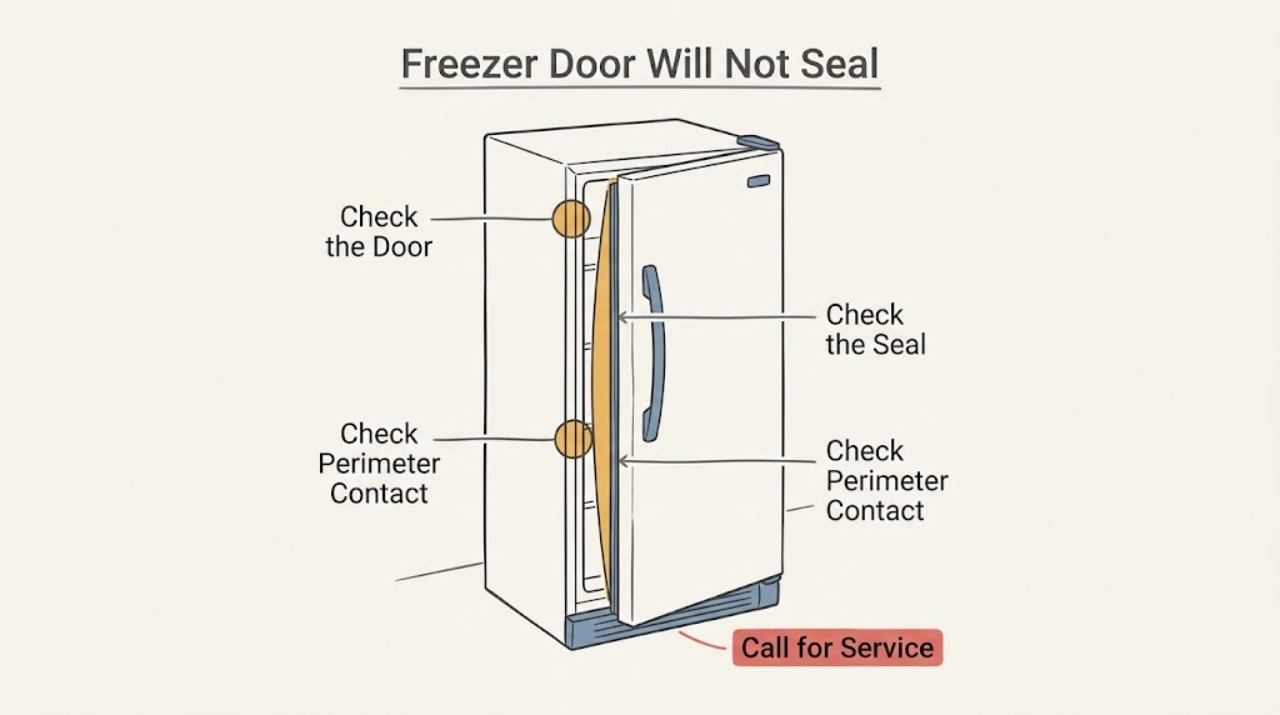
A Haier freezer door that will not seal is usually being held open by a package, a dirty or distorted gasket, frost, or a door and cabinet alignment problem. Empty the door edge of anything that interferes, inspect the full gasket perimeter, and clean the gasket with a soft cloth and mild baking-soda solution; do not use abrasive or harsh chemicals. With the door closed, a thin sheet of paper should be held consistently around the perimeter, while a repeated gap or a paper slip at one area points to a gasket, door, hinge, or alignment problem. Haier notes that gaskets can be slightly misaligned after a door reversal and that leveling affects whether a freezer door stays open. Do not pry away ice, heat the liner, bend the door, remove the gasket, adjust a hinge, or work near wiring without model-specific instructions. If the gasket is torn, the gap remains after cleaning and clearing obstructions, frost returns, the door is visibly sagging, or food is warming, keep the door closed and arrange qualified Haier appliance service; stop immediately for a damaged cord, burning smell, smoke, or water near electrical parts.
Before you begin
Safety first
- This article supports only clearing loose obstructions, gentle exterior gasket cleaning, visual inspection, a paper contact check and recording symptoms. Door or hinge adjustment, gasket removal or replacement, electrical diagnosis, defrost-system access and sealed refrigeration-system work require model-specific instructions or a qualified technician.
Work through in order
Diagnostic checks
Use only checks that match the exact appliance or system and its official guide.
-
Check 1
Open the freezer briefly and inspect the door shelves, baskets, packages, ice buildup and cabinet lip for anything protruding into the gasket path. Reposition only ordinary loose items so the door can close without force; do not bend the door or remove fixed parts.
Expected result: A package, basket, shelf, ice ridge or food item touches the gasket or cabinet, or nothing visible interferes.
Next step: Close the door normally and recheck the perimeter after clearing the obstruction. If the same gap remains or the door springs back open, record its location and continue to the gasket and alignment checks.
Stop if: Stop if the door, liner or shelves are cracked, the obstruction cannot be removed without force, or ice is bonded to the liner; do not pry, chip or heat it.
Why this matters
Why: A contact point makes an obstruction the leading cause and does not prove the gasket is defective. If nothing interferes, continue with the gasket and alignment checks rather than pushing harder on the door.
-
Check 2
With the door open, inspect the entire magnetic gasket for dirt, dried food, folds, tears, splits, hardened sections, pulled-out corners or a section that has rolled inward. Clean the gasket and the mating cabinet surface with a soft cloth dampened with mild soapy or baking-soda solution, then dry it; do not use abrasives, solvents, bleach or metal pads.
Expected result: The gasket becomes flexible and lies flat after cleaning, or it remains torn, split, folded, hardened, pulled away or visibly misshapen.
Next step: Close the door and repeat the perimeter contact check after cleaning. If damage or a persistent deformation remains, keep the freezer closed as much as possible and arrange service; do not glue, cut or replace the seal by appearance alone.
Stop if: Stop if cleaning exposes a sharp liner edge, damaged insulation, liquid near electrical parts or a gasket that will not stay seated without force.
Why this matters
Why: Dirt or a fold can prevent contact and may be correctable with cleaning and careful seating. A tear, split, permanently misshapen section or gasket pulled from its channel points to a replacement or model-specific service need.
-
Check 3
Place a thin sheet of paper at several different points between the closed gasket and cabinet, including both upper corners, both lower corners, the hinge side and the handle side. Close the door normally and pull the paper gently without yanking; do not use a tool or force the door against a gap.
Expected result: The paper is held around the perimeter, slips freely at one section, or slips at several sections while the door appears closed.
Next step: Mark or photograph the loose section and compare it with the gasket's folds and door position. If cleaning and clearing obstructions do not change the result, arrange model-specific service rather than trying to bend the gasket or door.
Stop if: Stop if the door must be forced shut, the paper test requires contact with frost or a sharp edge, or the door is unstable or sagging.
Why this matters
Why: Consistent resistance supports a reasonably continuous seal. A repeatable free spot indicates a local gasket, door, hinge or cabinet alignment issue. Gaps at several sides make overall alignment, leveling, a distorted door or a badly seated gasket more likely.
-
Check 4
Look at the freezer compartment and gasket perimeter for a narrow frost line, heavy frost on one edge, condensation, wetness, or food becoming soft. Note whether the problem began after frequent or prolonged door openings, loading warm food, a door reversal, or a long power interruption; do not scrape or melt ice with a sharp or heated object.
Expected result: Frost follows one gasket section, frost is widespread, the compartment is wet or warm, or no frost or temperature symptom is present.
Next step: Keep the door closed and follow only the exact model's safe defrost instructions if frost blocks closure; otherwise arrange service for recurring or heavy frost, a warm compartment or a gap that remains after cleaning.
Stop if: Do not chip ice, pour hot water into the compartment, use a hair dryer or heat gun, puncture the liner, or continue operating if the liner, cord or electrical area is damaged.
Why this matters
Why: A localized frost line supports air entering through a gap or misaligned gasket. Widespread frost can also follow prolonged openings, warm or uncovered food, blocked air circulation or a defrost problem, so it does not identify the door seal alone. A warm freezer raises food-safety and appliance-service urgency.
-
Check 5
With the freezer on a stable floor, view the door from the front and side. Note whether the gap is wider at the hinge or handle side, the door drops when opened, the cabinet rocks, the door was recently reversed, or a two-door unit's freezer door stays open instead of settling closed. Do not loosen hinge hardware or alter leveling feet unless the exact owner manual directs it.
Expected result: The cabinet rocks or leans, the door is visibly sagging, the gap changed after reversal or relocation, the door stays open, or the door and cabinet appear aligned.
Next step: Record the side and height of the gap and the recent installation history. Use the model manual or qualified service for leveling or hinge adjustment; do not compensate by leaning the appliance or forcing the door.
Stop if: Stop if the appliance could tip, hinge hardware is loose or bent, the door is unsupported, or adjustment would require removing panels or powered components.
Why this matters
Why: A rocking or leaning cabinet can prevent a consistent seal, and a sagging or recently reversed door makes hinge, spacer, or gasket seating issues more likely. An aligned cabinet with a local paper-test gap shifts suspicion toward the gasket or door surface.
-
Check 6
Record the Haier model and serial information from its ordinary-access label, the gap location, paper-test results, gasket condition, frost pattern, door-reversal or relocation history, and whether food is staying frozen. Take photos only from a safe position and keep the door closed between checks.
Expected result: The gasket is damaged, the paper slips repeatedly after cleaning and clearing obstructions, the door remains sagged or misaligned, frost returns, or the freezer cannot maintain temperature.
Next step: Arrange qualified Haier appliance service and provide the model, observations and photos. Protect food according to local food-safety guidance if the freezer is warming; do not order a seal or hinge solely by dimensions or appearance.
Stop if: Stop using the appliance and seek urgent help for smoke, burning smell, sparks, a damaged cord, water near electrical parts, a refrigerant-like odor, or a door or cabinet that could tip.
Why this matters
Why: These results need model-specific inspection of the gasket, door, hinges, cabinet level, defrost or temperature system, and possibly the refrigeration system. The visible gap does not establish which part is compatible or failed.
Use your observations
Decision map
Find the observation that best matches what you see, then follow the next safe action.
-
PATH 01Safety boundary
What you see
Do this next
Remove or reposition only the loose obstruction, close the door normally and repeat the perimeter check. If the gap remains after the path is clear, continue to gasket and alignment service.
Why this path and its safety boundary
Why it matters: The obstruction is more likely than a failed seal and can hold a good gasket open.
Safety stop: Do not force the door, chip bonded ice, or use a sharp or heated tool.
-
PATH 02Safety boundary
What you see
Do this next
Clean and dry the gasket gently, let it lie flat without stretching it, then repeat the paper check. Arrange service if the gap or distortion remains.
Why this path and its safety boundary
Why it matters: A surface obstruction or gasket seating issue is more likely than a compressor problem; a torn or permanently distorted gasket needs replacement diagnosis.
Safety stop: Do not glue, cut, heat, stretch, remove or substitute the gasket without model-specific instructions.
-
PATH 03Safety boundary
What you see
Do this next
Keep the door closed, clear any safe obstruction and arrange service if cleaning does not restore continuous contact or the frost returns.
Why this path and its safety boundary
Why it matters: Air infiltration through a local gasket or door-alignment gap is more likely, although frost can also be related to frequent openings or a recent door reversal.
Safety stop: Do not scrape, drill or heat the liner, and do not keep opening the freezer to monitor a worsening frost pattern.
-
PATH 04Safety boundary
What you see
Do this next
Record the gap side and installation history and use the exact owner manual or qualified service for leveling and hinge correction. Do not loosen hinge hardware as a trial.
Why this path and its safety boundary
Why it matters: Leveling, hinge geometry, a spacer, door mounting or gasket seating is more likely than a simple dirty seal.
Safety stop: Stop if the appliance can tip, the door is unsupported, a hinge is bent or loose, or adjustment requires removing a panel.
-
PATH 05Safety boundary
What you see
Do this next
Keep the door closed, minimize warm-air entry, protect food under local food-safety guidance and arrange qualified Haier appliance service with the model and observations.
Why this path and its safety boundary
Why it matters: A persistent seal, door, defrost, temperature or refrigeration fault needs model-specific service; a visible gasket defect does not rule out another contributing problem.
Safety stop: Stop immediately for smoke, burning smell, sparks, a damaged cord, water near electrical parts or a cabinet or door that is unsafe to support.
Helpful context
Understand the symptom
A door can look closed without sealing
A corner may touch the cabinet while another section of the gasket has a gap. Cold air leakage can leave frost or condensation, make the freezer run longer, and soften food before the gap is obvious. Check the whole perimeter rather than judging the latch or one corner alone.
Clear the cause before condemning the gasket
Packages, baskets, shelves, ice, or food on the door edge can hold it out of position. Haier also notes that a gasket may be slightly misaligned after a door reversal. A clean, intact gasket with a uniform contact pattern points the investigation toward the door, hinges, cabinet level, or an obstruction rather than automatically toward a replacement seal.
Keep the freezer and its refrigerant system closed
Safe user checks are visual inspection, clearing an obstruction, gentle gasket cleaning, and a paper contact check. Do not use a knife or heated tool on ice, remove panels, disturb wiring, bend the door, change hinge geometry, or open the sealed refrigeration system. Use the model's owner instructions or qualified service for any adjustment or replacement.
Safety boundary
Stop conditions
- Stop and disconnect power only when safe for smoke, burning smell, sparks, a damaged cord or water contacting electrical parts; leave the area and obtain appropriate appliance or electrical help.
- Do not chip, puncture or heat ice; do not use knives, hair dryers, heat guns or hot water against the freezer liner or gasket.
- Do not bend the door, force it against an obstruction, stretch or glue the gasket, loosen hinge hardware, remove panels or alter leveling as a guess.
- Keep the freezer closed and arrange service when the gasket is torn, the paper slips repeatedly, the gap remains after cleaning and clearing obstructions, frost returns or food is warming.
- Use the exact Haier owner manual or a qualified technician for door reversal, hinge or leveling adjustment, gasket replacement, defrost-system work, electrical diagnosis or any sealed refrigeration-system work.
Only after diagnosis
Potential parts
- Haier freezer door gasket
Consider this part only if the gasket is torn, split, permanently distorted or unable to hold contact after cleaning and correct door alignment is confirmed.
Gasket profile, dimensions, corners and mounting method vary by exact Haier model; confirm model fit and installation instructions before ordering. - freezer door hinge or hinge spacer
Consider this category only when qualified diagnosis finds a sagging door, uneven gap or damaged hinge hardware rather than a dirty or damaged gasket.
Hinge orientation, spacer geometry and fasteners depend on the exact Haier model and door configuration; do not select by appearance alone. - freezer leveling foot or cabinet adjustment hardware
Consider this category only when the cabinet is unstable or its level prevents the door from settling and the owner manual identifies a replaceable adjustment component.
Leveling parts and adjustment limits vary by freezer design; confirm the model manual and stability requirements before replacement or adjustment. - freezer defrost or temperature-control component
Consider this category only when recurring frost or warming remains after the door path and seal are verified and qualified diagnosis identifies a defrost or control fault.
Electrical and temperature-control parts are model-specific and require qualified diagnosis; a frost symptom alone does not establish part fit or failure.
When checks do not resolve it
Need a professional?
Arrange qualified Haier appliance service when a clean and intact gasket still leaves a repeatable gap, the door is sagging or misaligned, the cabinet is not stable, frost returns, the door was recently reversed and will not seal, or the freezer is warming. Provide the exact model and serial information if safely visible, gap location, paper-test results, gasket condition, frost pattern, obstruction and leveling observations. Seek urgent appliance or electrical help for smoke, burning smell, sparks, a damaged cord, water near electrical parts or an unstable door or cabinet.
Safety scope: This article supports only clearing loose obstructions, gentle exterior gasket cleaning, visual inspection, a paper contact check and recording symptoms. Door or hinge adjustment, gasket removal or replacement, electrical diagnosis, defrost-system access and sealed refrigeration-system work require model-specific instructions or a qualified technician.
Common questions
FAQ
How do I check whether my Haier freezer door gasket is sealing?
Clear the gasket path, close the door normally and gently pull a thin sheet of paper at several points around the perimeter. Consistent resistance supports continuous contact; a repeatable free spot identifies a local gap to document. This does not distinguish a gasket from a door or hinge problem, so arrange service if cleaning and clearing obstructions do not restore the seal.
Can a package make a Haier freezer door fail to seal?
Yes. Haier lists packages that hold the door open and food or other items that block closure as causes of air infiltration or frost. Check the door shelves, baskets and cabinet lip for protrusions, but do not force the door or remove fixed parts to make clearance.
How should I clean a Haier freezer door gasket?
Use a soft cloth with a mild cleaning solution, wipe the gasket and mating cabinet surface, and dry both before closing the door. Haier advises keeping freezer gaskets clean and pliable and avoiding harsh chemicals, abrasives, solvents and metal scouring pads. Do not stretch, glue or cut a damaged gasket.
Why does frost appear when the Haier freezer door will not seal?
Air can enter through a gasket gap, a recently reversed or misaligned door, or an obstruction. Haier also lists frequent or prolonged openings, warm or uncovered food and blocked air circulation as frost causes. A frost line near one edge supports a local seal gap, while widespread frost needs a broader defrost or usage diagnosis.
Why does my Haier freezer door stay open instead of sealing?
Check for an obstruction and observe whether the cabinet rocks, leans or has recently been moved. Haier notes that a door can briefly pop open from normal air movement but should close again; a door that stays open makes leveling, door alignment, hinge or gasket problems more likely. Use the owner manual or qualified service for adjustments.
Read the exact guide
Official sources
- How can I check if the door seal is OK?Haier Pakistan · Official Haier Pakistan troubleshooting page used only for the simple paper or banknote contact check and its escalation meaning; exact appliance construction and adjustment remain model-specific.
- Haier - Chest and Upright Freezer Cleaning and MaintenanceHaier Appliances · Official Haier freezer support page used for keeping the door or lid gasket clean and pliable, choosing a soft cleaning method and avoiding harsh or abrasive chemicals.
- Haier - Refrigerator Fresh Food or Freezer Door Pops OpenHaier Appliances · Official Haier support page used for distinguishing a door that closes again normally from one that stays open and for the leveling observation on a freezer door that remains open.
- Haier - Compact Refrigerator Door GasketHaier Appliances · Official Haier gasket support guidance used for the general seal-gap decision: a gasket can be pressed in during shipping or need resetting after a door reversal, and a visible gap should be evaluated before replacement.
- Haier Refrigerator - Ice or Frost Forming on Back WallHaier Appliances · Official Haier support page that explicitly discusses frost in a freezer compartment and links air infiltration to packages holding the door open, recently reversed doors, misaligned gaskets and torn or split gaskets.
Community feedback
Share a repair observation
Share a plain-text repair observation. Accepted observations are published automatically; this page may take a moment to update.