
On this page
Start here
Quick answer
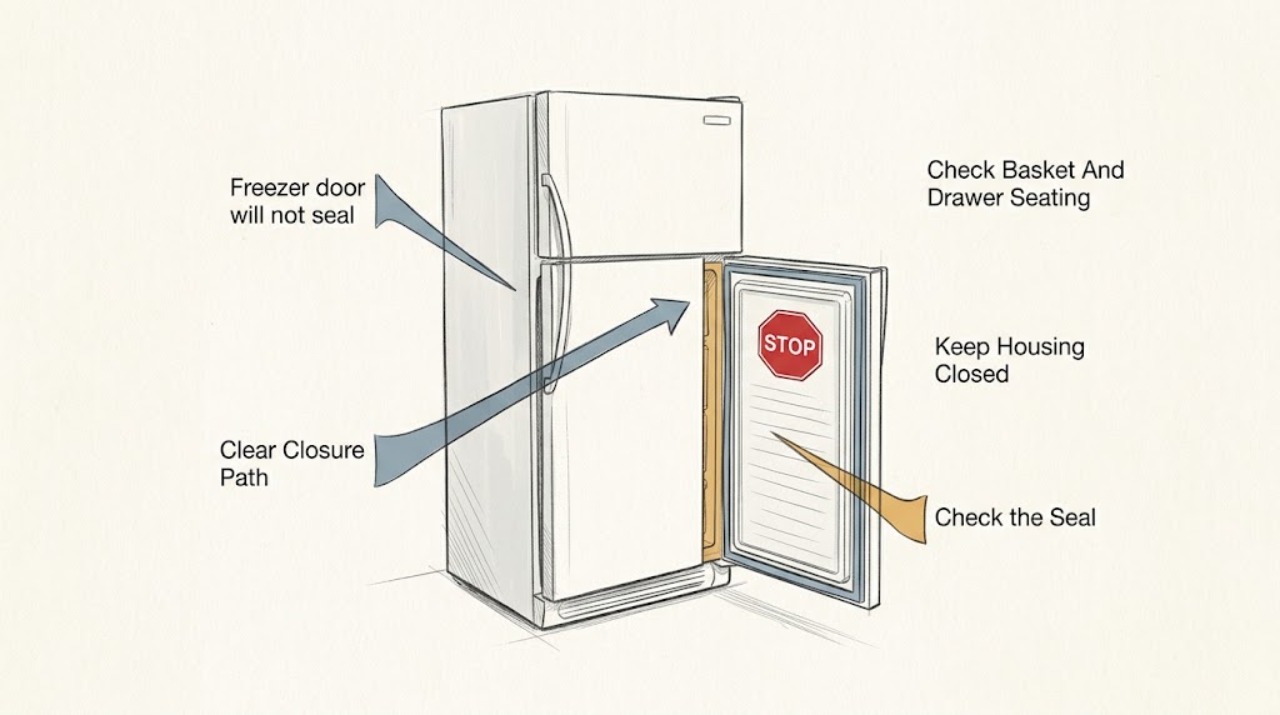
A GE freezer door that will not seal is usually blocked by a package, bin, shelf, ice, shipping material, or a drawer basket that is not seated; it can also be out of level or have a gasket that is loose, wrinkled, torn, or not touching the frame evenly. Empty the closing path, reseat accessible bins or baskets, inspect the gasket and frame, and compare the gap around the door. If the hinge or door is bent, the gasket is torn, frost returns after the path is cleared, or the door still will not seal, stop at ordinary-access checks and arrange qualified appliance service.
Before you begin
Safety first
- This article covers ordinary-access storage, basket, gasket, frame, visible leveling, and frost observations. It does not authorize hinge or track removal, cabinet or liner disassembly, electrical or fan testing, sharp-tool frost removal, unapproved heating, or internal part replacement.
Work through in order
Diagnostic checks
Use only checks that match the exact appliance or system and its official guide.
-
Check 1
Open the freezer and inspect the full closing path for packages projecting past the shelves, open bins, a shelf or ice cube, food against the door, or leftover packing material. Rearrange only accessible items so the door or drawer can move without force.
Expected result: The door closes after an obstruction is removed; an item still contacts the frame; or nothing visible blocks the path.
Next step: Run a normal closure check after removing the obstruction. If the door still springs open or leaves a gap, continue with the basket, gasket, and level checks.
Stop if: Do not force the door against a hard obstruction, chip ice with a sharp object, or continue if glass, sharp metal, or a damaged shelf is in the path.
Why this matters
Why: A changed closure after rearranging confirms a physical obstruction rather than proving a bad gasket. A clear path keeps the gasket, leveling, hinge, and drawer alignment in consideration.
-
Check 2
For a bottom-freezer drawer, observe whether the lower basket is fully seated in its slides and whether the drawer travels evenly. For other models, confirm shelves, bins, and door compartments are in their intended positions; use the model instructions for any permitted repositioning.
Expected result: The basket is tilted or not fully seated, the drawer rubs on one side, a bin projects into the door path, or all storage parts are seated and clear.
Next step: Reseat only an accessible basket, shelf, or bin according to the model guide and check the seal again. Do not remove slides, bend tracks, or adjust a drawer front without model-specific instructions or service.
Why this matters
Why: A mis-seated basket or storage part can hold the gasket away from the frame and mimic a gasket failure. A smooth, fully seated drawer with an uneven perimeter gap points more toward door alignment or gasket condition.
-
Check 3
With the door or drawer open, inspect the gasket around its full perimeter for a section pulled out of its retaining groove, folds, wrinkles, cuts, or tears. Look at the mating cabinet frame for dirt or frost, and compare whether the gasket touches evenly at the top, bottom, hinge side, and handle side.
Expected result: The gasket is loose but intact, visibly deformed, cut or split, not touching evenly, or clean and evenly seated.
Next step: Follow the exact GE model instructions for a permitted gasket seating or cleaning step. Stop and arrange service for a torn gasket, damaged frame, hinge, bent door, or a gap that remains after the gasket is seated.
Why this matters
Why: A loose or deformed gasket can be an ordinary-access fit or model-specific adjustment issue; cuts and tears indicate replacement is likely. Even contact shifts attention to leveling, hinge, drawer alignment, or a hidden obstruction.
-
Check 4
From the side and front, observe whether the freezer is level enough for the door to close on its own, whether the door or drawer sits noticeably high or low, and whether the frame is parallel to the gasket. Check only visible leveling indicators and do not loosen hinges or cabinet fasteners.
Expected result: The door does not close on its own, the cabinet or door is visibly out of alignment, the gasket gap is wider at one end, or alignment appears normal but the seal still leaks.
Next step: Use the exact model leveling instructions or arrange service if adjustment is not an ordinary user step. A broken hinge, bent door, damaged track, or persistent uneven gap requires qualified repair.
Why this matters
Why: GE identifies leveling and hinge condition as closure factors. A one-sided gap or a door that will not settle can indicate leveling, hinge, track, or door alignment rather than a gasket alone.
-
Check 5
Look for frost or ice concentrated at the freezer opening, along one gasket section, or on the rear wall, and record whether it began after frequent openings, a warm food load, or the door failing to close. Do not scrape frost with a sharp tool or remove an interior panel.
Expected result: Frost is concentrated around the opening, packages are frosted after repeated openings, the door now seals but frost remains, or heavy frost returns despite a clear closure path.
Next step: Keep the door closed and follow the exact GE care instructions for safe frost handling. Arrange service if the frost is heavy, returns, the fan is not operating, or the door still fails to seal.
Stop if: Stop if water reaches electrical parts, the liner is damaged, a fan is exposed or will not stop, or frost removal would require heat, sharp tools, or panel removal.
Why this matters
Why: Frost at the opening supports warm humid air entering through a closure problem; frost can take time to clear after the cause is corrected. Heavy or recurring frost after the seal is restored may indicate a gasket, fan, defrost, or cooling issue.
-
Check 6
After the accessible obstruction, basket, gasket, and alignment observations, record the GE model, door style, where the gap appears, whether the door latches or springs open, the gasket condition, frost location, and any hinge or track noise. Do not keep forcing the door closed to continue testing.
Expected result: The door seals evenly after a permitted correction; a gap remains; the hinge or track is damaged; or frost or temperature problems continue after closure appears normal.
Next step: Monitor only after normal closure and cooling return. Otherwise arrange qualified GE appliance service and provide the complete pattern; do not replace a gasket or hardware without exact model confirmation.
Why this matters
Why: A resolved gap supports an accessible closure cause. A persistent gap or damaged hardware requires repair, while continued frost or cooling trouble suggests a second appliance fault beyond the door seal.
Use your observations
Decision map
Find the observation that best matches what you see, then follow the next safe action.
-
PATH 01Next step
What you see
Removing a package, bin, shelf, ice cube, or packing material lets the door or drawer close flush and the gasket contacts the frame evenly.
Do this next
Keep storage below the closing path and check the door after loading. Escalate if frost or a gap returns with an unobstructed path.
Why this path and its safety boundary
Why it matters: The seal problem was most consistent with a closure obstruction; the gasket and hinge are less likely to be the first fault.
-
PATH 02Next step
What you see
The gasket is pulled from its groove, visibly wrinkled or deformed, torn, split, or fails to touch the frame evenly after the closing path is clear.
Do this next
Follow the exact GE instructions for permitted gasket seating or adjustment. Arrange service for damage, persistent deformation, or any need to remove the gasket or alter the door.
Why this path and its safety boundary
Why it matters: The gasket is a stronger suspect than a storage obstruction. A loose intact section may be a model-guided seating issue; a cut, tear, or persistent deformation needs replacement or service.
-
PATH 03Next step
What you see
The door remains uneven or springs open with no obstruction, the gasket gap is wider on one side, the drawer rubs, or a hinge or track appears damaged.
Do this next
Stop at visible inspection and arrange qualified appliance service or model-specific leveling help. Do not bend the door, remove hinges, or force the drawer into alignment.
Why this path and its safety boundary
Why it matters: Leveling, hinge, track, or door alignment is more likely than a gasket-only problem. GE identifies a broken hinge as requiring service.
-
PATH 04Next step
What you see
The door now appears closed but frost remains or returns around the opening, the rear wall develops heavy ice, or the freezer fan is not operating normally.
Do this next
Keep the door closed, avoid sharp tools or panel removal, protect food if temperatures rise, and arrange qualified service if the frost does not clear or returns.
Why this path and its safety boundary
Why it matters: The original air leak may have caused residual frost, but recurring heavy frost or a stopped fan points to a gasket, defrost, airflow, or cooling issue that cannot be resolved by repeated door adjustments.
-
PATH 05Next step
What you see
The visible path is clear, storage parts are seated, the gasket appears intact, and the door still will not seal or the freezer warms.
Do this next
Arrange qualified GE appliance service and provide the gap location, door style, frost pattern, and model information. Stop forcing the door or removing panels.
Why this path and its safety boundary
Why it matters: A concealed alignment, hinge, frame, gasket-retainer, temperature, or cooling fault remains possible; the public checks cannot distinguish it safely.
Helpful context
Understand the symptom
A seal problem starts with the closing path
A freezer door can look aligned while a tall package, open bin, shelf, small ice cube, or shipping material holds it away from the cabinet. Bottom-freezer drawers also depend on the lower basket being fully seated in its slides. Clear these accessible causes before treating the gasket or hinge as failed.
Use the gasket contact pattern as evidence
GE describes a properly sealing freezer door as touching the refrigerator frame with an even gap at the top and bottom. A gasket pulled from its retainer, folded, wrinkled, cut, or split changes that contact pattern. Frost near the opening is also a useful clue because warm humid air can enter when a package or gasket prevents complete closure.
Door style changes the check
Top-freezer and side-by-side doors use a visible perimeter gasket, while a bottom-freezer refrigerator may use a sliding drawer, lower basket, and gasket seated in a groove. Follow the instructions for the exact GE model and do not force a drawer, straighten a hinge, or remove a panel to make the seal appear even.
When the door check becomes a service call
A torn gasket, broken hinge, bent door, recurring heavy frost, or a gap that remains after accessible obstructions are removed requires model-specific repair or adjustment. Keep the door closed as much as practical and document the gap, frost location, and closure pattern for the technician rather than repeatedly forcing the door shut.
Safety boundary
Stop conditions
- Stop using or opening the freezer for water near electrical parts, a damaged liner, exposed wiring, a fan that will not stop, a broken hinge or track, or a door that cannot be controlled safely.
- Do not force the door, bend hardware, remove hinges or panels, chip ice with a sharp object, or use unapproved heat to clear frost.
- If the freezer remains warm or heavy frost returns after the closure path is corrected, protect the food and arrange qualified appliance service.
Only after diagnosis
Potential parts
- freezer door gasket
Consider only when inspection and service diagnosis confirm a cut, torn, persistently deformed, or nonsealing gasket after the closure path is clear.
Confirm the exact GE model and manufacturer fit information before ordering any gasket. - door hinge or drawer slide hardware
Consider only when qualified diagnosis confirms damaged hinge, track, or drawer hardware causing an uneven gap or uncontrolled closure.
Hardware varies by door style and model; verify fitment and installation requirements before ordering. - door gasket retainer or frame hardware
Consider only when the gasket will not remain seated and service finds a failed retainer or damaged mounting surface rather than a simple obstruction.
Confirm model-specific construction and compatibility with the manufacturer or technician. - freezer fan or defrost component
Consider only when recurring heavy frost or a stopped fan is confirmed as a separate appliance fault after the door seal is corrected.
Do not select a cooling or defrost component from symptoms alone; verify exact model and qualified diagnosis.
When checks do not resolve it
Need a professional?
Arrange qualified GE appliance service when the door or drawer still will not seal after accessible obstructions are cleared, the gasket is torn or persistently deformed, the door is bent or misaligned, a hinge or track is damaged, heavy frost returns, the fan is not operating, or the freezer warms. Use qualified electrical help for damage or water near electrical parts.
Safety scope: This article covers ordinary-access storage, basket, gasket, frame, visible leveling, and frost observations. It does not authorize hinge or track removal, cabinet or liner disassembly, electrical or fan testing, sharp-tool frost removal, unapproved heating, or internal part replacement.
Common questions
FAQ
Why will my GE freezer door not seal?
Check for packages, bins, shelves, ice, shipping material, or a bottom-drawer basket that blocks closure. If the path is clear, inspect gasket seating and damage, leveling, and even contact around the frame; a persistent gap can require service.
Can frost cause a GE freezer door not to seal?
Yes. Frost or ice can obstruct the opening, and a poor seal lets warm humid air enter and create more frost. Do not chip ice with a sharp tool; arrange service if heavy frost returns after the closure path is corrected.
Can I push a GE freezer gasket back into place?
If the gasket has pulled loose and the exact GE instructions permit it, it may be possible to reseat it in its retainer. Cuts, tears, persistent deformation, or an uneven gap need model-specific replacement or service, and the gasket should not be forced.
When should I call for GE freezer door service?
Arrange service for a broken hinge, bent door or track, a gasket that remains damaged or nonsealing, recurring heavy frost, a fan that is not operating, or a freezer that warms after accessible closure checks. Keep the cabinet and liner intact while waiting.
Read the exact guide
Official sources
- Top Freezer Refrigerator - Adjusting or Replacing the Door GasketsGE Appliances · GE top-freezer gasket seating, deformation, damage, model instructions, and service
- Refrigerator - Door Will Not CloseGE Appliances · GE refrigerator and freezer door closure obstructions, leveling, hinge condition, and service boundary
- Bottom Freezer Refrigerator - Freezer Drawer Not Sealing ProperlyGE Appliances · GE bottom-freezer drawer basket seating, gasket seating, even door contact, and seal diagnosis
- Refrigerator & Freezer - Ice on Freezer WallGE Appliances · GE freezer frost from door openings, warm loads, packages, gasket sealing, fan symptoms, and service
Community feedback
Share a repair observation
Share a plain-text repair observation. Accepted observations are published automatically; this page may take a moment to update.