
On this page
Start here
Quick answer
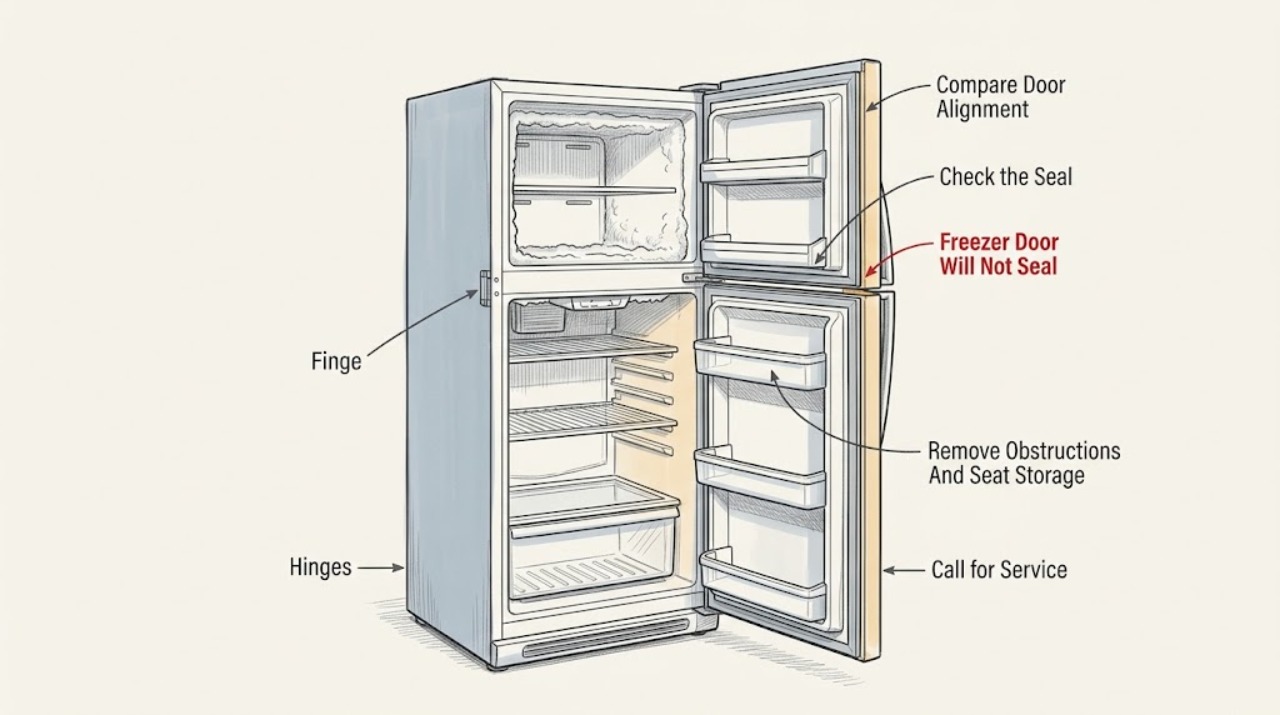
If a freezer door will not seal even though the cabinet is level, first look for an obstruction or drawer that is not fully seated, then inspect the gasket for dirt, warping, gaps, or a section pulled out of its channel. A level cabinet rules out one common cause but does not rule out a gasket problem, an uneven door or rail, a loose hinge, a bent frame, frost at the contact area, or a package pushing from inside. Manufacturers describe the same practical sequence: verify the door closes completely, remove anything blocking it, check shelves, bins, rails, and gasket seating, and use the model manual for any alignment adjustment. Clean a gasket with mild soapy water and dry it; do not cut, heat, glue, stretch, or pry the seal. If a paper or light test still shows a gap after the freezer is empty and the gasket is clean and seated, stop repeated use and arrange qualified appliance service because warm air can create frost and reduce cooling performance.
Work through in order
Diagnostic checks
Use only checks that match the exact appliance or system and its official guide.
-
Check 1
Close the freezer slowly and inspect the entire gasket perimeter with the compartment empty enough to see it. Identify whether the unit has a hinged door or pull-out drawer, whether the gap is at one corner or the full edge, and whether the door rebounds open or stops against something. Do not slam the door or force it against resistance.
Expected result: The door closes evenly; a corner or side stays open; the gasket touches except at one spot; the door rebounds; or the drawer stops before reaching the frame.
Next step: Continue with the matching obstruction, gasket, frost, or alignment check, keeping the freezer closed as much as possible while troubleshooting.
Stop if: Stop for a cracked frame or door, a hinge or rail that is loose or bent, a door that cannot be supported safely, or a gap that allows food to warm or frost to spread rapidly.
Why this matters
Why: A localized gap makes gasket deformation, door twist, hinge position, or rail alignment more likely. A door that stops or rebounds suggests an obstruction, bin, shelf, rail, or hinge issue rather than a level-cabinet problem. An even perimeter gap after other checks suggests a damaged gasket or frame.
-
Check 2
Check the front edge, door shelves, packages, ice containers, shelves, baskets, and drawer rails for anything preventing complete closure. If the freezer was recently installed or serviced, look for remaining shipping material. Reseat only a bin or drawer that is plainly designed for user removal; do not pry a stuck rail or remove a door without the model instructions.
Expected result: A package projects into the gasket path; a shelf or bin is out of position; a drawer is not fully on its rails; shipping material is present; or the interior is clear and correctly seated.
Next step: Remove or reseat the safe, obvious obstruction and close the door gently. If the seal still fails, move to the gasket and frost checks rather than adding force.
Stop if: Stop for a jammed drawer, bent rail, broken shelf support, sharp plastic or metal, a door that must be lifted, or any need to disassemble the freezer interior beyond the model instructions.
Why this matters
Why: A single package or mis-seated storage part can create a local gap even with a level cabinet. If the interior is clear and the door still misses the frame, the gasket, hinges, frame, or rail alignment becomes more likely.
-
Check 3
With the door open, inspect the rubber gasket and the mating frame for food residue, frost, tears, splits, hardened areas, warping, or a section pulled out of its groove. Clean the gasket with warm soapy water and a soft cloth, dry it, and gently press only a visibly displaced edge back into its channel if the model design allows. Do not cut, glue, stretch, pry, or heat the gasket.
Expected result: The gasket is dirty but intact; a short section is out of its channel; the gasket is torn, warped, hardened, or loose; frost remains at the contact edge; or the gasket looks sound and fully seated.
Next step: Close the door gently and recheck the perimeter. If the gasket remains damaged or the gap persists, keep the door closed as much as possible and use the exact model service procedure for a seal or alignment diagnosis.
Stop if: Stop for a damaged seal, sharp frost or plastic, chemical residue, a gasket that will not stay in its channel, or any temptation to use heat or adhesive to reshape it.
Why this matters
Why: Dirt or a displaced section can interrupt contact and may improve after cleaning or reseating. A tear, permanent deformation, or continuing gap after cleaning points to a gasket or door-alignment repair. Frost at the edge indicates warm air has been entering and can hide the original sealing defect.
-
Check 4
Look for frost or ice concentrated along the gasket, door frame, or one corner. After removing only light frost with a damp cloth and drying the area, close the door and use a strip of paper at several points around the perimeter; feel for slight, consistent resistance without pulling hard. Do not use a hair dryer, knife, metal scraper, or other heat or sharp tool.
Expected result: There is no frost and paper has similar slight resistance; frost is concentrated at one gap; paper slips out at one section; or heavy frost prevents the gasket from contacting the frame.
Next step: If the contact remains uneven after light frost is removed and the gasket is clean, stop repeated operation and arrange service. Follow the exact manual for any full defrost procedure and protect frozen food according to the model guidance.
Stop if: Stop for heavy ice that cannot be cleared safely, water near electrical components, a damaged liner, a failed seal with warming food, or any need to use heat or sharp tools.
Why this matters
Why: A localized frost line or paper failure identifies a likely air-leak area, but it does not distinguish a gasket from a door or frame alignment problem. Heavy or recurring frost can require a complete model-specific defrost or service diagnosis; removing surface frost alone does not repair the seal.
-
Check 5
If the cabinet is confirmed level and the interior, gasket, and frost checks do not restore a seal, record the freezer model, door style, gap location, paper-test pattern, gasket condition, hinge or rail movement, recent installation or door removal, and any temperature or frost change. Consult the model manual for an approved hinge, rail, or door-height check; do not improvise an adjustment.
Expected result: The gap began after installation or door removal; a hinge or rail has play; the frame is bent; the gasket is damaged; the paper test fails consistently; or the exact alignment procedure is unavailable.
Next step: Keep the door closed, limit warm-air entry, and arrange qualified appliance service. Provide the model, door style, exact gap, and the results of the obstruction, gasket, and frost checks.
Stop if: Stop before removing a freezer door, loosening hinges or rails, bending the frame, replacing the gasket without model confirmation, or continuing if food is warming or the freezer is making abnormal mechanical sounds.
Why this matters
Why: A level cabinet with a persistent local gap makes door assembly, rail, frame, or gasket alignment more likely than cabinet leveling. A damaged or permanently deformed part needs replacement or service, and an unknown adjustment can worsen the seal or door support.
Use your observations
Decision map
Find the observation that best matches what you see, then follow the next safe action.
-
PATH 01Next step
What you see
Do this next
Remove or reseat only the obvious user-accessible obstruction, then close the door gently. Escalate for a bent rail, broken support, or obstruction that cannot be removed without disassembly.
Why this path and its safety boundary
Why it matters: An interior obstruction or storage component that is not fully seated is more likely than a level-cabinet issue.
-
PATH 02Next step
What you see
Do this next
Clean and dry the gasket, reseat only the displaced section if permitted, and retest. Do not glue, stretch, heat, or cut it; arrange service if contact remains uneven.
Why this path and its safety boundary
Why it matters: The seal itself is the leading suspect. Cleaning or careful reseating can address surface contamination or a visibly displaced edge; damage or permanent deformation requires a model-appropriate replacement or service decision.
-
PATH 03Next step
What you see
Do this next
Remove only light frost safely, keep the door closed, and follow the exact model defrost or service guidance. Request service for heavy or recurring frost, a damaged gasket, or an uneven frame.
Why this path and its safety boundary
Why it matters: Warm moist air has likely been entering at a local sealing defect. Frost can then hold the door open, so removing surface frost without correcting the gap is temporary.
-
PATH 04Next step
What you see
Do this next
Use the exact manual only to identify an approved adjustment; otherwise keep the freezer closed and arrange qualified appliance service. Do not bend the frame or loosen support hardware as an experiment.
Why this path and its safety boundary
Why it matters: Door, hinge, rail, frame, or model-specific height alignment is more likely than cabinet leveling. The correct adjustment depends on the freezer design and model.
Helpful context
Understand the symptom
A level cabinet does not prove the door and gasket are aligned
The cabinet can be level while the door is sitting unevenly on a hinge, a freezer drawer is not fully on its rails, or the rubber gasket has a gap. Begin with the door empty enough to see the full perimeter. Check whether the gap is all around or only at one corner, and whether the door springs back open or simply meets an object. A freezer that is repeatedly run with a gap can draw in warm, moist air and form frost, which can make the original gap worse.
Clean and reseat before considering replacement
Food residue, frost, or a gasket pulled partly out of its channel can prevent a continuous contact surface. Wipe the seal with warm soapy water and a soft cloth, dry it, and press only a visibly displaced section back into its channel if the model guidance permits. Do not use sharp tools, solvents, adhesive, a heat gun, or a hair dryer. A torn, hardened, permanently deformed, or loose seal is a replacement or service decision, not a reason to force the door shut.
Use the exact manual for alignment work
Freezer doors may be hinged, pull-out drawers, or part of a French-door assembly. Their adjustment points are not interchangeable. Once food, bins, rails, packaging, and frost are ruled out, record the model and use its manual for approved hinge or rail adjustment. If a hinge is loose, a rail is bent, the frame is damaged, or the door must be removed, stop at that point unless the exact procedure and safe support requirements are known.
Safety boundary
Stop conditions
- Stop repeated operation for a persistent gap with warming food, heavy or recurring frost, a cracked door or frame, or water near electrical components.
- Do not use a hair dryer, heat gun, knife, metal scraper, solvent, adhesive, or sharp tool on the gasket, liner, or frost.
- Do not bend the door or frame, force a drawer, remove a hinge or rail, or lift a freezer door without the exact model procedure and safe support.
- Do not replace a gasket, hinge, rail, or door from appearance alone; confirm the complete model and approved fitment information.
- Arrange qualified service when cleaning, reseating an obvious obstruction, and light-frost removal do not restore even gasket contact or when any repair requires structural or door-assembly work.
Only after diagnosis
Potential parts
- Freezer door gasket or seal
Consider this part class only when the obstruction and frost checks are complete and the gasket is torn, permanently warped, hardened, or fails to contact the frame evenly.
Gasket profile, retaining channel, magnet, door style, and model fit vary; confirm the complete freezer model and the manufacturer's parts information before selecting anything. - Freezer hinge, rail, roller, or alignment hardware
Consider this part class only when the door or drawer is not aligned after the interior is correctly seated and a safe inspection confirms loose, bent, worn, or damaged support hardware.
Hinge geometry, rail assemblies, rollers, fasteners, and adjustment procedures differ by freezer design; use the exact model manual and do not infer fit from appearance. - Freezer door or frame assembly
Consider this part class only when the frame or door is cracked, twisted, or unable to hold an evenly seated gasket after qualified diagnosis.
Door handing, insulation, liner, trim, hinges, and finish are model-specific; a structural door or frame repair should be confirmed by qualified service.
When checks do not resolve it
Need a professional?
Arrange service when the gasket remains damaged or uneven after cleaning, the gap persists with the interior clear, frost returns, the door or drawer is misaligned, a hinge or rail is loose or bent, the frame is damaged, food is warming, or diagnosis requires door removal or sealed-system access.
Have this ready
- Complete freezer model and whether the door is hinged, pull-out, or part of a French-door assembly
- Confirmation that the cabinet is level and the exact side or corner where the gap occurs
- Obstruction, gasket cleaning, light-frost, and paper-test results
- Whether the problem followed installation, door removal, moving the appliance, or a frost event
- Any warming food, recurring frost, abnormal sounds, damaged frame, hinge, rail, or gasket
Common questions
FAQ
Why will my freezer door not seal if the cabinet is level?
Leveling only rules out one possible cause. The door can still have a package or drawer obstruction, a gasket pulled from its channel, localized frost, a loose hinge or rail, a bent frame, or a model-specific alignment problem. Empty the closure path, inspect the gasket, and check the exact gap location before considering adjustment.
How do I check whether a freezer gasket is sealing?
Inspect the entire perimeter for even contact, then place a strip of paper at several points and close the door gently. Slight, consistent resistance is a useful indication of contact; a paper strip that slips out repeatedly at one section identifies an area for closer inspection. Clean the gasket and check that it is seated in its channel, but do not force or heat it.
Can a package or drawer keep a freezer door from sealing?
Yes. A projecting package, mis-seated shelf or basket, or drawer that is not fully on its rails can leave a local gap even when the cabinet is level. Remove or reseat only an obvious user-accessible obstruction, and stop if a rail is bent or the drawer is jammed.
Is frost around the freezer door proof that the gasket is bad?
Frost at one edge shows that warm, moist air may be entering, but it does not by itself distinguish a damaged gasket from an obstruction, door alignment issue, or frame problem. Remove only light frost safely, restore complete closure, and arrange service if frost returns or the gap remains. Do not use a hair dryer or sharp tool.
When should I call for freezer door sealing service?
Arrange service when the gasket is torn, hardened, permanently warped, or still uneven after cleaning; when the gap remains with the interior clear; when frost returns; when a hinge, rail, or frame is loose or damaged; when food is warming; or when the repair requires removing the door or support hardware.
Read the exact guide
Official sources
- Frost forms in the Samsung freezer, refrigerator, or ice bucketSamsung · Official Samsung support page used for the relationship between door gaps, warm moist air, frost, gasket cleaning, and the warning against hair dryers; model-specific details remain model-bound.
- Bottom Freezer Refrigerator - Freezer Drawer Not Sealing ProperlyGE Appliances · Official GE guidance used for general drawer and gasket observations; its adjustment video and details apply to compatible GE bottom-freezer designs only.
- Samsung refrigerator or freezer doors will not closeSamsung · Official Samsung support page used for general door-sealing diagnostic patterns; model-specific French-door rail steps are not generalized to every freezer.
- Doors are Not Sealing Properly - Undercounter RefrigeratorWhirlpool · Official Whirlpool product-help page used for general sealing checks; its undercounter model context and leveling instructions are not substituted for the freezer's manual.
Community feedback
Share a repair observation
Share a plain-text repair observation. Accepted observations are published automatically; this page may take a moment to update.