
On this page
Start here
Quick answer
Start with safe observation: check whether a package, basket, frost, or visible gasket damage is keeping the freezer door from meeting the cabinet evenly. Note the door gap, contact pattern, and any temperature or frost change without removing the door, hinge, gasket, or frost. A small obstruction may be a use or loading issue, but an uneven gap, damaged seal, door sag, heavy frost, temperature rise, electrical or burning symptom, or a door that will not stay closed needs appliance service. Keep the door closed as much as practical while food safety is uncertain and follow food-safety guidance for any food that may have warmed.
Before you begin
Safety first
- Do not remove the door, hinge, gasket, panels, or frost; do not use heat, force, sharp tools, or live electrical or refrigeration tests.
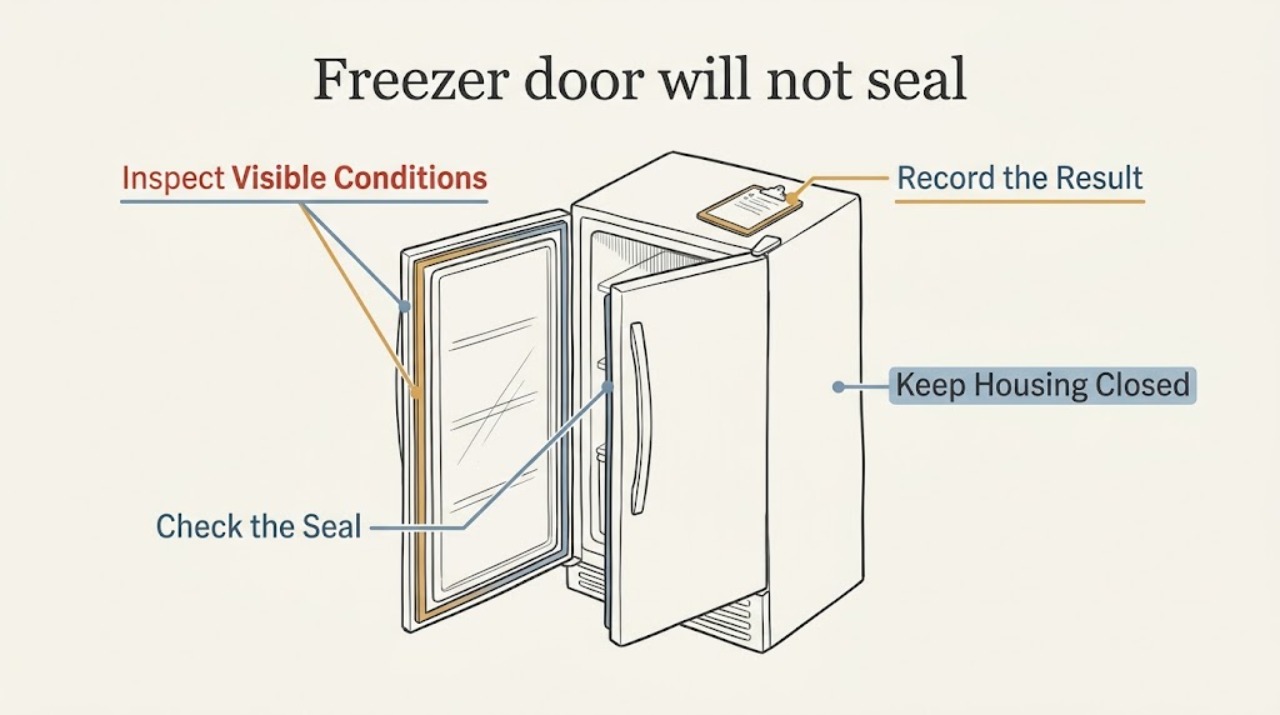
Work through in order
Diagnostic checks
Use only checks that match the exact appliance or system and its official guide.
-
Look for an obstruction in the closing path
With the door open only as needed, visually inspect the front edges of packages, shelves, baskets, drawers, and the frame for anything that projects into the closing path; do not force the door or move heavy contents.
Expected result: Note whether the gap lines up with a package or storage component, whether a basket or drawer appears visibly out of position, or whether the path looks clear.
Next step: If the path is clear or the obstruction cannot be safely addressed without moving heavy contents, stop using the door as a test and arrange appliance service.
Stop if: Stop if the door is heavy, unstable, pinches, will not stay open safely, or requires force, removal, or access behind the appliance.
Why this matters
Why: A localized obstruction points toward a loading or storage-position issue, while a clear path makes gasket contact, alignment, frost, or hardware more likely.
-
Observe the gasket contact around the frame
From the front and sides, inspect the visible gasket and frame contact with the door closed gently; look for a folded section, crack, brittleness, missing section, debris, or a gap that is wider in one area.
Expected result: Record whether the gasket appears continuous and evenly contacting, whether the gap is local or extends along a side, and whether frost or moisture follows the gap.
Next step: Provide the location and pattern to a technician and use the freezer's model-specific service documentation for any permitted maintenance; do not reshape or replace the gasket based on appearance alone.
Stop if: Do not pull, cut, heat, glue, pry, or remove the gasket, and stop if the seal or frame is sharp, loose, or contaminated.
Why this matters
Why: A damaged or uneven gasket can prevent an air seal; a uniform-looking gasket with an uneven door gap points more toward alignment, hinge, cabinet, or frost conditions.
-
Check for frost or ice along the sealing surface
Look at the inner edge of the door, gasket, and cabinet frame for a visible frost or ice pattern without scraping, probing, or using a tool or heater.
Expected result: Note whether frost is concentrated along the gap, spreads around the frame, is present inside the compartment, or is not visible.
Next step: Keep the door closed and ask for appliance service if frost is extensive, returns, or is accompanied by temperature change.
Stop if: Do not chip, scrape, puncture, melt with an electrical heater, or use a sharp object on frost or ice.
Why this matters
Why: Frost at the sealing surface can hold the door open and can also be a consequence of warm air entering; extensive frost may require a model-specific service or defrost plan rather than a door adjustment.
-
Observe alignment and the way the door settles
From a stable standing position, compare the visible top, bottom, hinge-side, and handle-side gaps with the door gently closed; note whether the door sits level, sags, rebounds, or pops back open.
Expected result: Record a consistent gap on one side, a corner that contacts first, a visible sag, or a door that closes evenly but still leaks air.
Next step: Give the gap pattern and freezer type to a repair professional rather than attempting a hinge adjustment without the model-specific procedure.
Stop if: Do not loosen hardware, add a shim, lift the door, or force the door against the frame.
Why this matters
Why: An uneven gap or sag can indicate alignment or hinge work, while even alignment with a visible air gap points more toward gasket condition or a frame problem.
-
Check the temperature and operating warning signs
Read an appliance thermometer or display only if one is already accessible, and note frost changes, a temperature alarm, unusual heat, burning odor, smoke, or repeated electrical interruption without touching panels or live parts.
Expected result: The freezer may remain cold with a small localized gap, show a rising or uncertain temperature, show a warning, or present an odor or electrical symptom.
Next step: Keep the door closed, protect food according to current food-safety guidance, and arrange professional appliance service. Escalate an electrical or burning symptom promptly.
Stop if: Stop using the appliance and seek professional help for burning odor, smoke, abnormal heat, damaged power components, or repeated breaker trips. Do not access electrical or refrigeration components.
Why this matters
Why: A temperature change makes food safety and cooling performance more urgent; burning odor, smoke, abnormal heat, or electrical interruption is a stop-use condition rather than a door-adjustment question.
Use your observations
Decision map
Find the observation that best matches what you see, then follow the next safe action.
-
PATH 01Safety boundary
What you see
If a package, basket, shelf, or drawer visibly blocks the closing path
Do this next
Keep the door closed and address only a light, clearly accessible obstruction without force; if the component is heavy, stuck, or out of position, arrange service.
Why this path and its safety boundary
Safety stop: Do not force the door or disassemble storage hardware.
-
PATH 02Safety boundary
What you see
If the gasket is cracked, folded, missing, or does not contact evenly
Do this next
Record the affected edge and freezer model and request model-specific gasket or door service.
Why this path and its safety boundary
Safety stop: Do not heat, glue, cut, pull, or replace the gasket without the correct service procedure.
-
PATH 03Safety boundary
What you see
If the gap is uneven, the door sags, or it pops back open with a clear path
Do this next
Arrange professional inspection for alignment, hinge, cabinet-level, or frame conditions and provide the observed gap pattern.
Why this path and its safety boundary
Safety stop: Do not loosen hinges, add shims, lift the door, or force it into alignment.
-
PATH 04Safety boundary
What you see
If frost is holding the door open or the freezer temperature is uncertain
Do this next
Keep the door closed, avoid tools or heaters, follow current food-safety guidance, and ask a technician for a model-specific frost and seal assessment.
Why this path and its safety boundary
Safety stop: Do not chip or scrape frost or continue running a freezer that shows unsafe food temperature or a serious operating warning.
-
PATH 05Safety boundary
What you see
If there is burning odor, smoke, abnormal heat, damaged power equipment, or repeated electrical interruption
Do this next
Stop using the freezer and seek professional appliance service; keep people away from the hazard and do not open electrical or refrigeration panels.
Why this path and its safety boundary
Safety stop: This is not a gasket adjustment situation.
Helpful context
Understand the symptom
Separate a blocked door from an alignment or seal problem
A freezer door can fail to seal because something in the storage area projects into the closing path, a basket or shelf is visibly out of position, frost is building at the frame, the gasket is damaged or not contacting evenly, or the door has shifted. The same symptoms can occur on an upright freezer, refrigerator-freezer drawer, or chest freezer lid, but the parts and adjustment method are model-specific.
Protect the food while you assess the door
Avoid repeated opening and closing while the seal is uncertain. Record any appliance thermometer reading that is already available and any visible ice crystals or thawing signs. Do not decide that food is safe by tasting it; use current food-safety guidance when the freezer has been warm or the door has remained open.
When a repair visit is the right next step
A professional can identify whether the gasket, hinge, door alignment, cabinet level, frost condition, or another appliance problem is responsible. Give the technician the freezer type, model label, location of the gap, timing of the change, visible frost pattern, and any temperature or odor warning.
Only after diagnosis
Potential parts
- freezer door gasket
Consider this only if a model-specific inspection confirms that the gasket is damaged or cannot contact the frame evenly.
Match the exact freezer model and gasket profile; a similar-looking seal may not fit or seal correctly. - freezer door hinge
Consider this only if a technician or model-specific diagnosis identifies hinge wear or damage behind an uneven or sagging door.
Confirm the freezer model, hinge side, and manufacturer fit information before ordering; do not use a hinge as an alignment substitute. - freezer door alignment shim
Consider this only when the model documentation or a professional diagnosis specifically calls for an alignment shim.
Alignment parts are model- and hinge-specific; do not add a generic shim or change door geometry without the approved procedure.
When checks do not resolve it
Need a professional?
Arrange appliance service when the clear closing path does not explain the gap, the gasket or door is damaged, frost returns, temperature is uncertain, or the door will not remain sealed. Stop use and seek prompt professional help for burning odor, smoke, abnormal heat, or electrical interruption.
Safety scope: Do not remove the door, hinge, gasket, panels, or frost; do not use heat, force, sharp tools, or live electrical or refrigeration tests.
Have this ready
- freezer type and model label
- where the gap appears and whether it is local or around the frame
- visible gasket damage, frost pattern, or obstruction
- door sag, rebound, or popping-open behavior
- available temperature reading and any warning, odor, or electrical symptom
Common questions
FAQ
Why is my freezer door not sealing?
Common observable possibilities include a package or basket in the closing path, frost at the frame, a damaged or uneven gasket, door alignment, or hinge and cabinet conditions. The visible pattern helps a technician choose the next inspection.
Can I heat or reshape a freezer gasket?
Do not heat, pull, cut, glue, or reshape it as a general fix. Gaskets and door geometry are model-specific; ask for the correct service procedure or a technician's assessment.
What should I do with food if the freezer door stayed open?
Keep the door closed and use current food-safety guidance rather than tasting food to judge it. An existing appliance thermometer, ice-crystal condition, and the duration and extent of warming can help guide that decision.
When should I stop using the freezer?
Stop and seek professional help for burning odor, smoke, abnormal heat, damaged power equipment, repeated electrical interruption, or a temperature problem you cannot safely assess.
Read the exact guide
Official sources
- Checking for Items Preventing Door or Lid ClosureWhirlpool · Use for checking visible obstructions, storage position, excessive frost, level-related sealing concerns, and damaged seals without generalizing across models.
- Bottom Freezer Refrigerator - Freezer Drawer Not Sealing ProperlyGE Appliances · Use for the observable relationship between packages or baskets, gasket seating, frost, and even contact; exact adjustment steps remain model-specific.
Community feedback
Share a repair observation
Share a plain-text repair observation. Accepted observations are published automatically; this page may take a moment to update.