
On this page
Start here
Quick answer
An LG freezer defrost drain is likely blocked when water or a sheet of ice collects at the bottom of the freezer, water overflows into the refrigerator compartment during defrost, or a drain-related error returns. First distinguish melted frost from a spilled container or water-line leak, protect the food, and unplug the appliance only when you can safely store the food and control the meltwater. LG's official guidance is to let frost melt naturally with the doors open; do not use a hair dryer, boiling water, knife, wire, or sharp tool. After complete thawing, wipe up water and inspect only the visible drain area, door seal, vents, and recurring frost pattern. If the drain remains blocked, the leak returns, frost builds again, an F dH or r dH code repeats, or the drain is behind a cover, keep the freezer out of service and arrange qualified LG appliance service. Do not remove an evaporator cover, probe the drain with a tool, or work on the defrost heater or wiring as a user test.
Before you begin
Safety first
- This article supports mapping the water pattern, protecting food and floors, natural thawing, and ordinary-access inspection of the visible drain area, gasket, vents, and external water source. Do not use forced heat or sharp tools, remove covers, reach into the defrost system, perform electrical or refrigerant work, or probe a hidden drain.
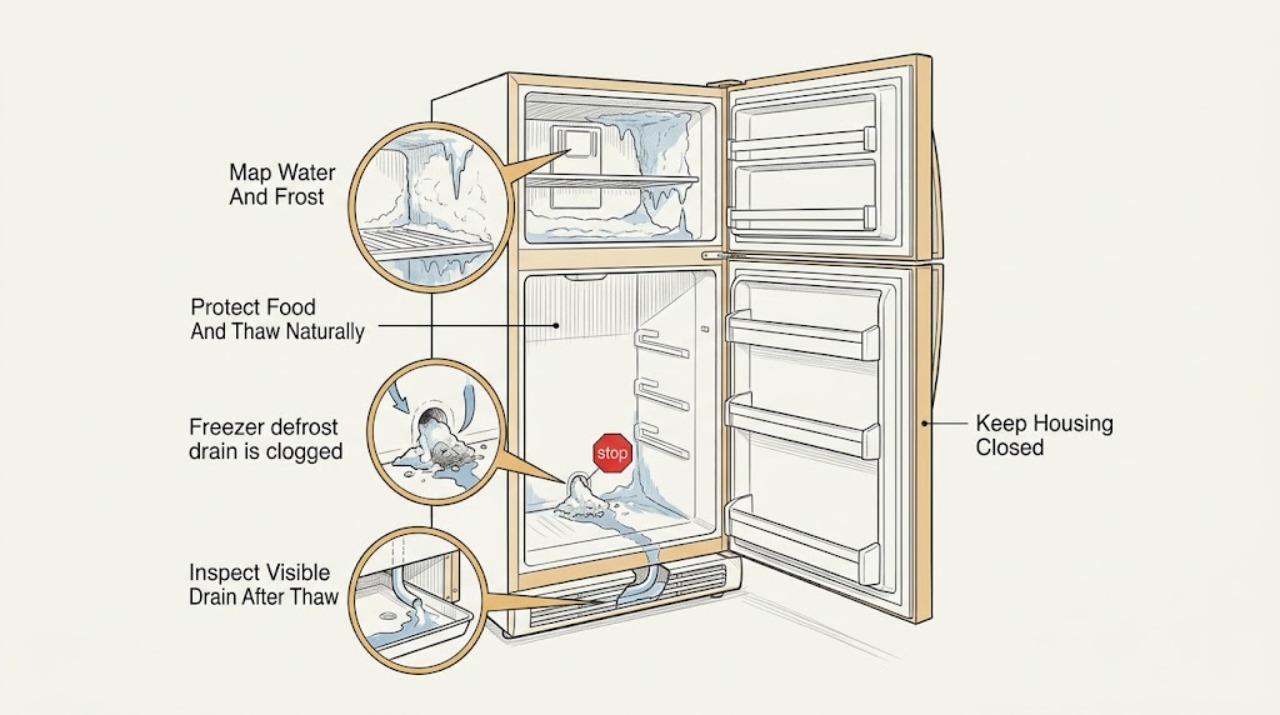
Work through in order
Diagnostic checks
Use only checks that match the exact appliance or system and its official guide.
-
Check 1
Before moving anything, photograph and describe where water or ice is present: the freezer floor, under a drawer, rear wall, ceiling, refrigerator compartment, or floor outside the appliance. Check whether a container spilled, a water line is wet, a door was left open, or frost is concentrated around the freezer drain or vents.
Expected result: There is a sheet of ice or water at the freezer bottom, water enters the refrigerator from above, frost returns at the same drain area, or the only water source is a spill or external line.
Next step: Record the pattern before thawing. For a suspected internal drain blockage, continue to the food and natural-thaw plan; for a water-line leak or damaged compartment, keep the appliance out of service and arrange qualified repair.
Stop if: Do not pull on wet wiring, remove panels, or chip ice to expose the drain while the freezer is powered or still frozen.
Why this matters
Why: A bottom-freezer ice sheet or defrost water overflow supports a blocked drain. A spill or external line has a different repair path, while door-edge frost or widespread frost can indicate warm-air entry rather than a drain-only issue.
-
Check 2
If the pattern fits a frozen drain, move perishable food to another safe cold location if available, disconnect power as LG instructs, leave the freezer or refrigerator doors open, place towels around the base, and allow the frost to melt naturally. Do not apply forced heat or hot water.
Expected result: The ice melts and water drains normally into the pan, the water overflows or cannot find the drain, or the frost is too heavy for a comfortable natural thaw and food cannot be safely stored.
Next step: Once fully thawed, wipe up water and inspect only ordinary-access areas. If the appliance cannot be safely emptied or the thaw would risk water damage, request service instead of improvising a faster defrost.
Stop if: Do not use a hair dryer, heat gun, heater, boiling water, knife, screwdriver, wire, or other sharp tool to melt or open the ice.
Why this matters
Why: Complete thawing can release an ice blockage and reveal whether the drainage path is open. An overflow, persistent blockage, heavy frost, or an unsafe food-storage situation means the issue should not be treated as a simple cleaning task.
-
Check 3
After the compartment is completely thawed and dry enough to inspect, look from ordinary access at the visible drain opening, freezer floor, drain-pan area if visible without removing a cover, and nearby loose debris. Wipe away loose surface residue only as the model instructions permit; do not insert anything into the drain or reach behind panels.
Expected result: The visible opening is clear and water follows the drain, loose debris is present at the opening, the opening remains blocked, or the drain is not visible without removing an evaporator or rear cover.
Next step: Restore the appliance only according to the LG model instructions when no leak or damage remains, then monitor for recurrence. If the opening remains blocked, cannot be safely reached, or water does not drain, arrange qualified service.
Stop if: Do not probe, drill, blow compressed air, pour chemicals, remove an evaporator cover, or disturb a heater, fan, sensor, or wiring to reach the drain.
Why this matters
Why: A clear drain after a full thaw makes an ice plug less evident, but does not prove that the deeper tube or defrost system is healthy. A hidden, recurring, or unreachable blockage needs model-specific service rather than probing.
-
Check 4
Inspect the freezer door or drawer, gasket, shelves, and vents after thawing. Confirm that no food or bin prevents complete closure, the gasket is clean and continuous, and vents are not blocked; note where frost returns during later normal use without repeatedly opening the door.
Expected result: The gasket is torn, pulled away, dirty, or fails to contact; a package blocks closure; vents are covered; or frost returns near the door, vents, or drain after the door and load are corrected.
Next step: Remove only loose obstructions and clean the seal using the model-approved method. Request service for a damaged seal, heavy or returning frost, or a drain that re-blocks after the door and vent conditions are corrected.
Stop if: Do not stretch, heat, glue, cut, or force the gasket, chip recurring ice, or remove an evaporator or vent cover.
Why this matters
Why: Warm moist air from a door gap or blocked circulation can create recurring frost that re-clogs the defrost drain. A sound seal and clear vents make a persistent drain tube, defrost, fan, or control problem more likely if the blockage returns.
-
Check 5
Record the exact LG model, freezer configuration, error code if any, thaw date, drain result, water location, frost location, door-seal result, and whether water or ice returns after normal operation. Do not use a reset or a temporary thaw to conceal a repeating error.
Expected result: An F dH or r dH code returns, the drain blocks again, the leak continues after a complete thaw, cooling performance changes, or the appliance operates normally without recurrence.
Next step: For a returned code, recurring blockage, continued leak, or cooling change, keep the appliance out of service as appropriate and arrange qualified LG service. Provide the record and photos; do not replace a heater, fuse, board, or drain part based on the symptom alone.
Stop if: Do not bypass a temperature fuse or heater, clear a code by repeated power cycling, or open the control, defrost, or sealed refrigeration system.
Why this matters
Why: LG associates F dH or r dH with a defrost failure that can involve a blocked drain, temperature fuse, heater, or main board; a repeated code or leak needs accurate diagnosis. A one-time ice blockage with normal operation afterward is less conclusive, but it should still be monitored.
-
Check 6
If water is on the floor or around the cabinet rather than clearly inside the freezer, inspect only the visible area around the appliance, nearby sink or boiler, and accessible water-line connections without moving a loaded unit or disturbing tubing.
Expected result: A nearby line, sink, boiler, or external source is wet, or the surrounding area is dry while water is clearly emerging from the freezer interior.
Next step: For an external water source, control the leak only within the installed system's safe instructions and arrange the appropriate qualified service. For an internal leak, continue the drain evidence and service handoff rather than moving the appliance aggressively.
Stop if: Do not pull the appliance by its water line, loosen fittings, open a wall, or work near wet electrical connections.
Why this matters
Why: An external leak is not a defrost-drain diagnosis and may need plumbing or water-line service. Water clearly emerging from the freezer interior keeps the drain, frost, door seal, and defrost branches in scope.
Use your observations
Decision map
Find the observation that best matches what you see, then follow the next safe action.
-
PATH 01Safety boundary
What you see
A sheet of ice or water is at the freezer bottom, or defrost water overflows into the refrigerator, and the pattern is not explained by a spill or external water line.
Do this next
Protect food, disconnect power, allow a natural complete thaw, and inspect only ordinary-access areas. Request service if water does not drain, the blockage is hidden, or the ice returns.
Why this path and its safety boundary
Why it matters: A blocked defrost drain is plausible: LG explains that ice, frost, or debris can stop defrost water from reaching the drain tray and make it overflow or refreeze.
Safety stop: Do not probe the drain or use forced heat, hot water, or a sharp tool to clear the ice.
-
PATH 02Safety boundary
What you see
Frost is concentrated around the door edge or vents, the door has a gap, the gasket is damaged or dirty, or food prevents complete closure.
Do this next
Correct only loose food obstructions and clean the gasket as directed. Request service for a damaged seal, recurring frost, or a drain that remains blocked after the air-entry cause is addressed.
Why this path and its safety boundary
Why it matters: Warm moist air entering through the door or blocked circulation is more likely to be creating the frost load; that frost can secondarily obstruct drainage.
Safety stop: Do not force the door, deform the gasket, chip bonded frost, or remove covers to reach vents.
-
PATH 03Safety boundary
What you see
After a complete natural thaw, the visible water path clears, the leak stops, cooling is normal, and no defrost-related code returns.
Do this next
Restore operation only per the exact model instructions, keep the door sealed and vents clear, and monitor the prior water or frost location. Request service if the drain blocks or leaks again.
Why this path and its safety boundary
Why it matters: An ice plug may have been the immediate obstruction, but the event is not proof that the underlying frost or drain cause cannot recur.
Safety stop: Do not repeat long thaws indefinitely, use forced heat, or treat a returning leak as normal maintenance.
-
PATH 04Safety boundary
What you see
The drain remains blocked after thawing, the opening is behind a cover, water continues to overflow, or the same ice and leak pattern returns.
Do this next
Keep the appliance out of service as appropriate and arrange qualified LG diagnosis. Provide photos, model, water location, thaw result, and recurrence timeline.
Why this path and its safety boundary
Why it matters: A deeper drain obstruction, drain-tube issue, recurring defrost or frost fault, or another component problem is possible; ordinary surface cleaning is not enough.
Safety stop: Do not remove the evaporator cover, probe or drill the tube, pour chemicals, bypass a heater or fuse, or open the sealed system.
-
PATH 05Safety boundary
What you see
An F dH or r dH code appears or returns, frost is extensive, or normal freezer temperature is not detected after the defrost attempt.
Do this next
Record the code and arrange qualified service, especially if it returns after the model-approved natural thaw. Protect food and do not disassemble the defrost system.
Why this path and its safety boundary
Why it matters: LG describes these as defrost-related faults that can involve a blocked drain as well as a temperature fuse, heater, or main board; the code cannot identify the failed part by itself.
Safety stop: Do not bypass the fuse, heater, or board, or repeatedly reset the code without resolving the frost and drain condition.
Helpful context
Understand the symptom
Confirm that the water pattern fits a defrost-drain problem
Water or ice at the bottom of the freezer, water dripping into the refrigerator during a defrost event, or ice returning in the same lower area supports a blocked drain. A spilled container, a water-line connection, a door left open, or a damaged gasket can look similar. Record where the water starts and where the frost is located before defrosting, because melting removes useful evidence.
Use natural thawing, not heat or a sharp tool
LG's freezer guidance calls for disconnecting power, relocating food when needed, opening the doors, protecting the floor, and allowing the frost to melt naturally. It specifically warns against using a hair dryer or hot water to speed defrosting. A drain opening that is hidden behind an evaporator cover is not an ordinary-access cleaning point; forcing access can damage the liner, heater, fan, wiring, or sealed cooling path.
A temporary thaw is not proof of a permanent repair
A full thaw can restore drainage when ice is the immediate blockage, but a returning drain blockage may reflect debris, a recurring frost or door-seal problem, a drain-tube issue, or a defrost-system fault. If water or ice returns after the accessible cleanup and the door-seal checks, service is the safer next step.
Safety boundary
Stop conditions
- Do not use a hair dryer, heat gun, heater, boiling water, knife, wire, screwdriver, or sharp tool to melt or clear freezer ice or probe a defrost drain.
- Stop and arrange service when the drain is behind a cover, remains blocked after a complete natural thaw, leaks continue, or frost and ice return.
- Do not remove an evaporator or rear cover, reach into a fan or heater, bypass a temperature fuse, alter defrost wiring, or open the sealed refrigeration system.
- Protect food and control water damage before disconnecting power for a long thaw; request service if safe food storage or water containment is not practical.
- Treat a returning F dH or r dH code, cooling change, damaged door seal, wet electrical connection, or persistent interior leak as a professional-service condition rather than repeated user testing.
Only after diagnosis
Potential parts
- LG freezer defrost drain tube or drain-pan component
Consider this category only after qualified diagnosis confirms that the drain remains obstructed or damaged after natural thawing and the exact model requires a replacement component.
Confirm the exact LG model and manufacturer's fit information; do not substitute a tube, pan, or grommet by appearance or probe a hidden drain. - LG freezer door gasket
Consider this category only if inspection confirms a torn, warped, or persistently non-sealing gasket is creating frost and warm-air entry.
Confirm the exact LG model and manufacturer's fit information; do not heat, glue, cut, or force a mismatched gasket. - LG defrost heater, temperature fuse, or sensor
Consider this category only after qualified diagnosis confirms a recurring defrost code or frost condition that is not explained by the door, load, or visible drain.
Confirm the exact LG model, electrical configuration, safety rating, and manufacturer's fit information; do not bypass a fuse or heater.
When checks do not resolve it
Need a professional?
Arrange qualified LG appliance service when a defrost drain remains blocked after a complete natural thaw, the drain is hidden behind a cover, water or ice returns, an F dH or r dH code repeats, frost is extensive, cooling changes, or the door seal or appliance is damaged. Seek appropriate electrical or water-line service for wet electrical connections or an external leak.
Safety scope: This article supports mapping the water pattern, protecting food and floors, natural thawing, and ordinary-access inspection of the visible drain area, gasket, vents, and external water source. Do not use forced heat or sharp tools, remove covers, reach into the defrost system, perform electrical or refrigerant work, or probe a hidden drain.
Common questions
FAQ
How do I know if my LG freezer defrost drain is clogged?
Water or a sheet of ice at the freezer bottom, water overflowing into the refrigerator during defrost, or ice returning at the same lower location supports a blocked drain. A spill, external water line, or door-seal frost can look similar, so photograph the pattern before thawing.
Can I use a hair dryer or hot water to clear an LG freezer drain?
No. LG warns against using a hair dryer or hot water to speed frost removal because it can damage or deform internal plastic parts. Disconnect power as the model guidance directs, protect food and floors, and let frost melt naturally.
Why does the drain clog again after the LG freezer is defrosted?
A complete thaw may remove an ice plug without correcting the cause of recurring frost or a deeper obstruction. Check only the door seal, closure, vents, and visible drain area. If water or ice returns, the issue may involve a drain tube, defrost component, fan, or concealed fault and needs service.
What does F dH or r dH mean on an LG freezer or refrigerator?
LG describes these as defrost-related failure codes that can involve a blocked drainage hole, temperature fuse, heater, or main board. A natural thaw may be part of the model guidance, but a code that returns requires qualified diagnosis rather than repeated resets or parts replacement by guesswork.
Should I unplug my LG freezer to thaw a blocked drain?
Only if you can safely protect the food, contain the meltwater, and follow the exact model guidance. LG's blocked-drain instructions use disconnected power, open doors, and natural thawing. If food storage, water containment, or access is unsafe, request service instead of improvising a faster thaw.
Read the exact guide
Official sources
- LG Refrigerator - Troubleshooting Ice Buildup in an LG RefrigeratorLG USA Support · LG refrigerator/freezer ice-buildup guidance; images and compartment access vary by model.
- [LG Refrigerator] Troubleshooting Water LeaksLG USA Support · LG refrigerator leak-source guidance used to separate an external leak from a freezer defrost-drain issue; exact installation controls.
- [LG Refrigerator] Troubleshooting CondensationLG USA Support · LG refrigerator/freezer condensation guidance; model-specific door and drain access controls.
- LG Refrigerator - Troubleshooting an F dH or r DH Error CodeLG USA Support · LG refrigerator/freezer defrost-code guidance; codes and defrost behavior vary by model.
- How to Troubleshoot Water Leaking from the Ceiling or Pooling on the Floor in Your LG Top Freezer RefrigeratorLG USA Support · LG top-freezer refrigerator guidance published for the drain-overflow symptom; exact model layout and owner instructions control.
- LG Refrigerator - Troubleshooting Leaking Inside My LG RefrigeratorLG USA Support · LG refrigerator/freezer guidance; images and exact steps vary by model, so the user's owner manual controls.
Community feedback
Share a repair observation
Share a plain-text repair observation. Accepted observations are published automatically; this page may take a moment to update.