
On this page
Start here
Quick answer
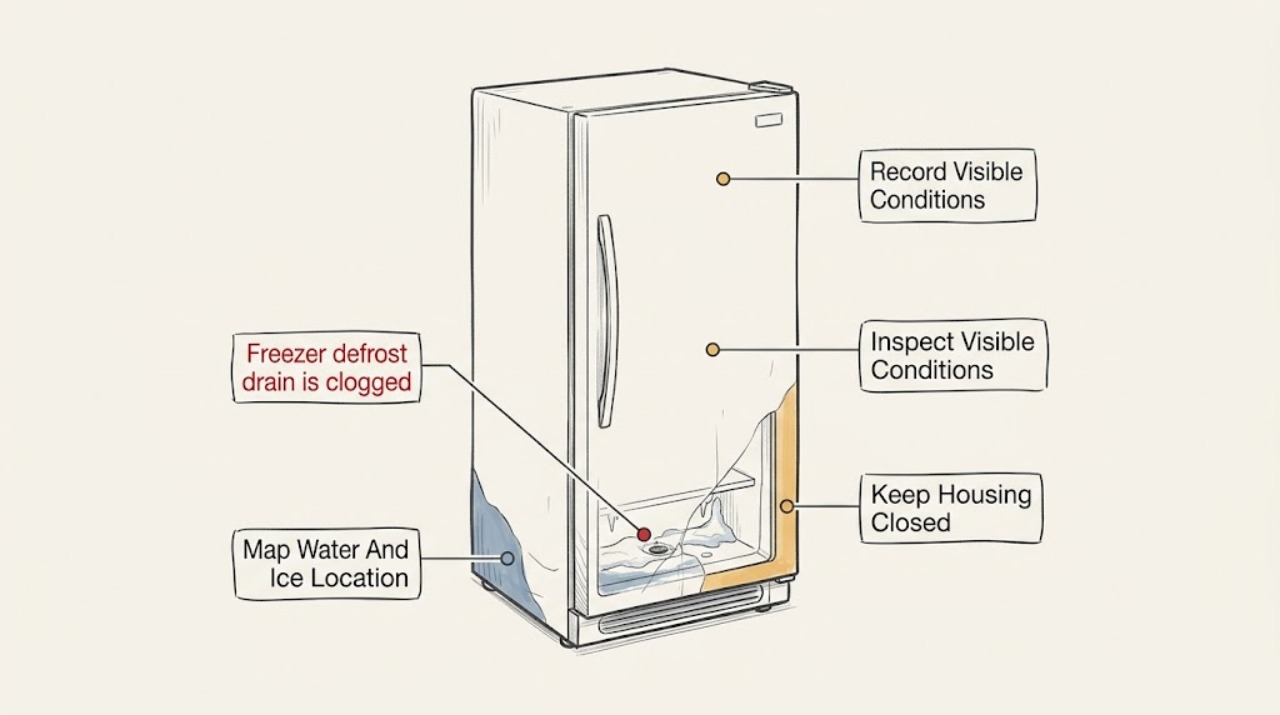
A clogged or frozen defrost drain often shows up as ice or water collecting on the freezer floor, under a basket, around the rear drain area, or on the floor outside the appliance. First document where the water or ice appears, when it returns, the door-seal condition, and the appliance temperature or food condition. Do not remove an interior panel, poke the drain with a sharp object, apply a heat source or chemical, or touch electrical, fan, or refrigerant components. If water reaches electrical parts, the freezer temperature or food safety is uncertain, there is a burning smell, or the problem keeps returning, keep the door closed as much as practical and arrange appliance-repair service.
Before you begin
Safety first
- Do not remove panels or liners, poke or flush a hidden drain, use sharp tools, heat, chemicals, or pressure, touch electrical, fan, coil, or refrigerant components, or move the appliance into a wet area.
Work through in order
Diagnostic checks
Use only checks that match the exact appliance or system and its official guide.
-
Check 1
With the freezer door open only briefly and without removing panels or shelves that require force, look at the accessible floor, lower basket area, door threshold, and nearby floor outside the appliance; do not touch ice around a hidden opening.
Expected result: Record whether ice is under a basket, water is pooling inside, water is escaping at the door, or a puddle appears on the floor outside, and note the side or corner where it starts.
Next step: Take a quick photo without exposing food or hidden parts and arrange service if the water or ice returns. Wipe only accessible water away from food and electrical areas without moving the appliance.
Stop if: Stop immediately if water reaches a cord, receptacle, control, or other electrical area, if the floor is slippery, or if seeing the area would require removing a panel or forcing a part.
Why this matters
Why: Ice beneath a lower basket or water escaping near the freezer can be consistent with defrost-water drainage trouble, while water at the door perimeter can also involve a seal or level issue. Location narrows the service handoff but does not prove the drain is blocked.
-
Check 2
Record when the ice or water appears and whether it returns after ordinary freezer operation, a door-left-open event, a power interruption, or a visible defrost event; do not force a defrost cycle or repeatedly open the door to test it.
Expected result: Note a one-time spill, a recurring puddle, ice that rebuilds in the same area, or water that appears after the appliance has warmed or lost power.
Next step: Provide the timeline to the appliance technician and keep the door closed as much as practical. Do not apply heat, chemicals, sharp tools, or water to the drain.
Stop if: Stop if the freezer is warming rapidly, food is thawing, the issue follows a burning smell or electrical event, or water is spreading toward electrical equipment.
Why this matters
Why: Repeated accumulation in the same location supports a drainage, defrost, or door-seal assessment; a spill or power event may have a different explanation. Timing alone cannot distinguish a frozen drain from a failed heater or control.
-
Check 3
From the outside, inspect the visible door gasket and frame for a continuous contact pattern, tears, gaps, frost tracks, or objects preventing normal closure; close the door normally without pressing hard or removing the gasket.
Expected result: Record whether the gasket looks continuous and the door closes evenly, or whether there is a visible gap, loose section, frost pattern, or door that springs back open.
Next step: Remove only an obvious loose item from the door path if it can be done safely, then report the seal observation. Do not peel, heat, glue, or replace the gasket without model-specific direction.
Stop if: Stop if the gasket is torn, the door is misaligned or heavy, frost prevents closure, or correcting the condition would require disassembly or force.
Why this matters
Why: Warm, humid air entering through a poor seal can increase frost and water accumulation and may mimic a drain problem. A good visible seal does not rule out a hidden drain or defrost fault.
-
Check 4
Read the freezer display or an appliance thermometer if already installed, and briefly observe whether food remains solidly frozen or shows signs of thawing; do not taste food and do not leave the door open while investigating.
Expected result: Record the visible temperature reading or uncertainty, the presence of ice crystals, soft or leaking packages, and whether the freezer has an alert or power-loss indication.
Next step: Keep the door closed, follow current food-safety guidance for uncertain or thawed food, and tell the technician the temperature and food condition. Do not compensate by changing wiring, controls, or refrigerant.
Stop if: Stop if the temperature cannot be confirmed, food is thawing, the display is abnormal, the cabinet is wet near electrical parts, or there is a burning smell.
Why this matters
Why: A confirmed cold reading with localized ice supports a service diagnosis focused on drainage or defrost behavior; an uncertain or elevated temperature changes the priority to food safety and cooling performance. Appearance or odor alone cannot establish food safety.
-
Check 5
From a safe position around the appliance, look for accessible water under or beside the freezer, a visibly displaced pan, damp flooring, or damage around the base; do not pull the appliance out, remove a rear cover, or reach beneath it.
Expected result: Note whether water is collecting outside, the floor or cabinet is soft or stained, the pan appears displaced if visible, or there is no external water despite interior ice.
Next step: Photograph the accessible base area and request appliance repair. Keep the appliance in place and avoid wet electrical areas until inspected.
Stop if: Stop for water near the cord or receptacle, a wet or damaged base, refrigerant or electrical concerns, a hot surface, burning odor, or any need to move the appliance.
Why this matters
Why: External water or a displaced pan can point to a drainage or appliance-level concern, while interior ice with no external water can remain within a hidden drain or defrost path. The distinction needs model-specific inspection.
Use your observations
Decision map
Find the observation that best matches what you see, then follow the next safe action.
-
PATH 01Next step
What you see
Ice or water repeatedly collects under the freezer basket or in the same interior area, while the temperature remains confirmed and there is no electrical warning.
Do this next
Arrange appliance-repair service for a model-specific defrost-drain and defrost-system assessment. Do not remove the interior panel or attempt to clear a hidden drain.
-
PATH 02Next step
What you see
Water appears at the door edge, the gasket has a gap or tear, or the door does not close evenly.
Do this next
Request assessment of the door seal, alignment, frost entry, and drain symptoms together. Do not heat, glue, peel, or replace the gasket without model-specific instructions.
-
PATH 03Next step
What you see
The freezer is warming, food is soft or thawed, the temperature is unknown, or a power event occurred.
Do this next
Keep the door closed as much as practical, follow current FoodSafety.gov guidance for uncertain food, and request prompt appliance service. Do not taste food or repeatedly open the freezer to check it.
-
PATH 04Next step
What you see
Water is near electrical parts, the cabinet or floor is wet or damaged, or there is a burning smell, smoke, sparking, or abnormal heat.
Do this next
Stop using the appliance if it can be done without approaching the hazard, keep people away from the wet area, and arrange urgent appliance or electrical service; use emergency services for smoke or fire. Do not touch wet electrical components.
-
PATH 05Next step
What you see
The freezer is a manual-defrost design or has no visible defrost drain, and the symptom is not explained by a spill or door seal.
Do this next
Confirm the model and manual-defrost design with the owner documentation or technician. Do not assume a universal drain location or use a tool, heat, or chemical to create one.
Helpful context
Understand the symptom
The drain design depends on the freezer
Not every freezer has a defrost drain. Manufacturer support information distinguishes self-defrost upright models from manual-defrost chest models, and model-specific layouts can put the drain behind an interior panel or use a different plug and pan arrangement. Ice or water location is useful evidence, but it is not permission to remove a panel or flush a hidden tube.
Keep water, food, and electricity separate
Use only external or already visible observations. Keep hands away from electrical parts, fans, coils, and hidden drain openings. Do not use a hair dryer, heat gun, boiling water, wire, knife, chemical cleaner, or pressurized tool to clear ice. If water approaches a receptacle, cord, control, or other electrical area, stop and arrange service.
Protect the food while arranging service
Limit door opening and document the appliance thermometer or display if one is already present. Do not taste food to decide whether it is safe. If the freezer has warmed, food contains no longer-frozen items, or the temperature cannot be confirmed, follow current government food-safety guidance and ask for professional advice rather than guessing.
Only after diagnosis
Potential parts
- freezer drain tube
Consider this category only if a technician confirms that the model has a drain tube and that it is damaged, obstructed beyond safe access, or otherwise the failed component.
Confirm the freezer model, self-defrost design, tube routing, seals, and manufacturer fit information; chest and manual-defrost designs may not use this part. - freezer drain heater
Consider this category only after a technician identifies a failed or missing drain-heating component and rules out the door seal, defrost control, drain path, and airflow causes.
Verify the exact appliance model, heater design, electrical specification, and approved installation procedure; never add a heat source or wire a heater as a DIY drain fix. - freezer drain pan
Consider this category only if the technician confirms that the accessible pan is cracked, displaced beyond adjustment, or incompatible with the appliance’s defrost-water path.
Confirm model, pan position, capacity, mounting, and clearance before selection; a pan replacement will not correct a hidden clog or defrost fault.
When checks do not resolve it
Need a professional?
Arrange appliance-repair service for recurring ice or water, an unexplained defrost-drain symptom, a freezer that is warming, a failed or uncertain door seal, or a condition that would require removing a panel. Seek urgent service for water near electrical parts, a burning smell, smoke, sparks, abnormal heat, or food-temperature uncertainty.
Safety scope: Do not remove panels or liners, poke or flush a hidden drain, use sharp tools, heat, chemicals, or pressure, touch electrical, fan, coil, or refrigerant components, or move the appliance into a wet area.
Have this ready
- Provide the freezer type and model information already visible, interior and exterior water or ice location, recurrence timing, door-seal result, visible temperature or food condition, power events, and safe photos. Do not provide or create photos of exposed electrical, fan, refrigerant, or hidden drain components.
Common questions
FAQ
Does ice under the freezer basket prove the defrost drain is clogged?
No. It is a useful clue, especially on models with a self-defrost drain, but a door-seal problem, defrost fault, spill, or model-specific design can look similar. Document the location and have the system assessed without removing a panel.
Can I poke the drain or melt the ice with a hair dryer?
No. Do not use sharp tools, heat, chemicals, pressure, or a hidden-drain flush. These can damage the liner or create electrical, fire, or water hazards. Arrange model-specific appliance service.
How do I know whether the food is still safe?
Use an appliance thermometer and current FoodSafety.gov guidance rather than taste, odor, or appearance alone. Keep the door closed as much as practical and treat unknown or thawed food as a food-safety decision separate from the drain repair.
When is a clogged freezer drain urgent?
Escalate promptly for water near electrical parts, warming or uncertain food temperature, a burning smell, smoke, sparks, abnormal heat, repeated water damage, or a condition that requires opening the appliance.
Read the exact guide
Official sources
- Food Safety in a Disaster or EmergencyFoodSafety.gov, U.S. Department of Health and Human Services · Emergency and power-loss food-safety guidance; it is included for temperature and food decisions when a freezer fault affects stored food, not for appliance repair.
- 4 Steps to Food SafetyFoodSafety.gov, U.S. Department of Health and Human Services · General government food-safety guidance; use current official guidance for the actual food and temperature circumstances.
- Refrigerator & Freezer - Drain TubesGE Appliances · GE and Hotpoint appliance support information; use its model distinctions as examples and confirm the reader’s own model.
- Side-by-Side Refrigerator - Drain TubeGE Appliances · GE side-by-side support article; its symptom locations and procedures are not universal to every freezer and are not used here as DIY clearing instructions.
Community feedback
Share a repair observation
Share a plain-text repair observation. Accepted observations are published automatically; this page may take a moment to update.