
On this page
Start here
Quick answer
If a Frigidaire freezer has water or ice collecting at the bottom and the defrost drain appears blocked, protect the food and the floor, then disconnect power before any cleaning or defrosting that your exact model manual permits. Do not chip ice with a knife, pour boiling water into an unknown opening, use an open flame or heat gun, remove sealed-system panels, or work near energized parts. First check that the door closes and the gasket seals, that food is not blocking air vents, and that the freezer has power; Frigidaire identifies a poor door seal, blocked airflow, and excessive frost as causes of frost or cooling problems. If the drain opening is not clearly user-accessible in the model instructions, if ice returns after the documented defrost procedure, or if water reaches wiring, stop and arrange appliance service. Record the model, symptoms, frost location, and whether the freezer is still cooling so the technician can distinguish a frozen drain from a door, airflow, defrost-system, or cooling fault.
Before you begin
Safety first
- Keep the freezer out of service when it is leaking toward electrical parts, unsafe to approach, repeatedly tripping power, warming food, or producing smoke or a burning smell. Do not remove evaporator or sealed-system panels, force a drain tube, or use flame or sharp tools.
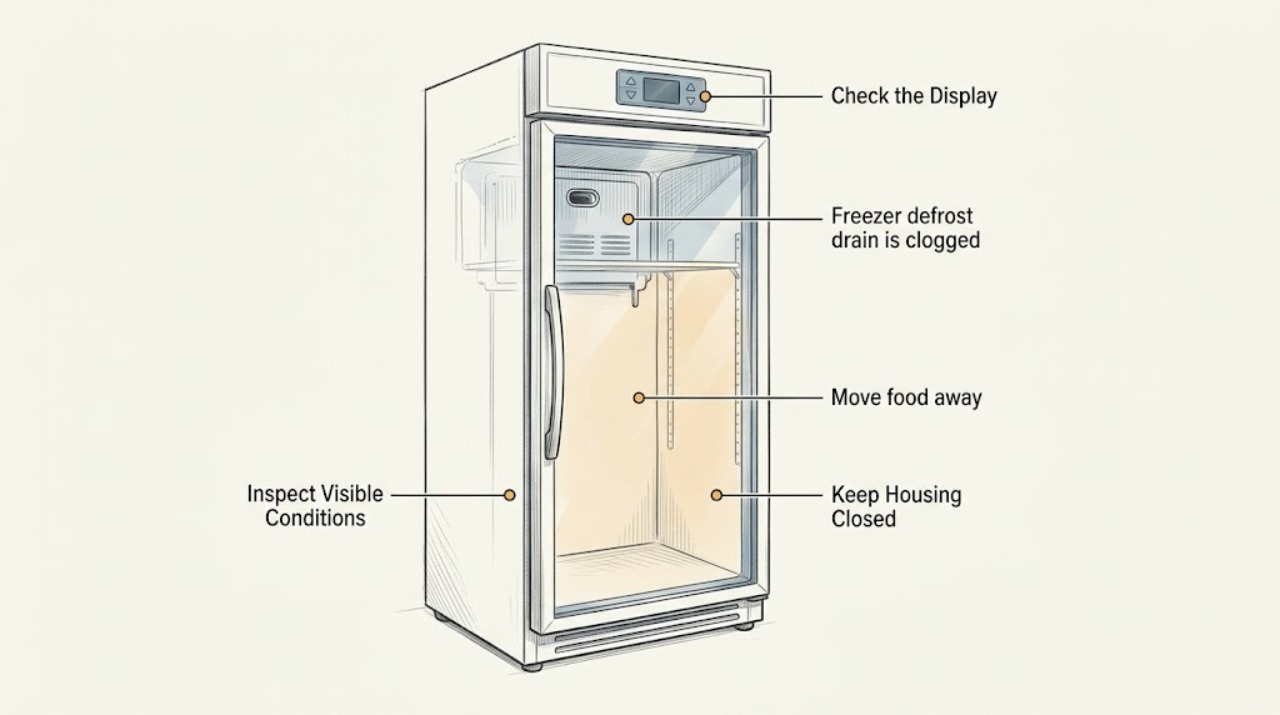
Work through in order
Diagnostic checks
Use only checks that match the exact appliance or system and its official guide.
-
Check 1
Move food away from the wet area, protect the floor, and from a dry position note whether there is standing water, a solid ice sheet, water under the cabinet, a warm interior, smoke, a burning smell, or water near the cord or electrical connections. Do not touch wet electrical parts.
Expected result: There is only localized ice or water, the leak is spreading, food is thawing, the cabinet is warm, or water has reached electrical equipment.
Next step: If water reaches electrics, there is smoke or a burning smell, or the appliance is unsafe to approach, keep clear and obtain qualified or emergency help. Otherwise continue only with power disconnected and the exact model instructions available.
Why this matters
Why: Localized ice can fit a blocked or frozen drain pattern, but spreading water, warming food, or water near electrics raises the urgency and may indicate a broader cooling or electrical problem.
-
Check 2
Inspect the door or lid closure and gasket without removing it: close the door on a clean, dry seal, look for a visible gap or distortion, and check that an ice-chute flap (if fitted) closes. Do not force the door or use a generic gasket adjustment.
Expected result: The gasket seals evenly, a corner remains open, the gasket is warped or torn, the ice chute stays open, or the freezer type has no such chute.
Next step: Correct only an obvious obstruction that the manual permits you to remove; otherwise photograph the gap or damaged seal and arrange service. Continue to the airflow check if the seal closes normally.
Why this matters
Why: A gap or open chute can admit warm moist air and create recurring frost that mimics a drain clog. An intact seal makes that cause less likely but does not prove the drain is clear.
-
Check 3
Check that interior lights or controls respond and verify the freezer is not set to Off; inspect the breaker or fuse only from a dry, safe position. Confirm the power cord is secure and do not use an extension cord as a workaround.
Expected result: The interior is powered and cold, the display is blank, the breaker has tripped, the cord is loose, or power returns only intermittently.
Next step: Follow Frigidaire's power guidance only for a safe reset; do not repeatedly reset a tripping circuit. If power remains absent or unstable, stop and call appliance or electrical service before investigating the drain.
Why this matters
Why: A blank or intermittent freezer can stop normal defrost and cooling cycles, while a powered freezer with localized bottom ice keeps a drain or airflow issue more plausible. Repeated breaker trips are not a drain-clearing signal.
-
Check 4
With power disconnected, identify whether the freezer is upright or chest style and consult the exact Frigidaire manual for the defrost-drain location and user-permitted procedure. Look only at an explicitly accessible opening; do not remove an evaporator cover, sealed panel, fan guard, or drain tube by force.
Expected result: The manual identifies a user-accessible drain, the opening is hidden behind a panel, ice or debris is visible, or the manual cannot be found for the model.
Next step: If the manual explicitly permits cleaning, perform only that procedure and keep tools away from liner, wiring, coils, and refrigerant tubing. If access is unclear or requires disassembly, stop and provide the model to qualified service.
Why this matters
Why: A clearly documented opening supports a limited model-specific cleaning step. A hidden opening, unknown procedure, or force needed to reach it means the suspected restriction is not a safe DIY access point.
-
Check 5
Check loading and airflow: leave the manual-specified vents clear, keep packages from pressing against the rear wall, and note whether frost covers one drain area or much of the back wall. Do not scrape heavy frost or bend an evaporator cover.
Expected result: Vents are blocked, frost is widespread, frost is concentrated at the bottom or drain area, or there is little frost but the freezer is warm.
Next step: Reposition food only as the manual allows and monitor after the documented procedure. If heavy frost, warming, or recurrence remains, stop operating the freezer and arrange service rather than dismantling the cooling system.
Why this matters
Why: Blocked airflow or widespread frost supports Frigidaire's frost and airflow causes. Bottom-only recurrence after a documented defrost is more consistent with a drain-path problem; little frost with warming suggests a cooling or power fault instead.
-
Check 6
After any model-approved defrost or cleaning step, record whether the floor stays dry, whether ice reforms, whether the freezer reaches and holds normal cooling, and how long the symptom takes to return. Keep the model, serial, photos, and procedure used for service.
Expected result: The symptom clears and cooling is normal, ice returns, water returns without visible ice, or cooling remains poor.
Next step: Use the freezer only if it is dry, cooling normally, and the manual's checks are complete. For recurrence, persistent water, poor cooling, or any unsafe sign, stop and request qualified Frigidaire appliance service.
Why this matters
Why: A lasting dry floor and normal cooling support a temporary accessible blockage or frost event. Recurrence or poor cooling points to a deeper drain restriction, defrost-system issue, airflow problem, or separate cooling fault that needs diagnosis.
Use your observations
Decision map
Find the observation that best matches what you see, then follow the next safe action.
-
PATH 01Next step
What you see
Water is spreading under the freezer, reaches wiring or the cord, food is warming, smoke or a burning smell is present, or the freezer is unsafe to approach.
Do this next
Keep clear, disconnect power only if it can be done without touching water or damaged equipment, and obtain qualified appliance or emergency help. Do not reset a wet or repeatedly tripping circuit.
Why this path and its safety boundary
Why it matters: The situation is no longer a limited drain check; water, electrical, food-safety, or equipment hazards may be present.
-
PATH 02Next step
What you see
The gasket has a gap or the ice-chute flap stays open, and frost is widespread or returns quickly.
Do this next
Remove only a simple obstruction allowed by the manual; replace a damaged seal or diagnose a persistent door problem through qualified service. Keep vents clear and do not scrape the liner.
Why this path and its safety boundary
Why it matters: Warm, moist air entering the compartment or blocked airflow is more likely than an isolated drain obstruction.
-
PATH 03Next step
What you see
Power is absent or intermittent, the breaker trips again, or the controls remain blank while the freezer is plugged in.
Do this next
Follow the official power checks once from a dry, safe position, then stop and call appliance or electrical service for persistent loss or trips. Do not use an extension cord or repeatedly reset the breaker.
Why this path and its safety boundary
Why it matters: The freezer may not be completing normal cooling or defrost cycles, and a circuit or appliance electrical fault is more likely than a drain-only issue.
-
PATH 04Next step
What you see
The exact manual permits access to the drain, a limited cleaning or defrost procedure is completed, and the floor dries while cooling returns to normal.
Do this next
Monitor for renewed water or ice and keep the procedure and timing recorded. Stop and arrange service if the symptom returns or cooling changes.
Why this path and its safety boundary
Why it matters: A temporary ice or accessible drain restriction is plausible, but recurrence still matters because the underlying frost cause may remain.
-
PATH 05Next step
What you see
The drain is hidden behind a panel, the opening cannot be identified, the model manual gives no user procedure, ice returns, or the freezer remains warm after defrost.
Do this next
Leave the freezer powered off if it is leaking or unsafe, preserve the model and symptom history, and request qualified Frigidaire appliance service. Do not remove evaporator covers or sealed-system parts.
Why this path and its safety boundary
Why it matters: The restriction may be deeper in the drain path, or a defrost, fan, airflow, or cooling fault may be involved; further access is not a safe generic repair.
Helpful context
Understand the symptom
What a clogged defrost drain usually looks like
A drain problem is most plausible when meltwater or a sheet of ice collects on the freezer floor, the same ice returns after it melts, or water appears below the appliance after a defrost event. The visible ice is not proof that the drain tube itself is reachable: the opening may be behind a cover or part of a model-specific defrost assembly. Treat the symptom as a clue and confirm the exact freezer instructions before opening anything.
Rule out door and airflow causes first
Frigidaire says frost can result from warm air entering through a warped or poorly sealing gasket, an ice-chute flap that does not close, a very low setting, or blocked airflow. A freezer with frost across the back wall or food packed against vents may have more than a drain restriction. Do not scrape the liner or rearrange panels to reach an assumed drain.
Use the model manual for any defrost step
An upright freezer's model number is on the interior side trim, while a chest freezer's is on the left exterior wall above the access panel, according to Frigidaire. Record it before looking up the manual. Follow only the manual's user-accessible cleaning or defrost instructions; a generic tool, water temperature, or disassembly sequence is not safe to assume across freezer designs.
A recurrence points beyond a surface blockage
If the ice or water returns after the exact documented procedure, the restriction may be deeper in the drain path or the underlying defrost system may not be melting ice correctly. A door leak, blocked vent, fan or sensor issue, or cooling fault can also recreate the symptom. Leave the appliance out of service if it is warming, leaking toward electrical parts, or cannot be safely assessed.
Safety boundary
Stop conditions
- Stop immediately for water near the cord or electrical parts, smoke, burning smell, damaged wiring, repeated breaker trips, rapid leakage, or an unsafe wet floor. Keep clear and obtain qualified or emergency help.
- Disconnect power before any model-approved defrost or cleaning step, but do not touch a plug, cord, or electrical equipment through water. Do not repeatedly reset a tripping circuit.
- Do not chip ice with a knife or sharp tool, use an open flame or heat gun, pour boiling water into an unidentified opening, bend an evaporator, remove sealed-system panels, or force a hidden drain tube.
- Stop when the exact model manual is unavailable, the drain location is uncertain, the permitted procedure does not clear the symptom, ice or water returns, or the freezer remains warm. Arrange qualified appliance diagnosis.
Only after diagnosis
Potential parts
- defrost drain tube, grommet, or drain-trough component
Consider this category only after qualified diagnosis confirms a restriction or damaged component in the drain path and the exact model parts list identifies it.
Drain routing, grommets, and trough designs vary by Frigidaire freezer model and style. Do not select a tube by appearance or generic dimensions. - door gasket or seal
Consider this category only if inspection confirms a torn, warped, or non-sealing gasket is allowing frost and recurring meltwater.
Upright and chest-freezer seals are model-specific; confirm the exact model and diagnosis before ordering. - defrost heater, sensor, or control component
Consider this category only when qualified diagnosis finds that ice returns because the defrost system is not operating, rather than because an accessible drain is blocked.
Defrost components differ by model and electrical design. Do not test or replace energized or sealed components as a user-level drain repair. - evaporator fan or airflow component
Consider this category only if qualified diagnosis links widespread frost, blocked airflow, or poor cooling to a fan or airflow fault.
Fan assemblies and controls are model-specific and may sit behind covers. Confirm the exact model and service diagnosis first.
When checks do not resolve it
Need a professional?
Arrange Frigidaire or qualified appliance service when the drain is inaccessible, the model-specific defrost procedure is unavailable, the freezer keeps leaking or icing after the documented check, cooling remains poor, the gasket is damaged, or power is unstable. Treat water near electrical equipment, smoke, burning smell, repeated breaker trips, or unsafe flooding as urgent safety conditions.
Safety scope: Keep the freezer out of service when it is leaking toward electrical parts, unsafe to approach, repeatedly tripping power, warming food, or producing smoke or a burning smell. Do not remove evaporator or sealed-system panels, force a drain tube, or use flame or sharp tools.
Common questions
FAQ
How do I know whether my Frigidaire freezer drain is clogged?
A recurring sheet of ice or water on the freezer floor after defrost is consistent with a drain-path problem, but it is not proof. First check the door seal, ice-chute flap if present, vents, power, and the amount and location of frost. Use the exact model manual to identify any user-accessible drain; stop if access requires panel removal.
Can I pour hot water into a Frigidaire freezer drain?
Do not pour boiling water into an unidentified opening or use heat as a generic fix. The safe drain location and permitted defrost method vary by model. Disconnect power and follow only the exact manual's user procedure; otherwise arrange qualified service.
Why does ice keep returning after the freezer drain seems clear?
Recurrence can mean the drain path is still restricted, but Frigidaire also identifies a poor gasket, an open ice-chute flap, blocked vents, excessive frost, and cooling or power problems as competing causes. Record how quickly ice returns and have service diagnose persistent or widespread frost.
Should I remove the evaporator cover to reach the drain?
No. Remove a cover only if the exact model instructions explicitly classify it as user-accessible; otherwise stop. A hidden drain may be part of the defrost and airflow assembly, and forcing access can damage the liner, wiring, fan, or refrigerant tubing.
When should I call a Frigidaire freezer technician?
Call when the drain is inaccessible, water or ice returns after the documented procedure, the freezer remains warm, power is unstable, the gasket is damaged, or you cannot safely identify the cause. Treat water near electrical parts, smoke, burning smell, repeated breaker trips, and unsafe flooding as urgent.
Read the exact guide
Official sources
- Where can I find my model and serial number?Frigidaire · Official Frigidaire owner-support page; model-number locations vary by upright versus chest freezer and should be used to retrieve the correct manual.
- What should I do if my freezer isn't running?Frigidaire · Official Frigidaire owner-support guidance for a freezer that is not running; electrical repairs remain outside a user-level drain inspection.
- Refrigerators / Freezer - Frost Build UpFrigidaire · Official Frigidaire owner-support guidance for frost buildup; it does not provide a universal drain-clearing or disassembly procedure for every freezer model.
- Freezer - Not Freezing or Not CoolingFrigidaire · Official Frigidaire owner-support guidance for freezer cooling symptoms; it does not establish a model-independent drain repair.
Community feedback
Share a repair observation
Share a plain-text repair observation. Accepted observations are published automatically; this page may take a moment to update.