
On this page
Start here
Quick answer
When water returns after you defrost a freezer, the defrost drain may still be blocked by ice or debris, or the drain path may be inaccessible without removing a panel. Frost-free freezers send meltwater through a drain tube to a pan below; ice on the freezer floor, water at the door, or repeated water on the floor can indicate that the path is not staying open. First protect the food and floor, disconnect power according to the model instructions, and allow the ice around the drain to thaw naturally. Do not use a knife, ice pick, hair dryer, heater, or force against the liner. If the drain opening is visibly accessible and the owner's manual permits flushing, use only that procedure and confirm that water reaches the pan below. If the drain is behind a panel, the freezer is a top- or bottom-freezer design that requires disassembly, water returns after a permitted flush, or frost rapidly builds again, stop and arrange qualified appliance service.
Before you begin
Safety first
- Do not remove freezer panels, test live defrost components, use heat or sharp tools, dismantle a hidden drain, or operate through a water-damage condition.
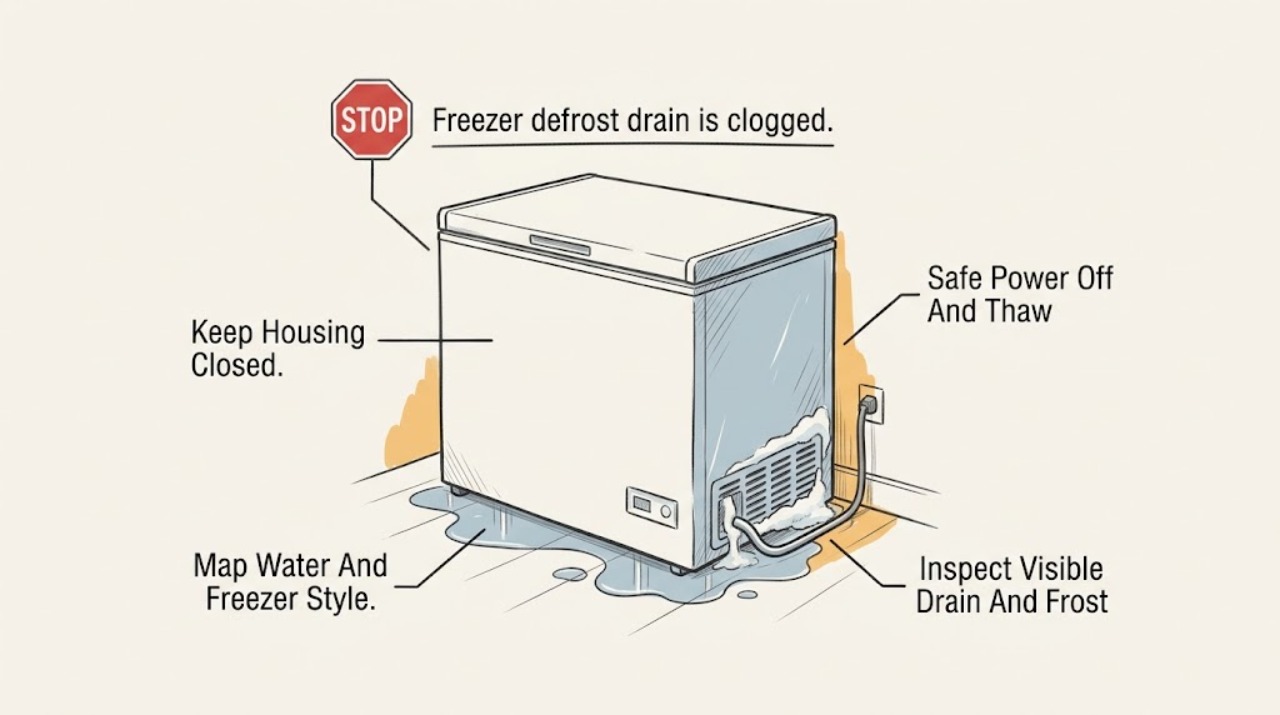
Work through in order
Diagnostic checks
Use only checks that match the exact appliance or system and its official guide.
-
Check 1
From a safe dry position, identify whether the freezer is chest, upright, top-freezer, bottom-freezer, or side-by-side, and record where water or ice appears: freezer floor, rear wall, under a basket or drawer, below the appliance, or at the door.
Expected result: The same low area repeatedly ices, water appears only during or after defrost, the freezer floor floods, water reaches the room floor, or the location is unclear.
Next step: Photograph the ice and water location, find the model number, and use the freezer's manual to determine whether the drain is intended to be accessed. Keep food and flooring protected while continuing only with safe checks.
Stop if: Stop for an active floor leak, unstable ice, wet electrical connections, or any need to climb, move the appliance, or remove a panel.
Why this matters
Why: A recurring low spot after defrost supports a drain-path problem, but the access and service boundary vary by freezer style. Water under drawers or on the floor can also involve a hidden tube or pan that is not a user-accessible part.
-
Check 2
Protect or relocate the frozen food, disconnect power as the exact owner's manual directs, place a pan or towels for meltwater, and allow ice around the drain area to thaw without force.
Expected result: The ice melts and exposes a drain opening, the opening remains hidden, meltwater overflows the collection setup, or the liner, gasket, cord, or cabinet appears damaged.
Next step: Keep power disconnected until the model-approved thaw and cleanup are complete. Use the access branch only if the manual identifies a visible drain and a safe flush procedure; otherwise arrange service.
Stop if: Do not use a knife, ice pick, sharp tool, hair dryer, heater, open flame, or electrical appliance near meltwater, and do not force stubborn ice or a panel.
Why this matters
Why: Natural thawing can reveal an accessible drain without damaging the liner. A hidden opening, uncontrolled water, or damage changes the task from a simple thaw to professional service and water-damage control.
-
Check 3
Only when the drain opening is visible without removing a panel, inspect the opening and surrounding channel for ice, food residue, labels, or debris; also note frost on the rear wall, floor, basket, and door gasket without scraping the liner.
Expected result: Ice or debris blocks a visible opening, the channel is open but frost returns at the same area, the opening cannot be seen, or the gasket has a gap, tear, or poor contact.
Next step: Follow the exact manual for an accessible drain flush or stop and request service for hidden access, recurrent frost, damaged gasket, or any obstruction that cannot be removed without force.
Stop if: Do not poke the drain with wire, drill, knife, ice pick, or compressed air, and do not remove an evaporator cover or rear panel as part of this check.
Why this matters
Why: A visible plug supports a localized drain obstruction. An open drain with recurrent frost shifts concern toward a seal, airflow, defrost, temperature, or hidden-tube problem; a hidden drain requires model-specific service rather than a generic probe.
-
Check 4
If the exact freezer manual permits homeowner cleaning of the visible drain, use only its approved warm-water flush method and a bulb baster or other specified tool; keep water away from controls and stop before the channel overflows.
Expected result: Water flows through and is heard or seen reaching the drain pan, flow is slow or backs up, water leaks into the compartment or floor, or the manual does not authorize this procedure.
Next step: If flow is clear, dry the compartment, restore power only as the manual directs, and monitor the next defrost event. If flow is not clear or water returns, leave the freezer off as needed and arrange appliance service.
Stop if: Do not use boiling water, chemical drain cleaner, compressed air, a wire, or a sharp probe, and do not flush a drain hidden behind a panel.
Why this matters
Why: A clear path to the pan supports a temporarily thawed or flushed drain. Slow flow, backup, leakage, or no authorized access indicates a deeper restriction, incorrect routing, pan problem, or service-required design.
-
Check 5
After the compartment is dry and power is restored only per the model instructions, inspect the door gasket contact, door closure, food placement, and frost pattern during normal use without blocking vents or repeatedly opening the door.
Expected result: The gasket is torn or loose, the door cannot close evenly, food holds it open, frost returns rapidly at the drain area, or the freezer remains dry with a normal frost pattern.
Next step: Correct only an obvious food-placement or door-closure issue without force. For a damaged gasket, recurring frost, temperature change, or repeat water, arrange qualified freezer service.
Stop if: Do not remove the gasket, cover vents, change defrost controls, or operate with a door that cannot seal.
Why this matters
Why: A poor door seal or blocked closure can admit moisture and recreate ice at the drain. Rapid or uneven frost with a clear drain suggests a defrost, airflow, temperature, or hidden drain issue rather than a one-time clog.
-
Check 6
Combine the freezer style, water location, drain access, flush result, frost pattern, door-seal condition, and recurrence to decide whether qualified appliance service is required.
Expected result: The visible drain clears and water does not return; or the drain is hidden, flow remains blocked, water reaches the floor, the pan overflows, frost returns, or the freezer has a temperature or fault symptom.
Next step: Keep the food and floor protected and arrange qualified appliance service for recurrence, hidden access, leaks, overflow, rapid frost, or temperature problems. Provide the model and the photos and observations.
Stop if: Do not remove panels, test live parts, change defrost components, or keep operating a freezer that is flooding or cannot maintain safe food temperature.
Why this matters
Why: A stable clear drain supports a resolved local ice or debris plug. Any recurrence or hidden-access condition leaves a drain tube, pan, defrost, seal, or control fault possible and cannot be selected from appearance alone.
Use your observations
Decision map
Find the observation that best matches what you see, then follow the next safe action.
-
PATH 01Safety boundary
What you see
The freezer manual identifies a visible drain opening, ice thaws, an approved flush flows to the pan, and water does not return after the compartment is dried.
Do this next
Restore power and food only as the manual directs, keep the door sealing normally, and monitor for recurrence during the next defrost cycle.
Why this path and its safety boundary
Why it matters: A temporary ice or debris restriction is more likely to have caused the backup.
Safety stop: Stop if water returns, the drain slows, frost rapidly rebuilds, or the cabinet or floor becomes wet again.
-
PATH 02Safety boundary
What you see
The drain is behind a freezer panel, the freezer style requires disassembly, or the manual does not provide an accessible cleaning procedure.
Do this next
Keep the freezer protected from further water and request qualified appliance service; provide the freezer style, model, ice location, and recurrence history.
Why this path and its safety boundary
Why it matters: The blockage may be in the hidden tube, pan, or defrost assembly, and manufacturer guidance places this access with service.
Safety stop: Do not remove the evaporator or rear panel, probe the tube, or use heat or sharp tools to reach it.
-
PATH 03Safety boundary
What you see
Water or ice returns at the same drain area after a permitted thaw and flush, or frost rapidly builds again while the visible drain remains open.
Do this next
Stop repeated flushing and arrange qualified appliance service to inspect the drain tube, pan, defrost system, seal, and temperature operation for the exact model.
Why this path and its safety boundary
Why it matters: A deeper or re-freezing drain restriction, door-seal problem, airflow issue, defrost component, or temperature fault becomes more likely than a one-time surface plug.
Safety stop: Do not alter defrost controls, remove covers, use a heater, or continue operating while water can reach food, wiring, or flooring.
-
PATH 04Safety boundary
What you see
Water reaches the floor, the drain pan overflows, meltwater cannot be contained, or the cabinet, cord, or nearby electrical equipment becomes wet.
Do this next
Disconnect power only if it can be done safely without contacting water, protect the floor, keep the freezer out of service, and arrange prompt appliance service.
Why this path and its safety boundary
Why it matters: The freezer has an active water-damage and electrical-risk condition in addition to a suspected drain problem.
Safety stop: Do not touch wet electrical parts, move the freezer through water, or restart it to test drainage.
-
PATH 05Safety boundary
What you see
The drain clears, but the gasket has a gap or tear, the door does not close evenly, or frost returns after food or the door holds it open.
Do this next
Correct only obvious food obstruction and arrange service for a damaged gasket, uneven door, recurring frost, or temperature change.
Why this path and its safety boundary
Why it matters: Moisture entering through a poor seal or closure can recreate frost and overload the defrost drain; the drain may not be the original cause.
Safety stop: Do not remove the gasket, block air vents, or keep operating with a door that cannot seal.
Helpful context
Understand the symptom
Why water returns after the freezer was defrosted
Defrosting can melt the ice that is visible on the freezer floor without clearing a frozen plug deeper in the drain tube. During the next automatic defrost cycle, meltwater meets that restriction and returns to the compartment or floor. A freezer may also have a drain opening behind an interior panel, a pan or tube that needs service, or a separate door-seal or defrost problem that creates excessive frost. The freezer style and the exact model manual determine whether any drain access is homeowner-safe.
Thaw safely and protect food and surfaces
Move food to safe cold storage, disconnect power as the owner's manual directs, and place towels or a pan where meltwater can collect. Let stubborn ice soften; do not chip it with a knife or ice pick, and do not use a hair dryer, heater, or other electrical appliance near meltwater. Avoid pulling on a panel or drain fitting. If the freezer cannot be safely emptied or isolated, use appliance service.
An accessible drain is different from a hidden one
Some side-by-side models have a visible drain hole near the rear interior floor, and the manufacturer may provide a manual-approved flush procedure. Many top- and bottom-freezer designs require disassembly to reach the drain tube, so a technician is recommended. Do not infer that a generic flush recipe or a visible puddle applies to every freezer; use the exact model instructions and stop when access requires a panel or service procedure.
Check why the blockage is recurring
If flow returns but water or ice comes back, look for a door gasket that does not seal, a door that is held open by food, or recurring frost at the same location. Warm moist air can create more frost than the drain can carry during defrost. A clean drain does not prove that the defrost heater, sensor, control, drain-tube routing, or pan is working correctly; those internal checks belong to a qualified servicer.
When a recurring drain backup needs service
Arrange appliance service if the drain is hidden behind a panel, the freezer repeatedly floods after a model-approved flush, water reaches the floor, the pan overflows, frost returns rapidly, the door gasket is damaged, or the unit has a fault or temperature problem. Persistent water can damage flooring and can refreeze into a slip hazard. Keep the freezer out of service when it cannot contain water safely.
Safety boundary
Stop conditions
- Disconnect power and stop use for water near electrical connections, an active floor leak, overflowing pan, damaged cord, or a freezer that cannot contain meltwater.
- Do not use a knife, ice pick, wire, compressed air, hair dryer, heater, open flame, or chemical drain cleaner to clear or thaw a freezer drain.
- Do not remove rear or evaporator panels, dismantle the drain tube, or alter the defrost system unless qualified service is performing the model-specific work.
- Arrange appliance service when the drain is hidden, a permitted flush does not restore flow, water returns, frost rapidly rebuilds, or food-safe temperature cannot be maintained.
Only after diagnosis
Potential parts
- defrost drain tube or drain grommet
Consider only when qualified service confirms a blocked, split, displaced, or re-freezing drain tube or grommet for the exact freezer model.
Tube routing and grommet dimensions vary by design; verify the exact model and approved repair procedure. - defrost drain pan or pan support
Consider only when service identifies a cracked, displaced, or overflowing pan after confirming the drain path is clear.
Pan shape, mounting, and location are model-specific; do not select from a photograph alone. - freezer door gasket
Consider only when a torn, loose, or poorly sealing gasket is confirmed as a source of recurring frost and drain overload.
Confirm the exact freezer model, gasket profile, and door configuration before ordering. - defrost heater, sensor, or control
Consider only after a technician confirms recurring frost or drain refreezing is caused by a failed defrost component rather than a seal or drain obstruction.
Do not bypass or substitute a defrost safety component; confirm the exact model part and electrical specifications through service.
When checks do not resolve it
Need a professional?
Arrange qualified appliance service when the freezer drain is behind a panel, the owner's manual does not authorize access, an approved thaw and flush does not restore flow, water returns after defrost, the pan overflows, water reaches the floor or electrical equipment, frost rapidly returns, the door gasket is damaged, or the freezer cannot maintain safe food temperature. Keep the unit off for an active electrical or water-damage hazard.
Safety scope: Do not remove freezer panels, test live defrost components, use heat or sharp tools, dismantle a hidden drain, or operate through a water-damage condition.
Common questions
FAQ
Why does water come back after I defrost the freezer?
Defrosting may melt visible ice while a deeper plug remains frozen in the drain tube. During the next defrost cycle, water meets the restriction and returns to the freezer or floor. A door-seal, pan, hidden-tube, or defrost-system problem can also recreate the symptom.
Can I flush a clogged freezer defrost drain myself?
Only when the exact model manual provides an accessible drain and an approved flush procedure. Some side-by-side designs allow this; many top- and bottom-freezer designs require disassembly and service. Do not probe a hidden drain or use sharp tools, heaters, or chemical cleaner.
How do I thaw ice around a freezer drain safely?
Protect the food and floor, disconnect power as the manual directs, collect meltwater, and let the ice soften naturally. Do not use a knife, ice pick, hair dryer, heater, open flame, or force against the liner or panel.
Why does the freezer drain clog again after it was cleared?
The tube may still be restricted or refreezing, or recurring moisture from a poor door seal, blocked closure, airflow issue, or defrost fault may be creating more frost. If water returns after an approved flush, arrange model-specific appliance service.
When should I call for freezer drain service?
Call when the drain is hidden, access requires a panel, water reaches the floor, the pan overflows, the drain remains blocked after the model-approved procedure, frost rapidly returns, the gasket is damaged, or food-safe temperature cannot be maintained.
Read the exact guide
Official sources
- Top Freezer Refrigerator - Drain TubeGE Appliances · GE top-freezer drain-tube symptoms and disassembly-required service guidance
- Bottom Freezer Refrigerator - Clogged Drain Tube, Ice on Freezer FloorGE Appliances · GE bottom-freezer drain-tube symptoms and repair-service boundary
- How to Defrost the FreezerWhirlpool · Whirlpool freezer defrost safety, water collection, model instructions, and sharp-tool boundary
- Side-by-Side Refrigerator - Drain TubeGE Appliances · GE automatic-defrost freezer drain-tube symptoms, accessible drain clearing, and service boundary
Community feedback
Share a repair observation
Share a plain-text repair observation. Accepted observations are published automatically; this page may take a moment to update.