
On this page
Start here
Quick answer
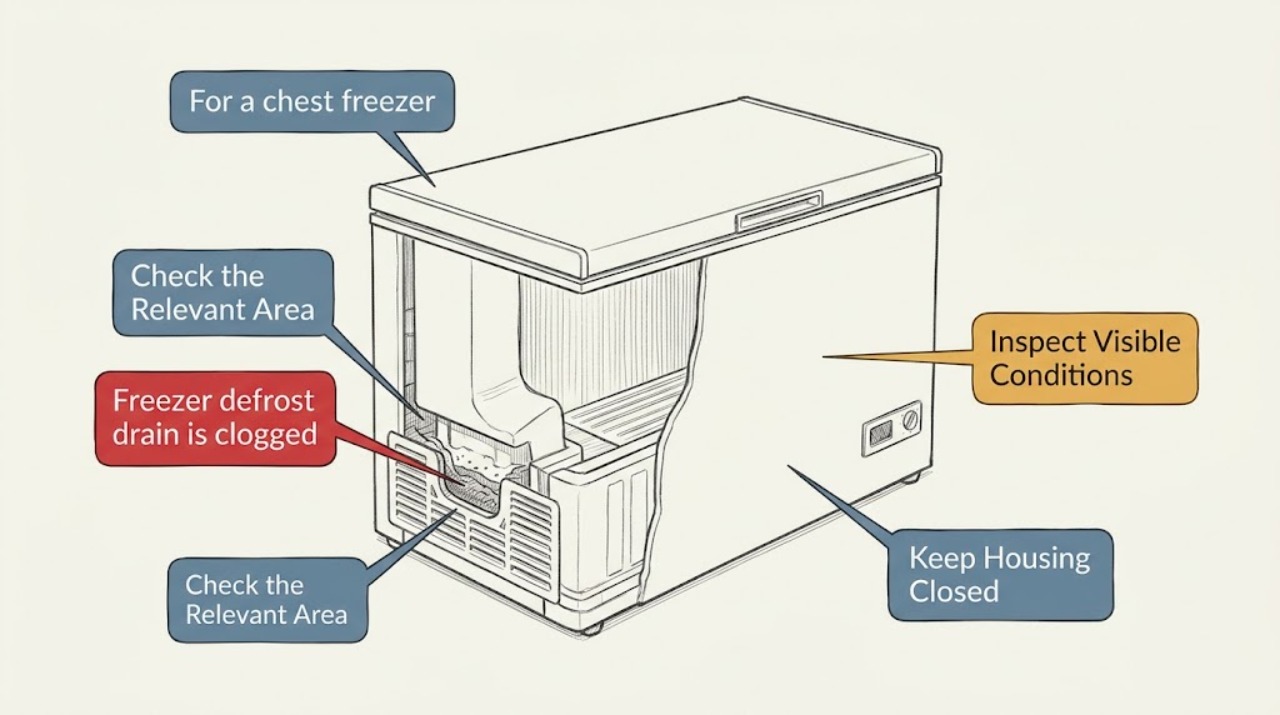
A clogged Haier freezer defrost drain usually shows as meltwater pooling inside, returning frost or ice around the drain opening, or water escaping onto the floor after a defrost. First protect the food and floor, turn the freezer off or unplug it only from a dry, safe location, and identify whether the unit is a chest freezer with an external drain plug or an upright model with an internal drain opening. Haier's official guidance says to remove the food, allow frost to melt, use a pan for draining where the model has a drain plug, and never use a sharp or metallic tool on ice because it can damage the cooling system. Do not probe deeply, pour water into a powered appliance, remove sealed panels, or force a blocked tube. If the drain remains blocked after the model-approved defrost, water reaches electrical parts, frost returns quickly, or the drain heater, tube, pan, or defrost system is suspected, keep the freezer off and arrange qualified appliance service.
Before you begin
Safety first
- Keep the freezer off for water near electrics, flooding, damaged cord or liner, recurring blockage, abnormal cooling, or a hidden drain. Do not use sharp tools, remove panels, test live components, or repeatedly restart to reproduce the leak.
Work through in order
Diagnostic checks
Use only checks that match the exact appliance or system and its official guide.
-
Check 1
Protect the area and food before touching the drain. Move food only if it can remain safely frozen elsewhere, turn the Haier freezer control to Off or unplug it from a dry, reachable connection, and look for water near the cord, compressor, control, or other electrical parts. Do not touch wet electrical equipment.
Expected result: Water is near electrical parts, the floor is flooding, the freezer is still powered while water is present, food is thawing, or the leak is a contained pool near the drain.
Next step: Keep clear, isolate power only from a safe dry location, contain water without reaching behind wet equipment, and arrange qualified help for electrical exposure or flooding. Otherwise continue with the freezer off and the food protected.
Stop if: Do not plug in, operate, or reach behind a Haier freezer while water is near electrical components or the connection is wet.
Why this matters
Why: Water near electrics or active flooding is a shock and property hazard. A contained pool can proceed to a model-specific defrost observation only after the appliance is safely de-energized.
-
Check 2
With power off and the freezer cool enough to inspect safely, identify the first wet point. Look at the interior drain opening or trough, the external drain plug on a chest model if present, the drain tube path that is visible without panels, the drain pan, the door or lid seal, and the area around the compressor.
Expected result: Ice surrounds an internal drain opening, water exits an external drain plug, the drain pan is overflowing, the seal has a gap, the compressor area is wet, or no drain path is visible.
Next step: Follow the exact model manual for the identified drain style. If the source is hidden, the pan cannot be safely accessed, or water reaches electrical parts, leave the freezer off and request service.
Stop if: Do not remove sealed covers, pull the freezer away while connected, or wipe around live or wet electrical parts to locate the leak.
Why this matters
Why: Ice at the opening or water at the drain plug supports a defrost-drain path; a seal, pan, compressor-area, or hidden source points to a different or additional problem. Haier models vary in drain design.
-
Check 3
For a Haier chest freezer with the documented external drain plug, place a stable shallow pan beneath the outside drain before removing the plug. Monitor the pan as frost melts and keep the drain opening unobstructed; for an upright or a model without an external plug, use only the drain and defrost method in that model's manual.
Expected result: Water flows into the pan, the plug is frozen or will not turn without force, the pan fills quickly, no water flows despite melted frost, or the unit has no external drain plug.
Next step: Keep monitoring without overflowing the pan and reinstall the plug only as the manual directs after drainage. Stop and arrange service for a stuck plug, no flow, hidden drain, or water that cannot be contained.
Stop if: Do not force a drain plug, insert a rigid tool into the tube, or leave a thawing freezer unattended with an unmonitored container.
Why this matters
Why: Flow into the pan confirms that the external drain route is open on that chest-freezer design. A frozen or immovable plug, rapid overflow, or no flow after approved defrost indicates a restriction or model-specific design that needs service guidance.
-
Check 4
Allow the frost around an accessible drain opening to melt naturally with the freezer off, using towels or a pan to control water. Remove only loose surface ice that comes away without force; do not chip, drill, scrape, or puncture the liner or cooling surfaces.
Expected result: The opening becomes visibly clear and water drains, surface ice melts but water remains pooled, the opening is hidden under a panel, or frost is too thick to melt within the model's approved defrost procedure.
Next step: Dry the accessible interior and follow the model's restart instructions only when the drain path is open and no damage is present. Arrange service for hidden, persistent, or recurring blockage.
Stop if: Never use a knife, screwdriver, drill, metal scraper, open flame, or unapproved heat source to clear freezer ice.
Why this matters
Why: Surface ice can temporarily seal a drain, but persistent pooling after a complete approved defrost suggests a tube, pan, heater, or internal defrost fault rather than a simple surface blockage.
-
Check 5
After the approved defrost and drainage, inspect the door or lid seal, food packaging, and loading pattern. Look for a seal gap, warm humid air entry, food or packaging blocking the drain area, frequent door opening, or a pan that cannot evaporate water; do not alter the seal or panels.
Expected result: The seal is visibly damaged or gapped, food or packaging blocked the opening, humid air enters frequently, the pan is full or inaccessible, or no entry or loading issue is visible.
Next step: Reposition only loose packaging and close the door or lid fully; arrange service for a damaged seal, inaccessible pan, recurring ice, or continued water on the floor.
Stop if: Do not continue using the freezer if water repeatedly reaches the floor, the seal is damaged enough to prevent closure, or the drain freezes again quickly.
Why this matters
Why: Warm humid air and blocked openings can increase frost and defrost water, while a damaged seal or pan problem can create water that resembles a drain clog. No visible user cause raises the likelihood of an internal drain or defrost fault.
-
Check 6
Once the drain is clear and the model-approved restart is complete, monitor the first defrost-related water event without placing hands inside the unit. Record whether water reaches the intended pan or drain, whether ice returns around the opening, and whether cooling, frost, or floor leakage changes.
Expected result: Water drains normally and the frost does not return, water backs up again, frost rapidly reforms, cooling is abnormal, or water appears away from the drain path.
Next step: Keep the freezer off and arrange qualified appliance service for recurrence, abnormal cooling, or a leak away from the drain. Provide the model, photos, drain style, and timing of the water event.
Stop if: Do not repeat full defrosts indefinitely, run the unit with water near electrics, or buy a drain heater or tube before model-specific diagnosis.
Why this matters
Why: A one-time clear drain with no recurrence supports a surface ice blockage; renewed ice or water, abnormal cooling, or a different wet point indicates a restricted tube, drain heater or defrost-system issue, seal problem, pan issue, or separate leak.
-
Check 7
Prepare the exact Haier model, chest or upright configuration, drain location, photographs of ice and water, defrost history, seal condition, and whether the appliance was moved or serviced. Use Haier's model documentation for any remaining user-level step and leave cabinet, sealed-system, heater, and electrical work to service.
Expected result: The drain is hidden, the approved defrost did not restore flow, the problem returns, the drain pan or heater is inaccessible, or the freezer cannot safely be returned to operation.
Next step: Arrange qualified Haier appliance service and provide the recorded pattern. Protect food according to its temperature and safety needs and keep the freezer off when the leak or electrical exposure persists.
Stop if: Do not remove panels, puncture insulation, test a heater live, or return the freezer to service solely because surface ice melted.
Why this matters
Why: Hidden or recurring blockage needs a technician to distinguish a tube, drain pan, drain heater, defrost control, seal, or water-source fault. A freezer that cannot safely contain water should not be used while awaiting diagnosis.
Use your observations
Decision map
Find the observation that best matches what you see, then follow the next safe action.
-
PATH 01Next step
What you see
A Haier chest freezer has surface frost around its external drain opening, and after power-off defrost water flows into a monitored pan without contacting electrical parts.
Do this next
Complete the model-approved defrost, keep the pan from overflowing, reinstall the drain plug as directed, and monitor for recurrence. Do not use sharp tools.
Why this path and its safety boundary
Why it matters: Surface ice or a temporary drain obstruction is more likely than a failed internal drain component.
-
PATH 02Next step
What you see
An upright Haier freezer has ice or water around an internal drain opening, but there is no external drain plug and the opening does not clear after the model-approved defrost.
Do this next
Keep the freezer off and arrange service; do not remove panels or push a wire, knife, or other tool into the drain.
Why this path and its safety boundary
Why it matters: A frozen or restricted internal tube, pan, drain heater, or defrost-system issue is more likely than a simple surface spill.
-
PATH 03Next step
What you see
Water appears around the compressor or at the rear pan, especially after humid conditions or frequent door opening, while the drain opening is not the first wet point.
Do this next
Keep water away from electrical parts, power off safely, and arrange service if the pan overflows, cannot be safely accessed, or the source is not clearly a user-accessible drain.
Why this path and its safety boundary
Why it matters: Defrost water exceeding pan evaporation or a separate rear leak is more likely than a blocked interior drain alone; Haier describes this rear-water pattern for some freezer designs.
-
PATH 04Next step
What you see
The door or lid seal has a visible gap, warm humid air enters frequently, or packaging blocks the drain area, and the drain clears after a complete safe defrost.
Do this next
Reposition only loose items and close the seal fully; arrange service for a damaged seal or recurring ice and water.
Why this path and its safety boundary
Why it matters: Excess frost and defrost water from air entry or loading is more likely than a failed drain component, although a damaged seal still needs attention.
-
PATH 05Next step
What you see
The drain clears briefly but freezes or backs up again, or water returns to the floor after the approved defrost.
Do this next
Keep the freezer off and arrange qualified appliance service with the recurrence timing and photos. Do not repeat tool-based clearing or buy parts by symptom alone.
Why this path and its safety boundary
Why it matters: A persistent tube restriction, drain heater or defrost fault, pan issue, seal problem, or separate leak is more likely than a one-time ice plug.
-
PATH 06Next step
What you see
Water is near the cord, compressor wiring, control, or other electrical parts; the floor is flooding; or the freezer has a damaged liner, cord, or seal that prevents safe closure.
Do this next
Keep clear, isolate power only from a safe dry location, protect food if possible, and obtain qualified or emergency help. Do not touch wet equipment or restart to test.
Why this path and its safety boundary
Why it matters: This is a shock, electrical, food-loss, or property hazard rather than a routine drain-clearing task.
Helpful context
Understand the symptom
Confirm that the water path is the defrost drain
A drain problem is more likely when water or ice is concentrated at the drain opening, under the evaporator area, or on the floor after frost melts. A chest freezer may route defrost water through an external drain plug, while an upright may send it through an internal tube to a pan. A door gasket leak, spilled food, cracked liner, blocked drain pan, or water around the compressor can look similar. Photograph the first wet area before moving food or wiping it away.
Use a complete, model-appropriate defrost rather than a sharp tool
Haier's chest-freezer instructions call for removing the food, switching the control off or unplugging the appliance, placing a pan under the drain plug, and allowing frost to melt. The exact drain location and procedure vary by model. Never chip ice with a knife, screwdriver, or other metallic instrument, and do not use force to push a blockage deeper into a tube. If the drain is hidden behind a panel or the approved thaw does not restore flow, stop at the user-level boundary.
A recurring clog needs the cause checked, not just the water removed
A drain that clears briefly and then freezes or overflows can reflect residual ice, a restricted tube, a drain pan problem, a defrost-system issue, a drain heater on equipped models, or warm humid air entering through the lid or door. Haier notes that frequent opening and humid food can increase defrost water in some freezer designs. Repeatedly thawing without checking the model's drain and defrost system can leave food at risk and can send water toward electrical parts.
Safety boundary
Stop conditions
- Stop for water near electrical parts, a wet cord or outlet, flooding, a damaged liner, an unsafe seal, abnormal cooling, or any situation where power cannot be isolated from a dry safe location. Arrange qualified or emergency help.
- Keep the freezer off when the drain remains blocked after the model-approved defrost, water returns to the floor, frost rapidly reforms, or the source is hidden behind a panel.
- Do not use knives, screwdrivers, metal scrapers, drills, open flames, unapproved heat, rigid wires, or force to clear a drain or frost. Do not puncture the liner or cooling system.
- Do not remove sealed panels, test a drain heater live, bypass a defrost control, pour water into a powered unit, or repeatedly restart the freezer to see whether the clog returns.
Only after diagnosis
Potential parts
- freezer drain tube
Consider this only if qualified inspection confirms a cracked, obstructed, frozen, or incorrectly routed drain tube after the model-approved defrost and accessible causes are ruled out.
Drain routing and tube dimensions vary by Haier chest and upright model. Confirm the exact model and service diagnosis before selecting a replacement. - freezer drain heater
Consider this only when the model has a drain heater and qualified testing confirms it is not preventing recurring drain freeze after airflow, seal, and defrost causes are checked.
Not every Haier freezer uses a drain heater, and heater placement and ratings are model-specific. Confirm the model, equipment, and diagnosis before ordering. - freezer drain pan
Consider this only if inspection confirms the intended defrost-water pan is cracked, displaced, blocked, or overflowing independently of the drain tube.
Drain pans differ by Haier freezer design and location. Confirm the exact model and safe fit before selecting a replacement.
When checks do not resolve it
Need a professional?
Request service for recurring or inaccessible drain blockage, a frozen drain that returns after defrost, a stuck drain plug, overflowing pan, damaged seal or liner, abnormal frost or cooling, water away from the intended drain path, or any electrical exposure.
Safety scope: Keep the freezer off for water near electrics, flooding, damaged cord or liner, recurring blockage, abnormal cooling, or a hidden drain. Do not use sharp tools, remove panels, test live components, or repeatedly restart to reproduce the leak.
Common questions
FAQ
How do I know my Haier freezer defrost drain is clogged?
Look for water or ice concentrated around the drain opening, water backing up after frost melts, or floor water that begins after a defrost. First wet point matters: a seal, rear pan, compressor area, or separate water source can look similar. Turn the freezer off safely and follow the exact model drain procedure.
Can I use a knife or screwdriver to clear a Haier freezer drain?
No. Haier warns that sharp or metallic tools can damage cooling coils. Allow accessible frost to melt with the freezer off and use only the model-approved drain method; arrange service if the blockage is hidden, stuck, or returns.
How do I drain a Haier chest freezer safely?
For a chest freezer with the documented external drain plug, remove the food, turn the control Off or unplug from a dry safe location, place a stable pan under the plug, remove the plug as the manual directs, and monitor the container while frost melts. Do not force the plug or leave the pan unattended.
What if my Haier upright freezer has no drain plug?
Do not assume the chest-freezer procedure applies. Locate the drain opening only as the exact upright model manual shows, let surface frost melt with power off, and do not remove panels or push tools into the tube. A hidden or persistent blockage needs qualified service.
Why does my Haier freezer drain clog again after defrosting?
Recurring blockage can reflect residual ice, a restricted tube, a drain heater or defrost fault on equipped models, a pan problem, or warm humid air entering through a poor seal. Check only the accessible seal and loading pattern; arrange service when ice or water returns.
Why is water leaking from the back of my Haier freezer?
Some Haier designs route defrost water to a rear container that can overflow in humid conditions or with frequent door opening. Keep water away from electrical parts and identify the first wet point. If the pan overflows, the source is unclear, or water reaches wiring, turn the freezer off safely and request service.
When should I stop using a Haier freezer with a clogged drain?
Keep it off for water near electrical parts, flooding, a wet cord or outlet, a damaged liner or seal, recurring blockage after an approved defrost, abnormal cooling, or a hidden drain. Isolate power only from a dry safe location and arrange qualified or emergency help rather than repeating tool-based clearing.
Read the exact guide
Official sources
- Haier - Defrosting Chest or Upright FreezerHaier Appliances · Haier Appliances support article covering chest or upright freezer defrosting; model-specific drain access and controls take precedence.
- Water leakage from the back of the freezerHaier · Haier India support article for freezer designs with a rear defrost-water container; rear layout varies by model and market.
- Haier - Chest Freezer Defrost and DrainingHaier Appliances · Haier Appliances support article for chest freezers that have the described drain-plug design; exact instructions vary by model.
- Haier Refrigerator - Leaking / Water on FloorHaier Appliances · Haier Appliances refrigeration support article; it uses refrigerator examples but the stated defrost-drain distinction is relevant only to models sharing that drain design.
Community feedback
Share a repair observation
Share a plain-text repair observation. Accepted observations are published automatically; this page may take a moment to update.