
On this page
Start here
Quick answer
Treat any flame, smoke, gas odor, delayed ignition, or abnormal yellow flame from an LG gas oven as a safety event before attempting troubleshooting. If an oven fire is contained and you can reach the control without approaching flames, turn the oven off and keep the door closed; if flames escape the oven, leave the home and call emergency services from outside. Do not use water on a grease fire, do not manually relight the oven, and do not use the range again after a fire or recurring abnormal flame until the exact LG manual and a qualified technician have cleared the appliance.
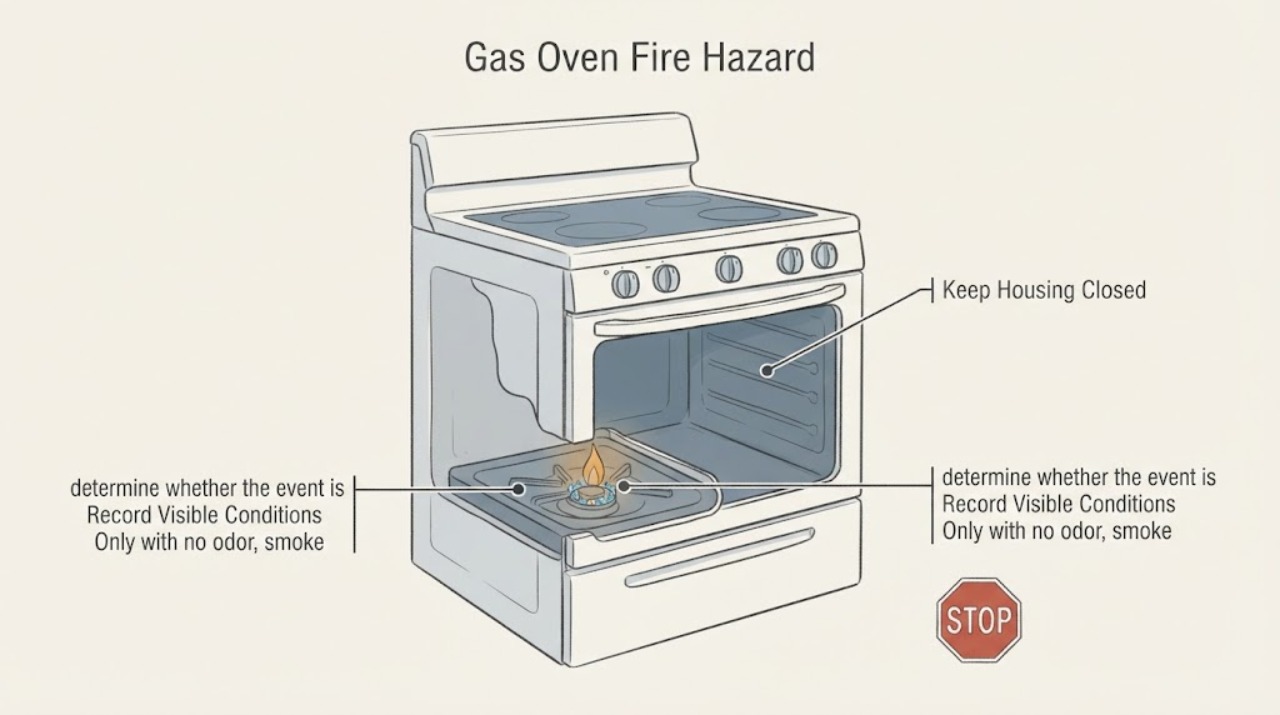
Work through in order
Diagnostic checks
Use only checks that match the exact appliance or system and its official guide.
-
Check 1
From a safe position, determine whether the event is a contained flame inside the oven, flames escaping the oven, smoke without visible flame, a gas odor or hissing, or an abnormal surface or bake flame. Do not approach the appliance to inspect a suspected leak.
Expected result: Flames escape the oven, smoke or heat spreads, a gas odor or hissing is present, or the flame is abnormal; alternatively, the event is a small contained oven flame with no spreading smoke and the controls can be reached safely.
Next step: If flames escape or the fire is growing, leave the home and call emergency services from outside. For gas odor or hissing, leave without operating controls or switches and contact gas or emergency professionals from a safe location. If the fire is contained and the control is safely reachable, turn the oven off and keep the door closed until cool.
Stop if: Do not open the oven door, test ignition, search for a leak, use a flame, or continue if smoke, heat, or flames make the control unsafe to reach.
Why this matters
Why: Escaping flames or a gas or combustion warning is an emergency and overrides appliance troubleshooting. A contained flame still requires the oven to be shut down and kept closed; it does not prove that the appliance is safe to reuse.
-
Check 2
After the area is safe and the oven is cool, record whether the fire or smoke occurred during Bake, Broil, a surface burner operation, or Self Clean, and record the exact model number and any display code. Do not restore power or gas merely to reproduce the event.
Expected result: The event occurred during Self Clean, during a normal cooking cycle, during surface-burner ignition, or after a gas-supply or installation change; a code or message may also be present.
Next step: Use the exact LG manual to identify the mode and code, then arrange qualified service for any fire, recurring smoke, abnormal flame, or unlisted code. Give the technician the sequence and whether the fire stayed inside the cavity.
Stop if: Do not borrow a code meaning from another LG range, remove panels, manually light the oven, or reset the appliance to see whether the hazard returns.
Why this matters
Why: The operating mode changes which exact LG manual and safety instructions apply. LG’s heating guidance says error-code meanings and ignition behavior vary by model, so a generic code or part diagnosis is unsafe.
-
Check 3
Only with no odor, smoke, heat, or active fire, inspect from the normal user position for obvious external conditions: a blocked oven vent, combustible material near the range, a damaged cord, or a visibly abnormal surface flame. Do not pull the range out or touch gas connections.
Expected result: The vent or combustion-air opening is blocked, combustible material is present, the cord or outlet is damaged or hot, the flame is yellow or unstable, or no external condition is visible.
Next step: Remove only an accessible combustible item or obstruction after the oven is cool. Have a qualified installer or gas technician handle gas conversion, pressure, connections, regulator work, and any persistent abnormal flame.
Stop if: Do not adjust gas pressure, open a regulator, move the range, use an extension cord, clean a hot burner, or test a leak with a flame.
Why this matters
Why: LG states that blocked ventilation, incorrect gas conversion, burner assembly, debris, and supply conditions can contribute to abnormal combustion. A clear exterior does not rule out an internal ignitor, burner, valve, sensor, control, or gas connection fault.
-
Check 4
Keep the LG gas oven off after any fire, flames escaping the cavity, recurring smoke, abnormal flame, gas odor, delayed ignition, or electrical warning, and arrange qualified inspection using the exact model and event record.
Expected result: The hazard does not recur only because the appliance is left off, or it returns when the oven is used; the display may also show an error or the control may be damaged.
Next step: Provide the model, mode, displayed code, flame or smoke location, gas odor or sound, whether flames escaped, and any breaker or outlet symptom to LG or a qualified gas-appliance technician. Follow emergency procedures for any renewed fire or suspected leak.
Stop if: Do not order a part from a generic symptom, bypass a safety device, open the gas circuit, perform live electrical tests, or resume cooking before qualified clearance.
Why this matters
Why: A temporary disappearance does not distinguish a damaged control, ignitor, burner, valve, sensor, wiring, ventilation, or gas-supply problem. Safe visual checks cannot establish that the appliance is fit for service after a fire.
Use your observations
Decision map
Find the observation that best matches what you see, then follow the next safe action.
-
PATH 01Next step
What you see
Flames escape the LG oven, smoke is spreading, or the fire cannot be safely controlled from the normal user position.
Do this next
Leave the home, close the door behind you if possible without delaying escape, and call 911 or the local emergency number from outside. Do not re-enter.
Why this path and its safety boundary
Why it matters: The event is an active home fire rather than a troubleshooting symptom.
-
PATH 02Next step
What you see
A fire remains inside the oven, the control is safely reachable, and there is no gas odor or spreading smoke.
Do this next
Turn the oven off if safe, keep the door closed until cool, and do not use the appliance again until the cause has been assessed. Leave and call emergency services if the fire grows or escapes.
Why this path and its safety boundary
Why it matters: The fire may be contained, but opening the door or restarting the oven can feed the hazard or release heat and smoke.
-
PATH 03Next step
What you see
There is a gas odor, hissing, delayed ignition, or a suspected leak, even if no flame is visible.
Do this next
Do not operate controls, switches, phones, or flames in the odor area. Leave and contact emergency or gas professionals from a safe location; do not re-enter until cleared.
Why this path and its safety boundary
Why it matters: This is a gas-safety emergency and the oven should not be tested to identify a component.
-
PATH 04Next step
What you see
The fire is out, but the oven has recurring smoke, a yellow or unstable flame, a damaged control or cord, or a recurring ignition event.
Do this next
Keep the oven off and arrange qualified LG or gas-appliance service with the exact model, mode, event sequence, and display information. Do not relight it to compare symptoms.
Why this path and its safety boundary
Why it matters: The appliance may have a combustion, gas-supply, ignition, control, or electrical fault that cannot be isolated by the visible symptom.
Helpful context
Understand the symptom
Separate an oven fire from a gas-leak warning
A visible flame inside the oven, flames escaping from the cavity, smoke, a gas odor, hissing, or a delayed ignition needs a safety response before diagnosis. If you smell gas or suspect a leak, do not operate the oven, switches, or other ignition sources; leave and contact emergency or gas professionals from a safe location. If flames escape the oven, the U.S. Fire Administration says to leave the home and call 911 from outside.
What to do when flames remain inside the oven
If the fire is inside the oven and you can reach the control without moving toward flames or smoke, turn the oven off and keep the door closed until it is cool. Do not open the door to inspect the fire, repeatedly restart ignition, use water on grease, or manually light a gas burner. Keep people away and leave if the fire grows, smoke spreads, or you cannot safely reach the control.
Do not treat abnormal flame color as a normal adjustment
A persistent yellow or otherwise abnormal flame, a flame that lifts or goes out, or a strong heating or combustion odor should end operation. LG explains that gas type, burner assembly, debris, and airflow affect combustion and that LP conversion must be performed by a qualified installer or gas technician. Do not adjust a regulator, gas pressure, or burner valve as a household repair.
Treat smoke or fire during Self Clean as a stop condition
LG states that a Self Clean cycle may need to be cancelled or interrupted for excessive smoke or fire. Use the OFF or CLEAR/OFF control only if it is safe to do so, and do not force a locked door; the lock releases after the oven cools. A fire, recurring smoke, damaged control, or any uncertainty about the appliance requires qualified service before further use.
When checks do not resolve it
Need a professional?
Leave and call emergency services from outside if flames escape the oven, smoke spreads, or the fire grows. For gas odor or hissing, leave without operating controls or switches and contact gas or emergency professionals from a safe location. Keep the appliance off and arrange qualified inspection for any contained fire, recurring smoke, abnormal flame, delayed ignition, damaged cord, or repeated fault.
Common questions
FAQ
What should I do if my LG gas oven catches fire?
If the fire is inside the oven and the control is safely reachable, turn the oven off and keep the door closed. If flames escape the oven or the fire grows, leave the home and call 911 or the local emergency number from outside. Do not open the door to inspect the fire or use water on grease.
Can I use my LG gas oven after a small fire goes out?
Do not restart it just to test it. Record the model, mode, flame or smoke location, and any code, then arrange qualified inspection before further use. A fire can involve the ignitor, burner, valve, controls, wiring, ventilation, or gas supply, and the visible symptom does not identify the safe repair.
Is a yellow flame on an LG gas range a fire hazard?
A persistent yellow or unstable flame should be treated as abnormal combustion and the range should be turned off. LG notes that gas type, LP conversion, burner assembly, debris, and airflow affect flame quality; gas conversion and gas-side work belong to a qualified installer or gas technician.
What if smoke or fire appears during LG Self Clean?
LG says to cancel or interrupt Self Clean for excessive smoke or fire using the OFF or CLEAR/OFF control when safe. Do not force a locked door; wait for the oven to cool and the lock to release. Arrange service if smoke or fire recurs.
Read the exact guide
Official sources
- Oven Not Heating - Gas RangesLG USA Support · Opened LG's official gas-range troubleshooting page. It addresses normal settings, direct power, the gas valve, the bake ignitor, and the fact that displayed error codes vary by model.
- Pictograph: Oven Fire SafetyU.S. Fire Administration · Opened the official U.S. Fire Administration oven-fire pictograph for the emergency branch when flames escape the oven.
- LG Range - How to Clean Your Oven Using Self CleanLG USA Support · Opened LG's official Self Clean instructions for the specific case of excessive smoke or fire during Self Clean.
- Cooking Fire SafetyU.S. Fire Administration · Opened the official U.S. Fire Administration cooking-fire safety page for the keep-clear, supervision, and grease-fire boundaries used here.
- LG Range - How to Install a Gas RangeLG USA Support · Opened LG's official gas-range installation guidance for gas-supply, conversion, ventilation, and service boundaries; it is not a substitute for the exact model manual.
- Burner Flames Uneven, Large, Small - Gas Cooktops - RangesLG USA Support · Opened LG's official gas-range flame troubleshooting page for combustion and flame-quality observations. It applies to gas ranges and leaves model-specific gas work to a qualified installer or technician.
Community feedback
Share a repair observation
Share a plain-text repair observation. Accepted observations are published automatically; this page may take a moment to update.