
On this page
Start here
Quick answer
Stop using an LG microwave if the burn is inside the cooking cavity, the cavity coating or wall is damaged, there has been sparking, smoke, a strong burning smell, a damaged door or seal, or the unit is not heating. LG says cavity damage can cause arcing and requires repair. If the mark is only an accessible food spill with no cavity damage, smoke, odor or door damage, disconnect power before cleaning the residue and identify the exact model before any further test. Do not open the cabinet, defeat the door interlock, replace an internal fuse, or run repeated powered tests to find the cause.
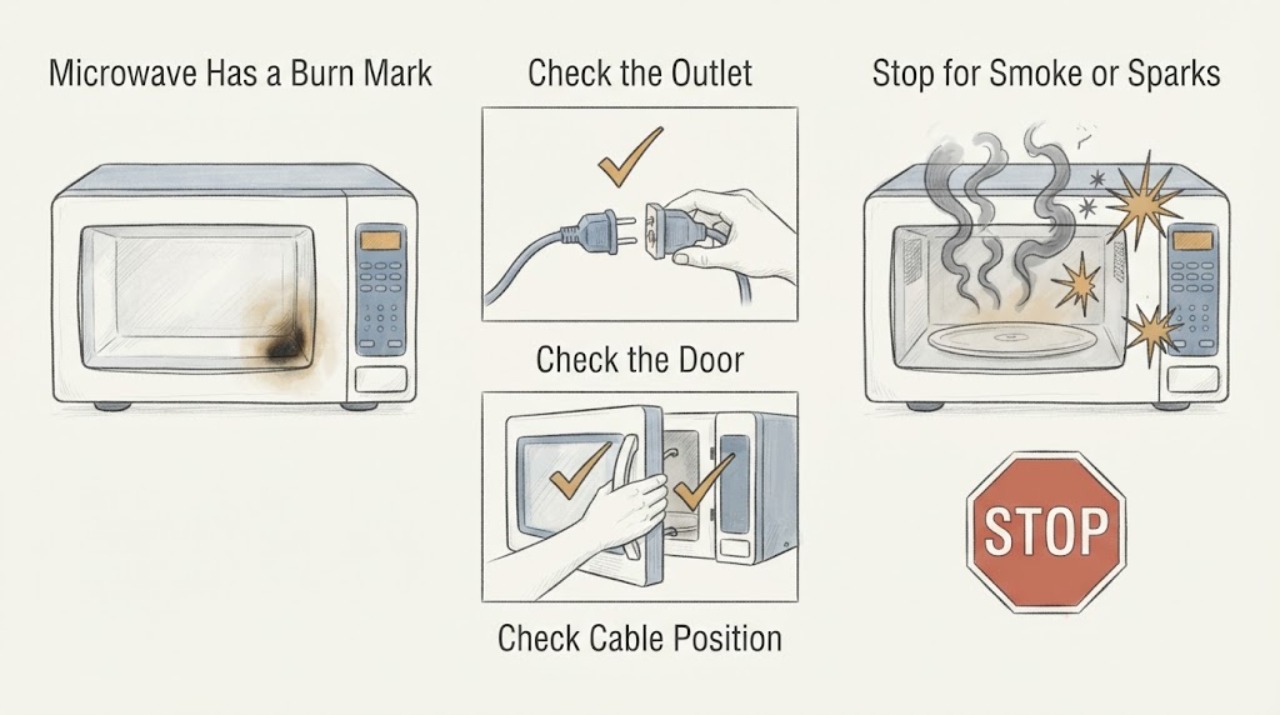
Work through in order
Diagnostic checks
Use only checks that match the exact appliance or system and its official guide.
-
Check 1
Stop the microwave immediately if there is smoke, a strong or persistent burning smell, visible arcing or sparking, a hot or damaged cord or outlet, a damaged door, or a burn mark inside the cooking cavity. Once it is safe, disconnect power without touching wet or damaged electrical parts; do not run another heating cycle.
Expected result: The mark is inside the cavity or near the door/seal, or the smell, smoke, spark, heat or damage continues; alternatively, there is only a superficial accessible mark with none of those warnings.
Next step: For any cavity, door, smoke, odor, spark or electrical damage, leave the microwave off and arrange qualified LG or microwave service. Do not clean through the door gap, open the cabinet or test it with water.
Why this matters
Why: LG says a damaged cavity can arc or spark and requires repair, and that continued strong burning smell or smoke requires immediate stop-use, unplugging and service. A visible cavity burn cannot be cleared by guessing that it is food residue.
-
Check 2
With power disconnected and the unit cool, identify the mark without removing covers: note whether it is food or grease on the interior surface, a chipped or blistered cavity coating, rust or a hole, a damaged waveguide-cover area, a mark on the exterior cabinet, or residue on the door and frame. Do not scrape, sand, paint, tape or patch a cavity or waveguide area.
Expected result: The residue wipes away from an intact surface, or the coating, wall, rack support, door, seal or frame is scorched, cracked, loose, rusted or perforated.
Next step: If the surface or door is damaged, photograph the area and provide the complete model number to service. If it is only accessible food residue and all safety surfaces are intact, clean only as the exact LG manual permits; do not power the unit until the residue and condition are verified.
Why this matters
Why: LG lists food buildup, unsuitable cookware, rack contact and cavity damage as different arcing conditions. A mark that changes the cavity surface or door sealing area is a service condition, not a cosmetic repair.
-
Check 3
If there is no cavity or door damage, no smoke or persistent odor, and the exact model manual allows user cleaning, check only the removable glass tray, rotating ring, visible food spills and any supplied rack. Use microwave-safe cookware only; do not use metal, metallic trim or wire ties, and do not operate the oven empty.
Expected result: Food residue or an incorrectly seated removable tray/rack is present, or the interior and accessories are clean, intact and correctly seated.
Next step: Correct only the accessible residue, cookware or removable accessory position documented for the model. If the mark remains, the cavity is damaged, or the unit still smells, sparks or fails to heat, stop and request service instead of retrying.
Why this matters
Why: LG says food particles can carbonize and spark, metallic cookware can spark, an improperly installed rack can touch the cavity wall, and an empty oven can burn or scorch the cavity. These checks explain an external cause only when the cavity itself is undamaged.
-
Check 4
Separate a heating complaint from a power or control complaint by checking the display, outlet and circuit from outside. Confirm the cord is in a wall outlet rather than an extension cord or surge protector, and check a GFCI or breaker only once if there is no heat, smoke, odor or visible electrical damage.
Expected result: The display is dead or the outlet has no power, or the microwave powers up but does not heat and the outlet remains stable.
Next step: If the outlet or circuit is the problem, use a qualified electrician when a reset does not hold. If the microwave powers up but does not heat, or a breaker trips again, leave it off and arrange LG or qualified microwave service; do not open the cabinet.
Why this matters
Why: LG says no power can come from the outlet connection, GFCI, breaker or a unit fault. Stable power with no heating is a microwave service issue; it does not identify a magnetron, diode, fuse or control-board failure for owner replacement.
-
Check 5
If and only if the cavity, door, cord, outlet and accessories are confirmed intact and there is no burning warning, use the exact LG model support page for a normal heating check. LG’s general guidance uses a cup of water to assess reheating, but do not perform that powered test when the assigned burn mark may be cavity damage.
Expected result: The model-supported check heats the water normally, or the water remains cold, the mark reappears, sparking occurs, or an odor or smoke returns.
Next step: If the safe model check fails or any warning returns, unplug or isolate power only when safe and arrange service with the model number and photos. Do not repeat the test, bypass interlocks or attempt high-voltage repair.
Why this matters
Why: Water heating can distinguish a normal heating result from a no-heat symptom only on an otherwise undamaged unit. A return of the burn, spark, odor or smoke overrides the test and requires stop-use; it is not evidence for a DIY internal part replacement.
Use your observations
Decision map
Find the observation that best matches what you see, then follow the next safe action.
-
PATH 01Next step
What you see
The burn is inside the cavity, on the cavity coating or wall, around the door-seal area, or accompanied by a spark, smoke or persistent burning smell.
Do this next
Leave the microwave off and arrange qualified service; do not clean, patch, paint, open or power-test the damaged area.
Why this path and its safety boundary
Why it matters: LG treats damaged cavity surfaces and persistent burning or smoke as stop-use conditions requiring repair.
-
PATH 02Next step
What you see
The only finding is removable food residue on an intact surface, with no odor, smoke, spark, door damage or cavity damage.
Do this next
Clean only as the exact model manual allows, verify microwave-safe cookware and removable accessory placement, and seek service if heating remains abnormal.
Why this path and its safety boundary
Why it matters: LG identifies food buildup as a possible source of arcing, but residue alone does not prove that it caused the reported no-heat condition.
-
PATH 03Next step
What you see
The microwave has stable power but water remains cold, or it heats only intermittently after the burn-related event.
Do this next
Stop using the unit and provide service with the complete model number, burn location, odor or spark history and outlet result. Do not open the cabinet or replace an internal fuse.
Why this path and its safety boundary
Why it matters: This is a no-heat service symptom; the external checks do not identify a safe internal component diagnosis.
-
PATH 04Next step
What you see
The outlet is dead, a GFCI or breaker trips again, or the cord or receptacle is hot or damaged.
Do this next
Stop resetting the circuit, isolate power only when safe and use a qualified electrician or appliance technician; do not use an extension cord or surge protector as a workaround.
Why this path and its safety boundary
Why it matters: The immediate issue is electrical safety or supply, not a confirmed microwave heating-part failure.
Helpful context
Understand the symptom
A burn mark beside a no-heat symptom is a safety decision before it is a heating diagnosis. The location matters: a food stain on a removable surface is different from scorched paint, rust, a hole, or arcing damage inside the cooking cavity. A microwave that has been damaged or is producing smoke or a strong burning smell should not be used to see whether it will heat again.
No model number was supplied. LG’s support pages state that settings and images can vary by model, so the complete model label is needed before using any control sequence or deciding whether a rack, cavity cover or cleaning procedure applies. Do not transfer a component diagnosis from another LG microwave.
Decide whether the mark makes the microwave unsafe to operate
When checks do not resolve it
Need a professional?
Use LG or qualified microwave service for any cavity or door damage, continued burning smell, smoke, sparking, no heat with stable power, or a recurring circuit trip.
Have this ready
- Provide the complete LG model number, whether the mark is inside or outside, photos of the mark with power disconnected, when the odor or spark occurred, whether food was inside, cookware and rack details, display status, outlet/GFCI result and whether water ever heated.
Common questions
FAQ
Can I keep using an LG microwave if the side is burned?
Not until you establish that the mark is only removable residue on an intact surface. LG says a damaged cavity can arc or spark and requires repair; smoke or a continuing strong burning smell also requires immediate stop-use and service.
Could food or cookware cause the burn mark?
LG identifies food buildup, metal or metallic-trim cookware, an incorrectly installed rack and operating empty as possible arcing causes. Those checks apply only when the cavity and door surfaces are intact; they do not make a damaged cavity safe.
How do I tell whether the microwave is heating?
LG’s general no-heating guide uses a cup of water as a user-level check, but do not run that test when there is a cavity burn, spark, smoke, strong odor, door damage or another stop-use warning. In those cases, arrange service instead of trying to reproduce the fault.
Can I replace the microwave fuse or magnetron myself?
No. A burn mark and no-heat symptom do not identify the failed part, and the cabinet contains shock and microwave-exposure hazards. Stop at external checks and use qualified service.
Read the exact guide
Official sources
- LG Microwave Oven – Troubleshooting No Power IssueLG USA Support · Opened official LG support. It covers secure wall-outlet connection, no extension cord or surge protector, GFCI and breaker checks, and service when the outlet works but the microwave does not.
- LG Microwave - Why is My Microwave Not Heating Properly?LG USA Support · Opened official all-model LG guidance. It covers food/load effects, door-opening effects, glass plate and rotation-ring placement, and a cup-of-water heating check that leads to LG service when water does not heat. The article excludes that powered test when burn, smoke, spark or cavity damage is present.
- LG Microwave: Why is my Microwave Arcing or Sparking?LG USA Support · Opened official LG microwave guidance. It identifies food spills, unsuitable cookware, an incorrectly installed rack, empty operation and cavity damage as possible arcing conditions; it directs stop-use and repair when the cavity is damaged.
- New LG Microwave Burning Smell or Noise: Causes and SolutionsLG USA Support · Opened official LG support. Although it discusses a temporary odor on first use, it explicitly says a strong continuing burning smell or smoke requires immediate stop-use, unplugging and service. No first-use assumption is made for this task.
Community feedback
Share a repair observation
Share a plain-text repair observation. Accepted observations are published automatically; this page may take a moment to update.