
On this page
Start here
Quick answer
Do not assume that a sound described as damper noise comes from the damper. First record whether it occurs during microwave cooking, the exhaust fan, turntable movement, door operation or startup/shutdown. LG says some cooking vibration, humming and clicking can be normal, while an unusually loud or sudden noise needs service after safe external checks. With the unit off, unplugged and cool, check only visible installation and turntable conditions, remove accessible food debris, and keep metal-pattern cookware out. A damper and blower arrangement depends on the model and venting configuration; without that information, do not remove a grille, blower plate or cabinet cover. Stop using the microwave for smoke, a strong persistent burning smell, arcing, heat damage, weak ventilation or a noise that remains after the visible checks.
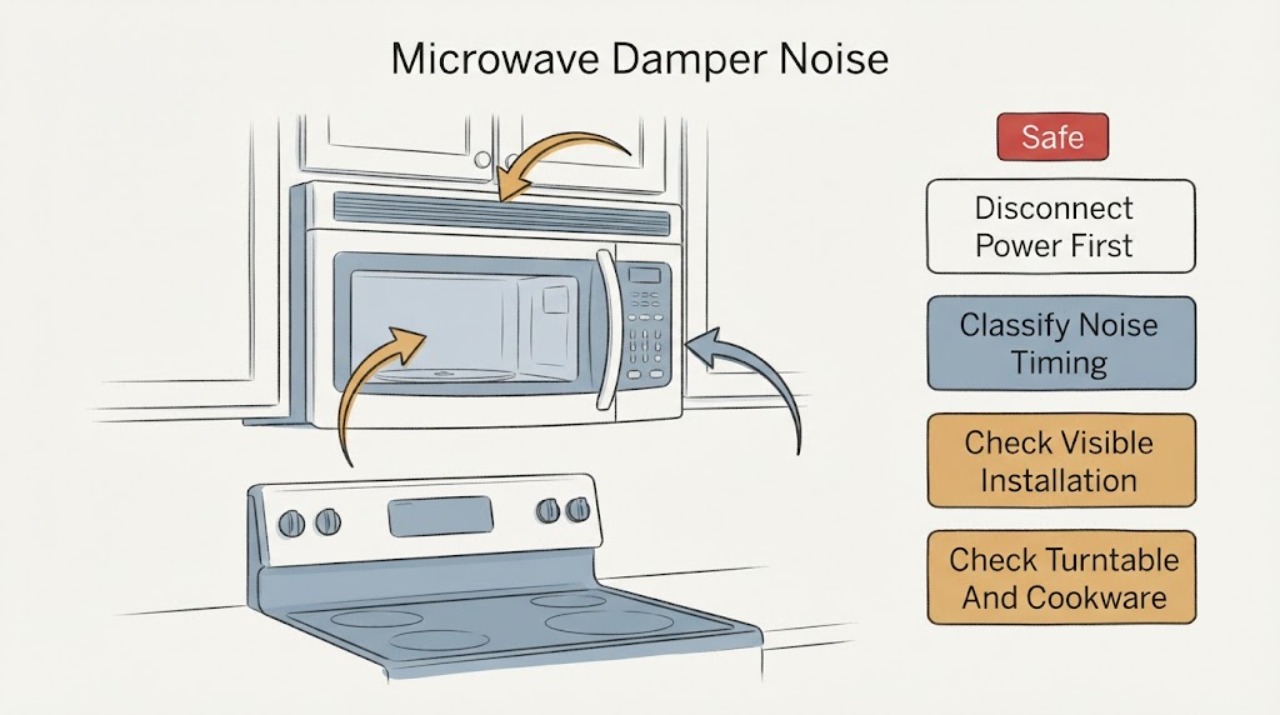
Work through in order
Diagnostic checks
Use only checks that match the exact appliance or system and its official guide.
-
Check 1
From outside the microwave, record when the noise starts and stops: cooking/heating, exhaust-fan operation, turntable rotation, door movement, or shutdown. Do not put hands near a vent, latch or moving tray while testing.
Expected result: The sound follows the turntable, appears only with the exhaust fan, occurs with heating, or is present at door operation or after shutdown.
Next step: Use the matching branch below and give the technician the timing, location, installation mode if known and whether the sound is new or sudden.
Why this matters
Why: Timing narrows the safe service description but does not identify a damper, fan, magnetron, latch or other internal part. LG documents several normal and abnormal noise contexts.
-
Check 2
With the microwave switched off, unplugged and cool, inspect only visible exterior conditions: whether the unit or nearby cabinet is loose, whether a removable external filter or vent opening is visibly obstructed, and whether an object on top or beside the unit can vibrate. Do not remove a grille, blower plate or cabinet cover.
Expected result: A visible obstruction, loose external item or installation movement is present, or the exterior looks clear.
Next step: Remove only a loose external object or a user-removable filter when the exact manual permits it. If the sound is from behind a panel, keep the microwave unplugged and arrange model-matched service.
Why this matters
Why: LG identifies installation vibration and venting configuration as possible contributors, but a clear exterior cannot prove that a hidden damper or blower is sound.
-
Check 3
With power disconnected and the cavity cool, reseat the glass tray and support ring, clear accessible food debris from the tray's contact area, and use only microwave-safe cookware without gold, silver or other metallic decoration. Do not insert tools into the waveguide, vents or door area.
Expected result: The tray or support was mis-seated, debris was present, or metallic-pattern cookware was used; alternatively, those conditions were already correct.
Next step: Run no further test if there was arcing, smoke, heat damage or a strong burning smell. Otherwise, follow the exact model manual for a controlled check; if the noise persists, use service rather than opening the appliance.
Why this matters
Why: LG says tray/support interference, debris and unsuitable cookware can cause noise or sparks. Correcting these conditions can remove a cooking-cycle noise but does not test a damper.
-
Check 4
If the sound occurs only when the exhaust fan runs, document whether the unit is wall-vented, roof-vented or recirculating and whether airflow is weak or changes with the fan setting. Observe from outside only; do not reach into a duct or try to move a flap by hand.
Expected result: The vent mode is known and airflow is normal, or the installation mode is unknown, airflow is weak, or the noise changes with the vent system.
Next step: Record the model number and installation mode for service. Leave the unit unplugged if ventilation is weak, the housing overheats or the noise is sudden and loud; do not remove the blower plate or cabinet.
Why this matters
Why: LG's installation material shows that damper and blower geometry depends on the venting arrangement and that incorrect installation can cause noise or weak ventilation. These observations cannot identify a failed damper without the exact model instructions.
-
Check 5
Stop using the microwave and arrange qualified service if the sound remains after the visible checks, becomes suddenly loud, or is accompanied by smoke, a strong persistent burning smell, arcing/sparking, heat damage, weak ventilation or damaged wiring.
Expected result: The hazard or persistent noise is absent and the sound was corrected by an external adjustment, or the hazard/noise remains.
Next step: Keep the unit unplugged and do not open the high-voltage housing, defeat a door interlock or perform live electrical tests. Provide the model, serial information, timing, vent mode, visible observations and any smoke or arcing details to the service provider.
Why this matters
Why: A corrected tray or external vibration issue supports a user-level cause; persistent or hazardous symptoms require diagnosis under the exact model's service procedure. LG does not support inferring a failed damper or high-voltage part from sound alone.
Use your observations
Decision map
Find the observation that best matches what you see, then follow the next safe action.
-
PATH 01Next step
What you see
The noise tracks turntable rotation, a tray/support was not seated, food debris is visible, or metallic-pattern cookware was used.
Do this next
Unplug and cool the microwave, correct only the visible tray or cookware condition, and stop for any arcing or heat damage. If the sound returns, arrange service.
Why this path and its safety boundary
Why it matters: LG identifies tray/support interference, debris and unsuitable cookware as causes of cooking noise or sparks; this does not confirm a damper fault.
-
PATH 02Next step
What you see
The sound occurs only with the exhaust fan, or it changes with the vent setting and seems to come from the upper or rear vent area.
Do this next
Record the exact model and venting mode, inspect only visible external openings, and use model-matched service. Do not reach into the duct or remove the blower plate or cabinet cover.
Why this path and its safety boundary
Why it matters: A vent, blower or damper context is plausible, but LG's installation document shows that the arrangement depends on venting mode and does not establish which part is defective for this no-model task.
-
PATH 03Next step
What you see
The sound is a familiar low hum, click or vibration during ordinary operation, with no smoke, arcing, heat damage, weak ventilation or change in cooking performance.
Do this next
Monitor without opening the unit. If the noise becomes sudden, loud, persistent or otherwise changes, stop use and arrange service.
Why this path and its safety boundary
Why it matters: LG documents some humming, clicking and vibration as normal operating sounds, although an unusually loud or new sound still deserves review.
-
PATH 04Next step
What you see
The microwave produces smoke, a strong persistent burning smell, arcing, heat damage, weak ventilation, damaged wiring or a sudden loud noise that remains after the visible checks.
Do this next
Stop use, unplug when it is safe to do so, keep the cabinet closed and arrange qualified service. Do not test again, open the high-voltage housing or bypass the door interlock.
Why this path and its safety boundary
Why it matters: These findings exceed user-level sound classification and may involve an unsafe cooking or venting condition; no internal component can be diagnosed safely from the supplied identity.
Helpful context
Understand the symptom
A damper-like sound is not a damper diagnosis
The task has no exact LG model and does not say whether the microwave is over-the-range, externally ducted or recirculating. LG's support material covers several different noise sources, including the turntable, installation vibration, fan activity and magnetron switching. Treat the word damper as a description of the sound until its timing and location are documented; do not name a part or order a replacement from that description alone.
Separate cooking noise from vent-fan noise
Listen from a safe position and note whether the sound follows heating, the exhaust-fan setting, turntable rotation, door movement or shutdown. A hum or click can be part of normal operation, while a new sudden or unusually loud sound is a reason to stop user diagnosis. This timing record is more useful for service than assuming that every rattle at the top or rear is a damper.
Why vent configuration matters
The opened LG installation document describes different roof, wall and room-venting arrangements and warns that incorrect blower or damper installation can create abnormal noise or weak ventilation. Because the task gives no model or installation mode, use the exact owner's or installation manual for any damper location or service instruction. This page limits the user check to visible conditions and does not authorize removing a blower plate or microwave cabinet cover.
When checks do not resolve it
Need a professional?
Arrange service when the noise is sudden, unusually loud, persistent after the tray, cookware and visible installation checks, or located behind a panel., Stop using the microwave for smoke, a strong persistent burning smell, arcing or sparks, heat damage, weak ventilation or damaged wiring., Do not remove the microwave cabinet or blower plate, reach into the duct, bypass a door interlock or perform live electrical or high-voltage tests.
Have this ready
- complete model and serial information
- whether the microwave is over-the-range and whether it vents through the wall, roof or room
- when the noise occurs and where it sounds loudest from outside
- whether the tray/support, cookware, visible vent opening and installation movement were checked
- any smoke, arcing, burning smell, weak ventilation, heat damage or change in cooking performance
Common questions
FAQ
Is every LG microwave damper rattle a bad damper?
No. LG's general guidance also covers turntable seating, debris, cookware, installation vibration, fan activity and switching sounds. With no exact model or venting mode, a damper cannot be identified from the description alone.
Can I open the microwave to check the damper?
Do not open the cabinet or high-voltage section for this symptom. The official LG installation document warns to unplug before work and describes model- and venting-specific blower and damper arrangements; use the exact manual and qualified service instead.
What information should I record before service?
Record the model and serial information, venting mode, when the sound occurs, where it is loudest, whether the tray/support is seated, and any smoke, arcing, burning smell, weak ventilation or heat damage.
Read the exact guide
Official sources
- LG Microwave - Troubleshooting Loud Noise While CookingLG USA Support · Official LG USA Help Library page opened directly. It is explicitly a general all-model guide, so it supports normal-noise context, visible tray/support and installation checks, and the service boundary rather than a model-specific damper diagnosis.
- LG Microwave NoisesLG USA Support · Official LG USA Help Library page opened directly. It is used only for the sound-timing distinction and general normal-versus-abnormal context, not for assigning a failed component.
- LG Microwave - Things to CheckLG USA Support · Official LG USA Help Library page opened directly. It supports general user-level cleaning, cookware and tray/support checks; it does not identify a damper or authorize cabinet access.
- New LG Microwave Burning Smell or Noise: Causes and SolutionsLG USA Support · Official LG USA Help Library page opened directly. Used only for the stop-use boundary when a strong burning smell persists or smoke appears; it does not establish the cause of a damper noise.
- LG Microwave Installation InstructionsLG USA Support · Official LG-hosted installation PDF opened directly. Used conditionally to show that roof, wall and room-venting arrangements differ, that damper/blower installation can affect noise and ventilation, and that work requires unplugging; it is not used to prescribe a model-specific removal procedure.
Community feedback
Share a repair observation
Share a plain-text repair observation. Accepted observations are published automatically; this page may take a moment to update.