
On this page
Start here
Quick answer
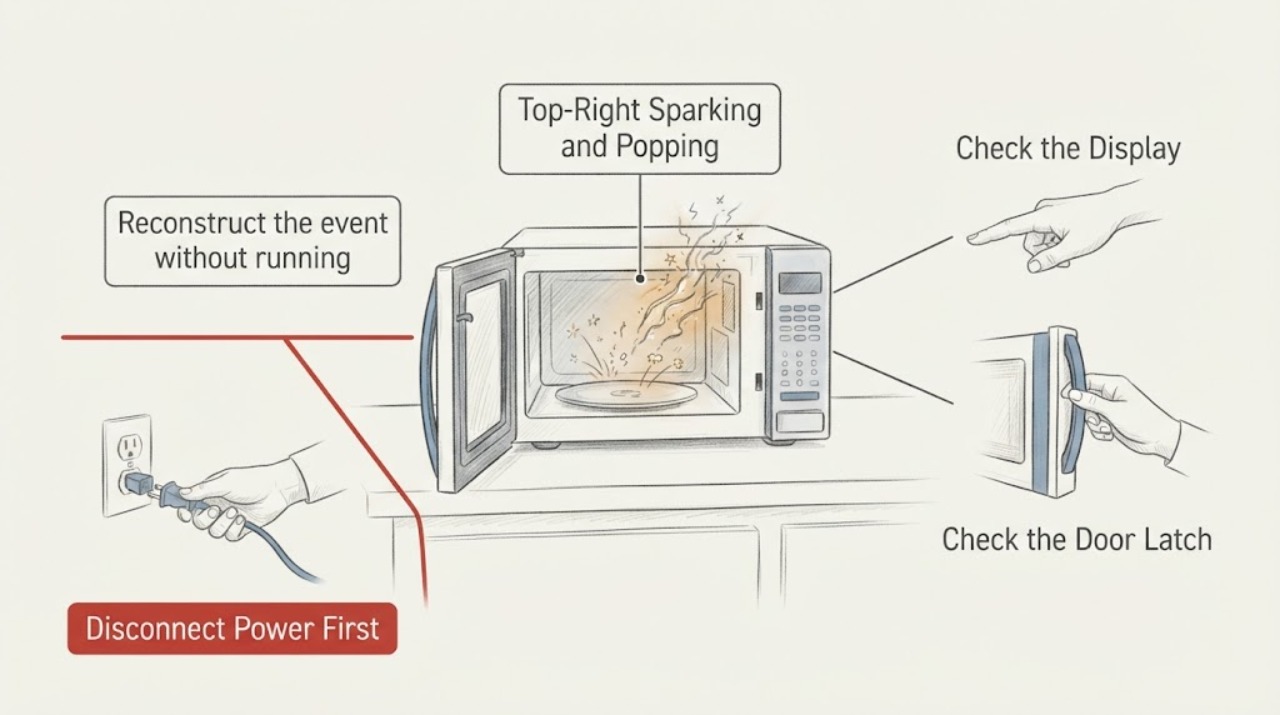
Treat a top-right spark with a loud pop on the LG LMV1831BD as an immediate stop condition, especially when it recurs after the microwave has sat unused for hours. If it is still running and the controls respond normally, press Stop/Clear without opening the door; then unplug it from a dry, safe location and keep the door closed. Do not retry with water or another load, remove the cabinet, touch the top-right waveguide-cover area, or bypass a door interlock. When the oven is cold and de-energized, make only a visual record through the door and from outside: note residue, cavity coating damage, a darkened or warped top-right area, rack-support damage, door damage, smoke, or scorching. LG identifies metal, residue, rack contact, and cavity damage as possible sparking causes, but a repeatable pop and arc needs qualified microwave service rather than another test.
Before you begin
Safety first
- Keep the LMV1831BD unplugged after a top-right spark and pop. Do not retry with water or another load, open the cabinet, touch the waveguide-cover or high-voltage area, defeat door interlocks, perform live testing, or operate with smoke, odor, scorch marks, or visible damage.
Work through in order
Diagnostic checks
Use only checks that match the exact appliance or system and its official guide.
-
Check 1
Stop the microwave immediately. If it is still operating and the controls respond normally, press Stop/Clear without opening the door; then unplug it from a dry, safe location. Keep the door closed and do not start another cycle.
Expected result: Record whether the flash was accompanied by a sharp pop, smoke, burning odor, repeated crackling, a tripped breaker, or a damaged cord or plug.
Next step: Leave the LMV1831BD unplugged and arrange qualified microwave service. If there is active fire or dangerous smoke, leave the area and contact local emergency services.
Stop if: Do not retry the microwave, keep pressing controls, pull a wet or damaged plug, or open the hot door to investigate.
Why this matters
Why: A single visible spark can have an external cause, but a loud or repeated pop, smoke, burning odor, electrical damage, or breaker trip raises the risk of continuing operation and cannot be screened by another run.
-
Check 2
Only after the oven is cold and de-energized, make a visual record through the closed door and from outside. Photograph or describe the upper-right cavity area, ceiling, walls, floor, turntable, rack supports if fitted, door edge, latch area, and visible seal without touching the waveguide-cover area or scraping the cavity.
Expected result: Look for a dark or warped top-right area, carbonized food, peeling or blistered coating, a pinhole, melted material, scorch marks, a missing rack support, door damage, or a displaced seal.
Next step: Keep the unit unplugged and send the photographs and observations to a qualified technician with the full model number. Do not clean, scrape, paint, remove, or replace anything in the upper-right area yourself.
Stop if: Do not touch or remove the waveguide cover, reach behind the cavity, remove the cabinet, or inspect live wiring.
Why this matters
Why: LG lists food residue, rack contact, and cavity damage among sparking causes. Visible charring, peeling, a hole, melted material, or door damage is a service condition, not a cleaning or repainting task.
-
Check 3
Reconstruct the event without running another test: note what was inside, whether any foil, metal, metallic trim, twist tie, rack, or empty cavity was involved, when the previous cycle ended, how long the oven sat, and whether the pop happened immediately on start or after heating began.
Expected result: The history points to metal or a rack, an empty cavity, a spill or residue, or an ordinary microwave-safe load with no obvious external trigger.
Next step: Give this history to service. Do not use a water-cup test or any other load to decide whether the problem has cleared, because the reported arc and pop already require a no-retry safety boundary.
Stop if: Do not infer a failed magnetron, diode, capacitor, waveguide cover, or control from the sound or location alone.
Why this matters
Why: Metal, empty operation, residue, and rack-to-wall contact are plausible external explanations, but timing after several idle hours does not rule in a part and a repeatable top-right pop without a confirmed safe cause remains unresolved.
-
Check 4
From outside and with power isolated, record the exact model label and installation context: LMV1831BD, serial or rating-label information, over-the-range mounting, vent arrangement, receptacle location, and any visible heat, cord, plug, or cabinet damage. Do not remove the microwave from its mounting or test the outlet live.
Expected result: The cord or plug is scorched, the receptacle is hot or damaged, the cabinet or mounting is loose, or all visible external electrical details look normal.
Next step: Keep the microwave isolated and provide the model and installation notes to the appliance technician. Use an electrician as well if the receptacle, cord, or household wiring shows heat or damage.
Stop if: Do not energize the unit to check the outlet, bypass a fuse or interlock, or remove the OTR cabinet for access.
Why this matters
Why: External electrical or mounting damage needs prompt professional attention; a normal-looking exterior does not clear internal microwave or interlock hazards.
-
Check 5
Prepare a service handoff instead of selecting a replacement part. Include the exact model, top-right spark location, loud-pop description, time since last use, load and cookware history, number of flashes, smoke or odor, visible scorch or cavity damage, and whether the breaker moved.
Expected result: The unit has a visible cavity or door defect, the event recurs after sitting, no external cause is found, or the technician needs access to internal microwave components.
Next step: Keep the LMV1831BD unplugged and request qualified microwave service to inspect the exact model before any part is ordered or the unit is returned to use.
Stop if: Do not open the cabinet, touch high-voltage components, perform live measurements, defeat interlocks, or approve a part solely from a generic sparking symptom.
Why this matters
Why: These patterns leave a cavity/waveguide-area, door-interlock, or high-voltage diagnosis unresolved. The symptom alone cannot identify which internal component is compatible or failed.
Use your observations
Decision map
Find the observation that best matches what you see, then follow the next safe action.
-
PATH 01Safety boundary
What you see
Smoke, flame, burning odor, a damaged or hot plug/receptacle, repeated breaker trips, or a damaged door is present.
Do this next
Leave the area for active fire or dangerous smoke and contact local emergency services. Otherwise isolate power only from a dry safe location and arrange qualified electrical/appliance service.
Why this path and its safety boundary
Why it matters: This is an immediate fire, electrical, or microwave-safety escalation, not a load-troubleshooting branch.
Safety stop: Do not open the cabinet, restart the microwave, pull a damaged plug, or repeatedly reset the breaker.
-
PATH 02Safety boundary
What you see
A cold visual record shows a darkened, warped, blistered, peeling, melted, or perforated upper-right cavity or waveguide-cover area, or the door/latch/seal is damaged.
Do this next
Keep the LMV1831BD unplugged and give the exact model and photographs to qualified microwave service for inspection.
Why this path and its safety boundary
Why it matters: The visible pattern is compatible with cavity or safety-component damage; it is not a safe cleaning, scraping, repainting, or replacement decision for the owner.
Safety stop: Do not touch the waveguide-cover area, remove the cover, bend the latch, or operate the unit to confirm the mark.
-
PATH 03Next step
What you see
The event occurred with metal, metallic trim, foil, a tie, an empty cavity, a rack contact, or obvious residue, and there is no visible damage in the cold record.
Do this next
Do not run a confirming test. Keep the microwave unplugged until qualified service or model-specific professional guidance clears it.
Why this path and its safety boundary
Why it matters: That history makes an external load, rack, or residue explanation more plausible, but the loud top-right pop remains an unverified safety event and the absence of visible damage does not prove the oven safe.
-
PATH 04Safety boundary
What you see
The microwave was running an ordinary microwave-safe load, no obvious external trigger is found, and the top-right pop/spark recurs after the unit has sat unused.
Do this next
Leave the unit unplugged and request qualified service. Provide the event timing, location, sound, and photos; do not perform a water test or any further run.
Why this path and its safety boundary
Why it matters: A repeatable location and delayed recurrence make an unresolved internal arc or damaged cavity/safety path more concerning than a one-off cookware mistake, but the exact failed part cannot be identified remotely.
Safety stop: No cabinet removal, waveguide-area contact, high-voltage testing, interlock bypass, or symptom-based part ordering.
Helpful context
Understand the symptom
The LMV1831BD is an over-the-range microwave, so a spark and loud pop at the upper-right side is not a safe invitation to repeat the run and see whether it clears. The delay after the previous use is useful history, not proof that the oven is safe: a carbonized splash, damaged cavity material, rack contact, or an internal arc can all produce a visible flash. Keep the microwave out of service while the event is documented.
LG's general prevention advice helps a technician distinguish a metal or residue event from a damaged cavity, but it does not justify a user opening the cabinet or touching the waveguide/high-voltage area. For this top-right pop, use only a cold, de-energized visual record and give the exact model, location, timing, load, and any smoke or scorch marks to qualified service.
Only after diagnosis
Potential parts
- waveguide-cover or cavity-related service component
Consider only after a qualified microwave technician confirms damage in the exact upper-right cavity or waveguide-cover area and identifies the correct service procedure.
Do not touch or replace this area from a top-right arc alone; verify the complete LMV1831BD identity and technician diagnosis before any part decision. - magnetron or high-voltage assembly
Consider only if qualified service diagnoses an internal high-voltage fault after the cavity, load, rack, door, and interlock possibilities are assessed.
Never open the cabinet or order an internal high-voltage part from the popping sound or spark location alone.
When checks do not resolve it
Need a professional?
Call qualified microwave service now for this event, and treat smoke, flame, burning odor, damaged wiring or receptacle, door damage, repeated breaker trips, or recurrence as an immediate safety escalation.
Safety scope: Keep the LMV1831BD unplugged after a top-right spark and pop. Do not retry with water or another load, open the cabinet, touch the waveguide-cover or high-voltage area, defeat door interlocks, perform live testing, or operate with smoke, odor, scorch marks, or visible damage.
Have this ready
- Provide LG LMV1831BD, the serial/rating-label details, top-right location, loud-pop and flash description, time since last use, load and cookware history, number of flashes, smoke or odor, breaker behavior, and cold visual photographs.
Common questions
FAQ
Can I test the LG LMV1831BD with a cup of water?
Not for this event. Although LG's general sparking guidance discusses safe cookware and a controlled test after ordinary causes are addressed, a reported top-right spark with a loud pop and delayed recurrence should remain unplugged. Do not run another cycle; arrange qualified microwave service.
Does the pop mean the magnetron has failed?
Not necessarily. Metal, residue, rack contact, cavity damage, the waveguide-cover area, door interlocks, and internal high-voltage components can present differently. The sound and location do not select a part, so do not open the cabinet or order a magnetron from the symptom alone.
Can I replace or clean the upper-right waveguide cover myself?
Do not touch or remove it for this case. Make only a cold visual record through the door and from outside, then keep the microwave unplugged. A qualified technician must determine whether the area, cavity, or an internal component is damaged.
Could sitting unused for a few hours cause the spark?
The idle interval is useful timing information, not a diagnosis. It does not make a repeatable pop safe to retest. Record the interval and the load, keep the unit off, and give the history to service.
Read the exact guide
Official sources
- Arcing/Sparking in a Microwave OvenLG USA · LG's general microwave arcing guidance; used for causes and the continued-use boundary, not to identify an internal part for LMV1831BD.
- LG LMV1831BD 1.8 cu. ft. Over-the-Range Microwave OvenLG USA Business · Exact LG LMV1831BD product page; used only for model and appliance-form-factor identity.
- LG LMV1831BD SupportLG USA · Exact US support page for LMV1831BD.BBDELGA.
- LG Microwaves - How to Prevent SparkingLG USA · LG general microwave prevention guidance; used for external-cause distinctions and service escalation, not as permission to retry this event.
- LG Microwave Oven Owner's Manual Safety InstructionsLG USA · Official LG microwave safety instructions opened for a different model; used only for generic safety boundaries, not LMV1831BD operating controls or diagnosis.
Community feedback
Share a repair observation
Share a plain-text repair observation. Accepted observations are published automatically; this page may take a moment to update.