
On this page
Start here
Quick answer
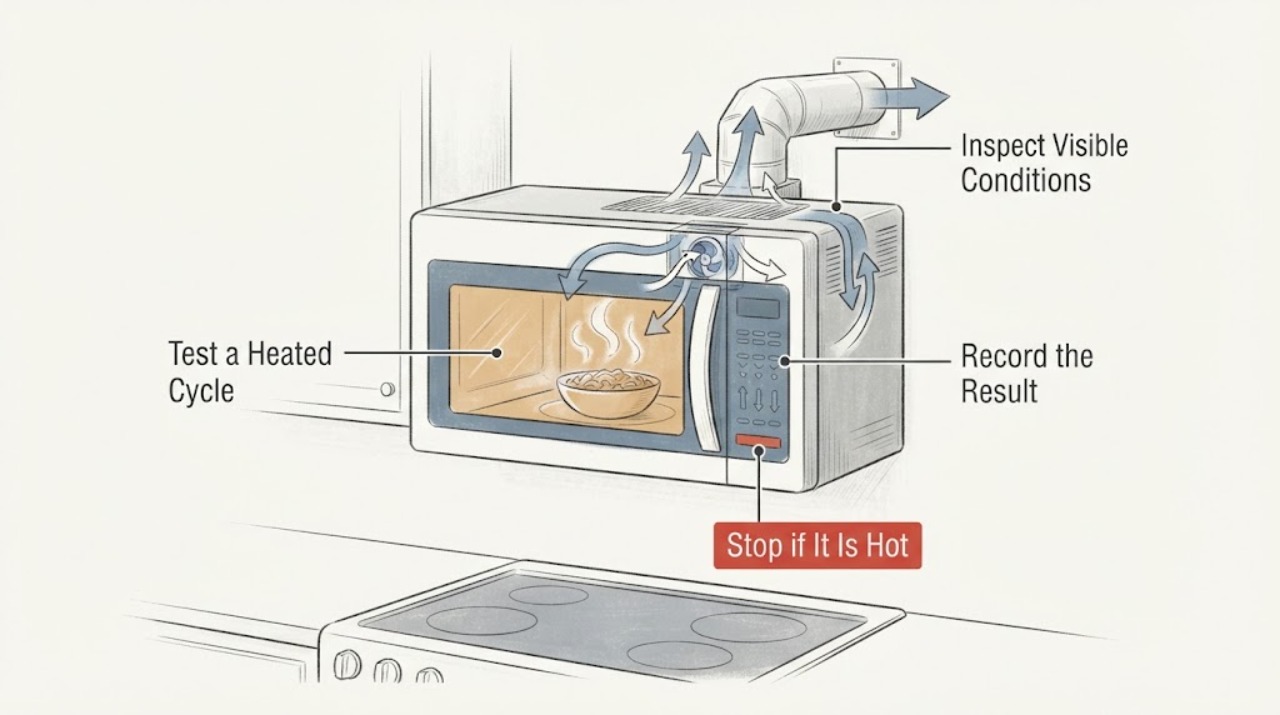
An LG over-the-range microwave can start its vent or cooling fan automatically, so fan operation during microwave cooking is not by itself proof of a fault. LG's opened owner material says the vent fan can turn on automatically when sensors detect excessive heat from the cooktop, while its installation instructions warn that a poorly seated or incorrectly configured blower and duct can cause abnormal noise, weak ventilation and overheating. First distinguish a low automatic fan from a manually selected high setting, note whether the cooktop was hot, and inspect only the accessible filters, grille and exterior airflow. Do not remove the microwave cover, rotate the blower or change ducting based on a generic button sequence. If the fan is loud, airflow is weak, the cabinet overheats, or it runs unrelated to cooking and does not stop after a normal cool-down, stop using the unit and arrange LG or qualified microwave service.
Work through in order
Diagnostic checks
Use only checks that match the exact appliance or system and its official guide.
-
Check 1
With the unit empty of cookware and the controls untouched except for one normal, supervised heating cycle, identify whether the sound is the vent fan, the turntable, the microwave hum or a combination. Note whether the fan is low or high, whether it starts immediately, and whether the cooktop below was recently hot.
Expected result: Only the low fan runs, the fan is high, the turntable or magnetron sound is also present, the cooktop was hot, or the fan starts with no cooking request.
Next step: Record the behavior and continue to the external airflow and cool-down checks. If the fan starts with no cooking request, smoke, sparks or an abnormal electrical smell, stop using the microwave and arrange service instead of repeating the test.
Stop if: Stop immediately for smoke, sparks, burning odor, visible damage or heating when no cooking cycle was requested.
Why this matters
Why: LG says the vent fan can be automatic when sensors detect cooktop heat, and the owner's material distinguishes fan, magnetron and other operating sounds. A sound description alone does not identify a failed component.
-
Check 2
During a brief normal microwave cycle, observe only the external vent grille, grease filters and the outside exhaust outlet if it is safely visible. Check for a steady but weak flow, rattling at the grille or adapter, a damper that visibly sticks, or air and noise escaping around an exterior connection. Do not remove the mounted microwave or any cover.
Expected result: Airflow is present and steady, airflow is weak, the grille or damper rattles, the external duct connection leaks air/noise, or the exterior path cannot be seen safely.
Next step: Clean only an accessible filter according to the exact model instructions and report loose or inaccessible ductwork to an installer or service provider. Do not reseat the blower or alter the duct from generic instructions.
Why this matters
Why: LG's installation instructions say the vent system must be properly configured and warn that incorrect blower or duct installation can cause abnormal noise and weak ventilation. A visible symptom can justify an installation inspection, but it does not prove which internal piece is wrong.
-
Check 3
After the cooking cycle ends, leave the door closed and observe whether the fan settles on its own after the appliance's normal cooling period. Do not repeatedly restart the microwave to force the fan off or compare different internal settings.
Expected result: The fan stops after cooling, remains at a low speed for an extended period, runs at high speed continuously, or continues with no recent cooking.
Next step: If the fan settles and there is no heat, odor or weak ventilation, record it as a likely automatic function and obtain the exact model manual for confirmation. If it does not settle or the cabinet remains unusually hot, stop using the unit and request service.
Why this matters
Why: A temporary cool-down can be an intended protection function, while a persistent fan unrelated to cooking or an abnormal high-speed run is outside the limited behavior established by the no-model evidence.
-
Check 4
Compare the sound after cleaning the accessible grease filters and removing only visible obstructions around the external grille. Do not use a sharp tool, spray cleaner into the grille or reach into the blower path.
Expected result: The sound and airflow improve, remain unchanged, become worse, or the filters are damaged or heavily coated.
Next step: Replace or service only the filter type documented for the exact model. For persistent noise, weak ventilation or heat, preserve the before/after observation for the installer or LG service rather than opening the cabinet.
Stop if: Stop if cleaning would require opening the appliance or if the filter/grille is damaged and cannot be handled without force.
Why this matters
Why: A visible filter or grille condition can add airflow noise, but improvement or no change does not distinguish a duct seating issue from an internal fan, sensor or control problem.
-
Check 5
Request LG or qualified microwave service when the fan is loud or high continuously, ventilation is weak, the cabinet overheats, the fan runs without a cooking request, or external checks do not explain the behavior. Provide the full model label, venting direction, fan speed, cooktop condition, timing and any odor or heat observation.
Expected result: The symptom persists after safe external checks, installation access is needed, or any microwave safety concern is present.
Next step: Keep the microwave off until it is assessed if it overheats, smells burned, sparks or starts on its own. Do not open the high-voltage cabinet or attempt an internal repair.
Why this matters
Why: The official sources support an automatic fan possibility and an installation-related noise/airflow possibility, but they do not support diagnosing a sensor, relay, motor or control board without the exact model and qualified testing.
Use your observations
Decision map
Find the observation that best matches what you see, then follow the next safe action.
-
PATH 01Next step
What you see
The fan is low, starts during cooking, the cooktop was recently hot, and it stops after the appliance cools without abnormal heat or odor.
Do this next
Keep the exact model number and consult its owner manual for the documented fan behavior; do not borrow another model's settings.
Why this path and its safety boundary
Why it matters: This pattern is consistent with an automatic heat-protection function documented for some LG over-the-range models, not proof of a fault.
-
PATH 02Next step
What you see
The fan runs during a microwave-only cycle while the cooktop is cold, is much louder than the microwave, or airflow/noise changes at the grille or duct outlet.
Do this next
Document fan speed, timing and visible airflow, then have an installer or qualified LG technician inspect the external vent configuration without the user opening the appliance.
Why this path and its safety boundary
Why it matters: The report may involve vent installation, damper or duct seating in addition to any automatic fan behavior; the exact model is needed before assigning a cause.
-
PATH 03Next step
What you see
The fan remains on high, continues long after cooking, runs with no cooking request, or the microwave cabinet becomes unusually hot.
Do this next
Stop using the microwave and request qualified service. Do not repeatedly power-cycle it, defeat an interlock or inspect the high-voltage section.
Why this path and its safety boundary
Why it matters: This is outside the limited normal behavior established by the no-model evidence and may indicate an unresolved cooling, control or installation problem.
-
PATH 04Next step
What you see
Smoke, sparks, burning odor, damaged wiring, a damaged door or a microwave that starts without a cooking request is observed.
Do this next
Stop operation, disconnect power only if it can be done without touching damaged or wet components, keep the unit out of service and contact qualified service. Do not operate it with the door open or open the cabinet.
Why this path and its safety boundary
Why it matters: The situation is an electrical or microwave-safety concern and is not appropriate for user troubleshooting.
Helpful context
Understand the symptom
The exact report is more specific than simply hearing a fan: a new LG over-the-range unit starts its low vent fan during a short microwave-only heating test, even after the cooktop has been cold for hours, and the sound is unusually loud. The model is not supplied, so this page does not assign a universal control sequence or declare a sensor or relay failure.
LG documentation separates the automatic fan function from the physical exhaust installation. A low automatic fan may be an intended heat-protection behavior on a particular model, while a loose adapter, damper, blower orientation or duct connection can make normal airflow sound much louder or ventilate poorly. The installation document is used here for recognition and service boundaries, not as a user disassembly guide.
Do not open the microwave cabinet, defeat a safety interlock, rotate the blower, reach into the duct or make live electrical measurements. If external observations show abnormal heat, smoke, damaged wiring, weak exhaust or a fan that never settles after cooking, stop and request qualified service.
When checks do not resolve it
Need a professional?
Request LG or qualified microwave service when the fan is persistently high, runs without a cooking request, remains abnormal after a normal cool-down, ventilation is weak, the cabinet overheats, or any smoke, burning odor, spark, damaged wiring or door defect appears. Do not identify or replace a sensor, relay, motor or control board from this symptom alone.
Common questions
FAQ
Is it normal for an LG over-the-range microwave vent fan to run while heating food?
It can be normal on some LG models when sensors detect heat from the cooktop, but the exact model and conditions matter. A low fan during cooking is different from a high fan that continues with no cooking request or abnormal heat.
Can a vent installation make the fan sound much louder?
Yes, the opened LG installation instructions warn that incorrect blower or exhaust installation can cause abnormal noise and weak ventilation. Have the vent configuration checked by an installer or qualified technician rather than removing the blower yourself.
Should I open the microwave to inspect the fan or sensor?
No. LG's installation instructions require qualified installation and warn against user adjustment or repair. Keep the checks external and arrange service for persistent or unsafe behavior.
Read the exact guide
Official sources
- Owner's ManualLG Electronics · The opened LG manual describes Vent On/Off, fan speed and automatic activation when sensors detect cooktop heat. It is used as family-level guidance only because the task supplies no model.
- LG Microwave vent fan runs when microwave is cookingReddit r/appliancerepair · Exact opened Reddit post matching the assigned LG over-the-range microwave symptom; community report only, not manufacturer technical guidance.
- Microwave Oven Installation InstructionsLG Electronics · The opened LG installation document covers venting configurations and warns that improper blower/duct installation can cause abnormal noise, weak ventilation and overheating; it does not establish the task's absent model.
Community feedback
Share a repair observation
Share a plain-text repair observation. Accepted observations are published automatically; this page may take a moment to update.