
On this page
Start here
Quick answer
Treat a gas smell near a Maytag gas dryer as a potential gas leak, not as a normal dryer odor. Do not operate the dryer, touch electrical switches, use a flame, or try to find the leak. Clear everyone from the area. If the gas shutoff is immediately reachable without entering the odor area or creating a spark, follow local emergency guidance to turn it off; otherwise leave it alone. From well away from the building, contact the gas supplier or emergency responders and follow their instructions. Do not return to troubleshooting or run a test cycle until the area and appliance have been declared safe by the appropriate gas or emergency professionals. Only after that clearance should you investigate non-gas odors such as a first-use oily smell, nearby paint or varnish fumes, mildew, or lint and vent problems using the exact Maytag manual.
Before you begin
Safety first
- This article does not authorize leak-finding, gas-line disassembly, relighting, electrical switching in the odor area, cabinet access, combustion testing, or repeated powered operation. Gas emergency instructions and qualified professionals control the return to service.
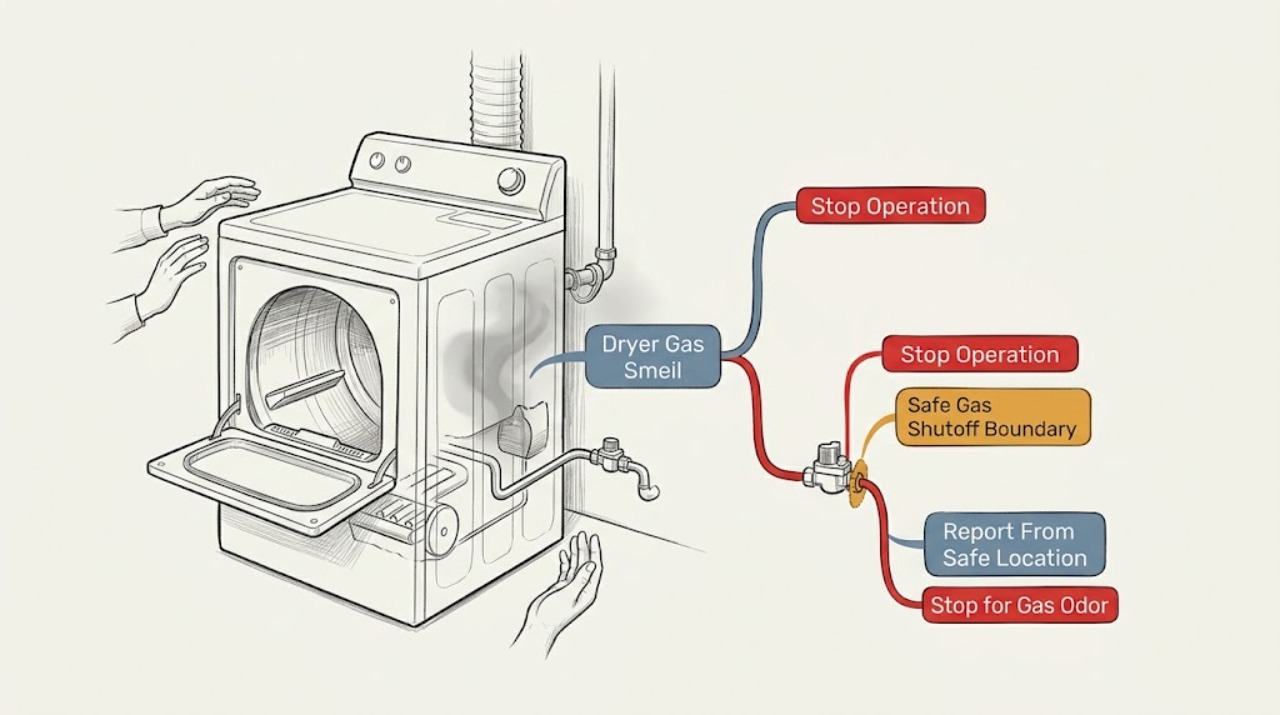
Work through in order
Diagnostic checks
Use only checks that match the exact appliance or system and its official guide.
-
Check 1
At the first unexplained gas smell near the dryer, stop operating the appliance and do not press controls, unplug the cord, switch lights, start an engine, smoke, use a lighter, or create any flame.
Expected result: From a safe position, note only whether the odor is present, whether anyone feels unwell, and whether there is hissing or visible fire; do not sniff fittings, open panels, or try to identify the exact leak point.
Next step: Warn occupants only if doing so does not require creating a spark, leave the room or building, and move to a location well away from the suspected odor.
Stop if: Do not return, restart the dryer, or attempt a leak-finding test until the appropriate gas or emergency professionals say the area is safe.
Why this matters
Why: A gas odor or hissing is an unresolved ignition and exposure hazard. It cannot be classified as a routine first-use or lint odor while the area is still occupied and uncleared.
-
Check 2
Only if the gas shutoff is immediately reachable on the way out, is clearly identified, and can be closed without entering the odor area or operating an electrical device, follow local emergency guidance to close it; otherwise do not search for or operate a valve.
Expected result: Record from outside the hazard area whether the appliance was already off, whether a shutoff was safely closed by an occupant without re-entering, and whether the odor or hissing remains; never return inside to verify.
Next step: Leave the area and report the suspected gas odor from a safe location to the gas supplier or emergency responders, following their instructions.
Stop if: Do not remove covers, move the dryer, turn a meter, disconnect a connector, loosen a fitting, or search for the leak.
Why this matters
Why: A safely accessible shutoff may limit fuel flow, but an inaccessible or uncertain valve is not a reason to delay evacuation or handle gas piping.
-
Check 3
From well away from the building and outside the suspected odor area, contact the local gas supplier or emergency responders and explain that a Maytag gas dryer may be associated with a gas odor.
Expected result: Provide the building location, whether anyone is unwell, whether the odor or hissing was noticed, whether the appliance was operating, and whether a shutoff was already closed without re-entry; do not return to gather details.
Next step: Follow the responder's instructions and keep people away until the area and appliance are explicitly cleared.
Stop if: Do not use a device, switch, vehicle, flame, or appliance in the suspected odor area, and do not re-enter just because the smell fades.
Why this matters
Why: The gas supplier or emergency responders determine whether evacuation, isolation, atmospheric checks, or further action is required. A home observation cannot certify that the leak is absent.
-
Check 4
Only after the gas supplier, emergency responders, or a qualified gas-appliance professional has cleared the area, write down the exact Maytag model, fuel type, cycle, time of odor, whether ignition occurred, any display message, and any prior service or installation work.
Expected result: Classify the cleared report as odor at rest, odor during ignition, odor during burner operation, odor near the connector or exhaust, or odor that was traced to another source by the professional; do not reproduce the symptom to classify it.
Next step: Give the record and the matching manual to the gas supplier, qualified installer, or appliance technician and follow their return-to-service decision.
Stop if: Stop and report again if any odor returns, if there is delayed ignition, a whoosh or boom, soot, flame outside the burner area, smoke, abnormal heat, or an unexplained alarm.
Why this matters
Why: The timing helps a qualified professional distinguish a supply or connection concern from combustion, venting, or a non-appliance source, but it is not a user diagnosis and does not authorize another cycle.
-
Check 5
After a professional has ruled out a gas leak and the exact manual permits ordinary care, compare the remaining odor with Maytag's non-gas odor guidance without operating the dryer to chase the smell.
Expected result: Record whether the dryer is new and has a semi-burning or oily first-use smell, the room was recently painted or refinished, a damp load sat for a long time, or the odor is instead burnt, sulfur-like, unexplained, or returning during operation.
Next step: Use the matching care instructions for a confirmed non-gas cause, or stop the dryer and request qualified service when the odor does not fit one of those documented situations.
Stop if: Do not run an empty cycle as an odor test unless the qualified professional and exact manual have cleared the appliance for operation; do not mask an odor with fragrance or cleaners.
Why this matters
Why: Maytag identifies first-use, surrounding finish fumes, and mildew as possible non-gas causes. A burnt, sulfur-like, returning, or unexplained odor remains a stop-and-service condition even after an earlier clearance.
-
Check 6
After gas safety has been cleared, inspect only the ordinary-access lint screen and visible exhaust path as the exact manual allows, or arrange a qualified vent inspection when access requires moving or opening the appliance.
Expected result: Record whether the lint screen is blocked or damaged, the accessible hose is crushed or sharply kinked, clothes were unusually hot or slow to dry, or the exhaust path cannot be safely judged; do not open the gas system or cabinet.
Next step: Correct only an obvious external care issue permitted by the manual, then have a qualified professional decide whether the dryer can return to service; use a vent specialist when the full path needs cleaning.
Stop if: Stop for charred odor, smoke, melting, abnormal heat, visible lint ignition, a damaged vent, or any need to move the dryer or access internal gas or electrical parts.
Why this matters
Why: Maytag links restricted or crushed venting with reduced airflow, longer drying, excess heat, and possible charred scent. This is a separate fire-risk path and does not establish that a gas smell was harmless.
-
Check 7
Use Maytag's manual lookup to match the dryer model before any return-to-service procedure, and provide the model and serial information to qualified support or the gas supplier.
Expected result: Confirm that the manual matches the dryer and record whether it provides model-specific gas, ignition, vent, or odor instructions; do not apply a procedure from a different Maytag dryer.
Next step: Follow the exact manual and the professional's clearance; arrange qualified installation or service for any gas connection, burner, ignition, combustion, or control work.
Stop if: Do not replace gas components, adjust a regulator, relight a burner, check for leaks with a flame or improvised solution, or open the cabinet.
Why this matters
Why: Gas dryers can differ in controls, installation, ignition, and service boundaries. The brand name alone is not enough to select a part, test, or repair step.
Use your observations
Decision map
Find the observation that best matches what you see, then follow the next safe action.
-
PATH 01Safety boundary
What you see
A rotten-egg or sulfur-like odor, hissing, or unexplained gas smell is present near the dryer.
Do this next
Do not operate switches or appliances, leave the area, and report it from a safe location to the gas supplier or emergency responders.
Why this path and its safety boundary
Why it matters: Treat it as a potential gas leak and ignition hazard, regardless of whether the odor is faint, intermittent, or the dryer is new.
Safety stop: Do not find the leak, use a flame, unplug the dryer, re-enter, or run another cycle.
-
PATH 02Safety boundary
What you see
The gas shutoff is clearly identified and immediately reachable without entering the odor area or creating a spark.
Do this next
Continue away from the building and report the suspected leak from a safe location.
Why this path and its safety boundary
Why it matters: It may be closed only within that safe evacuation path and according to local emergency guidance; it is not permission to handle the connector or meter.
Safety stop: Leave any uncertain, distant, or obstructed valve alone and never return to operate it.
-
PATH 03Safety boundary
What you see
Professionals have ruled out a gas leak, the dryer is new, and the remaining odor is a mild semi-burning or oily smell only during first use.
Do this next
Follow the exact owner manual and the professional's return-to-service instructions; stop if the smell becomes gas-like, burnt, strong, or persistent.
Why this path and its safety boundary
Why it matters: Maytag describes this as a possible normal first-use odor for a new gas or electric dryer, but the professional's clearance remains the prerequisite.
Safety stop: Do not use first-use guidance to dismiss an odor before gas safety has been established.
-
PATH 04Safety boundary
What you see
Gas safety is cleared and the odor tracks a recently painted or refinished room or a damp load left too long.
Do this next
Follow Maytag's care guidance for the confirmed source and ventilate only as directed after the area is safe; request service if the odor remains unexplained.
Why this path and its safety boundary
Why it matters: Maytag identifies surrounding finish fumes and mildew from damp loads as possible non-gas sources; the source still must not be assumed when symptoms change.
Safety stop: Stop for sulfur-like, burnt, smoky, returning, or appliance-localized odor.
-
PATH 05Safety boundary
What you see
After gas clearance, the dryer has a charred scent, unusually hot clothes, slow drying, smoke, soot, or a vent warning.
Do this next
Stop using the dryer and arrange qualified appliance and, when needed, vent service before operation resumes.
Why this path and its safety boundary
Why it matters: Restricted airflow or a combustion or fire-safety problem may be present; a vent issue is separate from and cannot excuse a gas odor.
Safety stop: Do not open the cabinet, relight anything, defeat a safety device, or repeat cycles to observe the symptom.
-
PATH 06Safety boundary
What you see
The odor returns after a professional clearance, after a repair, or when the dryer starts or heats.
Do this next
Stop operation, leave the area if gas odor is present, and contact the gas supplier or qualified service again from a safe location.
Why this path and its safety boundary
Why it matters: The appliance is not established safe for continued use; a prior clearance or a fading smell does not prove the cause is gone.
Safety stop: Do not perform another test cycle, smell-check fittings, or reset and retry.
Helpful context
Understand the symptom
A suspected gas odor changes the task from troubleshooting to emergency response
A rotten-egg or sulfur-like odor, hissing, or an unexplained gas smell near a gas dryer can indicate a leak. Do not press the dryer controls, unplug it, switch lights, use a lighter, smoke, or inspect fittings to locate the source. Move people and pets away without creating ignition sources. A faint or intermittent odor still needs to be reported; smell is not a reliable all-clear.
Do not confuse a cleared gas emergency with an ordinary dryer odor
Maytag says a new gas or electric dryer can have a semi-burning or oily smell, and nearby painting, staining, varnishing, or a damp load can create other odors. Those possibilities must not be used to dismiss a gas smell. They can be considered only after the gas supplier, fire department, or qualified service professional has cleared the area and appliance.
The exhaust path is a separate fire-safety issue
Maytag warns that blocked or crushed venting reduces airflow and can contribute to excess heat, longer drying, and a charred scent. Do not investigate the vent while a gas odor is present. After the emergency is cleared, use the model manual or a qualified vent professional for the exhaust system; an airflow problem does not explain away an unresolved gas odor.
Safety boundary
Stop conditions
- For any suspected gas odor or hissing, do not operate the dryer, touch electrical switches, use flames, smoke, unplug the appliance, or try to locate the leak.
- Clear occupants and pets from the area and contact the gas supplier or emergency responders only from a safe location away from the suspected odor.
- Close the gas shutoff only when it is immediately reachable without entering the odor area or creating a spark; never return to search for or handle gas piping.
- Do not run an empty cycle, relight a burner, adjust a regulator, disconnect a connector, use a flame or improvised leak test, or open the cabinet.
- Do not treat a first-use oily smell, paint fumes, mildew, lint, or vent restriction as the explanation until the suspected gas leak has been professionally ruled out.
- Stop for returning odor, delayed ignition, a whoosh or boom, soot, smoke, fire, charred or melting odor, abnormal heat, damaged venting, or any electrical symptom.
When checks do not resolve it
Need a professional?
Treat an active or recurring gas odor as an emergency gas-safety report, not a routine appliance appointment. After the area is safe, arrange qualified gas-appliance service for any odor during ignition or heating, delayed ignition, soot, burner or connection concern, unexplained return of odor, or any repair requiring access to gas, combustion, electrical, or control components. Arrange vent-professional service when the exhaust path is restricted or cannot be safely assessed.
Safety scope: This article does not authorize leak-finding, gas-line disassembly, relighting, electrical switching in the odor area, cabinet access, combustion testing, or repeated powered operation. Gas emergency instructions and qualified professionals control the return to service.
Common questions
FAQ
Can a new Maytag gas dryer normally smell during first use?
Maytag says a new gas or electric dryer can emit a semi-burning or oily smell. That explanation applies only after a suspected gas leak has been ruled out and the area and appliance have been cleared. A sulfur-like, hissing, returning, or unexplained odor requires stopping and reporting the concern.
Should I unplug the Maytag dryer when I smell gas?
No. Do not operate switches, unplug the appliance, use a flame, or try to find the leak in the suspected odor area. Leave the area and report the emergency from a safe location. If a gas shutoff is immediately reachable without entering the odor area or creating a spark, follow local emergency guidance; otherwise leave it alone.
Can a clogged vent cause a gas smell?
Maytag links restricted venting with poor drying, extra heat, lint, and a charred scent, but a vent problem does not prove that a gas odor is harmless. Treat a gas-like or unexplained smell as an emergency first. Investigate the vent only after professional clearance and only within the exact manual's safe limits.
Can I check the gas connection myself?
Do not loosen, disconnect, smell-check, relight, or leak-test a gas connection. Maytag's gas-dryer safety instructions reserve installation and service for qualified professionals. Give the exact model and the observed timing to the gas supplier or qualified appliance technician.
What if the gas smell disappears?
A fading odor is not an all-clear. Do not restart the dryer or re-enter to investigate simply because the smell is gone. Report the suspected leak from a safe location and wait for the gas supplier, emergency responders, or qualified professional to clear the area and appliance.
Read the exact guide
Official sources
- HOW TO CLEAN A DRYER VENT IN 8 STEPSMaytag · Maytag general dryer vent guidance; the exact owner's manual and a qualified professional control a particular installation, especially for a gas dryer.
- Removing Odors or Smells - DryerMaytag Product Help · Maytag Product Help for dryer odors; it is not a gas-leak diagnosis and must not be used to dismiss a suspected gas odor.
- Recognizing and Responding to Pipeline EmergenciesU.S. Department of Transportation, Pipeline and Hazardous Materials Safety Administration · U.S. federal natural-gas emergency guidance for suspected odorized gas; local emergency responders and gas suppliers provide site-specific instructions.
- GAS DRYER OWNER’S MANUALMaytag · Maytag gas dryer owner manual; exact model and local gas and electrical requirements control the installed appliance.
- MAYTAG® MANUALS & LITERATUREMaytag · Maytag's official manual lookup; match the exact dryer model before applying any operating or care instruction.
Community feedback
Share a repair observation
Share a plain-text repair observation. Accepted observations are published automatically; this page may take a moment to update.