
On this page
Start here
Quick answer
Stop using a Maytag dryer that is not tumbling. With the drum empty, first note whether the controls light, the motor hums, or the drum is difficult to turn by hand. Confirm the door is latched, the Control Lock is off, the selected cycle can run, and the Start control is held as your model requires. If the motor runs but the drum stays still, Maytag identifies the drive belt as a likely cause; a seized drum, drive motor, rollers, idler, door switch, thermal fuse, or control can require professional diagnosis. Unplug the dryer before any inspection behind the cabinet, and stop immediately for burning odor, smoke, sparks, abnormal heat, violent movement, metal-on-metal noise, a gas odor, or a tripped breaker.
Before you begin
Safety first
- Only ordinary-access, power-off observations are described. Do not open the cabinet, test live terminals, bypass the door switch, defeat thermal protection, work on gas components, or keep resetting a tripped breaker.
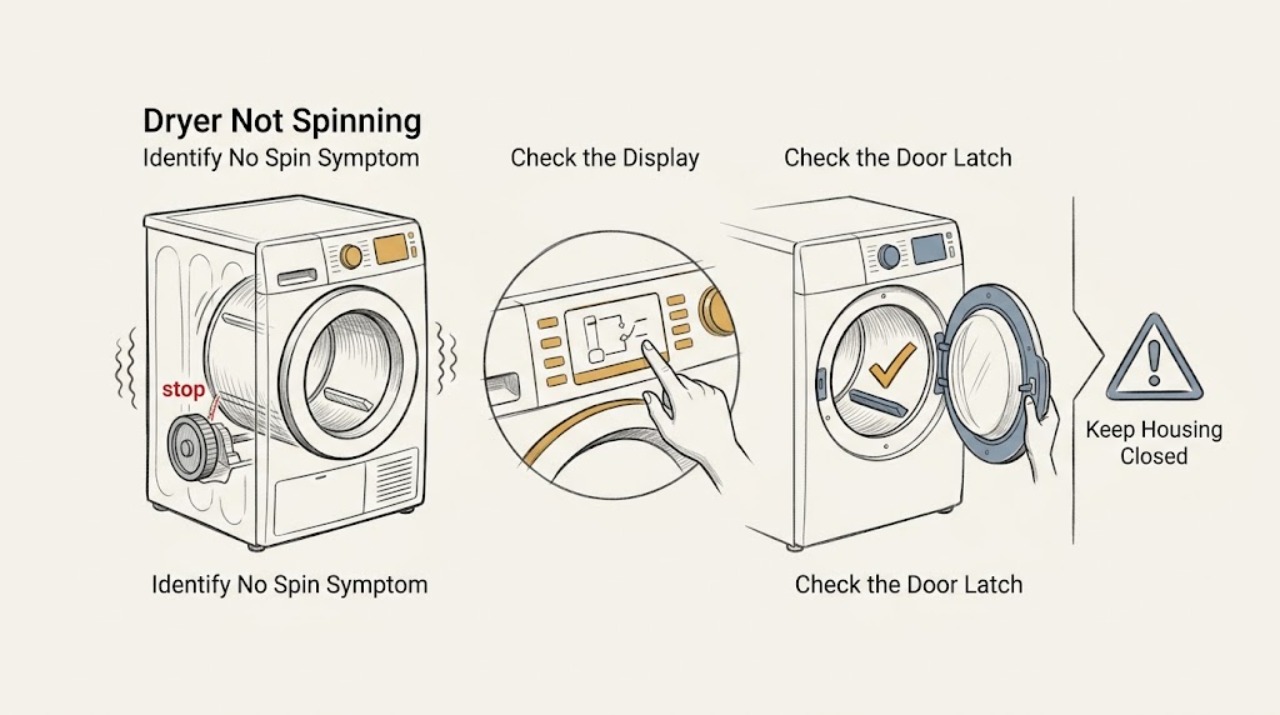
Work through in order
Diagnostic checks
Use only checks that match the exact appliance or system and its official guide.
-
Check 1
Remove the load, leave the door open, and record the full Maytag model number, whether the drum light or controls illuminate, whether the problem occurs at startup or mid-cycle, and what you hear when the Start control is used. Do not repeat a start attempt if there is a hazard sign.
Expected result: The controls may be dark; the controls may light but the drum may remain still; a motor hum may be audible; or there may be a loud rumble, squeal, scraping sound, smoke, odor, or abnormal heat.
Next step: If there is smoke, burning odor, gas odor, sparking, abnormal heat, violent movement, metal scraping, damaged wiring, or a breaker trip, disconnect power only if it can be done without contact with damage and use the safety stop below. Otherwise continue with the external start and door checks.
Stop if: Stop immediately for smoke, burning or gas odor, sparks, exposed or damaged wiring, a hot or damaged outlet, violent movement, metal-on-metal scraping, or repeated breaker trips.
Why this matters
Why: Dark controls keep power and supply in the decision path. A running-sounding motor with a still drum makes the belt or mechanical drive path more likely. Rumble or squeal supports a roller or idler concern. A hazard sign overrides further testing.
-
Check 2
With the drum empty and the area dry, verify the plug is fully seated, the selected cycle is a running Automatic or Time Dry option supported by the model, and Control Lock is not active. Press and hold Start, Push to Start, or Hold to Start for the period specified for the model; Maytag’s general guidance says two to five seconds. Do not remove covers or touch terminals.
Expected result: The dryer may start and tumble; it may remain silent with controls lit; or the home fuse or breaker may trip again.
Next step: If the dryer remains silent, proceed to the door-latch and obstruction check. If a breaker trips again, leave it off and arrange electrical or appliance service according to the safety condition.
Stop if: Do not continue if the outlet, cord, plug, or terminal area is hot, scorched, loose, wet, damaged, or repeatedly trips the breaker.
Why this matters
Why: A start after correcting a control, cycle, or door-selection issue points to an operating condition rather than a confirmed failed motor part. A repeat trip or abnormal outlet condition is an electrical-service boundary, not a reason to keep resetting power.
-
Check 3
Inspect the door opening and latch area with power off. Remove only clothing, packing material, or lint that is visibly blocking the latch; close the door firmly until every latch engages. Do not tape or bypass the latch or door switch.
Expected result: The door may close and latch normally; it may look closed but fail to latch; or it may pop open, have a damaged latch, or leave the dryer unresponsive when Start is held.
Next step: If the latch is clear and secure but the drum still does not move, do not bypass the safety circuit; move to the empty-drum movement check and arrange service if the symptom persists.
Stop if: Stop if the door, hinge, latch, switch area, or surrounding cabinet is cracked, loose, sharp, scorched, or cannot close safely.
Why this matters
Why: A blocked or unlatched door can prevent the motor from starting. A latch that will not engage or a dryer that still does not recognize a closed door suggests a door latch or switch circuit requiring model-specific service.
-
Check 4
Unplug the dryer or switch off its dedicated supply, confirm the drum is empty and cool, then gently turn the drum by hand from the opening. Do not force it, remove panels, or reach around the drum.
Expected result: The drum may turn with ordinary resistance; it may be difficult or impossible to move; or it may turn with grinding, wobble, scraping, or a loose-feeling path.
Next step: Leave the appliance disconnected and book qualified service for any abnormal resistance or noise. If it turns freely and the prior checks passed but still will not tumble, have the belt, motor, thermal protection, switch circuit, and control diagnosed with the exact model information.
Stop if: Stop the hand check if the drum binds, drops, has sharp edges, contains a loose object that cannot be removed safely, or the cabinet is hot or damaged.
Why this matters
Why: A drum that is difficult to turn can be seized or mechanically restricted. Grinding, rumbling, or wobble can indicate rollers, slides, idler, bearings, or another support problem. A drum that turns freely while the motor was heard earlier makes the belt or drive connection a stronger service lead, but it does not prove the exact part.
-
Check 5
Compare the safe observations without opening the cabinet: motor sound with no drum movement, no motor sound after power and latch checks, a mid-cycle stop, or loud rumbling/squealing. Keep the dryer disconnected while recording the result and model number for service.
Expected result: A motor sound with a still drum is consistent with a drive belt or drive connection issue; no motor response can involve the start circuit, door switch, thermal fuse, motor, or control; mid-cycle stopping can involve motor or thermal protection; rumbling or squealing can involve rollers, slides, or the idler.
Next step: Stop using the dryer and give the technician the exact model, gas or electric type, symptom timing, sound, drum-movement result, power observations, and any hazard event. Do not run an additional load to see whether it recovers.
Stop if: Any failed drive component, seized drum, thermal event, damaged cord, gas odor, smoke, sparks, or repeated electrical trip requires the dryer to remain out of service until qualified diagnosis.
Why this matters
Why: Maytag’s parts guidance treats these components as model-dependent service items. The external symptom narrows the diagnostic path but cannot establish safe compatibility or justify a live electrical test.
Use your observations
Decision map
Find the observation that best matches what you see, then follow the next safe action.
-
PATH 01Safety boundary
What you see
Smoke, burning or gas odor, sparks, abnormal heat, violent movement, metal scraping, damaged electrical parts, or a repeated breaker trip is present.
Do this next
Stop the cycle, keep people away, and if safe disconnect the appliance from power without touching damaged or wet components. For gas odor, do not operate switches or create an ignition source; leave the area and contact the appropriate emergency or gas authority from a safe location. Arrange qualified appliance or electrical service.
Why this path and its safety boundary
Why it matters: This is a safety event, not a normal no-spin troubleshooting branch.
Safety stop: Do not re-energize or test the dryer until the hazard has been assessed.
-
PATH 02Safety boundary
What you see
The drum light and controls are dark.
Do this next
Check the plug and household supply only from a dry, undamaged position. An electric-dryer supply issue or recurring trip belongs with a qualified electrician; if supply is normal, arrange appliance service.
Why this path and its safety boundary
Why it matters: The immediate path is supply, plug, fuse, breaker, or internal power—not a proven belt failure.
Safety stop: Stop if the cord, outlet, plug, or breaker is damaged, hot, wet, scorched, or trips again.
-
PATH 03Safety boundary
What you see
Controls light, but the dryer remains silent after the correct cycle, Control Lock check, firm Start hold, and a fully latched door.
Do this next
Keep the dryer off and arrange service; do not bypass the door switch or open the cabinet for live tests.
Why this path and its safety boundary
Why it matters: The door switch, start/control circuit, thermal protection, motor, or another model-specific control condition remains possible.
Safety stop: Any odor, heat, sparking, damaged part, or breaker event moves immediately to the hazard branch.
-
PATH 04Safety boundary
What you see
A motor sound is heard but the drum does not turn.
Do this next
Do the cool, unplugged hand-movement check once. If the drum turns freely or the symptom is abnormal, leave the unit disconnected and have the belt, motor, idler, rollers, and supports diagnosed.
Why this path and its safety boundary
Why it matters: Maytag identifies the drive belt as a likely lead; a seized drum or another drive restriction remains possible.
Safety stop: Do not continue if the drum binds, scrapes, smells hot, or the cabinet has damage.
-
PATH 05Safety boundary
What you see
The empty drum is hard to turn, grinds, wobbles, rumbles, or squeals.
Do this next
Keep power disconnected and schedule qualified mechanical service; do not force the drum or run a load.
Why this path and its safety boundary
Why it matters: A seized drum or worn mechanical support such as rollers, slides, idler, or bearings is more likely than a simple setting issue.
Safety stop: The dryer remains out of service until the source of resistance or noise is found.
-
PATH 06Safety boundary
What you see
The dryer is cool, dry, undamaged, the door latches, no hazard was observed, and the issue appeared to be a control or selection mistake.
Do this next
Run no additional load unless the empty test starts and tumbles normally. If the no-spin symptom returns, stop and arrange service.
Why this path and its safety boundary
Why it matters: One controlled empty-drum test can confirm whether the operating condition was corrected; it is not a repair validation for a suspected drive fault.
Safety stop: Stop at once if the test produces odor, heat, smoke, sparks, noise, movement, or a trip.
Helpful context
Understand the symptom
Start with the symptom, not a replacement part
A dryer can appear to run while the drum remains still, or it can fail to start at all. Those observations lead to different checks. Leave the dryer off while you identify the model number, dryer type, selected cycle, and what happened immediately before the no-spin condition. Do not keep running a non-tumbling load: without drum movement, clothing can remain against a hot surface and the machine is not operating as intended.
Why the sound matters
A motor hum with no drum movement points toward the belt or a mechanically restricted drum, while no response at all keeps power, controls, door recognition, and the start path in play. A loud rumble or squeal can implicate rollers or the idler. These are clues for the next safe step, not permission to open a live cabinet or order a part without model confirmation.
Electric and gas models
Both electric and gas Maytag dryers use an electrically driven drum system, but their power and fuel arrangements differ. Do not test terminals or gas components yourself. For an electric model, recurring breaker trips or suspected supply wiring require an electrician; for a gas model, any gas odor requires immediate shutdown and qualified help.
Safety boundary
Stop conditions
- Smoke, burning odor, gas odor, sparks, arcing, or visible flame.
- Abnormally hot cabinet, plug, cord, outlet, or control area.
- Repeated circuit-breaker or fuse operation, damaged electrical parts, or wet electrical areas.
- Violent movement, metal scraping, a seized drum, or a drum that cannot turn normally when cool and unplugged.
- A door, latch, switch, cabinet, vent, or gas connection that is damaged or cannot operate safely.
Only after diagnosis
Potential parts
- dryer drive belt
Consider only when the motor is heard or the drum turns freely by hand but does not move under power, and a technician confirms belt failure for the exact model.
Confirm the complete Maytag model number and manufacturer fit information before ordering. - dryer drive motor
Consider only after the start, door, supply, belt, and drum-restriction paths have been diagnosed and the motor is confirmed faulty.
Motor design and fit vary by model; use the exact model documentation. - dryer drum rollers or idler pulley
Consider only when the empty drum has documented rumble, squeal, wobble, or abnormal resistance and service confirms the support part.
Confirm model-specific part grouping and fit before purchase. - dryer door latch or door switch
Consider only when the latch cannot engage or the dryer does not recognize a safely closed door after visible obstruction is removed.
Use the exact model and service documentation; never bypass a door safety switch.
When checks do not resolve it
Need a professional?
Arrange qualified appliance service when the controls and latched door are confirmed but the drum still will not tumble, when the motor is heard without drum movement, when the drum is hard to turn or noisy, when the dryer stops mid-cycle, or when any internal belt, motor, thermal, switch, wiring, or control diagnosis would be required. Use an electrician for a supply, outlet, cord, or recurring breaker problem. For any gas odor or fire concern, leave the area and use the appropriate emergency or gas-safety channel from a safe location.
Safety scope: Only ordinary-access, power-off observations are described. Do not open the cabinet, test live terminals, bypass the door switch, defeat thermal protection, work on gas components, or keep resetting a tripped breaker.
Common questions
FAQ
Why does my Maytag dryer hum but the drum does not spin?
Maytag identifies a drive belt as a likely cause when the motor can be heard but the drum remains still. A seized drum or another drive restriction can sound similar, so unplug the cool dryer, check only whether the empty drum turns normally, and arrange service rather than opening the cabinet.
Can I keep using a Maytag dryer that is not tumbling?
No. Maytag advises against continuing to use a dryer that does not spin because the drum is needed to circulate air and the malfunction can worsen. Keep it out of service until the cause is corrected.
What should I check if my Maytag dryer has power but will not start?
Check that Control Lock is off, the selected cycle can run, Start is held as the model requires, and the door is fully latched with no visible obstruction. If controls still light but the motor does not respond, professional diagnosis may be needed for the door switch, start path, thermal protection, motor, or control.
Is a dryer belt the only reason a Maytag dryer will not spin?
No. Maytag also lists power, door latch, Control Lock, drive motor, seized drum, rollers, idler, thermal protection, and control conditions. Use the sound and cool hand-movement observations to narrow the path, but do not infer a part fit without the exact model.
When should I stop troubleshooting immediately?
Stop for smoke, burning or gas odor, sparks, abnormal heat, violent movement, metal scraping, damaged electrical parts, wet electrical areas, or a breaker that trips again. Disconnect only if safe, keep away from a gas or fire hazard, and obtain qualified help from a safe location.
Read the exact guide
Official sources
- Parts of a Dryer: A Guide to Repair or Replace Common Gas or Electric Dryer PartsMaytag · Maytag general parts guide; it does not establish fit for a particular model.
- MAYTAG® ELECTRIC DRYERMaytag · The opened W10150622 manual covers several Maytag electric dryer models; use the exact owner manual for a particular unit.
- Not Starting or Not Operating - Dryer - Product HelpMaytag Product Help · Maytag dryer product-help guidance; features differ by model.
- Not Tumbling or Spinning - Dryer - Product HelpMaytag Product Help · Maytag dryer product-help guidance; exact model behavior and installation vary.
- How to Fix a Dryer That Won’t SpinMaytag · Maytag consumer guidance; exact controls and repair procedures vary by model.
Community feedback
Share a repair observation
Share a plain-text repair observation. Accepted observations are published automatically; this page may take a moment to update.