
On this page
Start here
Quick answer
If an AEG dryer is powered but the drum does not spin, first separate a no-start condition from a drive symptom: check the outlet and breaker, close the door, clear delay start or child lock, and check for a full water tank or displayed code. With the appliance unplugged, remove an overloaded or tangled load and see whether the drum moves freely without forcing it. A drum that remains still with the appliance powered, especially with a motor-related code, needs model-specific service rather than a guessed belt or motor replacement. AEG says its dryer controls vary by model, a full tank can stop a cycle, and code E54 indicates a motor-control problem; do not use the appliance if it trips protection, smells hot, shows damaged wiring, or makes a sharp rubbing sound.
Before you begin
Safety first
- Keep the appliance disconnected when the no-spin fault persists or any electrical/mechanical hazard is present. Do not bypass interlocks or dismantle internal components.
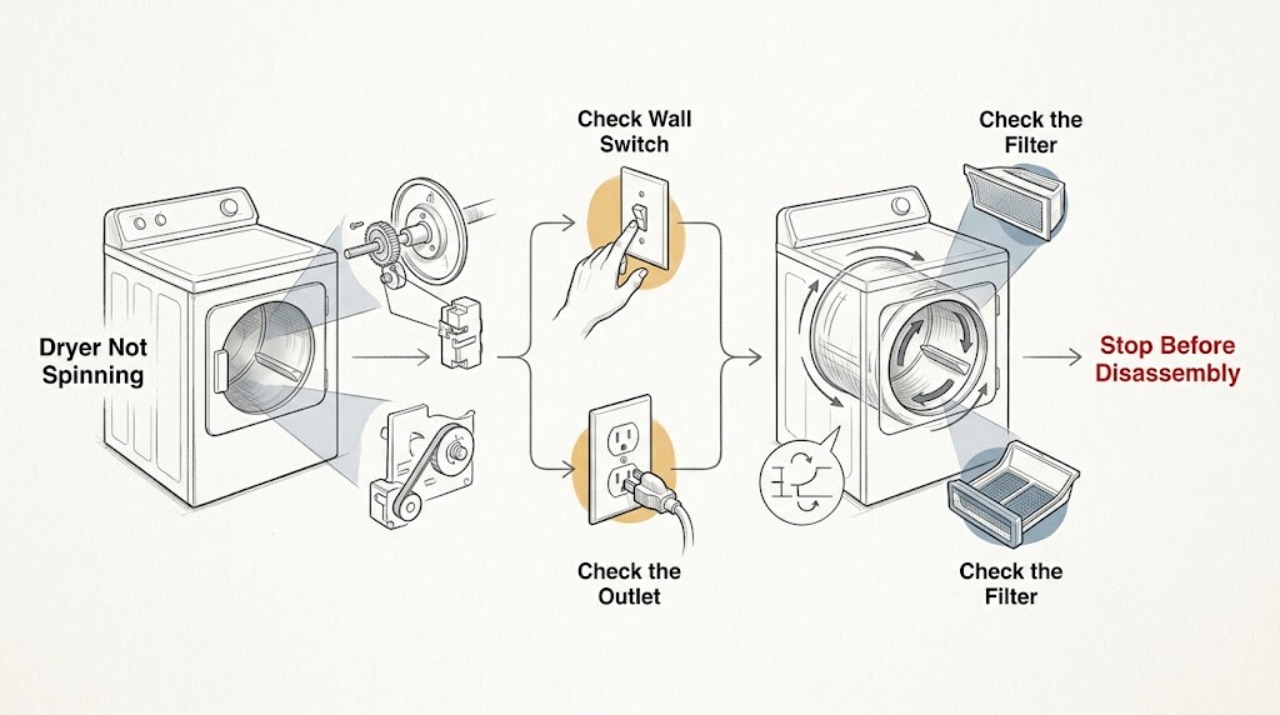
Work through in order
Diagnostic checks
Use only checks that match the exact appliance or system and its official guide.
-
Check 1
Switch the dryer off and check the symptom without reaching behind panels. If the appliance has a damaged cord, scorch mark, burning smell, water around the electrical connection, or a breaker/RCD that trips again, leave it disconnected.
Expected result: Note whether the display or indicator lights are completely dark, whether the control panel responds, and whether the protection device trips again when the dryer is selected.
Next step: If safe, continue to the outlet and supply check; if protection trips again or there is heat or damage, stop and arrange qualified service/electrical inspection.
Stop if: Do not energize the dryer with visible cord damage, liquid at the connection, smoke, or a repeated protection trip.
Why this matters
Why: A dark, unresponsive dryer is first a supply or control-power problem, not proof of a failed drum drive. A repeated trip indicates an electrical fault or unsafe load and is not a reset to keep repeating.
-
Check 2
Verify the outlet and start conditions. With the dryer disconnected, plug a small known-working device into the same outlet; then reconnect the dryer, select a cycle, close the door fully, and press Start/Pause once. Check for Delay Start, a padlock/child-lock symbol, energy-saving standby, or a full water-tank indicator.
Expected result: The outlet either powers the test device or does not. On the dryer, note a flashing Start/Pause light, a padlock, a countdown, a tank-full symbol, or a cycle that begins but leaves the drum still.
Next step: Restore only the external supply condition that is clearly safe, cancel the indicated option using the model manual, empty the water tank if its indicator is lit, and test once on a simple programme.
Stop if: Do not bypass the door switch or defeat a child lock; do not keep resetting a breaker to make the dryer run.
Why this matters
Why: A dead outlet or tripped fuse/RCD can mimic a dead dryer. A door, lock, delay, standby, or full-tank state can block the cycle before any motor diagnosis is meaningful; AEG notes that lock controls vary by model.
-
Check 3
Unplug the dryer, open the door, remove the laundry, and inspect only the accessible drum, door seal, and filter area. Remove a loose item or lint that is plainly accessible; do not remove covers. Gently move the empty drum by hand without forcing it.
Expected result: Record whether the empty drum turns smoothly, is stiff or jammed, scrapes, or has an object caught at the door seal or drum edge. Note whether the filter is clogged and whether the load was unusually heavy or tangled.
Next step: Clear only the visible obstruction, clean the accessible filter as the manual directs, reload a small balanced load, and perform one test cycle only if the drum moves normally and no hazard is present.
Stop if: Stop immediately for sharp rubbing, a loose structural part, exposed wiring, a hot smell, or any need to dismantle the drum drive.
Why this matters
Why: A changed result with the load removed suggests load size or an accessible obstruction may be involved, but it does not prove the drive is sound. A jammed, scraping, or abnormally stiff drum points to a mechanical fault that requires inspection.
-
Check 4
Run one short, supervised test with an empty or light load only after the preceding checks pass. Listen and watch for a normal start, a brief attempt followed by silence, a hum without rotation, or an error code; do not put hands into a moving drum.
Expected result: Write down the exact code, beeps, and timing. Distinguish a drum that never attempts to move from one that starts and stops under load, and note whether the display remains responsive.
Next step: Turn the dryer off, disconnect it, and provide the model/PNC, code, load condition, and observed sound to an authorised technician if no-spin repeats.
Stop if: Do not run repeated tests when the drum does not rotate, a motor hum persists, or an error code returns.
Why this matters
Why: A repeatable no-rotation symptom after the start conditions and free-drum check shifts suspicion toward the drive, motor-control system, or another internal interlock. AEG specifically describes E54 as a motor-control problem; a code is evidence for service triage, not a part number.
-
Check 5
Prepare a service handoff instead of guessing at an internal part. Record the full model and product identification from the rating plate, the programme used, whether the drum was empty or loaded, the exact code, and whether the drum was free by hand while unplugged.
Expected result: You should have a reproducible symptom description and a clear safety state: normal supply but no rotation, mechanical restriction, or an unresolved control/error condition.
Next step: Keep the dryer disconnected if the no-spin fault persists and request authorised service; retain any displayed code and do not dismantle internal components unless the manufacturer specifically instructs it.
Stop if: Stop DIY diagnosis at the cabinet, wiring, motor, drum-support, or control-board level.
Why this matters
Why: These observations narrow the inspection without claiming that a belt, idler, roller, motor, or control board is compatible. Model-specific documentation and an authorised inspection are needed before parts are selected.
Use your observations
Decision map
Find the observation that best matches what you see, then follow the next safe action.
-
PATH 01Next step
What you see
The display is dark or the outlet does not power a test device.
Do this next
Check the plug, breaker/RCD, and outlet only within normal household safety limits; use an electrician or authorised service if the fault repeats.
Why this path and its safety boundary
Why it matters: Treat this as a supply/power path issue first; do not diagnose the drum drive until safe power is restored.
-
PATH 02Next step
What you see
The display works but a padlock, delay countdown, standby state, or full-tank indicator blocks Start/Pause.
Do this next
Clear the indicated state using the exact model manual, empty the tank where applicable, and test once.
Why this path and its safety boundary
Why it matters: The cycle may not have reached the motor command.
-
PATH 03Next step
What you see
The door will not latch or Start/Pause flashes without a cycle.
Do this next
Remove laundry caught at the seal, close the door normally, and arrange service if the latch or hinge is damaged.
Why this path and its safety boundary
Why it matters: A door/interlock condition can prevent a start; do not bypass it.
-
PATH 04Next step
What you see
The unplugged drum is stiff, jammed, or scraping.
Do this next
Leave the dryer disconnected and request service without forcing the drum or removing panels.
Why this path and its safety boundary
Why it matters: An internal mechanical obstruction or drive fault is possible; the observation is not enough to name a part.
-
PATH 05Next step
What you see
The controls accept a cycle, the drum is free, but it hums, twitches, stops, or returns E54.
Do this next
Disconnect the dryer and provide the exact code and model details to authorised service.
Why this path and its safety boundary
Why it matters: The symptom is consistent with an internal drive or motor-control fault that needs professional diagnosis; AEG identifies E54 as motor control.
-
PATH 06Next step
What you see
The drum spins only after reducing or untangling the load.
Do this next
Use the programme's documented load guidance and stop if the no-spin symptom returns.
Why this path and its safety boundary
Why it matters: Load condition may be contributing, but recurrence under a normal load still needs evaluation.
Helpful context
Understand the symptom
What a no-spin symptom tells you
A silent drum with no response from the controls points toward supply, door, or control state. A running display with a hum, a brief twitch, or a code points to a different branch: the cycle has been accepted, but the drive may be unable to turn the load. The symptom alone cannot identify a belt, roller, motor, or control board, so record the exact model and any code before ordering a part.
Use the model manual for controls
AEG dryers use model-dependent button combinations and options. Treat the owner's manual as the authority for clearing a padlock, cancelling a delay, selecting a timed programme, and interpreting a code. One documented change at a time makes the result useful; repeated random resets can hide which condition changed.
Safety boundary
Stop conditions
- Stop and disconnect the dryer for a repeated breaker/RCD trip, damaged cord, scorch mark, smoke, burning smell, or liquid at the electrical connection.
- Stop if the empty drum is jammed, scrapes sharply, or needs force to move.
- Do not bypass a door switch or open the cabinet to reach the belt, motor, rollers, wiring, or control board.
- Stop using the appliance when no-spin repeats after safe external checks or an error code returns.
Only after diagnosis
Potential parts
- drum drive belt
Only a service inspection can establish whether a belt is broken, displaced, or not the cause of the no-spin symptom.
Match the full model and product identification; do not infer fit from the AEG brand alone. - drum support or idler assembly
A stiff, scraping, or noisy empty drum may lead a technician to inspect support components, but the symptom does not identify a specific assembly.
Confirm the exact model documentation and the technician's diagnosis before selecting a part. - motor or motor-control assembly
A repeatable no-spin with a free drum or an E54 code can justify professional inspection of motor-control components.
E54 is a motor-control clue, not proof that a particular motor or board is compatible or failed.
When checks do not resolve it
Need a professional?
The dryer has power and accepts a programme, but the drum still will not rotate after one safe unloaded test., The drum is mechanically restricted, the door/latch is damaged, or the appliance makes a new rubbing or motor noise., E54 or another code returns after the model-specific documented reset/check, or the appliance trips electrical protection.
Safety scope: Keep the appliance disconnected when the no-spin fault persists or any electrical/mechanical hazard is present. Do not bypass interlocks or dismantle internal components.
Common questions
FAQ
Why does my AEG dryer run but the drum does not spin?
If the display accepts a cycle but the drum stays still, first rule out door, lock, delay, tank, load, and accessible-obstruction conditions. If the unloaded drum is free but still will not rotate, an internal drive or motor-control inspection is needed; a belt or motor should not be selected from the symptom alone.
Can a full water tank stop an AEG dryer from spinning?
Yes, on models with a water tank, AEG says the appliance can stop when the tank is full. Empty it as directed, return it correctly, and press Start/Pause once; if the drum still does not rotate, continue with the separate drive diagnosis.
What does E54 mean on an AEG dryer?
AEG describes E54 as a motor-control problem. Reduce the load and check the external supply as directed, but if the code or no-spin symptom remains, disconnect the dryer and arrange authorised service rather than replacing a part by guesswork.
Should I open my AEG dryer to check the belt?
Not as a first check. Unplug the appliance for accessible cleaning and observation, but leave cabinet-level belt, motor, drum-support, wiring, and control work to a qualified technician unless AEG specifically instructs otherwise for your model.
Read the exact guide
Official sources
- Tumble dryer does not start / does not workAEG · AEG tumble dryers that do not start or whose drum does not rotate without an error message
- How to clean and maintain your AEG tumble dryerAEG · AEG tumble dryer filter, water-tank, condenser, drum, sensor, and airflow maintenance
- Tumble dryer displays error code E54AEG · AEG tumble dryers displaying E54 alongside a no-spin or motor-control symptom
Community feedback
Share a repair observation
Share a plain-text repair observation. Accepted observations are published automatically; this page may take a moment to update.