
On this page
Start here
Quick answer
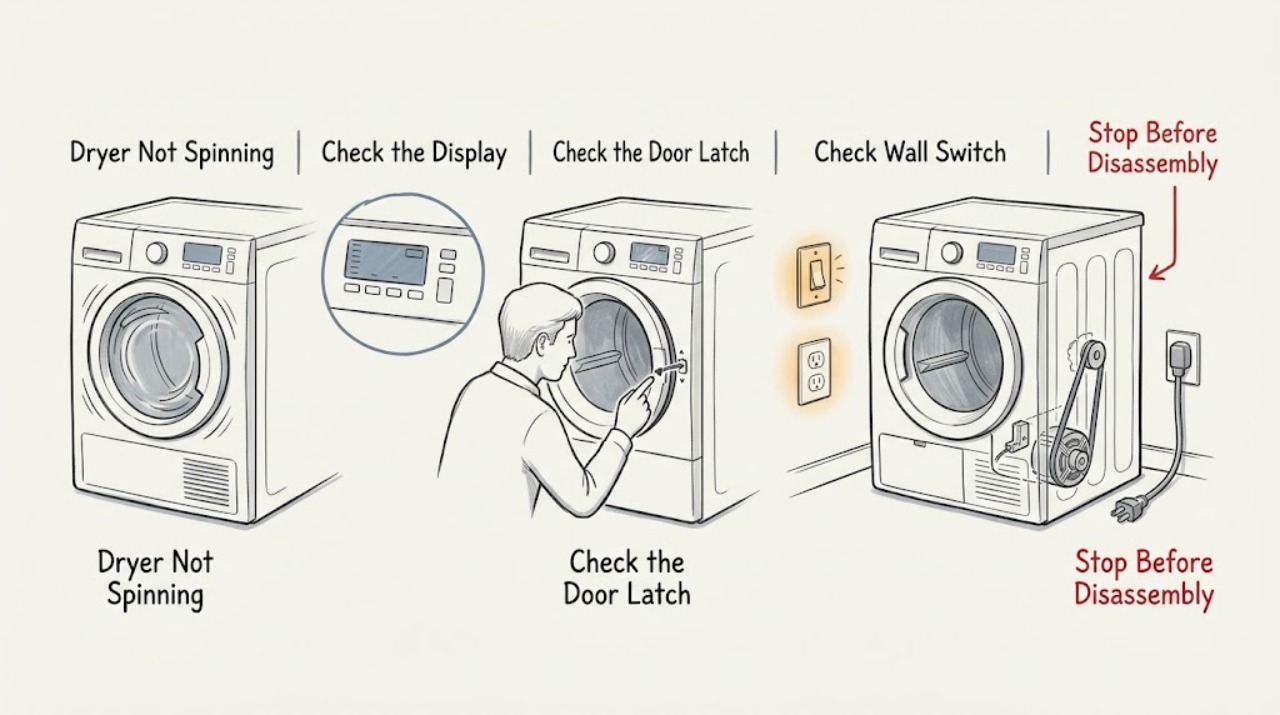
If a Beko dryer is not spinning, first make sure the door is fully closed, a program has been selected and started, and there is no child lock or delay setting shown. With the dryer switched off and cool, turn the drum gently by hand only as an external observation: normal resistance, a drum that turns unusually freely, or a drum that is jammed point to different branches. Beko identifies a seized drum, motor fault, and worn or broken drive belt as common causes, and says no sound when the dryer is switched on may indicate a motor fault. Do not remove the cabinet, reach for the belt or motor, bypass the door switch, or perform live electrical tests. Stop for smoke, burning smell, sparks, a hot or damaged cord, a jammed drum with a harsh obstruction, or repeated breaker trips; arrange qualified appliance service, with household wiring concerns handled by a qualified electrician.
Work through in order
Diagnostic checks
Use only checks that match the exact appliance or system and its official guide.
-
Check 1
From a dry position, note whether the display and controls power on, whether the dryer makes any sound when Start is pressed, and whether the drum is completely still, moves briefly, or only tumbles during an anti-crease or cooldown stage.
Expected result: The dryer is completely dead, the display is active but there is no motor sound, the motor sounds but the drum stays still, or the drum tumbles intermittently during a documented end-of-cycle mode.
Next step: Use the power and program checks below without opening the cabinet. If the drum is still with abnormal noise or the symptom recurs, stop and arrange service rather than trying to make it spin by force.
Why this matters
Why: No power is a supply branch rather than proof of a belt failure. Beko says no motor sound may indicate a motor fault, while a running motor with a still drum makes a drive or drum obstruction more likely. Intermittent anti-crease movement may be an intentional cycle state.
-
Check 2
Check the visible operating state: close the loading door until it latches, verify that a program is selected, press Start/Pause as the model requires, and look for child-lock, delay, tank-full, or filter-warning indicators. Do not force the door or bypass a lock.
Expected result: The door was not latched, Start was not pressed, child lock or delay was active, the water tank or filter warning is shown, or all visible conditions are correct.
Next step: Correct only the matching condition using the exact model manual and try one normal start if there are no hazard signs. If the drum remains still with correct settings, continue to the powered-off drum observation and service boundary.
Why this matters
Why: Beko states that an open door, an unstarted program, child lock, delay, or a full tank can prevent normal operation. These conditions can mimic a no-spin fault without establishing a mechanical failure.
-
Check 3
Switch the dryer off, disconnect it only if the plug is safely accessible and dry, wait for the drum to stop and cool, then turn the empty drum gently by hand. Do not reach behind the drum or remove any cover.
Expected result: The drum offers some resistance, spins unusually freely, is very difficult to turn, or will not move at all.
Next step: Do not run a freely spinning or jammed drum. Keep the dryer off and arrange qualified appliance service; do not access or replace the belt, motor, or switch yourself.
Why this matters
Why: Beko says a correctly belted drum should feel stiff and offer resistance, while a very freely spinning drum may indicate a broken belt. A drum that is very difficult or impossible to turn may indicate seizure or a door-switch-related condition; hand feel alone cannot identify the failed part.
-
Check 4
Inspect only the accessible door area and drum opening for a garment, hard object, or visibly displaced seal that could obstruct the door or drum. Do not reach into a tight obstruction, remove the door, or manipulate the door switch.
Expected result: Laundry or an object is caught at the door, the door closes normally with a clear opening, or the drum remains jammed despite no visible obstruction.
Next step: Remove only a loose, accessible item with the dryer off and cool, then try one model-approved start. If the door, drum, or seal is damaged or the jam persists, stop and call service.
Why this matters
Why: A door that cannot close correctly can prevent a cycle from starting, while a jam with no visible cause needs mechanical diagnosis. Beko distinguishes a difficult-to-turn drum from a freely turning drum, but neither observation authorizes cabinet access.
-
Check 5
Check the visible power cord, plug, outlet area, and household breaker without touching wet or damaged equipment. Note whether the dryer loses power when Start is pressed, whether the breaker trips, or whether the supply looks normal while the motor remains silent.
Expected result: The cord or outlet is hot or damaged, the breaker trips, the display goes blank under a start command, or the external supply appears normal.
Next step: Leave the dryer off for damage, repeated trips, or loss of power and contact a qualified electrician or appliance technician as appropriate. Do not use an extension cord, replace protection with a larger rating, or open the machine.
Why this matters
Why: Beko treats a damaged supply or an electrical fault as a service issue. A normal-looking supply with no motor sound can still indicate an internal motor or control fault; it does not justify live testing.
-
Check 6
After the visible cause is corrected, use at most one model-approved normal start while staying nearby. Observe whether the drum begins turning smoothly, the motor hums without rotation, the dryer stops again, or smoke, burning smell, sparks, or abnormal heat appears.
Expected result: The drum rotates normally, the motor runs but the drum remains still, the no-spin symptom returns, or a hazard appears.
Next step: For any hazard or repeat failure, stop using the dryer and arrange qualified service. Give the technician the model, program, drum hand-resistance result, motor sound, display indicators, and supply observations; do not continue cycling it.
Why this matters
Why: A successful start after a door or program correction supports a cycle-state explanation. A motor sound with no drum movement, a returning no-spin symptom, or any hazard points toward a mechanical, electrical, or safety fault requiring diagnosis.
Use your observations
Decision map
Find the observation that best matches what you see, then follow the next safe action.
-
PATH 01Next step
What you see
Smoke, burning smell, sparks, melted material, a hot or damaged cord or outlet, water near electrical parts, or repeated breaker operation is present.
Do this next
Stop immediately, keep the dryer off, and obtain qualified appliance or electrical help as appropriate. Do not restart, open panels, bypass the door switch, or work on wiring.
-
PATH 02Next step
What you see
The door, program, child lock, delay, tank, or filter indicator shows a user-resolvable cycle condition.
Do this next
Correct that visible condition using the exact model manual and try one normal start. If the drum remains still or the indicator returns, stop and arrange service.
-
PATH 03Next step
What you see
The empty drum spins unusually freely, is difficult to turn, or will not move with power disconnected.
Do this next
Do not operate the dryer or access the belt, motor, or drum support. Book qualified appliance service for mechanical diagnosis.
-
PATH 04Next step
What you see
The drum still does not spin after the visible cycle and supply checks, or the motor runs without rotating the drum.
Do this next
Keep the dryer off and arrange qualified appliance service. Beko does not recommend user repairs; provide the exact model and all observations instead of opening the cabinet.
Helpful context
Understand the symptom
A no-spin symptom can be mechanical or simply a cycle state
A dryer that powers on but leaves the drum still is different from one that is completely dead, pauses because the door or tank condition is not satisfied, or tumbles intermittently in an anti-crease mode. Beko's hand-resistance check is only a clue; it does not prove a belt or motor diagnosis. Record the model and exact behavior before seeking service.
Keep the cabinet closed
Switch the dryer off and let it cool before any external observation. User checks stop at the controls, door, visible supply, and a gentle drum observation with power off. Do not remove covers, access the belt or motor, bypass the door switch, probe wiring, or work inside the appliance. Stop immediately for smoke, burning smell, sparking, a hot or damaged cord or outlet, water near electrical parts, or repeated breaker operation.
Only after diagnosis
Potential parts
- drive belt
Only consider this category after a qualified diagnosis or the model manual identifies a broken belt; unusually free drum rotation is a clue, not proof of belt failure.
Confirm the exact model and product code from the rating label and have fitment verified before selecting a component. - drive motor or door switch
Only consider this category when qualified diagnosis finds a motor or door-safety fault after the visible controls and powered-off drum checks are normal.
Motor and switch designs vary by model; do not bypass or replace either component based only on a no-spin symptom.
Common questions
FAQ
What should I check first when my Beko dryer is not spinning?
Check that the door is closed, a program has been selected and started, and no child lock, delay, tank, or filter indication is preventing the cycle. Then switch off and cool the dryer and gently assess the empty drum's resistance without opening the cabinet.
What does it mean if a Beko dryer drum spins freely by hand?
Beko says a drum that spins very freely may indicate a broken drive belt. It is only a clue, so keep the dryer off and have a qualified technician confirm the belt, drum, and motor rather than removing the cabinet yourself.
Why does my Beko dryer make a sound but the drum does not turn?
A motor sound with no drum movement can make a drive or drum obstruction more likely, while no sound at all may indicate a motor fault. Beko recommends professional service and does not recommend attempting repairs yourself.
When should I stop using a Beko dryer that will not spin?
Stop for smoke, burning smell, sparks, melted material, unusual heat, a damaged cord or outlet, water near electrical parts, repeated breaker trips, a jammed drum, or a no-spin symptom that returns after the visible checks. Keep the cabinet closed and arrange qualified appliance or electrical service.
Read the exact guide
Official sources
- Why is my tumble dryer not getting hot?Beko UK official support · Official Beko guidance connecting overload and airflow with dryer performance, describing an external drum-resistance observation, and recommending no user repair.
- How to troubleshoot potential problems when your tumble dryer is not workingBeko UK official support · Official Beko guidance on visible power, door, program/start, drain, tank, child lock, and delay conditions that can mimic a no-spin issue; controls vary by model.
- Why is my tumble dryer not spinning?Beko UK official support · Official Beko guidance identifying seized drum, motor, belt, and door-switch possibilities through sound and powered-off drum resistance; it recommends service rather than user repair.
- Dryer / User ManualBeko official documentation · Official Beko manual showing the dryer control, door, power cord, and model-specific maintenance context; it is not a universal code or repair guide for every Beko dryer.
- How to use and maintain your Tumble DryerBeko UK official support · Official Beko safety guidance on suitable loads, lint, heat build-up after interruption, and staying nearby during operation.
Community feedback
Share a repair observation
Share a plain-text repair observation. Accepted observations are published automatically; this page may take a moment to update.