
On this page
Start here
Quick answer
If a GE dryer is not spinning, first separate a dryer that will not start from one whose motor runs but the drum stays still. With the dryer off and unplugged, remove a heavy or wet load and retry only with a normal-size load. Confirm the door closes tightly, the cycle and START control are set correctly, and the household breaker or fuse is intact; most electric dryers use two breakers or fuses. If the drum turns unusually freely by hand while the dryer is unplugged, GE says the drive belt may be broken or loose and service is required. Do not run a gas dryer without its vent, reach into the cabinet, bypass the door switch, or inspect live wiring. Stop for a burning smell, smoke, scorching, a hot or damaged cord, repeated breaker trips, or violent movement, and arrange qualified GE appliance service.
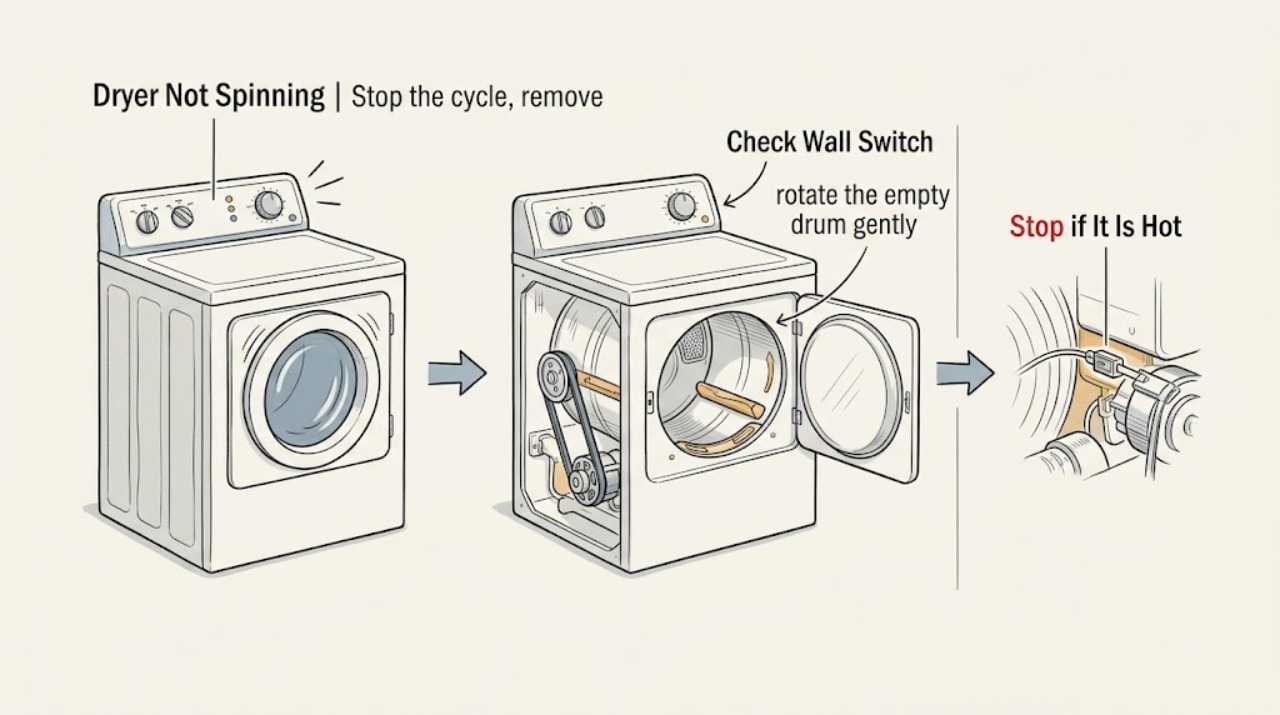
Work through in order
Diagnostic checks
Use only checks that match the exact appliance or system and its official guide.
-
Check 1
Stop the cycle, remove the load, and note whether the dryer is silent, hums, or runs while the drum remains still. With the dryer off and unplugged, inspect the drum opening for an obvious obstruction and do not reach into the cabinet or around the motor.
Expected result: The dryer is completely silent, the motor sound is present without tumble, the drum is blocked, or the drum is empty but free to rotate.
Next step: Continue to the power, door, and control checks only if there is no heat, smoke, or odor. If the drum is jammed or the motor runs without tumble, stop and arrange service.
Stop if: Stop for smoke, burning smell, scorching, a hot cabinet, violent movement, or a drum that cannot be moved safely by hand when unplugged.
Why this matters
Why: Silence points toward power, door, controls, or a motor-start path; motor sound without tumble points toward the drive system. A blocked or freely rotating drum needs service evaluation rather than repeated starts.
-
Check 2
Use a normal-size, evenly distributed load rather than a heavy wet load of towels or jeans. Close the dryer door firmly and select a valid fabric, temperature, and drying time setting; press START completely once. Do not hold or bypass the door switch.
Expected result: The drum begins with the smaller load, the dryer remains silent, the door does not close or the switch looks scorched or pushed in, or START has no effect.
Next step: If the dryer starts and tumbles normally, stop adding load until capacity and balance are confirmed. If it remains silent or the door switch is damaged, unplug it and arrange service.
Stop if: Stop if the door switch is scorched, pushed in, loose, damaged, or the dryer starts only when the switch is held by hand.
Why this matters
Why: GE says overload can cause a drive belt to slip and lists a tightly closed door, correct cycle, fully depressed START, and door-switch condition among no-start checks. A damaged switch or latch is not a user bypass.
-
Check 3
With the dryer unplugged, rotate the empty drum gently by hand and compare the resistance with the normal feel described by the model's manual; do not force a stuck drum. If it turns unusually freely, note that result without removing the rear or front panel.
Expected result: The drum turns unusually freely, is hard to move or scrapes, or has ordinary resistance but the dryer still does not tumble under power.
Next step: Arrange qualified service for a free-spinning, jammed, or scraping drum. Do not order a belt or roller solely from this observation and do not open the cabinet.
Stop if: Stop if the drum has sharp damage, a loose support, a burning smell, or the hand check would require removing a panel.
Why this matters
Why: GE says a drum that turns freely counter-clockwise during operation may indicate a broken or loose drive belt. Hard movement or scraping can involve the drum support system; normal hand resistance does not clear the motor or controls.
-
Check 4
Inspect only the household outlet and breaker or fuse panel for safe status. For an electric dryer, remember that the appliance may use two breakers or fuses; do not touch the terminal block or power-cord connections at the rear while energized, and do not reset a breaker that is hot, damaged, or trips immediately.
Expected result: A breaker or fuse is interrupted, only part of the supply is present, the dryer remains dead after a safe restoration, or the breaker trips again.
Next step: If the panel is safe, restore the household supply once and make one start attempt. If the dryer remains silent or the supply trips again, leave it off and arrange a qualified electrician or appliance technician.
Stop if: Stop for a hot panel, smoke, arcing, water, damaged plug or cord, exposed conductors, or repeated breaker trips.
Why this matters
Why: GE identifies plug and household breakers or fuses as no-start checks. A partial or recurring supply issue can leave some functions available while preventing normal operation and requires electrical diagnosis.
-
Check 5
For a gas dryer, confirm from outside that its vent remains connected and unobstructed and that the appliance has not been operated with the vent removed. Do not use a match to light the dryer, access the burner, or continue testing if gas odor, smoke, or combustion symptoms are present.
Expected result: The vent is disconnected or blocked, the dryer has a gas odor or burning smell, or the vent is intact and the drum still will not tumble.
Next step: Stop using the gas dryer and have the vent and appliance inspected by qualified service. For gas odor, leave the area and follow local gas-safety guidance; do not relight.
Stop if: Stop immediately for gas odor, smoke, a burning smell, flame outside the burner area, or a disconnected or damaged vent.
Why this matters
Why: GE warns not to operate a gas dryer without the vent because combustion fumes could enter the room and says not to light its automatic ignition with a match. Vent condition does not explain a stopped drum but can create a separate fire or carbon-monoxide risk.
-
Check 6
If the dryer tumbles briefly and stops, or runs with a grinding, scraping, or repeated thump, stop the cycle and record the timing. Inspect only the lint filter and visible exhaust path when unplugged; do not use a dryer with a stopped drum or use an unapproved vent material.
Expected result: The drum stops under load, the sound tracks rotation, lint or the vent is obstructed, or the symptom remains with the dryer empty.
Next step: Remove lint and correct only an accessible vent obstruction as the model installation guide permits. If the drum still stops, scrapes, or fails to turn empty, arrange service.
Stop if: Stop for a hot cabinet, lint smell, smoke, belt odor, violent vibration, or any need to open the cabinet.
Why this matters
Why: Overload can make a belt slip, while a rotation-related noise can indicate a support or drive problem. GE says proper venting matters for safe airflow, but vent cleaning will not repair a drum that has stopped mechanically.
-
Check 7
Record the full model and serial information, dryer type (electric or gas), cycle and settings, load size, whether the motor hums, hand-rotation result while unplugged, door-switch condition, breaker behavior, and vent observations. Do not dismantle the dryer to identify a belt, roller, motor, bearing, or control part.
Expected result: The record shows an overload, no-start control, power, belt or drum-support, vent, or gas/electrical safety branch, or no safe external cause is found.
Next step: Arrange qualified GE appliance service for a drum that spins freely, remains stationary with a running motor, stops repeatedly, or needs cabinet access. Keep the dryer out of service until repaired.
Stop if: Stop all user testing when an internal drive, motor, switch, wiring, burner, or exhaust component would need access.
Why this matters
Why: GE support and model manuals determine the correct internal test and part compatibility. A generic no-spin symptom cannot safely identify a replacement belt or motor.
Use your observations
Decision map
Find the observation that best matches what you see, then follow the next safe action.
-
PATH 01Next step
What you see
The dryer is silent and the plug, door, cycle, START control, or household breaker is the apparent issue.
Do this next
Correct only the safe external condition and make one start attempt. Persistent no-start, a damaged door switch, or a recurring breaker trip needs qualified service.
-
PATH 02Next step
What you see
The motor runs or hums but the drum does not turn, or the empty drum turns unusually freely.
Do this next
Stop using the dryer and arrange service; GE identifies a loose or broken belt as a possible cause and does not authorize cabinet disassembly in this guidance.
-
PATH 03Next step
What you see
The drum begins with a lighter load but stops, slips, or makes rotation-related noise under load.
Do this next
Do not overload or keep retrying. Arrange service for the drive, motor, or drum-support system if the symptom returns with a normal load.
-
PATH 04Next step
What you see
The dryer is gas-fired and the vent is disconnected or there is gas odor, smoke, or a burning smell.
Do this next
Stop immediately, do not light it manually, leave the area for gas odor as appropriate, and arrange qualified gas-appliance and vent service.
-
PATH 05Next step
What you see
The dryer has a hot or damaged cord, scorching, arcing, repeated breaker trips, violent movement, or a drum that is jammed.
Do this next
Disconnect power only if safe, keep the appliance out of service, and arrange qualified electrical or appliance diagnosis.
Helpful context
Understand the symptom
No start and no tumble are different symptoms
If the dryer is silent, begin with power, door, and controls. If the motor runs or hums but the drum does not move, the load and drive system become the focus. Do not keep running the dryer with the drum stopped: heat and airflow are no longer behaving as designed, particularly on a gas model.
Use only an unplugged hand check
GE's drum guidance uses a simple observation: with the dryer off, a drum that turns unusually freely can indicate a loose or broken belt. That check does not identify every failed part, and it does not authorize removing panels. If the drum is jammed or the hand check is unclear, stop rather than forcing it.
Gas and electrical boundaries matter
Do not light a gas dryer manually, operate it without the exhaust vent, bypass the door switch, or inspect a terminal block while energized. Unplug the dryer before any permitted lint or vent maintenance. Burning, frayed, or loose wiring and repeated breaker trips require qualified service.
Safety boundary
Stop conditions
- Do not operate the dryer for smoke, burning smell, scorching, a hot or damaged cord, arcing, violent movement, a jammed drum, or repeated breaker trips.
- Do not operate a gas dryer without its vent, light it with a match, or continue testing with gas odor or combustion symptoms.
- Unplug the dryer before permitted maintenance or cleaning; do not bypass the door switch or inspect live terminal-block wiring.
- Stop testing when a belt, motor, roller, bearing, switch, burner, wiring, or cabinet component would need access.
When checks do not resolve it
Need a professional?
Professional diagnosis is appropriate for persistent no-tumble, a free-spinning or jammed drum, rotation-related noise, repeated stops, damaged door switch, electrical supply symptoms, or any gas dryer condition requiring access to the burner, ignition, vent, or cabinet.
Common questions
FAQ
Why does my GE dryer run but the drum does not spin?
A heavy wet load can make the drive belt slip, and GE says a drum that turns unusually freely may indicate a loose or broken belt. Stop using the dryer and arrange service rather than opening the cabinet.
What should I check if my GE dryer will not start or tumble?
Check the plug, closed door, cycle settings, fully depressed START control, door-switch condition, and household breakers or fuses. Persistent no-start or a damaged switch needs qualified service.
Can a circuit breaker cause a GE electric dryer not to spin?
Yes. GE notes that dryers may use two breakers or fuses. Inspect only a safe household panel and reset once; a recurring trip, hot cord, smoke, or damaged wiring needs an electrician or appliance technician.
Can I light a GE gas dryer with a match if it will not spin?
No. GE states that gas dryers use automatic electric ignition and must not be lit with a match. Do not operate a gas dryer without its vent or continue with gas odor; arrange qualified service.
When should I stop using a GE dryer that is not spinning?
Stop for smoke, burning smell, scorching, a hot or damaged cord, arcing, violent movement, a jammed drum, repeated breaker trips, gas odor, or a disconnected vent. Unplug only when safe and arrange qualified service.
Read the exact guide
Official sources
- Dryer - Will Not Run or StartGE Appliances · Official GE Appliances support article for dryers that will not run or tumble; model-specific controls and electrical requirements still apply.
- GE Dryer Use and Care Guide 49-90099GE Appliances · Official GE Appliances manual for specified dryer families; use exact model instructions for controls and installation.
- Dryer - Hot to the Touch or SweatsGE Appliances · Official GE Appliances support article for dryer heat and airflow concerns; use model installation instructions for vent layout.
- Support for GE Washers and DryersGE Appliances · Official GE Appliances owner-support hub; use the model or serial information to select matching guidance.
- Dryer - Drum Does Not TurnGE Appliances · Official GE Appliances support article for dryer drums that do not tumble; the hand-rotation and load guidance should be applied to the matching dryer design.
Community feedback
Share a repair observation
Share a plain-text repair observation. Accepted observations are published automatically; this page may take a moment to update.