
On this page
Start here
Quick answer
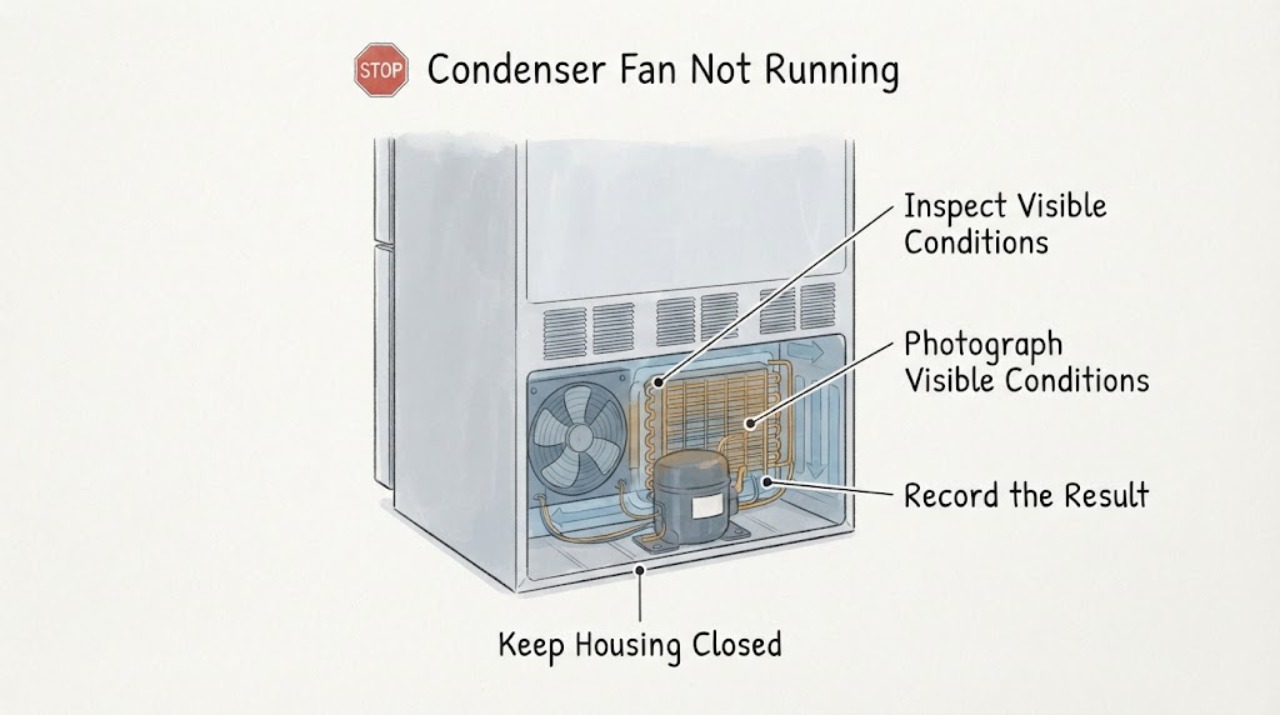
Do not diagnose a Maytag MSD2754GRW condenser fan from ambient humidity alone. Maytag describes the condenser fan as the fan that cools the condenser coils and helps prevent compressor overheating, but a fan may be off when the compressor is not being called to cool. From a safe position, first identify whether the compressor is running by its sound and whether the refrigerator and freezer are holding temperature; do not touch the compressor or reach behind the cabinet. If the compressor is running while the condenser fan is visibly still, cooling is deteriorating, the compressor is unusually hot, the refrigerator cycles repeatedly, or a breaker trips, stop trying to run it and arrange qualified service. Check only the accessible front/side clearance and any visible grille or lint accumulation without pulling the refrigerator forward or removing the machine-compartment cover. A clean visible area does not rule out a seized motor, open wiring, control issue, or compressor-side fault, and a hot door mullion or 57% humidity does not prove one. Never hand-spin the fan, probe live voltage, remove the rear cover, bypass a control, or select a fan motor, capacitor, relay, or board from the symptom alone.
Before you begin
Safety first
- Do not pull the refrigerator, remove the base or machine-compartment cover, hand-start the condenser fan, touch the compressor, probe live wiring, discharge a capacitor, or bypass a control. Keep hands and tools away from the fan outlet and use only an accessible dry disconnect if power must be isolated for an immediate safety concern.
Work through in order
Diagnostic checks
Use only checks that match the exact appliance or system and its official guide.
-
Check 1
Read and photograph the complete Maytag rating-label model and serial information from an accessible location, and note whether the refrigerator is a US/Canada variant or another market. Do not move the appliance or remove a cover to find the label.
Expected result: The label clearly shows MSD2754GRW with a complete suffix, the model is incomplete or different, or the label cannot be reached safely.
Next step: Use Maytag's official manuals lookup with the complete label, or provide the label to a qualified technician. Keep the appliance in its current safe position while the identity is unresolved.
Stop if: Stop if finding the label requires pulling the refrigerator near a wall outlet, straining tubing, removing a panel, or working around wet electrical parts.
Why this matters
Why: Maytag's manuals and technical documents are selected by complete model number. A similar MSD or Whirlpool-family refrigerator is not sufficient evidence for fan wiring or a replacement component.
-
Check 2
From the front or side and without touching the machine compartment, listen for the compressor's steady hum or cycling and observe the condenser-fan outlet only if it is already visible. Keep hands, tools, and clothing away from the fan and compressor.
Expected result: The compressor is quiet and the refrigerator is cold, the compressor is running while the fan is still, the compressor repeatedly clicks or stops, or the compressor sound cannot be distinguished safely.
Next step: If the compressor is running and the fan is not, limit operation and arrange service. If the compressor is quiet and temperatures are stable, continue only with the external airflow and temperature checks; never force the fan to run.
Stop if: Stop immediately for a burning odor, arcing, exposed wiring, an unusually hot compressor area, repeated breaker trips, or a need to reach behind the cabinet.
Why this matters
Why: A fan being off with no compressor demand can be a normal cycle. A running compressor with a stationary condenser fan increases the likelihood of an airflow/fan-path fault and can raise compressor temperature; repeated clicking or uncertainty does not identify a specific part.
-
Check 3
Check the displayed or independently observed refrigerator and freezer temperatures, food condition, frost, and whether the compressor seems to run for an unusually large portion of the day. Do not use a long powered test, touch the compressor, or remove interior panels.
Expected result: Both compartments remain cold, one or both compartments are warming, the compressor runs nearly continuously, frost or blocked interior airflow is present, or temperatures are unknown.
Next step: Protect perishable food if temperatures are rising. If cooling is deteriorating or the compressor is running continuously with a stopped fan, stop use and call service; do not compensate with a household floor fan or repeated restarts.
Stop if: Stop for unsafe food temperature, a very hot cabinet/compressor area, smoke, odor, or a need to access the evaporator or condenser internally.
Why this matters
Why: Normal cooling with a fan that is only intermittently off makes a cycle explanation more plausible. Warming, continuous compressor operation, or frost raises the urgency of the airflow/condenser and broader cooling branches, but does not prove the condenser fan is the sole cause.
-
Check 4
From outside, inspect the refrigerator's accessible clearance and visible grille for lint, pet hair, or an object blocking airflow. Check whether the appliance is pushed tightly against the wall, but do not pull it forward, remove the base or rear cover, or insert a brush into the fan.
Expected result: The visible grille/clearance is blocked, the area looks clean and open, the fan outlet is inaccessible, or the cabinet has heat damage or a wet connection.
Next step: Remove only a loose object that is already accessible and harmless, without moving the appliance. For persistent lack of fan movement, inaccessible components, heat damage, or wet electrical areas, arrange service.
Stop if: Stop for a damaged grille, heat-discolored wiring, water near electricity, or any need to move the refrigerator or remove a machine-compartment cover.
Why this matters
Why: Restricted airflow or dirty condenser surfaces can make heat rejection harder and cause longer compressor operation. A clean visible grille does not rule out an internal fan or electrical fault, and 57% humidity does not establish the cause.
-
Check 5
Document the fan/compressor relationship, temperature trend, sound, visible airflow, humidity context, exact model, and any cycling or breaker history for service. Do not hand-spin the fan, access internal wiring, or replace a component based on the visual symptom.
Expected result: The fan resumes with the compressor and cooling is normal, the fan remains stopped while the compressor runs, the issue recurs intermittently, or the refrigerator is warming or noisy.
Next step: If the fan remains stopped under compressor demand or cooling is impaired, leave the refrigerator running only as necessary to protect food and arrange prompt qualified service. Give the provider the complete model and observations rather than a presumed part diagnosis.
Stop if: Do not continue operating for observation if the compressor area is abnormally hot, the appliance smells burned, the breaker trips, or food safety is compromised.
Why this matters
Why: A fan that follows compressor demand and preserves cooling is less urgent than a stopped fan during compressor operation. Recurrence, warming, abnormal noise, or electrical symptoms require a technician to distinguish motor, obstruction, wiring, control, compressor, or airflow causes.
Use your observations
Decision map
Find the observation that best matches what you see, then follow the next safe action.
-
PATH 01Next step
What you see
The compressor is quiet, both compartments remain cold, the fan is only observed off at that moment, and no abnormal heat or noise is present.
Do this next
Monitor without hand-spinning or extended testing, keep the visible airflow path clear, and seek service if cooling worsens or the fan is repeatedly stopped while the compressor runs.
Why this path and its safety boundary
Why it matters: The observation does not establish a failed condenser fan; the refrigerator may be in an off portion of its cooling cycle. Humidity 57% does not change that conclusion.
-
PATH 02Next step
What you see
The compressor is audibly running while the condenser-fan outlet remains still, and the cabinet or compressor area is getting hotter or the compartments are warming.
Do this next
Stop repeated operation and arrange qualified refrigerator service. Do not remove the rear cover, hand-start the blade, probe live voltage, or buy a part from this pattern alone.
Why this path and its safety boundary
Why it matters: This pattern makes a condenser airflow/fan-path problem important because Maytag says the fan cools the condenser and helps prevent compressor overheating. It still does not identify a motor, relay, wiring, or control board by itself.
-
PATH 03Next step
What you see
The visible grille or clearance is blocked, but the compressor/fan relationship and cooling remain otherwise normal.
Do this next
Remove only a loose accessible obstruction and restore the installation clearance without pulling the refrigerator. If the fan still does not follow compressor demand or temperatures rise, call service.
Why this path and its safety boundary
Why it matters: Restricted external airflow or dirty condenser surfaces can make heat release harder and lengthen compressor run time. It is a lower-risk external airflow lead, not proof of an internal fan failure.
-
PATH 04Next step
What you see
The compressor clicks repeatedly, a breaker trips, the compressor area is extremely hot, there is a burning smell, or the refrigerator is no longer protecting food temperatures.
Do this next
Stop use, protect food, and isolate power only from a safe dry location if needed. Arrange qualified appliance service; do not touch the compressor, open the machine compartment, or perform live electrical tests.
Why this path and its safety boundary
Why it matters: The symptom may involve compressor start/electrical protection, airflow, wiring, or another cooling fault. It is not safe to isolate the condenser fan as the sole cause from a non-contact observation.
-
PATH 05Next step
What you see
The complete MSD2754GRW model or market cannot be matched to Maytag documentation, or the fan is inaccessible without moving the refrigerator or removing a cover.
Do this next
Stop DIY diagnosis and provide the complete label, serial if safely visible, fan/compressor observations, temperature trend, clearance, humidity context, and photos to Maytag or qualified service.
Why this path and its safety boundary
Why it matters: The evidence is insufficient for model-specific wiring, test values, or part fitment. Older Maytag platforms and similar model strings must not be treated as interchangeable.
Helpful context
Understand the symptom
The MSD2754GRW is an older Maytag side-by-side identity from the task, so record the complete label before using a manual or ordering anything. The 57% humidity is only context: it may affect how warm the cabinet or center mullion feels, but it cannot tell you whether the fan motor, compressor circuit, wiring, or airflow is at fault.
The useful first split is compressor demand. If the compressor is quiet and the refrigerator is cold, the condenser fan may simply be in an off portion of its cycle. If the compressor is running and the condenser fan does not run, heat cannot leave the condenser normally; pair that observation with cabinet temperature and sound, then stop before opening the machine compartment or taking an energized measurement.
When checks do not resolve it
Need a professional?
Use qualified appliance service for a stopped fan during compressor operation, impaired cooling, continuous compressor run, excessive heat, abnormal cycling/noise, inaccessible airflow components, or any electrical symptom. Use emergency help for smoke or fire and qualified electrical/plumbing help when the installation area is unsafe.
Safety scope: Do not pull the refrigerator, remove the base or machine-compartment cover, hand-start the condenser fan, touch the compressor, probe live wiring, discharge a capacitor, or bypass a control. Keep hands and tools away from the fan outlet and use only an accessible dry disconnect if power must be isolated for an immediate safety concern.
Have this ready
- Provide the complete MSD2754GRW model and market suffix, serial number if safely visible, refrigerator/freezer temperature trend, compressor sound and cycle, fan sound or lack of movement, visible grille/clearance condition, humidity context, recent moves or repairs, and any odor, heat, leak, or breaker history.
Common questions
FAQ
Should the Maytag MSD2754GRW condenser fan run all the time?
Not necessarily. The fan is part of the heat-rejection system, but the refrigerator can cycle cooling demand. Judge it together with whether the compressor is running and whether both compartments hold temperature. A fan stopped while the compressor runs and cooling worsens needs service.
Does 57% humidity explain a hot door area or stopped condenser fan?
No. Humidity can change how warm or damp exterior surfaces feel, but it cannot identify a fan, compressor, wiring, or airflow fault. Use the compressor/fan relationship and actual cooling trend instead.
Can I reach behind the refrigerator to check or spin the fan?
Do not hand-spin the fan or remove the rear cover for this check. Maytag service material treats the machine compartment, fan wiring, compressor, and capacitor as service work. Use only a visible external observation and arrange service when the fan does not run under compressor demand.
What if the compressor is running but the condenser fan is not?
That combination is more concerning than a fan observed off while the compressor is quiet, because the fan normally moves cooling air across the condenser and compressor area. Limit operation, protect food, and arrange qualified service rather than testing voltage or buying a motor.
Can I clean the condenser to fix the fan?
You may remove only a loose, accessible obstruction without moving the refrigerator or opening a cover. Maytag notes that dust and pet hair on condenser coils can restrict heat release, but a clean visible grille does not rule out an internal fan or electrical fault; persistent symptoms need service.
Read the exact guide
Official sources
- Troubleshoot | MaytagMaytag · Maytag's official troubleshooting hub; it routes refrigerator owners to product documents and service without exposing model-specific live-test procedures.
- Appliance Manuals and Literature | MaytagMaytag · Official Maytag manuals portal; it instructs users to enter the complete model number to retrieve the applicable manual, so it establishes the identity-verification boundary but not model-specific fan wiring.
- 10 Reasons Your Refrigerator is Not CoolingMaytag · Maytag's general refrigerator guidance; it supports the airflow/compressor symptom split but does not assign a part to the exact MSD2754GRW.
- Service Manual - 16025629Maytag Services · Opened Maytag service manual with 2005 refrigeration service content; it describes condenser/fan/compressor relationships and warnings but does not prove every procedure or component applies to MSD2754GRW.
Community feedback
Share a repair observation
Share a plain-text repair observation. Accepted observations are published automatically; this page may take a moment to update.