
On this page
Start here
Quick answer
If food in a Maytag refrigerator is freezing, first confirm the refrigerator and freezer settings, then move food away from the cold-air vents. Maytag recommends about 37°F for the refrigerator and 0°F for the freezer, but the exact controls vary by model. If the ice maker is switched on without a water supply, turn it off according to the Owner's Manual. Make one change at a time and allow the temperature to stabilize; recurring freezing after these checks needs service.
Before you begin
Safety first
- Do not chip ice with a sharp tool, bypass controls, or work on sealed refrigeration components.
Work through in order
Diagnostic checks
Use only checks that match the exact appliance or system and its official guide.
-
Check 1
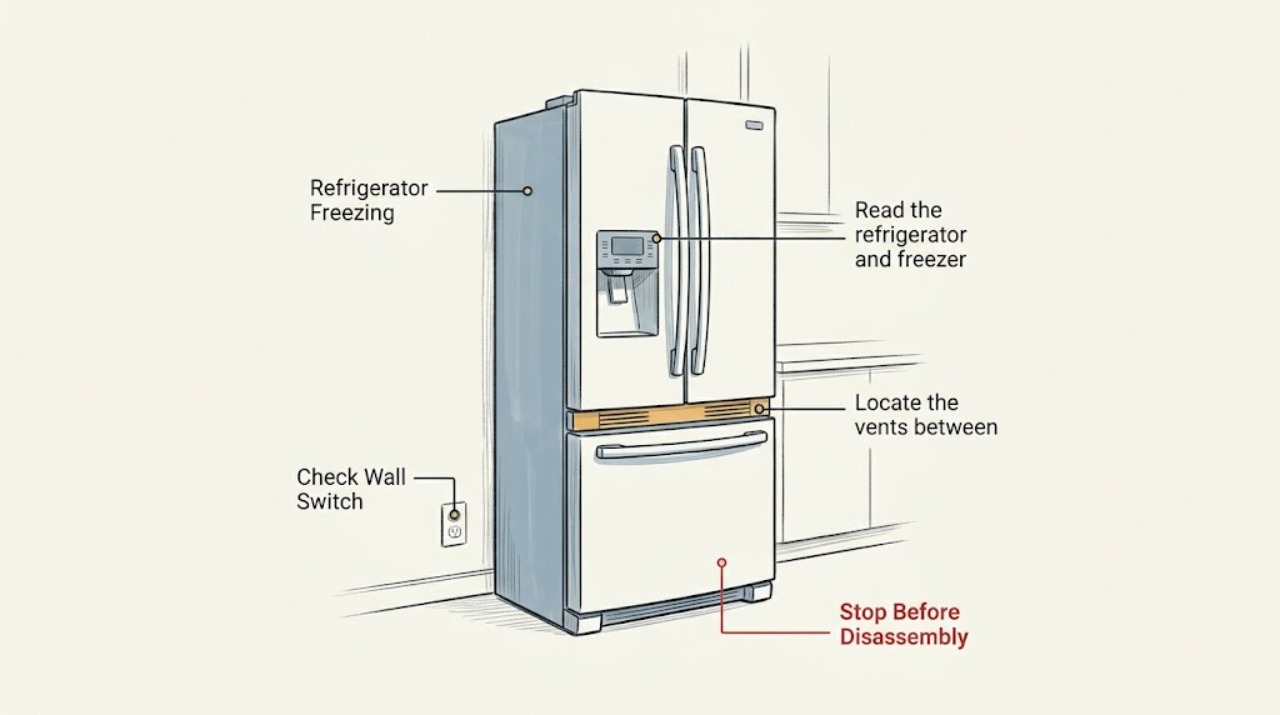
Read the refrigerator and freezer settings, then compare the measured temperatures with a thermometer placed in the middle of each compartment, away from a wall or vent.
Expected result: The refrigerator is set colder than the model's normal range, or the reading is near the freezing point; alternatively, the settings and central reading are reasonable.
Next step: Raise the refrigerator or freezer setting by one model-approved increment and wait 24 hours before judging the result; do not repeatedly change controls.
Why this matters
Why: An overly cold setting or a cold control reading can explain frozen food. A normal central reading with one frozen location points more toward airflow placement or a local control issue.
-
Check 2
Locate the vents between the freezer and fresh-food compartment and rearrange containers so food is not pressed against a vent, rear wall, or return-air opening.
Expected result: A package is directly in the cold-air path or shelving is blocking a vent, or the passages are clear.
Next step: Leave clear space around the vents and monitor the same food location after the temperature has stabilized.
Why this matters
Why: Maytag explains that air moving from the freezer can freeze items placed directly in its path and that blocked airflow can create temperature problems.
-
Check 3
If the ice maker is installed but the refrigerator is not connected to household water, check whether the ice maker is switched on; use the model manual for the control location.
Expected result: The ice maker is on without water, or it is off or connected to a supply.
Next step: Turn the ice maker off when there is no water supply, then allow the refrigerator to stabilize. If it is connected and freezing continues, use the setting and airflow results to decide on service.
Why this matters
Why: Maytag says an unconnected ice maker that remains on can buzz and can contribute to an overly cold freezer or fresh-food section.
-
Check 4
Check whether Fast Cool or a similar temporary cooling feature is enabled, and note whether the freezing began after a large grocery load, a power event, or a long period of open doors.
Expected result: A temporary feature or recent operating event matches the start of the symptom, or there is no such change.
Next step: Disable the temporary feature only as described in the manual and wait for stabilization. Arrange service if freezing returns with normal settings and clear airflow.
Why this matters
Why: Temporary cooling demand can change compartment temperature; a recurring symptom without that context is less likely to be a one-time recovery period.
Use your observations
Decision map
Find the observation that best matches what you see, then follow the next safe action.
-
PATH 01Next step
What you see
Only food directly beside a vent freezes while the central refrigerator temperature is normal
Do this next
Move the food away from the vent and keep the passage clear; reassess after 24 hours.
-
PATH 02Next step
What you see
Both compartments are colder than intended after a control or temporary cooling change
Do this next
Return controls toward the model's normal setting one increment at a time and wait between changes.
-
PATH 03Next step
What you see
Freezing persists with normal settings, clear vents, and an appropriately connected or disabled ice maker
Do this next
Protect temperature-sensitive food and arrange Maytag service; do not remove panels or bypass a control.
Helpful context
Understand the symptom
A local cold spot is different from a complete cooling failure
Food that freezes beside a vent or on the rear wall usually calls for an airflow and control check. Do not keep lowering settings or move every item at once; isolate one observation so you can tell whether the symptom changes.
When checks do not resolve it
Need a professional?
Arrange Maytag service if food continues freezing after the controls, vents, temporary cooling setting, and ice-maker condition have been checked, or if the diagnosis would require opening panels or changing refrigeration components.
Safety scope: Do not chip ice with a sharp tool, bypass controls, or work on sealed refrigeration components.
Common questions
FAQ
What temperature should a Maytag refrigerator use when food is freezing?
Maytag's general guidance starts around 37°F for the refrigerator and 0°F for the freezer, but use the settings and instructions for your model. Change one increment and wait for stabilization before changing it again.
Can an unused ice maker make the refrigerator too cold?
Yes. Maytag says an ice maker that is on without a water supply can contribute to buzzing and an overly cold freezer or fresh-food section. Turn it off according to the Owner's Manual when it is not connected.
Read the exact guide
Official sources
- Tips for Properly Setting the ControlsMaytag Product Help · Maytag refrigerator controls
- Preventing Food from Freezing in the RefrigeratorMaytag Product Help · Maytag full-size refrigerators
Community feedback
Share a repair observation
Share a plain-text repair observation. Accepted observations are published automatically; this page may take a moment to update.