
On this page
Start here
Quick answer
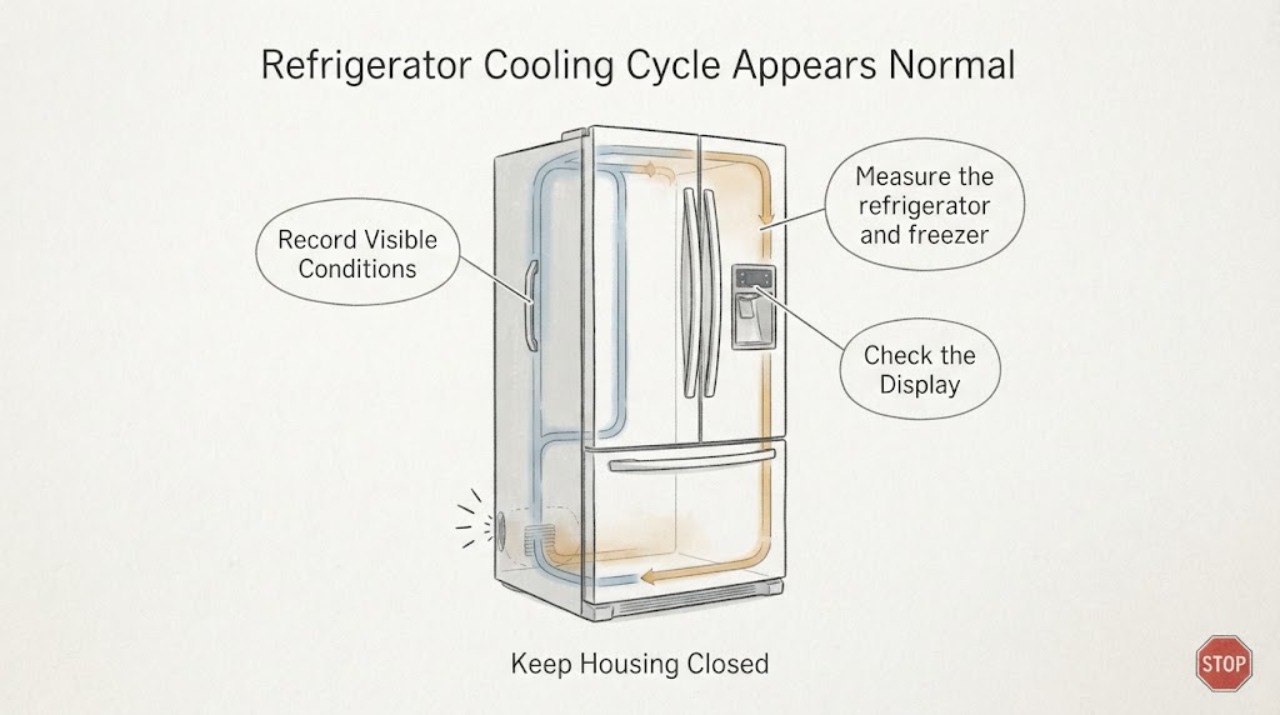
A refrigerator can hum, whoosh, click, gurgle or briefly sizzle as the compressor, fans, refrigerant and defrost system operate. Maytag identifies many of those sounds as normal, including gurgling after a cooling cycle and a low steady hum while temperatures are maintained. Confirm the result with an independent temperature check and the exact model settings: Maytag’s general troubleshooting page lists 37°F for the refrigerator and 0°F for the freezer as recommended targets, while the owner manual remains the model authority. If temperatures are stable, doors seal and the sound follows a normal cycle, monitor it. If the compressor clicks on and off every few minutes, the compartments stay warm, a warning or leak appears, or an internal electrical or sealed-system check would be required, stop treating the cycle as normal and arrange qualified service.
Work through in order
Diagnostic checks
Use only checks that match the exact appliance or system and its official guide.
-
Check 1
Record the complete model number, the sound or cycle transition, where the sound comes from, how often it repeats, and whether the refrigerator and freezer are actually keeping food cold.
Expected result: The sound is a brief hum, whoosh, click, gurgle or defrost sizzle tied to a cycle, or it is a frequent click, harsh scrape, alarm, leak or persistent abnormal noise.
Next step: If the sound matches an official normal category and temperatures are stable, continue to the temperature and external-condition checks. If it is harsh, escalating or paired with warmth, use the service branch.
Stop if: Do not open the sealed system or electrical compartment to identify the sound.
Why this matters
Why: Maytag lists several brief or repeating sounds as normal operation, but a frequent restart pattern or a sound paired with warm food is a different concern. Location and timing are more useful than the word “normal” alone.
-
Check 2
Measure the refrigerator and freezer with a suitable appliance thermometer after the unit has had time to stabilize, and compare the readings with the exact owner manual; Maytag’s general troubleshooting reference lists 37°F for the refrigerator and 0°F for the freezer.
Expected result: Both compartments are near the manual target, one or both remain warm, or the readings swing widely while the sound repeats.
Next step: If temperatures are stable, keep monitoring and avoid unnecessary resets. If they remain warm or fluctuate beyond the manual range, protect perishable food and request service.
Stop if: Do not turn controls to the coldest setting as a substitute for diagnosis or assume a normal sound proves cooling.
Why this matters
Why: A normal-sounding cycle is useful only if it maintains safe temperatures. Maytag says new installation or a large food load may require up to 24 hours to return to temperature, but persistent warmth is not explained by sound alone.
-
Check 3
Check the accessible controls and operating conditions: cooling is enabled, no showroom or cooling-off mode is active, vents are not blocked, doors close fully, and the refrigerator is not newly loaded or repeatedly opened.
Expected result: A setting is off, a vent is blocked, a door is open or poorly sealed, or the refrigerator is newly installed/loaded; otherwise these conditions appear normal.
Next step: Correct only the accessible setting, obstruction or door-use condition described by the exact manual, then allow the documented stabilization period. If temperature remains wrong, request service.
Stop if: Do not move internal panels or adjust refrigerant or electrical components.
Why this matters
Why: Maytag identifies cooling settings, blocked vents, door openings, large food loads and installation time as reasons temperatures or run time can differ without proving a component failure.
-
Check 4
Inspect the external environment without opening the cabinet: the refrigerator should be on a solid level floor, away from an unapproved heat source, with the model-required airflow space and no loose items vibrating on top.
Expected result: The cabinet rocks, the unit is beside a heat source or in an unsuitable location, airflow space is blocked, or loose objects vibrate; otherwise the installation appears sound.
Next step: Correct only the accessible installation condition using the owner or installation instructions. If a move or leveling adjustment would expose wiring or require cabinet disassembly, stop and use service.
Stop if: If the environment is correct but the refrigerator is warm or short cycling, continue to the service branch.
Why this matters
Why: Maytag links leveling and installation conditions with vibration, door sealing, airflow and cooling demand. These external observations can explain noise or longer operation without identifying an internal part.
-
Check 5
Compare the compressor pattern with the official distinction between extended normal operation and short cycling: note whether it runs for a longer period to recover from a load or starts and stops every few minutes.
Expected result: The unit runs steadily for a longer period and temperatures recover, or it clicks/restarts repeatedly with little cooling progress.
Next step: If it is recovering and temperatures return to target, monitor it. If it is short cycling or remaining warm, protect food and request qualified service without repeated power tests.
Stop if: Do not diagnose the compressor, relay, fan or control from the sound pattern alone.
Why this matters
Why: Maytag says efficient compressors can run longer under higher cooling demand, but identifies frequent short cycling as a pressing service concern.
-
Check 6
Prepare a service handoff when measured temperatures remain out of range, short cycling continues, a warning or leak appears, or the next check would require an electrical panel, sealed system, refrigerant circuit or internal fan access.
Expected result: The issue resolves after an accessible setting, door, vent or installation correction, or it persists with normal external conditions.
Next step: If it persists, provide the model, temperature readings, sound recording or timing, settings, room conditions and recent loading history to a qualified technician.
Stop if: If readings remain stable and the official sound pattern continues without a safety symptom, monitor rather than replacing a part.
Why this matters
Why: The official sources support external observation and user-level settings but do not establish an internal cause for an unidentified Maytag model from a normal-looking cycle.
Use your observations
Decision map
Find the observation that best matches what you see, then follow the next safe action.
-
PATH 01Next step
What you see
The sound is a brief hum, whoosh, gurgle, click, pop or defrost sizzle and both compartments hold the exact manual temperature.
Do this next
Monitor the timing and temperature; do not open the sealed system or replace a part based on the sound alone.
Why this path and its safety boundary
Why it matters: Maytag identifies these sound families as possible normal cooling, refrigerant, fan, switching or defrost operation.
-
PATH 02Next step
What you see
The compressor runs longer after installation, a large food load, frequent door opening or warm surroundings, but temperatures recover.
Do this next
Allow the documented stabilization period, limit unnecessary door openings and verify the model’s installation conditions; request service if temperatures do not recover.
Why this path and its safety boundary
Why it matters: Maytag says efficient compressors can run for extended periods when cooling demand is higher.
-
PATH 03Next step
What you see
The compressor clicks or restarts every few minutes, or the compartments remain warm despite apparent cooling sounds.
Do this next
Protect perishable food and request qualified service; do not repeatedly power-cycle or attempt compressor, relay, fan or sealed-system work.
Why this path and its safety boundary
Why it matters: Maytag distinguishes frequent short cycling or persistent warmth from expected long operation.
-
PATH 04Next step
What you see
A vent, door seal, control mode, heat source, level condition or installation clearance is visibly wrong.
Do this next
Correct only the condition covered by the exact manual and reassess temperature; stop if the correction needs cabinet or electrical access.
Why this path and its safety boundary
Why it matters: An accessible operating or installation condition may be increasing cooling demand or transmitting vibration.
-
PATH 05Next step
What you see
Temperatures are stable and no leak, alarm, food-safety concern or abnormal noise is present, but the user is unsure whether the cycle is normal.
Do this next
Keep a short log of temperatures and sound timing, then consult the exact owner manual if the pattern changes; no component diagnosis is justified from the current evidence.
Why this path and its safety boundary
Why it matters: The opened Maytag guidance supports normal cycle sounds and longer efficient operation when cooling performance is maintained.
Helpful context
Understand the symptom
Normal sound is not the same as normal cooling
Maytag explains that refrigerant, fans, defrost water and switching components can produce gurgling, whooshing, humming, clicking, popping or sizzling sounds. A sound may be normal when it is brief or tied to a cooling or defrost transition, but the refrigerator still needs to hold temperature. Use the measured temperature and pattern over time to decide whether the cycle is behaving normally.
Longer run time can be expected in some conditions
Maytag says an efficient compressor may run longer than an older refrigerator, especially after installation, after adding a large amount of food, when doors are opened frequently, or in a warm room. That explanation applies to the documented model family and does not excuse a warm compartment, repeated short starts or a new abnormal noise.
Use the exact model for settings and installation limits
The task has no model number. Maytag’s general troubleshooting page provides a useful reference for temperature targets and common settings, but controls, clearances, leveling and cooling modes vary by product. Record the model before changing settings or interpreting a sound that is specific to a French-door, side-by-side or other design.
When checks do not resolve it
Need a professional?
Request qualified service if either compartment remains warm, the compressor short cycles, a warning/alarm or leak appears, food safety is uncertain, or the next diagnostic step would require electrical, sealed-system, refrigerant, compressor, fan or control access.
Have this ready
- complete model number
- refrigerator and freezer thermometer readings
- sound timing and location
- control settings and modes
- installation/room conditions
- recent loading and door-opening history
- any leak, alarm or food-temperature concern
Common questions
FAQ
Is gurgling after a Maytag cooling cycle normal?
Maytag says gurgling can occur as refrigerant flows through the tubes after a cooling cycle, and it can also occur as water equalizes in the drain tube when doors open or close. Check temperature and persistence rather than treating the sound alone as a failure.
Can a Maytag refrigerator run for most of the day?
Maytag says high-efficiency compressors may run longer, especially after installation, a large food load, frequent door openings or warm surroundings. If the unit short cycles, stays warm or never recovers temperature, request service.
What temperature should I use as a general check?
Maytag’s general troubleshooting page lists 37°F for the refrigerator and 0°F for the freezer. Use the exact owner manual for your model and verify with a thermometer rather than relying on the control display alone.
Does a normal cooling sound prove the compressor is healthy?
No. Maytag’s sound guidance describes several normal noises, while its troubleshooting guidance treats short cycling or persistent warmth as service concerns. Do not diagnose or replace an internal part from sound alone.
Read the exact guide
Official sources
- Gurgling Noise - Side by Side RefrigeratorMaytag Product Help · Official Maytag side-by-side guidance; used narrowly for the documented gurgling mechanism and normal-operation boundary, with exact model manual controlling other designs.
- How Does a Refrigerator Work?Maytag · Official Maytag educational explanation of compressor, condenser, evaporator, heat absorption and repeated cooling cycles; not a model-specific repair procedure.
- Refrigerator TroubleshootingMaytag · Official Maytag refrigerator troubleshooting article; general reference only, with exact model manual controlling settings and installation limits.
- Refrigerator Normal Sounds and NoisesMaytag Product Help · Official Maytag refrigerator sound guidance; sound categories are used to distinguish normal patterns from symptoms, not to diagnose a specific model part.
- Motor or Compressor Runs too Much - RefrigeratorMaytag Product Help · Official Maytag French-door bottom-freezer guidance; long-run conditions and installation details are kept model-family scoped.
Community feedback
Share a repair observation
Share a plain-text repair observation. Accepted observations are published automatically; this page may take a moment to update.