
On this page
Start here
Quick answer
For the assigned Maytag MFX2571XEBO refrigerator, first confirm the model suffix from the rating plate: the final character in EBO is the letter O, not the digit 0. Then measure the refrigerator and freezer compartments separately and document where frost returns after a complete, safe defrost. Maytag describes light, even frost that clears after a defrost cycle as potentially normal, while a blocked vent, a door gasket that does not seal, or warm humid air can create excessive frost and uneven temperatures. If the vents are clear, the doors seal, the controls are reasonable, and heavy frost returns quickly after all ice has melted while the upper refrigerator drawers remain warm, the remaining possibilities include an internal defrost, fan, sensor, control, or sealed-system problem. Do not remove the evaporator cover, chip ice, heat the liner with a hair dryer, or select a part from the frost pattern; leave the refrigerator safe and arrange qualified Maytag refrigeration service.
Before you begin
Safety first
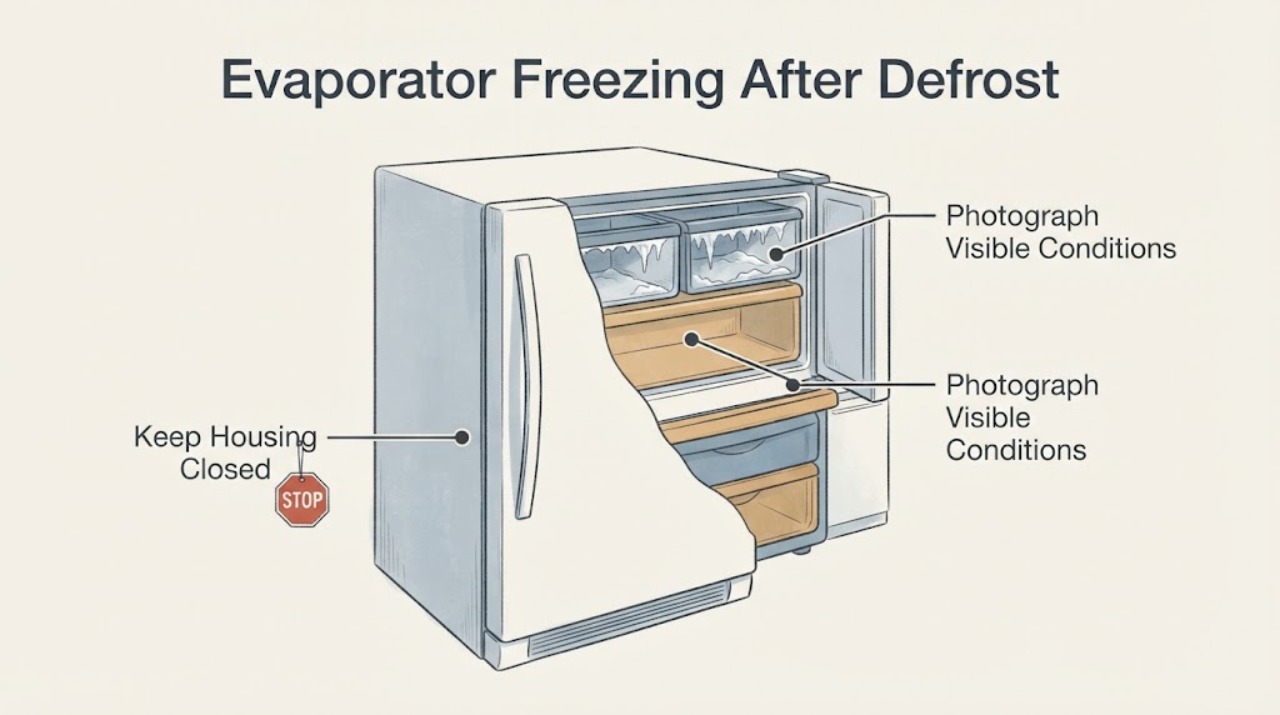
- Do not remove the evaporator cover or rear panels, chip ice near the liner or tubing, use a hair dryer or heater, probe live wiring, bypass a sensor or control, or handle a sealed refrigerant circuit. Stop immediately for smoke, burning odor, arcing, a hot plug, exposed wiring, water near electrical parts, a damaged liner or tube, or unsafe food temperatures.
Work through in order
Diagnostic checks
Use only checks that match the exact appliance or system and its official guide.
-
Check 1
Read the rating plate and record the complete Maytag model and serial number. Confirm whether the suffix is MFX2571XEBO with a letter O at the end, not MFX2571XEB0 with a zero. Place thermometers in the middle of the fresh-food compartment and freezer, away from walls and vents, and record the upper-drawer temperature separately without relying on touch alone.
Expected result: The full model and suffix are legible and the freezer is cold while the upper drawers are warm, or the model character and compartment measurements are uncertain.
Next step: Use the exact rating-plate identity to retrieve the Maytag literature and continue with the external frost and airflow checks. If the suffix is uncertain, stop model-specific troubleshooting and resolve the O/0 identity first.
Stop if: Do not remove the liner or evaporator cover to read a hidden label, probe live wiring, or order a component from a temperature difference alone.
Why this matters
Why: The official Maytag dimension sheet identifies the MFX2571XE platform but does not replace the complete suffix-specific manual. A warm upper drawer with a cold freezer is an uneven-temperature observation; it does not identify a defrost heater, fan, sensor, seal, or sealed-system failure by itself.
-
Check 2
With food protected and the refrigerator disconnected only when it is safe to do so, photograph the frost before disturbing it. Classify where it is visible: around a door gasket or opening, directly over a supply or return vent, as a thin even layer that clears after defrost, or as heavy ice that covers the cooling surface and returns quickly. Do not remove an evaporator cover or chip at stubborn ice.
Expected result: Frost is limited to a door perimeter, a blocked vent, a light even film, or rapid heavy refrost that again restricts airflow after all ice has melted.
Next step: Use the matching branch below: inspect the gasket and closure for a perimeter pattern, clear external airflow obstructions, or stop user-level troubleshooting and arrange service for rapid heavy recurrence. Preserve the photo for the technician.
Stop if: Do not use a knife, ice pick, metal tool, hair dryer, heater, or other forced-heat method near the liner, tubing, wiring, or controls.
Why this matters
Why: Maytag links frost and moisture to door opening and sealing, blocked vents, humidity, and normal defrost behavior. A documented rapid-recurrence pattern with restricted airflow changes the next step toward service, but frost location alone cannot name the failed internal part.
-
Check 3
Inspect the freezer drawer and refrigerator door closure from the outside. Check for food or a bin preventing closure, a gasket that is folded, dirty, torn, or not contacting the cabinet, and visible moisture or frost concentrated around the seal. Clean only the accessible gasket with the mild method in the manual and dry it; do not remove the gasket.
Expected result: The drawer or door cannot close fully, the gasket has a visible gap or damage, or the closure and gasket appear uniform while heavy frost returns.
Next step: Correct only a plainly visible closure or food obstruction and monitor after stabilization. Arrange service for a torn, displaced, or persistently leaking gasket; if the seal is sound, continue to the vent and control checks.
Stop if: Do not stretch, glue, heat, or replace the gasket without the exact model procedure, and do not keep the door open while testing a refrost condition.
Why this matters
Why: Maytag says an obstructed or poorly sealing door allows humid air in and can create frost. A uniform seal with rapid recurrence makes an air-ingress explanation less complete and leaves an internal airflow or cooling-system branch for service.
-
Check 4
Locate the model-specific supply and return vents in the freezer and fresh-food sections. Move food, bins, and packages away from those openings and leave the rear wall and return path clear. Note whether the upper drawers remain warm, whether airflow is weak, and whether ice is visibly covering a vent or return passage; do not remove panels to reach the evaporator.
Expected result: A container blocks a vent, the frost blocks a return path, airflow is weak or uneven, or all accessible passages are clear while the top drawers remain warm.
Next step: Rearrange only the accessible contents and allow the compartments to stabilize. If frost has already sealed the passage or airflow remains weak with clear vents, stop using the refrigerator as a DIY panel-repair project and arrange service.
Stop if: Do not pry ice from a vent, insert tools into an air passage, remove a fan guard, or operate with a panel or guard missing.
Why this matters
Why: Maytag explains that freezer air enters and exits the refrigerator through vents and that blocked airflow can cause excessive frost, warm spots, or food freezing in the airflow path. Clear external airflow can rule out a simple loading issue but cannot rule out a hidden fan, defrost, sensor, control, or sealed-system fault.
-
Check 5
Verify the refrigerator and freezer settings against the exact manual and make no more than one small, model-approved adjustment at a time. Maytag's general guidance uses about 37°F to 40°F for the refrigerator and 0°F for the freezer; after any change, wait for the full stabilization period before judging the upper drawers. Record whether rapid refrost continues independently of the setting.
Expected result: The settings are substantially colder than intended, the controls are reasonable but the upper drawers remain warm, or heavy frost returns quickly at normal settings.
Next step: Return the controls only to the exact manual's normal range and wait for stabilization. If the frost returns rapidly or the drawers remain warm, stop repeated adjustments and arrange qualified refrigeration service.
Stop if: Do not turn controls to extreme settings to compensate for blocked airflow, repeatedly power-cycle the refrigerator, or leave perishable food in a compartment with an unverified temperature.
Why this matters
Why: A setting can explain overcooling or food freezing near an outlet, but it does not explain away a repeat frost blockage after a complete defrost. Persistent uneven temperature with normal settings is a service-level observation.
-
Check 6
Prepare a service record after the safe external checks: exact model with the final EBO character, serial and market, temperatures by compartment and upper drawer, time from complete defrost to visible refrost, frost distribution, door-seal observations, vent and airflow state, settings, and any unusual fan or compressor sound. Keep the refrigerator running only if there is no hazard and food temperatures are safe.
Expected result: Heavy frost returns quickly, airflow is restricted, the upper drawers remain warm, or the symptom is not reproducible after a long stable period.
Next step: Arrange Maytag or qualified refrigeration service and provide the record and photographs. Protect or relocate perishable food if measured temperatures are unsafe.
Stop if: Stop using the refrigerator and obtain urgent help for smoke, burning odor, exposed wiring, a hot plug, electrical arcing, water near electrical parts, or a damaged refrigerant circuit.
Why this matters
Why: The sequence and frost pattern help a technician distinguish moisture ingress and external airflow from a hidden defrost, fan, sensor, control, or sealed-system diagnosis. They do not justify a user-selected component.
Use your observations
Decision map
Find the observation that best matches what you see, then follow the next safe action.
-
PATH 01Next step
What you see
The rating plate is unclear between MFX2571XEBO and MFX2571XEB0, or the exact suffix does not match the Maytag literature being used.
Do this next
Stop model-specific troubleshooting, photograph the rating plate from a safe position, and use Maytag's Owner Center or Manuals & Literature lookup with the exact characters. Do not order a part from a visually similar model.
Why this path and its safety boundary
Why it matters: The platform-level MFX2571XE document cannot establish the controls, frost procedure, sensor arrangement, or part fit for an uncertain suffix.
-
PATH 02Next step
What you see
Frost or moisture is concentrated at the freezer drawer gasket or door perimeter, and the drawer is obstructed, fails to close, or has a visible seal gap.
Do this next
Correct only the visible obstruction and clean/dry the accessible gasket using the exact manual. Arrange service for a torn, displaced, or persistently leaking gasket; do not keep defrosting without correcting the seal.
Why this path and its safety boundary
Why it matters: Humid-air entry through the closure or gasket is more likely than a proven internal defrost or sealed-system fault.
-
PATH 03Next step
What you see
Containers block the supply or return vents, or frost visibly blocks a passage, while the central compartment temperature is otherwise reasonable.
Do this next
Clear only the accessible food and bin obstruction and allow the refrigerator to stabilize. If frost itself is blocking the passage or airflow remains weak, arrange service rather than prying the ice away.
Why this path and its safety boundary
Why it matters: An airflow or loading restriction is more likely to explain a warm top drawer, local freezing, or uneven frost than an immediate need to replace an internal component.
-
PATH 04Next step
What you see
After a complete safe defrost, the frost is light and even or limited near vents, clears as the refrigerator runs, and the upper-drawer and central temperatures return to the exact manual's range.
Do this next
Keep doors closed promptly, maintain clearance around vents, monitor the same locations, and use the exact manual for settings. Arrange service if the frost becomes heavy, returns rapidly, or the upper drawer becomes warm again.
Why this path and its safety boundary
Why it matters: Maytag describes light frost that clears after a defrost cycle as potentially normal, especially with humidity or recent door openings; this pattern does not establish a failed defrost part.
-
PATH 05Next step
What you see
The doors seal and close, vents are clear, settings are reasonable, and heavy frost rapidly returns after all visible ice has melted while the top drawers remain warm or airflow is restricted again.
Do this next
Stop repeated manual defrosts and arrange Maytag or qualified refrigeration service. Give the provider the exact EBO model identity, refrost time, temperature readings, frost photographs, and airflow observations; keep panels and wiring closed.
Why this path and its safety boundary
Why it matters: The pattern is no longer explained by a simple setting, local food placement, or one-time humidity event. An internal defrost, fan, sensor, control, drain, or sealed-system issue becomes a service-level possibility, but the frost pattern does not identify which one.
-
PATH 06Next step
What you see
There is smoke, burning odor, electrical arcing, a hot plug, exposed wiring, water near electrical parts, a damaged liner or tube, or the only remaining check requires removing an evaporator or rear panel.
Do this next
Stop using it, disconnect power only if that can be done without approaching the hazard, keep food and people clear, and obtain qualified appliance or electrical help. Do not recreate the frost or defrost fault.
Why this path and its safety boundary
Why it matters: The refrigerator has crossed the safe external-observation boundary and may present an electrical, water, sharp-edge, or sealed-system hazard.
Helpful context
Understand the symptom
Rapid refrost is a different decision from ordinary freezing
Maytag describes a thin, even layer or light frost near vents that clears after a defrost cycle as potentially normal. The assigned symptom is different when a complete defrost is followed by rapid heavy refrost and the upper refrigerator drawers remain too warm: the frost is now blocking or reflecting a cooling and airflow problem, not just a control setting or one item placed by a vent. The safe task is to document the frost distribution and external conditions, then decide whether the pattern is explained by door-seal air entry, blocked airflow, or a service-level internal fault.
Verify EBO versus E B 0 before using a manual
The opened Maytag dimension document identifies the MFX2571XE bottom-mount platform, while the assigned topic adds the suffix EBO. Read the rating plate instead of assuming that a nearby MFX2571XE variant has identical controls or service documents. Record the last character exactly as printed; a letter O and a digit 0 are not interchangeable model identities for a parts or manual lookup.
Only after diagnosis
Potential parts
- freezer or refrigerator door gasket
Consider this class only when the complete EBO model identity is confirmed and the gasket has a visible tear, deformation, or persistent closure gap that remains after safe cleaning and obstruction checks.
The official sources establish gasket sealing as a frost factor but do not establish a part number or fit for MFX2571XEBO. Verify the complete rating-plate model before ordering or replacing. - defrost-system, fan, sensor, control, or sealed-system service component
Consider an internal component only after a qualified technician confirms rapid refrost with clear doors and vents and measures the model-specific defrost, airflow, temperature-sensing, and cooling paths.
Rapid refrost and warm upper drawers do not select a heater, thermostat, sensor, fan, control, drain, or sealed-system part. Do not buy or access an internal component from the frost pattern alone.
When checks do not resolve it
Need a professional?
Arrange Maytag or qualified refrigeration service when heavy frost rapidly returns after a complete safe defrost despite a sound gasket, clear vents, and reasonable settings; when the top drawers remain warm or airflow becomes restricted again; when frost requires panel removal; or when any electrical, water, liner, or sealed-system hazard appears.
Safety scope: Do not remove the evaporator cover or rear panels, chip ice near the liner or tubing, use a hair dryer or heater, probe live wiring, bypass a sensor or control, or handle a sealed refrigerant circuit. Stop immediately for smoke, burning odor, arcing, a hot plug, exposed wiring, water near electrical parts, a damaged liner or tube, or unsafe food temperatures.
Have this ready
- Provide the complete model and serial information, explicitly noting whether the final character is the letter O in EBO, market, refrigerator/freezer and upper-drawer temperatures, settings, time from full defrost to refrost, frost photographs, door-seal result, vent and airflow observations, and any fan or compressor sound.
Common questions
FAQ
Is the last character in Maytag MFX2571XEBO a letter O or a zero?
The assigned identity is MFX2571XEBO with the final character written as the letter O. Verify the rating plate before using a manual or ordering parts; the Maytag document opened for research identifies the MFX2571XE platform and does not replace the complete suffix check.
Why can the top refrigerator drawers be warm when the evaporator area is frozen?
Heavy frost can restrict the airflow that moves cold air between the freezer and refrigerator sections. A warm upper drawer with clear vents after rapid refrost can also indicate an internal defrost, fan, sensor, control, or sealed-system issue, but the frost does not identify which part failed.
Does a complete defrost prove the refrigerator is fixed?
No. It can temporarily restore airflow while the underlying condition remains. Record how quickly heavy frost returns and whether the upper drawers warm again. If recurrence is rapid after the gasket, vents, and settings are checked, arrange service instead of repeating manual defrosts.
Can I break the evaporator ice or use a hair dryer?
No. Maytag's defrost safety guidance warns against sharp tools and electrical appliances such as hair dryers or heaters because they can damage the freezer. Use only the exact model's safe defrost instructions and keep internal panels closed.
Read the exact guide
Official sources
- Dimension Guide - MFX2571XE Bottom Mount RefrigeratorMaytag · The assigned model is Maytag MFX2571XEBO, whose base platform appears in this official document as MFX2571XE. The document is used to verify the platform and electrical safety boundary only; it does not establish suffix-specific controls or internal repair instructions, and it does not settle an O/0 transcription without the rating plate.
- How to Check the Air Vents for Blockage - Ensuring Proper Air FlowMaytag Product Help · Supports external vent and loading checks for the assigned Maytag refrigerator; vent locations vary by model and the page does not authorize removing an evaporator panel or fan guard.
- Appliance Manuals and Literature | MaytagMaytag · Use the complete rating-plate model MFX2571XEBO with this Maytag lookup before using any control, defrost, or service instruction; it does not establish part fit by itself.
- Service & Support Owners Center | MaytagMaytag · Directly relevant to verifying the complete MFX2571XEBO identity, including the final O/0 character, before applying model-specific guidance; the opened portal itself is not a frost diagnosis.
- Frosting in the Freezer Section - RefrigeratorMaytag Product Help · Applies to external frost, door-seal, humidity, and vent observations for the assigned bottom-mount Maytag refrigerator; it does not identify a model-specific internal component for MFX2571XEBO.
- How to Defrost the FreezerMaytag Product Help · Used only for the safety boundary against sharp tools, forced heat, and unsafe defrosting; the page is a general Maytag freezer guide and the exact MFX2571XEBO refrigerator manual controls any model-specific defrost procedure.
- What's Normal Condensation or FrostMaytag Product Help · Supports distinguishing light, even frost that clears after defrost from persistent excessive frost; it is symptom-level guidance and not a diagnosis of MFX2571XEBO internal parts.
- What to Check if the Refrigerator Section is Too ColdMaytag Product Help · Supports settings and external airflow checks for an over-cold or uneven Maytag refrigerator, while persistent rapid refrost remains a service boundary rather than a control-setting diagnosis.
Community feedback
Share a repair observation
Share a plain-text repair observation. Accepted observations are published automatically; this page may take a moment to update.