
On this page
Start here
Quick answer
Water in the bottom of a Maytag refrigerator in a hot garage should first be separated into visible condensation/moisture, a spill or door-seal problem, and water returning from an unresolved leak or drainage path. Maytag says garages can exceed the recommended environment for standard refrigerators and that hot conditions can make the cooling system run longer; its water-inside guidance says some condensation is normal in humid conditions. For the assigned M1TXEMMWQ00, verify the full model label and manual before applying temperature limits or any garage mode. Keep food at a safe temperature, check only accessible water sources, door sealing, vents, level and room clearance, and arrange service if water returns, cooling is unsafe, or the source is hidden. Do not pull the refrigerator out alone or probe an internal drain tube.
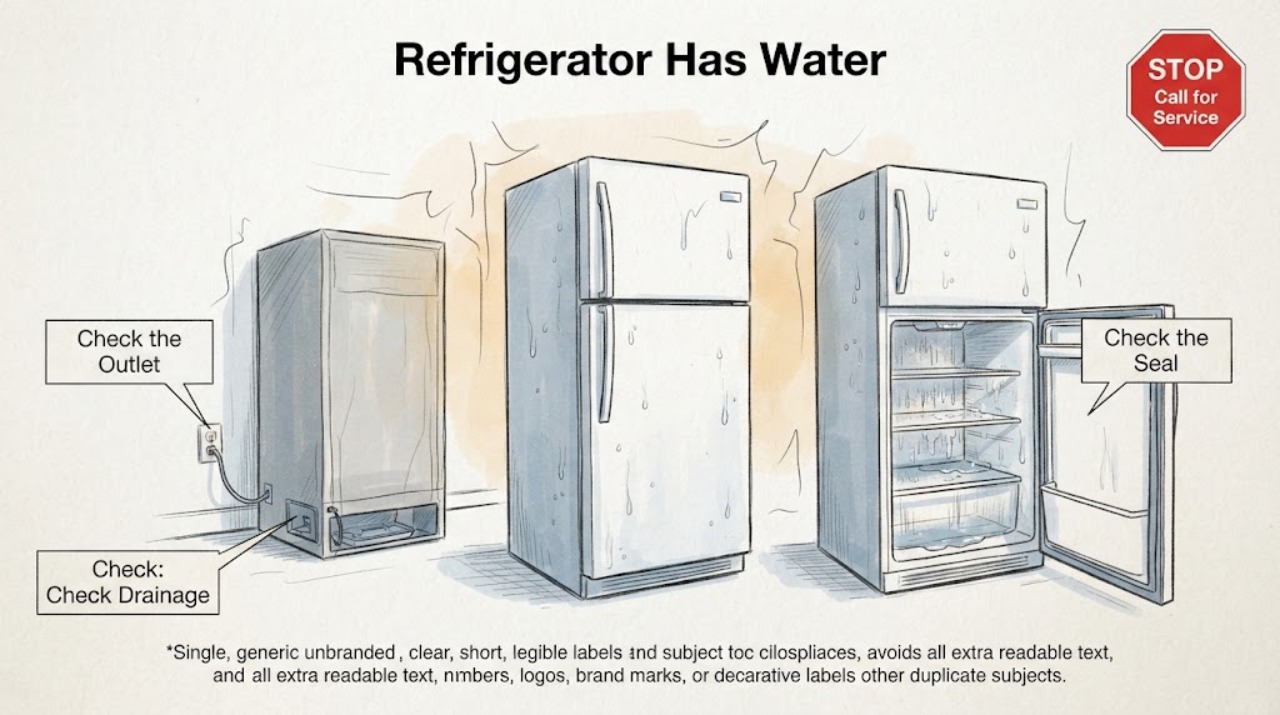
Work through in order
Diagnostic checks
Use only checks that match the exact appliance or system and its official guide.
-
Check 1
Protect food first. Check the refrigerator and freezer temperatures with a reliable thermometer if cooling has changed, and move perishable food to a known-safe cold appliance if temperatures are rising. If water is near an outlet, cord, or other electrical equipment, do not stand in it or unplug through water; isolate power only when safe.
Expected result: Food temperatures remain safe and the water is a small isolated amount, or temperatures are rising/food is warming and water is spreading.
Next step: For warming food, spreading water, or electrical exposure, keep the refrigerator closed, protect the food, and arrange appliance service; do not keep testing it in the hot garage.
Why this matters
Why: Maytag says ambient conditions can cause improper temperatures and that a garage can make a refrigerator work harder. Water plus unsafe temperature or electrical exposure is a service and food-safety concern, not a routine cleaning issue.
-
Check 2
Wipe the accessible water from the refrigerator floor and note exactly where it reappears: under a crisper, along a door edge, at the rear interior wall, on a shelf, or only on the outside floor. Do not remove the rear cover, chip ice, or reach into an enclosed drain path.
Expected result: The water does not return after a spill/condensation event, or it returns at the same location or increases over time.
Next step: If it returns, keep the area dry and request service with the location, timing, garage temperature/humidity and cooling status. Do not pour water or tools into a drain opening to test it.
Why this matters
Why: A one-time small amount can be condensation or a spill; returning water indicates an unresolved leak, condensation path, or drainage condition that cannot be identified safely by location alone.
-
Check 3
Inspect the door gasket and door path from outside for dirt, tears, gaps, or a container preventing the door from closing evenly. Close the door normally and check that the seal is continuous; do not force the door or remove the gasket to improve the seal.
Expected result: The gasket is dirty/damaged or the door does not seal, or the gasket is clean and the door closes evenly.
Next step: Remove only an accessible obstruction and clean the visible gasket surface. Request service for a damaged gasket, misaligned door, or water that continues after the seal check.
Why this matters
Why: Maytag links door sealing and humidity control with moisture management. A poor seal can admit warm, humid garage air and increase condensation, but a normal seal does not rule out an internal water source.
-
Check 4
Check the garage environment and the refrigerator's external clearance without moving the appliance alone. Record the approximate room temperature, nearby heat sources, blocked base grille, cabinet/wall contact, and whether the refrigerator is level and stable.
Expected result: The garage is outside the model's documented range, the refrigerator is near a heat source or blocked, or the environment and clearance are within the manual's limits.
Next step: Improve only safe, external airflow and clearance consistent with the complete M1TXEMMWQ00 manual. Do not install a fan against the cabinet, remove covers, or move the refrigerator alone; service is needed if water or unsafe temperatures persist.
Why this matters
Why: Maytag says hot garages can overwork a standard refrigerator and that blocked ventilation or heat sources can reduce performance. These conditions can increase run time and condensation but do not prove a drain or sealed-system fault.
-
Check 5
With the doors open briefly, confirm that interior air vents are not blocked by food and that shelves are not packed against the rear wall. Keep the refrigerator at the manual's recommended control setting rather than making a large temperature change, and wait the manual's stabilization period after any adjustment.
Expected result: Vents are blocked or the unit is overpacked, or airflow is clear and the controls are already at the documented setting.
Next step: Move only items that visibly block a vent and monitor temperature. If water continues, food warms, frost builds, or the source is hidden, stop owner checks and arrange service.
Why this matters
Why: Maytag says blocked vents can create temperature and moisture issues and that warm conditions or large loads can increase run time. A clear airflow path does not identify an internal drain blockage.
-
Check 6
If the water is only a minimal amount of surface condensation and the refrigerator maintains safe temperatures, reduce prolonged door opening and continue observing after the garage environment returns to a documented range. Do not treat evaporation as proof that a recurring leak is fixed.
Expected result: The moisture remains minimal and does not return, or it reappears repeatedly or is accompanied by frost, odor, noise, or temperature change.
Next step: For repeated or combined symptoms, keep food protected and schedule service. Provide the model suffix, water location, recurrence pattern, garage temperature/humidity, door-seal result and temperature readings.
Why this matters
Why: Maytag says minimal condensation can be normal in humid conditions, but repeated water or combined cooling symptoms exceed a simple condensation explanation.
Use your observations
Decision map
Find the observation that best matches what you see, then follow the next safe action.
-
PATH 01Next step
What you see
The water is minimal, does not return after wiping, and the refrigerator maintains safe temperatures in a humid garage.
Do this next
Keep the door gasket clean, minimize long openings, maintain safe clearance and monitor temperature; use the complete model manual for environmental limits.
Why this path and its safety boundary
Why it matters: This is consistent with a temporary spill or condensation, but it is not proof that an enclosed drain path is clear.
-
PATH 02Next step
What you see
The garage is hotter than the model documentation allows, the refrigerator is near a heat source, or external ventilation is blocked.
Do this next
Restore only safe room conditions and external clearance consistent with the manual, then monitor with a thermometer. Request service if water recurs or temperatures remain unsafe.
Why this path and its safety boundary
Why it matters: Ambient heat can make a standard refrigerator run longer and can contribute to temperature and moisture problems; it does not establish a drain-tube or compressor failure.
-
PATH 03Next step
What you see
Water returns at the same interior or floor location, or it appears with frost, a damaged gasket, or a cooling change.
Do this next
Keep food protected, avoid moving the refrigerator alone, and arrange Maytag or qualified refrigerator service. Do not pour water into the drain, remove covers, or attempt an internal tube repair.
Why this path and its safety boundary
Why it matters: A recurring moisture path or leak remains unresolved; a visible symptom does not identify an internal drain, valve, sealed-system, or defrost component.
-
PATH 04Next step
What you see
The refrigerator cannot maintain safe food temperatures, water is spreading near electrical equipment, or the source cannot be located from visible checks.
Do this next
Isolate the appliance only if safe, move perishable food, contain accessible water without moving the appliance, and request urgent qualified service.
Why this path and its safety boundary
Why it matters: The problem has exceeded safe owner-level observation; continued operation can risk food, property or electrical safety.
Helpful context
Understand the symptom
Water at the bottom is a location, not a diagnosis. A hot, humid garage can increase condensation and make a standard refrigerator run longer, while a door that does not seal or a blocked airflow path can add moisture and temperature stress. A puddle that returns after wiping, or water associated with frost, unsafe food temperatures, or a water connection, needs service rather than an improvised drain-tube repair.
The assigned identity is Maytag M1TXEMMWQ00. Maytag's official manuals page requires entering the appliance model number to retrieve the correct literature. Use the complete label, including the final suffix, before applying model-specific ambient limits, control positions, or cleaning instructions.
Trace the water without opening the refrigerator system
When checks do not resolve it
Need a professional?
Use Maytag or qualified refrigerator service for recurring water, unsafe temperature, frost plus water, a damaged seal, inaccessible drainage, or any electrical exposure.
Have this ready
- Provide the complete model number M1TXEMMWQ00, water location and recurrence, garage temperature/humidity, thermometer readings, door-gasket/clearance/vent observations, frost or leak history, and whether the appliance can be safely isolated.
Common questions
FAQ
Can a hot garage cause water inside a Maytag refrigerator?
Hot or humid garage conditions can make a standard refrigerator run longer and can increase condensation or temperature stress. They do not prove that recurring water is only environmental; use the complete model manual and investigate repeated water or cooling changes.
Is a small amount of water in the refrigerator always a clogged drain?
No. Maytag says minimal condensation can be normal in humid conditions. Wipe it, identify whether it returns, and check only the visible seal, airflow and environment; do not pour water or tools into an internal drain to test it.
Should I move M1TXEMMWQ00 out of the garage to diagnose it?
Do not move a full or built-in refrigerator alone. Record the room conditions and visible clearance first; use the model manual or qualified service for relocation and any inaccessible rear checks.
When is water in the refrigerator urgent?
Treat recurring water with warming food, frost, a damaged gasket, spreading floor water, or water near electrical equipment as a service issue. Protect food and isolate the appliance only when safe rather than continuing to test it.
Read the exact guide
Official sources
- Water Inside RefrigeratorMaytag Product Help · Maytag refrigerator family guidance. It distinguishes a water/filter issue from minimal humidity condensation and sends unresolved cases to service; filter-specific advice is used conditionally only if the assigned unit has a filter.
- Appliance Manuals and Literature | MaytagMaytag · Opened Maytag's official manuals portal. It requires the complete appliance model number to retrieve the correct manual and documents; this is used to preserve the M1TXEMMWQ00 identity and prevent applying another model's limits.
- What is the Proper Location and Environment for your Maytag RefrigeratorMaytag Product Help · Maytag full-size refrigerator family guidance. It says standard refrigerators may not perform properly in hot/cold garages and directs owners to the specific manual for model requirements; it does not diagnose an internal drain.
- Too Warm in Freezer Compartment - Top Freezer RefrigeratorMaytag Product Help · Top-freezer family guidance. It distinguishes standard indoor-use units from garage-ready configurations and supports external airflow, gasket, level and temperature checks; exact model controls remain manual-specific.
- Not Cooling - Top Freezer RefrigeratorMaytag Product Help · Top-freezer family guidance, relevant to the assigned top-freezer model family. It supports external garage, vent, load, control and temperature checks without identifying internal drain or sealed-system faults.
- What Is a Garage-Ready Refrigerator?Maytag · Maytag family guidance. It explains that garage-ready status and ambient ranges vary by model, that hot garages can stress standard units, and that airflow, level and humidity management matter; it is not a specific M1TXEMMWQ00 manual.
Community feedback
Share a repair observation
Share a plain-text repair observation. Accepted observations are published automatically; this page may take a moment to update.