
On this page
Start here
Quick answer
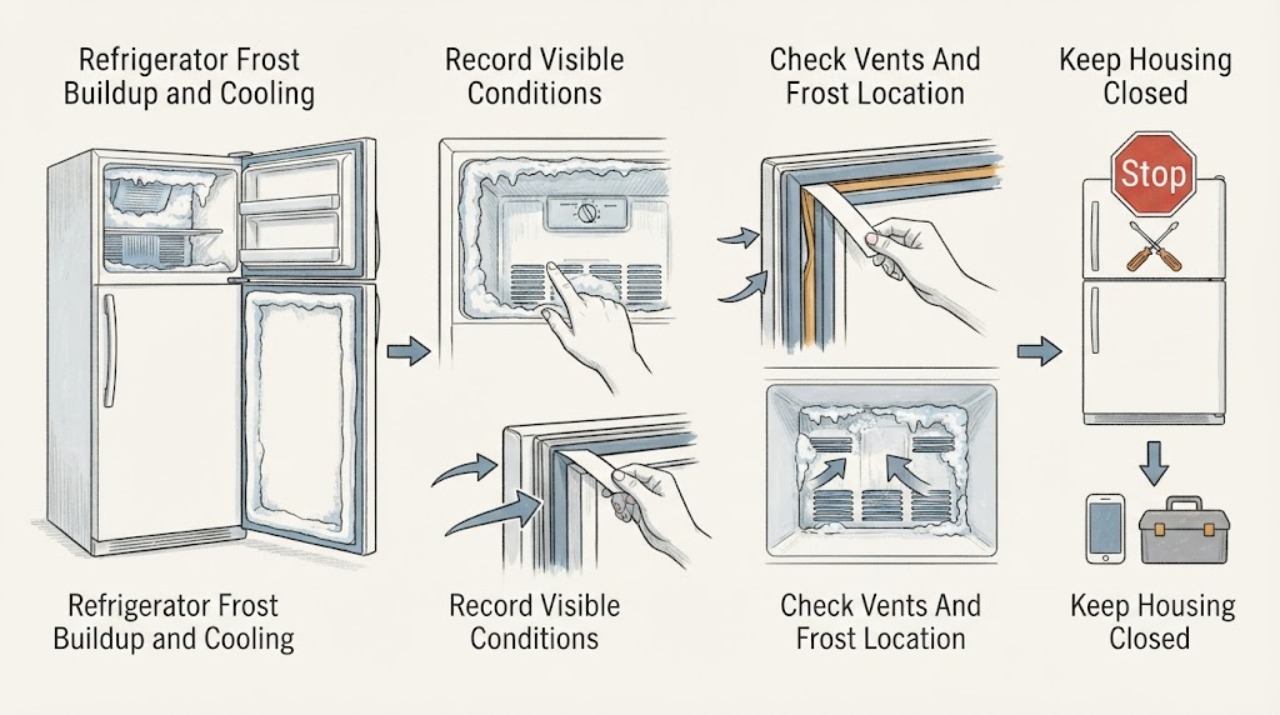
First separate moisture and airflow causes from a confirmed cooling-system failure. Maytag says frost can follow a door left open, frequent openings, a poor gasket seal or blocked vents; blocked vents can also create temperature and moisture problems. Check the door closure and gasket, keep food away from vents, verify that cooling is turned on and use the model manual for control or defrost behavior. Make one small temperature change and allow 24 hours before judging it. If frost returns quickly, covers vents, or the refrigerator stays warm after the external checks, protect perishable food and arrange Maytag service instead of diagnosing a heater, fan, sensor or sealed-system part from frost pattern alone.
Work through in order
Diagnostic checks
Use only checks that match the exact appliance or system and its official guide.
-
Check 1
Record the refrigerator and freezer temperatures with an appliance thermometer if available, and note whether food is warming, while keeping doors closed as much as practical.
Expected result: The measured temperature is near the model's expected range, or one or both compartments remain warm despite the display setting.
Next step: Protect perishable food if temperatures are unsafe, then continue only the external checks that fit the model. Do not infer a defrost or compressor part from the reading alone.
Why this matters
Why: Actual temperature and frost pattern are more useful than a control display alone; a warm compartment with accumulating frost needs an airflow, seal or service decision.
-
Check 2
Check that the refrigerator and freezer doors close fully, that packages are not holding a door open, and that the gasket contacts the cabinet continuously without visible obstruction.
Expected result: A door was left open, the gasket is obstructed or not sealing, or the doors close normally with no visible gap.
Next step: Remove the obstruction and minimize door openings. If the gasket or alignment needs adjustment, use the exact model manual or service route rather than forcing the door.
Why this matters
Why: Maytag identifies warm humid air from open doors and poor gasket sealing as frost and moisture causes; a sound seal makes that explanation less likely but does not diagnose the cooling system.
-
Check 3
From inside the compartments, identify the model-specific supply and return vents and move food or containers away from them; note whether frost is concentrated around a vent or covers a broad panel.
Expected result: A vent is blocked or covered by frost, or all vents are open but cooling remains uneven and frost continues.
Next step: Keep vents clear and follow the owner manual for any permitted defrost method. Do not chip ice with a sharp tool, apply uncontrolled heat or remove panels to reach the evaporator.
Why this matters
Why: Maytag says blocked vents reduce airflow and can produce frost, moisture and warm spots; broad or recurring frost with open vents needs model-specific evaluation.
-
Check 4
Verify from the display or model manual that cooling is enabled and that the refrigerator is not in a model-specific showroom, demo or off state; make at most one small documented temperature adjustment.
Expected result: Cooling was disabled or a display/demo state was active, or the controls were already normal and the refrigerator remains warm.
Next step: After a permitted change, wait 24 hours and recheck temperatures. If cooling remains poor or frost returns, arrange service rather than changing settings repeatedly.
Why this matters
Why: Maytag notes that some models need cooling manually turned back on and that demo/showroom behavior varies by model; normal controls with persistent warmth point beyond a simple setting.
-
Check 5
After the seal, airflow and control checks, monitor whether frost quickly returns or the refrigerator still cannot hold temperature; keep the appliance closed and do not open the rear or evaporator area.
Expected result: The refrigerator stabilizes after the documented external correction, or frost/cooling failure persists or returns.
Next step: Keep food safe, record the model and temperature history, and contact Maytag service. Do not order or install an internal part based only on the frost pattern.
Why this matters
Why: A recurring frost-and-warm condition cannot be assigned safely to a defrost heater, fan, sensor, damper, board or sealed-system fault from appearance alone.
Use your observations
Decision map
Find the observation that best matches what you see, then follow the next safe action.
-
PATH 01Next step
What you see
Frost follows a door left open, frequent openings or a gasket obstruction, and the seal becomes normal after the obstruction is removed.
Do this next
Keep doors closed as much as practical and monitor temperatures. Use the model manual or service if frost returns with a confirmed seal.
Why this path and its safety boundary
Why it matters: Warm humid air entering the compartment is a supported explanation for the frost; it is not evidence of a failed defrost component.
-
PATH 02Next step
What you see
Food or frost blocks an air vent and the temperature is uneven, with warmer or frozen spots near the airflow path.
Do this next
Clear only accessible food obstructions and follow the model manual for frost removal; do not dismantle the air path.
Why this path and its safety boundary
Why it matters: The pattern is consistent with restricted air circulation, which Maytag links to frost and temperature problems.
-
PATH 03Next step
What you see
Cooling was off, a model-specific demo/showroom state was active, or a control change has not yet had 24 hours to stabilize.
Do this next
Use only the matching manual's control procedure, wait the documented stabilization period and recheck actual temperatures.
Why this path and its safety boundary
Why it matters: The current warm reading may reflect operating state or insufficient stabilization rather than a confirmed component failure.
-
PATH 04Next step
What you see
Frost rapidly returns, covers the evaporator/vents, or the refrigerator remains warm after the external seal, airflow and control checks.
Do this next
Protect perishable food and schedule Maytag service. Do not use a sharp tool, uncontrolled heat, panel removal or a guessed replacement part.
Why this path and its safety boundary
Why it matters: The problem has crossed the user-level boundary; the evidence cannot distinguish defrost, fan, sensor, damper, control or sealed-system causes.
Helpful context
Understand the symptom
Frost is a moisture and airflow clue, not a component diagnosis
A small amount of freezer frost can be normal, but a growing layer together with warm food or blocked airflow needs attention. Maytag lists humid air entering through open doors, a poor seal and blocked vents as causes. The location and recurrence of frost help choose the next external check, but do not prove a failed defrost heater, fan, sensor or control board.
Start with the door seal and clear airflow
Make sure the refrigerator and freezer doors close completely, that nothing obstructs the gasket, and that containers do not cover the supply or return vents. Maytag notes that vent locations vary by model, so use the matching owner manual rather than removing an interior panel to reach a fan or evaporator.
Give temperature changes time to settle
Check that cooling is enabled and record the actual compartment temperatures with an appliance thermometer if available. Maytag recommends small control changes and a 24-hour stabilization period; a display setting or one warm reading does not identify the cause. If the refrigerator remains warm or frost rapidly returns, service is the next decision.
When checks do not resolve it
Need a professional?
Contact Maytag service when frost returns quickly, vents remain covered, the refrigerator stays warm after the external checks and stabilization period, the door cannot seal, or internal access would be required.
Have this ready
- Provide the complete model number, refrigerator configuration, measured refrigerator/freezer temperatures, frost location and recurrence, door/gasket observations, control state, and whether cooling improved after clearing an obstruction.
Common questions
FAQ
Can frost buildup alone prove the defrost heater is bad?
No. Maytag also lists open doors, frequent openings, poor gasket sealing and blocked vents as frost causes. A recurring frost-and-warm condition needs model-specific service diagnosis rather than a guessed heater replacement.
Why is the refrigerator warm when the freezer has frost?
Blocked airflow can leave one compartment warm while frost or ice restricts the vents between compartments. Clear accessible food obstructions and follow the exact manual; persistent or recurring frost needs service.
How long should I wait after changing the temperature?
Maytag recommends allowing 24 hours after a small control adjustment before judging the result. Control labels and procedures vary by refrigerator type, so use the model manual.
Should I remove heavy frost with a knife or heat gun?
No. Do not chip ice with a sharp tool or apply uncontrolled heat. Move food to safe storage and use the model manual or Maytag service for a permitted defrost process, especially when frost returns or cooling has failed.
Read the exact guide
Official sources
- How to Check the Air Vents for Blockage-Ensuring Proper Air FlowMaytag · Opened official Maytag Product Help article. Used for vent locations varying by model, blocked-vent signs, moisture/frost and uneven temperature, and accessible airflow checks.
- How to Help Eliminate Condensation and FrostMaytag · Opened official Maytag Product Help article covering Maytag refrigerator and freezer condensation, frost and ice causes. Used for door openings, gasket sealing, vent blockage, model-manual and service boundaries.
- Tips for Properly Setting the ControlsMaytag · Opened official Maytag Product Help article. Used for model-varying controls, cooling/demo state, measured-temperature verification and the 24-hour stabilization interval.
- Not Cooling - Top Freezer RefrigeratorMaytag · Opened official Maytag Product Help page explicitly scoped to top-freezer refrigerators. Used only for conditional top-freezer examples such as cooling state, demo mode, vents and service; it is not treated as proof for every Maytag configuration.
Community feedback
Share a repair observation
Share a plain-text repair observation. Accepted observations are published automatically; this page may take a moment to update.