
On this page
Start here
Quick answer
Heavy ice can block freezer airflow and leave the refrigerator warm, but the ice is a symptom rather than proof of a specific defrost part failure. For the Maytag MTB1891AR, move food to safe cold storage, disconnect power and use a complete, gentle defrost; inspect the door seal and airflow after everything is dry. Do not chip ice with a sharp tool or use a hair dryer/heater. If ice returns quickly or cooling does not recover, stop using the appliance and arrange service instead of opening the sealed or electrical systems.
Before you begin
Safety first
- Disconnect power before defrosting. Do not use a knife, ice pick, hair dryer, heater or other electrical appliance to melt ice; do not remove freezer panels or work on electrical, defrost or sealed-system components.
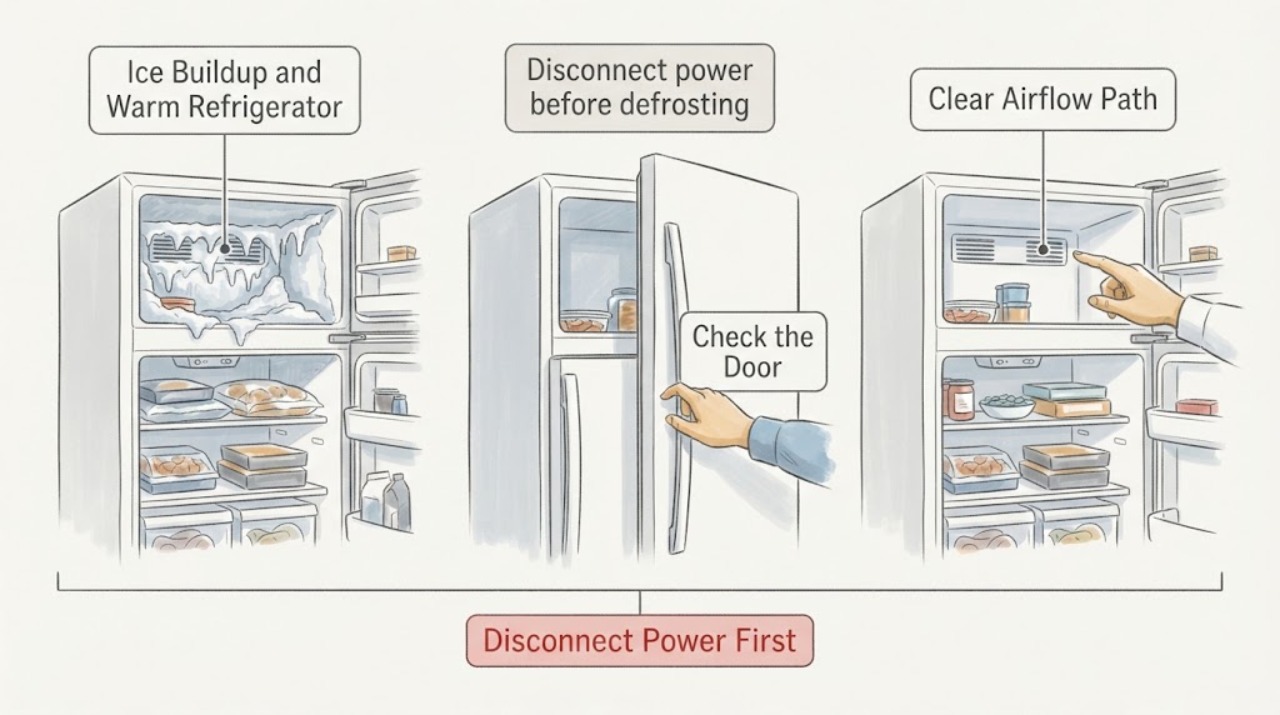
Work through in order
Diagnostic checks
Use only checks that match the exact appliance or system and its official guide.
-
Check 1
Before changing settings, note where the ice is concentrated, whether the refrigerator compartment is warm, whether the freezer door closes evenly, and whether food or containers block visible air passages. Transfer perishable food to another cold location if temperatures are unsafe.
Expected result: Ice is a broad layer that blocks airflow, concentrated near a door edge/seal, or returns after a recent defrost.
Next step: Continue with a complete safe defrost and seal/airflow inspection. Do not pry at the ice or dismantle the freezer wall.
Why this matters
Why: Maytag identifies frost, warm humid air entering through poor sealing, frequent openings and blocked airflow as conditions that can reduce performance; this observation does not identify a failed defrost component.
-
Check 2
Disconnect power before defrosting. Remove or protect frozen food, place towels or a pan for meltwater, leave the freezer open, and allow the ice to soften. Use only a plastic or wooden spatula for softened frost if needed; never use a knife, ice pick, hair dryer or heater.
Expected result: The ice melts fully without damage, or a stubborn section remains attached.
Next step: Clean and dry the liner, gasket and drain area, then restore power only after the interior is dry. If the appliance cannot be safely defrosted, use service.
Why this matters
Why: A full thaw can restore airflow, while a stubborn section should be allowed more time rather than attacked with a sharp or electrically heated tool.
-
Check 3
With power still off, clean the door gasket with warm soapy water and inspect it for cracks, tears, gaps or trapped debris. Close the door and check that it seals evenly; rearrange food so it does not hold the door open or block airflow.
Expected result: The gasket is damaged or does not seal, the door is obstructed, or the seal and airflow look normal.
Next step: Correct only debris or loading that is visibly preventing a seal. Replace a damaged seal or obtain model-specific service rather than forcing the door or changing internal controls.
Why this matters
Why: Maytag identifies poor door sealing and obstructed airflow as contributors to frost buildup and reduced efficiency. A normal external seal does not rule out an internal fault.
-
Check 4
After the complete thaw and dry-out, restore power and monitor whether cooling returns and whether frost begins rebuilding unusually soon. Record the model/suffix, time to refreeze, compartment temperatures and any unusual sound.
Expected result: Cooling returns and frost stays controlled, or the refrigerator remains warm/ice returns quickly.
Next step: For rapid recurrence or no cooling recovery, stop repeated defrost cycles and arrange a qualified refrigerator service visit with the recorded observations.
Why this matters
Why: Improvement after thaw supports an airflow/frost condition; rapid recurrence or persistent warmth needs model-specific diagnosis and does not prove one defrost part.
Use your observations
Decision map
Find the observation that best matches what you see, then follow the next safe action.
-
PATH 01Next step
What you see
A full safe thaw restores cooling and frost does not quickly return.
Do this next
Keep the gasket clean, avoid blocking air passages and minimize warm-air entry; follow the exact manual if frost returns.
Why this path and its safety boundary
Why it matters: The immediate restriction was likely ice/airflow related, but the cause of moisture entry still deserves prevention through seal and loading checks.
-
PATH 02Next step
What you see
The gasket is cracked, torn or visibly unable to seal, or the door is held open by loading.
Do this next
Remove the obstruction and arrange a model-compatible gasket/service correction for damaged sealing. Do not keep running with a persistent gap.
Why this path and its safety boundary
Why it matters: Warm humid air can enter and create frost; the door-seal path is a more direct external issue than an assumed defrost heater diagnosis.
-
PATH 03Next step
What you see
Ice returns quickly after a complete thaw, or the refrigerator remains warm despite clear airflow and a closed door.
Do this next
Stop guessing at parts and schedule a qualified technician with the full model/serial, ice location, temperature history and time to recurrence.
Why this path and its safety boundary
Why it matters: The generic Maytag pages do not identify which internal defrost, airflow or sealed-system component is at fault for MTB1891AR.
Helpful context
Understand the symptom
Ice buildup explains poor airflow, not the failed part
Maytag’s frost guidance says accumulated frost can block airflow and make the freezer work harder. Door-seal leakage, frequent warm-air entry and poor loading can create frost, while recurring frost after a full defrost can require model-specific service. Do not infer a heater, timer, thermostat or sealed-system failure from the ice pattern alone.
Defrost with power disconnected
A complete defrost is an external maintenance step, not an invitation to remove covers. Maytag directs users to disconnect power, protect the food, allow ice to melt, and avoid sharp tools or electrical appliances used as heaters. Collect meltwater and let the interior dry before restoring power.
Use the exact manual if the symptom returns
Maytag’s official manual portal requires the full appliance model to retrieve the matching literature. The exact MTB1891AR manual was not surfaced in the official portal during this research, so no model-specific defrost test or part replacement is included. A rapid return of ice or persistent warmth needs a qualified technician with the model and serial information.
When checks do not resolve it
Need a professional?
Arrange qualified service if the refrigerator remains warm after a complete safe thaw, frost returns quickly, the gasket cannot seal, or internal defrost/airflow/sealed-system work would be required. Disconnect power before defrosting and never use sharp tools or electrical heaters on the ice.
Safety scope: Disconnect power before defrosting. Do not use a knife, ice pick, hair dryer, heater or other electrical appliance to melt ice; do not remove freezer panels or work on electrical, defrost or sealed-system components.
Have this ready
- Provide the full MTB1891AR model and serial, ice location and thickness, freezer/refrigerator temperatures, whether a complete thaw restored cooling, gasket condition and time until frost returned.
Common questions
FAQ
Can ice buildup make the refrigerator warm?
Yes. Maytag says accumulated frost can block airflow and reduce freezer performance, which can leave the refrigerator side warm. The ice does not identify a single failed part by itself.
How should I defrost the MTB1891AR safely?
Disconnect power, protect the food, let the ice melt, collect water and dry the interior. Maytag says not to use a knife, ice pick, hair dryer or heater; follow the exact owner manual when available.
What if the ice comes back after defrosting?
Check the gasket and airflow externally, then arrange service if frost returns quickly or cooling remains poor. Do not assume the heater, timer or thermostat is bad without model-specific diagnosis.
Read the exact guide
Official sources
- How to Defrost the FreezerMaytag Product Help · Opened Maytag official defrost guidance. It directs power disconnection, food protection, meltwater control and gentle thawing, and prohibits hair dryers/heaters and sharp tools. It also tells users to consult the exact owner manual for model-specific information.
- MAYTAG® MANUALS & LITERATUREMaytag · Opened Maytag’s official manual portal. It requires entering the full model number to retrieve matching manuals and explains that exact manuals should be used; an exact MTB1891AR document was not surfaced in this session, so this source supports the documentation boundary rather than a model-specific repair claim.
- How to Avoid Frost Build UpMaytag Product Help · Opened Maytag official frost guidance. It explains that accumulated frost can block airflow and reduce performance, and links frost to door sealing, warm-air entry and blocked airflow. It supports general external checks, not a model-specific internal diagnosis.
Community feedback
Share a repair observation
Share a plain-text repair observation. Accepted observations are published automatically; this page may take a moment to update.