
On this page
Start here
Quick answer
On the Maytag MFI2570FEZ, first note exactly when the horrible sound starts: only while the exterior ice paddle is pressed, during a water dispense, during an automatic ice-maker fill, or even when nobody is dispensing. Maytag identifies this model as a French-door refrigerator with a factory-installed ice maker and exterior ice and water dispenser. A brief crusher or water-valve sound can be normal, while a new grinding, repeated chattering, jam-like stall, leak, or noise that continues after dispensing needs a safe stop and service assessment. Check the ice type, bin seating, visible cubes, filter/flow symptoms, and tubing only from outside; do not force the auger, remove panels, or test the dispenser live.
Before you begin
Safety first
- Do not remove the dispenser fascia or cabinet, probe live circuits, force the auger or crusher, bypass the door or control, disconnect water tubing, or reach into a moving mechanism. Isolate the refrigerator from a safe position for smoke, burning odor, water near electrical parts, damaged cord, abnormal heat, or repeated protection trips.
Work through in order
Diagnostic checks
Use only checks that match the exact appliance or system and its official guide.
-
Check 1
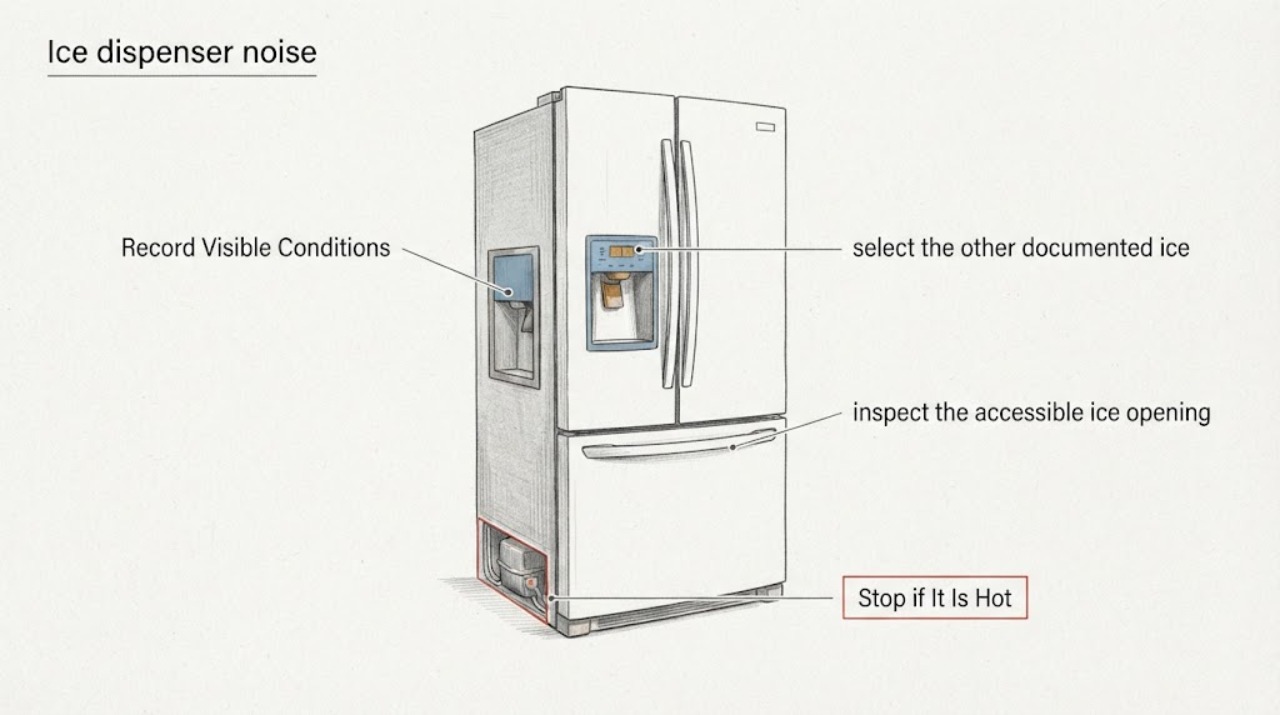
Record the complete model and serial information and make one short audio/video record from a safe position. Note whether the sound begins when selecting cubed or crushed ice, when pressing the ice paddle, while dispensing water, during an automatic ice-maker fill, or with the doors closed and no dispensing request.
Expected result: The sound is limited to ice dispensing, limited to water dispensing, occurs during both, or occurs independently of dispensing; the model is confirmed or uncertain.
Next step: Use the complete identity and timing in the service request. If the model or sound source is uncertain, do not remove the dispenser fascia or cabinet to locate it.
Stop if: Stop using the dispenser for smoke, burning odor, exposed wiring, a hot plug, water near electrical parts, a jam that needs force, or a repeated breaker trip.
Why this matters
Why: Maytag's exact product page identifies MFI2570FEZ as an exterior ice-and-water dispenser model. Timing separates a dispenser-path complaint from normal or abnormal cooling sounds and prevents a generic compressor diagnosis from being attached to an ice-paddle event.
-
Check 2
If the noise occurs only when dispensing ice, select the other documented ice type once and use a sturdy glass while making one brief dispense observation. Keep the glass close to the opening, do not press harder than needed, and stop if the ice jams or the auger stalls; do not reach into the chute or bin with tools.
Expected result: The sound occurs only with crushed ice, with cubed ice, with either type, or the dispenser stalls, grinds, chatters continuously, or produces no ice.
Next step: If one ice type is quiet and the other is noisy, stop using the noisy mode and provide the result to service. If both modes grind, stall, or fail to dispense, keep the dispenser unused and arrange appliance service.
Stop if: Do not chip ice with a sharp object, force the paddle, manually turn the auger, remove the bin while the motor is actuated, or operate with cracked plastic or exposed moving parts.
Why this matters
Why: Maytag states that crushed ice is processed before dispensing and that brief crusher noise can occur; the ice type that triggers the sound helps distinguish the crusher path from a broader auger or bin problem. A repeated grind or stall is not identified as a normal setting effect.
-
Check 3
With dispensing stopped, inspect the accessible ice opening and bin interface for a visible clump, cube bridge, bin that is not seated, or ice spilling against the chute. Clear only loose ice that can be removed without a tool and reseat the bin only as the model's normal user operation permits; do not remove covers or reach into the drive mechanism.
Expected result: A loose clump or mis-seated bin is visible, the opening is clear and the bin is seated, or the obstruction cannot be cleared safely.
Next step: Remove only the reachable loose ice, reseat the bin, and make one brief observation. If noise returns, the bin is damaged, or access requires tools, leave the dispenser unused and call service.
Stop if: Do not pry frozen cubes, pour hot water into the mechanism, bend the bin, remove a panel, or place fingers near the auger or crusher.
Why this matters
Why: A visible ice obstruction or mis-seated container can load the dispenser and create a jam-like noise, but a clear path with persistent noise shifts attention toward the auger/actuator or another internal part. The external observation does not identify the failed component.
-
Check 4
If the noise is a buzz or chatter during water dispensing or automatic ice-maker fill, check only the visible supply setup: confirm the household shutoff is intended to be open, look for a sharply kinked or vibrating tube without pulling the refrigerator, and note whether water flow is weak after a recent filter change. Do not disconnect the water line.
Expected result: The sound is tied to water flow, the shutoff is partly closed or unknown, tubing vibrates or is kinked, flow is weak, or the noise occurs with normal flow and no visible line issue.
Next step: Correct only an accessible shutoff or visible tubing position that is safe and ordinary. For weak flow, a leaking connection, or persistent chatter, stop dispensing and arrange qualified appliance or plumbing service as appropriate.
Stop if: Do not pull out the refrigerator, loosen fittings, bypass the filter, use a non-matching filter, or operate with a leak or water near electrical parts.
Why this matters
Why: Maytag's product-help guidance links dispensing chattering to pressure changes or flow restrictions, including a partly closed shutoff, kinked/vibrating tubing, air after filter replacement, and a restricted filter. A normal visible supply does not prove that the internal valve or actuator is good.
-
Check 5
If the sound occurs with no dispensing request, listen from outside the closed refrigerator and record whether it is a brief hum or pulse during a cooling cycle, a soft hiss or drip, a vibration/rattle from tubing or the cabinet, or a loud persistent scrape, knock, or electrical buzz. Do not move the appliance or access the compressor or fan compartment.
Expected result: The sound is brief and repeats with normal cooling or defrosting, changes with door or dispenser operation, or is loud, new, persistent, or accompanied by temperature loss, odor, or abnormal heat.
Next step: Monitor only a brief, repeatable sound with stable cooling and no hazard. For a new persistent sound, cooling change, odor, heat, or an unclear source, keep the unit closed and schedule qualified service.
Stop if: Do not touch the compressor, fan, wiring, or refrigerant tubing; isolate power from a safe position for smoke, burning odor, water near electrics, damaged cord, or repeated protection trips.
Why this matters
Why: Maytag describes brief fan/compressor changes, refrigerant flow, water-valve operation, and expansion sounds as possible normal refrigerator noises. A persistent or excessive sound, especially with cooling loss or a hazard, is outside a safe user diagnosis and cannot be assigned to the compressor from sound alone.
Use your observations
Decision map
Find the observation that best matches what you see, then follow the next safe action.
-
PATH 01Next step
What you see
The noise starts only when pressing the ice paddle, changes with cubed versus crushed selection, and stops when dispensing stops; the bin and chute show no reachable obstruction.
Do this next
Stop using the noisy ice mode, preserve the recording, and arrange Maytag or qualified appliance service without opening the dispenser assembly.
Why this path and its safety boundary
Why it matters: The dispenser/crusher/auger path is more likely than the refrigerator compressor, but the safe external checks cannot identify which internal part is responsible.
-
PATH 02Next step
What you see
The sound is a buzz or chatter during water dispensing or automatic ice-maker fill and is accompanied by weak flow, a recent filter change, a partly closed shutoff, or visibly vibrating/kinked tubing.
Do this next
Correct only the accessible ordinary condition and make one brief observation. Use appliance or plumbing service for persistent noise, a leak, weak flow, or any connection that must be opened.
Why this path and its safety boundary
Why it matters: A pressure or flow restriction is more likely than a crusher fault; Maytag lists these conditions as possible causes of dispensing chatter.
-
PATH 03Next step
What you see
The sound occurs without dispensing, is loud or persistent, or is joined by temperature loss, abnormal heat, smoke, burning odor, water near electrics, or repeated power trips.
Do this next
Stop using the appliance or dispenser as appropriate, isolate it from a safe position for an active hazard, protect food, and arrange prompt qualified appliance/electrical service.
Why this path and its safety boundary
Why it matters: The issue is not safely bounded as a dispenser sound. A fan, compressor, electrical, tubing, or cooling fault may be involved, and the hazard symptoms require an immediate stop.
Helpful context
Understand the symptom
The sound timing matters more than the word horrible
The MFI2570FEZ has a factory-installed ice maker in the refrigerator and an exterior ice-and-water dispenser. A sound that begins only when the ice paddle is pressed points toward the bin, crusher, auger, actuator, or dispenser path; a sound during water dispensing points toward flow, the inlet valve, tubing, or filter; a sound that occurs without dispensing may be a fan, compressor, refrigerant-flow, leveling, or tubing vibration. Maytag's guidance treats several brief operating sounds as normal, but a new or excessive sound that cannot be identified is a reason to schedule service.
Do not diagnose the part from the video or sound alone
A video can establish timing and location, but it cannot prove that the ice-maker assembly, auger motor, water valve, filter, fan, or compressor has failed. Maytag's dispenser guidance lists pressure changes, a partially closed shutoff, kinked or vibrating tubing, trapped air after filter replacement, and a restricted filter as possible causes of chattering. Keep the decision at that level until the exact symptom pattern and safe external checks are documented.
When checks do not resolve it
Need a professional?
Arrange Maytag or qualified appliance service when the noise returns after safe bin, ice-type, and visible flow checks; when the dispenser grinds, stalls, chatters continuously, or leaks; when the sound is not tied to dispensing; or when cooling changes, heat, odor, electrical symptoms, or repeated trips occur. Use plumbing service when the household shutoff or supply connection is the unresolved cause.
Safety scope: Do not remove the dispenser fascia or cabinet, probe live circuits, force the auger or crusher, bypass the door or control, disconnect water tubing, or reach into a moving mechanism. Isolate the refrigerator from a safe position for smoke, burning odor, water near electrical parts, damaged cord, abnormal heat, or repeated protection trips.
Have this ready
- Provide the exact MFI2570FEZ model and serial information, the audio/video record, whether the noise occurs with ice, water, automatic fill, or no dispensing, cubed/crushed selection, bin and chute observations, filter timing, water-flow symptoms, and any temperature or safety change.
Common questions
FAQ
Is a loud sound while dispensing crushed ice automatically a failed auger?
No. Maytag says crushed ice is processed before dispensing and brief crusher noise can occur. If the sound is new, grinding, repeated, stalls the dispenser, or also occurs with cubed ice, stop that mode and arrange service instead of ordering an auger from the sound alone.
Why does the dispenser chatter when water or ice is requested?
Maytag lists pressure changes and flow restrictions such as a partly closed shutoff, kinked or vibrating tubing, air after filter replacement, a restricted filter, and valve vibration. Check only visible external conditions; persistent chatter or a leak needs service.
Could this be the compressor even if the video sounds like the ice dispenser?
The timing is the first distinction. A sound that starts only with the ice paddle is more consistent with the dispenser path; a sound that occurs without dispensing may be a fan, compressor, refrigerant-flow, or cabinet vibration. Sound alone cannot prove the component.
Can I remove the ice bin or panel to inspect the motor?
Use only ordinary bin handling documented for the model, with dispensing stopped. Do not remove panels, reach into the drive mechanism, manually turn the auger, or perform a live test; arrange qualified service when the safe external checks do not resolve the noise.
Read the exact guide
Official sources
- MFI2570FEZ | MaytagMaytag · The opened Owner's Center is explicitly labeled MFI2570FEZ and identifies the appliance as a 36-inch wide French-door refrigerator with a 25 cu. ft. capacity; it provides the model-specific support and service route.
- 25 cu. ft. French Door RefrigeratorMaytag · The opened manufacturer specification lists MFI2570FEZ as the fingerprint-resistant stainless model and describes its factory-installed ice maker and exterior ice/water dispenser.
- How to Stop a Refrigerator from Making NoiseMaytag · The opened Maytag article describes common refrigerator noises and limited external checks such as ice-maker supply, leveling, and loose tubing; it includes MFI2570FEZ among the refrigerator models shown and does not diagnose a specific internal part.
- Refrigerator Noise - High-Pitched or PulsatingMaytag Product Help · Maytag's opened article discusses high-frequency and pulsating refrigerator sounds, including fans, refrigerant-flow equalization, and compressor speed changes, and directs owners to model manuals or service when needed.
- Refrigerator Noise - Chattering Noise When DispensingMaytag Product Help · Maytag's opened product-help article is scoped to full-size refrigerators and addresses chattering or rattling while dispensing water, including pressure, shutoff, tubing, air, filter, and valve causes; it is not a model-specific part diagnosis.
Community feedback
Share a repair observation
Share a plain-text repair observation. Accepted observations are published automatically; this page may take a moment to update.