
On this page
Start here
Quick answer
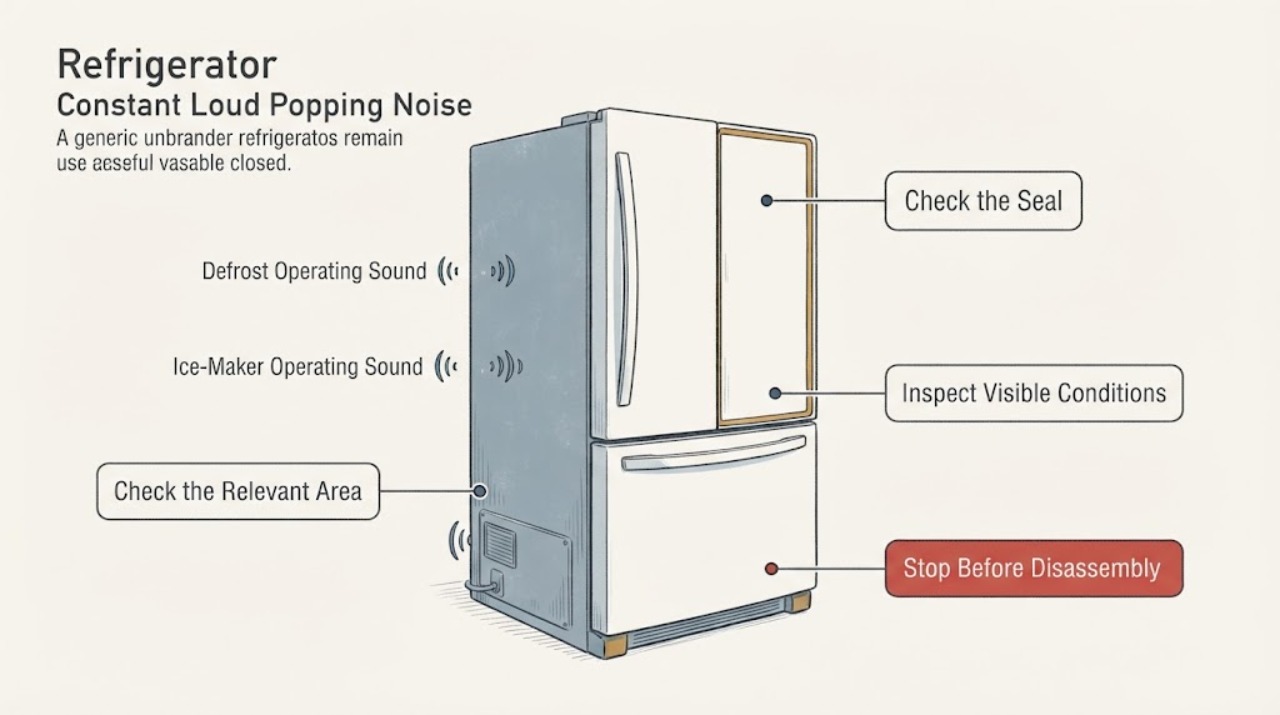
Maytag says a popping or cracking sound can come from contraction and expansion of the refrigerator walls during cool-down or defrost, and a loud bang can occur when ice drops into the ice bin. Those explanations fit a sound tied to a cooling/defrost or ice-making event while the refrigerator holds temperature. A constant, newly louder, impact-like sound that is not tied to those events, shakes the cabinet, or comes with poor cooling, water, smoke, burning odor, or a damaged cabinet needs service. Without opening the cabinet, note when the sound occurs, check that the refrigerator is stable and level and that nothing on top or around it is vibrating, and record the complete PSB2151GR model information for Maytag service. Do not remove sealed-system covers or replace a part from the sound alone.
Work through in order
Diagnostic checks
Use only checks that match the exact appliance or system and its official guide.
-
Check 1
Use the sound already observed to note whether it occurs at startup, shutdown, during a defrost period, immediately after an ice-maker harvest, after a door closes, or at unrelated intervals. Do not force a defrost, start a diagnostic mode, or keep opening the doors to make it happen.
Expected result: The pop is brief and repeats with a cooling/defrost or ice-ejection event, or it is constant/loud and its timing is unrelated or worsening.
Next step: For a cycle-linked brief sound with normal cooling, continue external monitoring and document it. For a constant, worsening or unexplained sound, arrange Maytag service and provide the timing description; do not open the cabinet.
Why this matters
Why: Maytag identifies expansion/contraction and ice ejection as possible normal sources. An unrelated, worsening or impact-like pattern is not explained by those normal-sound descriptions alone.
-
Check 2
From the floor, look for items on top or beside the refrigerator that can vibrate, and check whether the cabinet rocks or appears visibly unlevel. Do not move a full refrigerator or adjust hidden components just to chase the noise.
Expected result: The cabinet is stable and clear, or it rocks/leans and the sound changes when nearby items vibrate.
Next step: Remove only a loose item from the top or side. If the cabinet is unstable, use the exact installation instructions or arrange service rather than improvising a lift or moving the loaded unit. If the sound persists, book service.
Why this matters
Why: Maytag says an unlevel cabinet and surrounding hard surfaces can amplify vibration or rattling, but leveling does not prove that a loud pop is harmless.
-
Check 3
Check performance without dismantling anything: confirm the refrigerator and freezer are maintaining their usual temperatures, doors seal normally, and there is no new water on the floor, heavy frost, burning odor, smoke, or damaged cord/cabinet.
Expected result: Cooling and seals are normal, or temperature loss, water, heavy frost, odor, smoke, or visible damage is present.
Next step: Move perishable food to another cold appliance if cooling is no longer safe and contact Maytag service promptly. For smoke, burning odor or electrical damage, stop using the refrigerator and use appropriate emergency/qualified service support.
Stop if: Stop using the refrigerator for smoke, burning odor, exposed wiring, damaged cord, or rapidly rising food temperature.
Why this matters
Why: A normal-sound explanation is less reassuring when the appliance is not cooling, the cabinet is damaged, or another failure symptom accompanies the pop.
-
Check 4
If the refrigerator has an ice maker or water connection, note whether the pop follows ice dropping, water filling, or a valve event. Do not remove the ice-maker cover, disconnect wiring, or manipulate the water valve to test the theory.
Expected result: The sound is clearly synchronized with an ice drop/fill event, or the ice-maker/water connection is not involved.
Next step: If the event is brief and the appliance performs normally, document it. If the sound is loud, constant, or accompanied by leaks or failed ice production, request model-specific service.
Why this matters
Why: Maytag describes ice ejection, water-valve activity and water-line sounds as operating sounds, but a constant loud pop is not identified as a specific part failure by sound alone.
-
Check 5
Record the complete model and serial label, the side-by-side configuration, sound timing, cooling status, ice-maker/water connection, and any safe recording already made. Use the exact PSB2151GR documentation when requesting service.
Expected result: The label confirms PSB2151GR, shows a suffix/variant, or cannot be read safely.
Next step: Give the exact label and symptom timeline to Maytag service. Do not order a compressor, fan, defrost heater, control, or ice-maker part from the sound description alone.
Why this matters
Why: Maytag directs users to model-specific manuals and service resources; a similar-looking refrigerator does not establish the same sound behavior or parts.
Use your observations
Decision map
Find the observation that best matches what you see, then follow the next safe action.
-
PATH 01Next step
What you see
The popping is brief and occurs during cool-down/defrost or as ice drops, while cooling, seals and cabinet condition remain normal.
Do this next
Monitor without dismantling the refrigerator. If the sound becomes constant, louder or changes with performance, arrange service.
Why this path and its safety boundary
Why it matters: This matches Maytag's documented normal operating sound explanations, although the exact model manual remains the best model-specific reference.
-
PATH 02Next step
What you see
The sound is constant or worsening, is not linked to a known cycle, shakes the cabinet, or occurs with abnormal vibration.
Do this next
Keep the cabinet closed, document the sound and timing, and schedule Maytag or qualified refrigerator service.
Why this path and its safety boundary
Why it matters: The normal expansion/ice-ejection explanation is not enough to account for the pattern; a service inspection is needed without guessing a part.
-
PATH 03Next step
What you see
The refrigerator is losing temperature, leaking, heavily frosting, producing smoke or a burning odor, or has a damaged cord/cabinet.
Do this next
Stop using it for smoke, burning odor or electrical damage; move perishables if cooling is unsafe; and contact appropriate qualified service promptly.
Why this path and its safety boundary
Why it matters: The sound is accompanied by a food-safety, water, fire or electrical warning and should not be treated as a normal-noise question.
-
PATH 04Next step
What you see
The pop follows an ice-maker harvest or water-valve event and the refrigerator otherwise performs normally.
Do this next
Record the event and use the exact model manual/service path if it is excessively loud, frequent or accompanied by leaks or failed ice production.
Why this path and its safety boundary
Why it matters: Maytag lists ice ejection and water-valve sounds among normal operating sounds, but this does not authorize ice-maker wiring or valve work.
Helpful context
Understand the symptom
Timing separates normal expansion from an unexplained constant bang
A refrigerator can pop as the inner walls contract or expand, especially during cool-down or defrost. Maytag also notes that ice dropping into a bin can sound like a loud bang. Those descriptions are conditional: they do not prove that every constant loud pop from a PSB2151GR is normal. The useful first observation is whether the sound is brief and linked to a known cycle, or whether it is becoming more frequent, shaking the cabinet, or occurring with a change in cooling or water behavior.
Use external observations before service
Maytag recommends a stable, level refrigerator and points to items on top, cabinet vibration, water-line activity, refrigerant flow, fans, and compressor cycling as sound sources. Check only those external conditions and the appliance's performance. A constant or unexplained loud impact sound is a service question, not a reason to open the rear cover or diagnose a compressor, fan, defrost part, or control.
When checks do not resolve it
Need a professional?
Provide the full PSB2151GR model/serial information, whether the unit is side-by-side, the sound recording if already captured, cycle timing, cooling/freezer temperatures, ice-maker/water status, and any vibration, leak, frost, odor or visible damage.
Common questions
FAQ
Can a Maytag refrigerator make a loud popping sound normally?
Yes, Maytag says contraction and expansion of the inside walls during cool-down or defrost can pop, and ice dropping into the bin can make a loud bang. A constant, worsening or unrelated impact sound still needs service if it cannot be tied to those events.
Does constant popping prove the compressor or defrost heater is failing?
No. Maytag's noise guidance does not map a pop to a specific failed part. Record timing and performance, then use model-specific service rather than ordering a component from sound alone.
What can I safely check first?
Check from outside for a stable cabinet, loose items vibrating on top or beside it, normal door sealing, normal cooling, leaks, heavy frost and any odor or smoke. Do not open covers or manipulate internal components.
When should I stop using the refrigerator?
Stop for smoke, burning odor, exposed wiring, a damaged cord/cabinet, rapidly rising food temperature or a major leak. Move perishables when safe and arrange qualified service.
Read the exact guide
Official sources
- Maytag Owner's Manual — RefrigeratorMaytag · Opened official Maytag refrigerator owner manual for general sound and service boundaries. It is not asserted to be the exact PSB2151GR manual; no model-specific part or control procedure is transferred.
- Refrigerator Noise - Popping or CrackingMaytag · Opened official Maytag Product Help topic tagged for full-size refrigerator families including side-by-side; used for the assigned PSB2151GR symptom as general noise guidance, not as proof of an internal part condition.
- Refrigerator Normal Sounds and NoisesMaytag · Opened official Maytag normal-sounds page. It explicitly lists popping, clicking, ice-maker, water-line, refrigerant and vibration sounds across Maytag refrigerator families; it does not diagnose the exact PSB2151GR from sound alone.
Community feedback
Share a repair observation
Share a plain-text repair observation. Accepted observations are published automatically; this page may take a moment to update.