
On this page
Start here
Quick answer
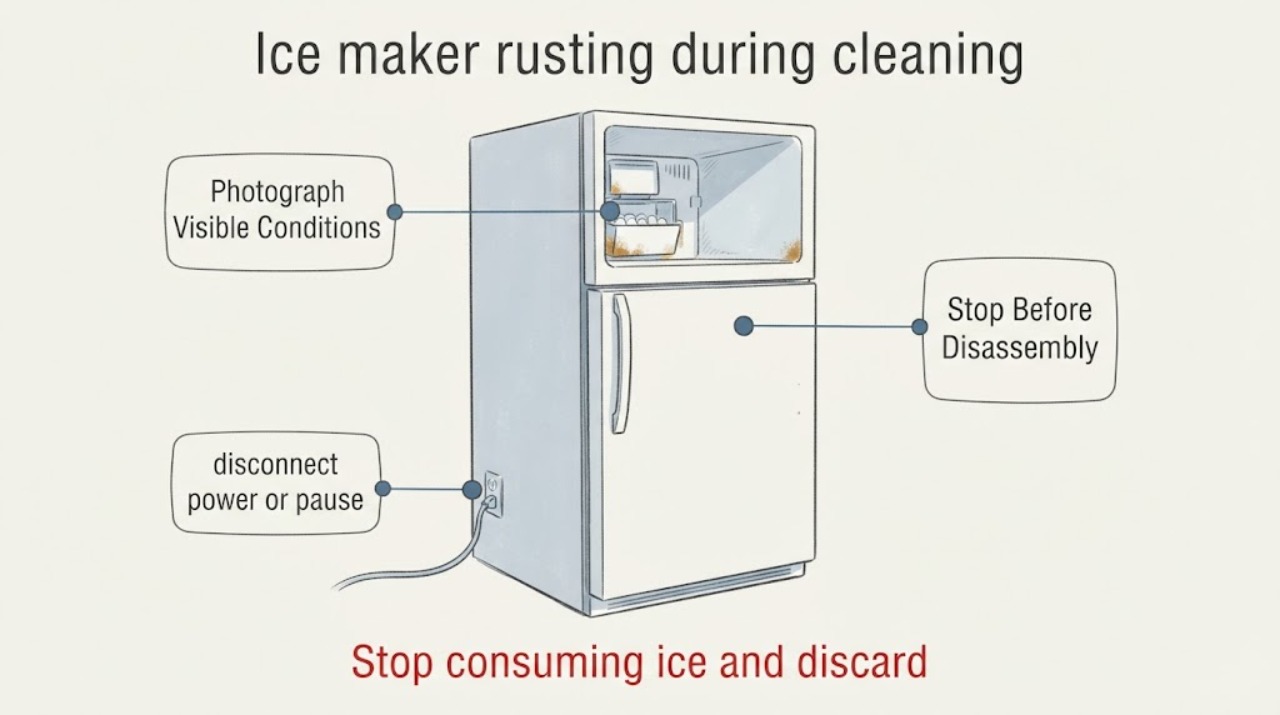
Stop using and discard any ice that touched the rust, flakes, or discolored residue. For the Maytag MFI2568AEQ, confirm the rating-label identity before using a manual for removal or parts; Maytag's opened model-family dimension guide lists MFI2568AEQ among its French-door bottom-freezer refrigerator SKUs, but it is not a suffix-specific cleaning manual. If the affected item is a removable bin or surface, disconnect power or pause the ice maker as the model instructions allow, wash it with warm water and mild dish soap using a soft cloth or non-scratch sponge, rinse, and dry completely. Do not use abrasives, harsh cleaners, bleach, or a guessed replacement part. A stain that wipes away with no pitting and no discoloration in the incoming water is a different decision from metal that is pitted, flaking, on a fixed food-contact surface, or repeatedly returning: in the latter cases leave the ice maker off and arrange model-specific service. If dispenser water and ice are both discolored, treat the water/filter/supply as unresolved and do not consume either one.
Work through in order
Diagnostic checks
Use only checks that match the exact appliance or system and its official guide.
-
Check 1
Read the refrigerator rating label and record the complete model as MFI2568AEQ, then photograph the rust-colored material before wiping it. Identify whether it is on a removable ice bin, an accessible removable part, the ice chute, or a fixed metal or coated surface.
Expected result: The label confirms MFI2568AEQ and the material is confined to a removable part, or the material is on fixed metal, under a coating, in the chute, or the label does not match.
Next step: Use the exact MFI2568AEQ documentation for any removal. If the label differs or the material is fixed, leave the ice maker unused and use the service branch rather than borrowing instructions from another Maytag platform.
Why this matters
Why: A confirmed model and removable location support only the model-directed cleaning path. A fixed, pitted, flaking, or identity-uncertain location cannot be safely assigned a replacement component from appearance alone.
-
Check 2
Stop consuming ice and discard all ice that may have contacted the rust, flakes, or unusual color; keep a photo and a small dry sample only if it can be collected without scraping or reaching into a moving mechanism.
Expected result: The material is visibly present in the ice, only on an empty removable bin, or not visible in the ice but is embedded in a fixed surface.
Next step: Keep the ice maker off while the source is identified. Do not taste-test the ice, scrape corrosion into the bin, or resume production merely because one batch looks clear.
Why this matters
Why: Visible material in the ice makes the batch unsuitable for consumption. A clean-looking batch does not prove the source is safe when a fixed surface is corroded; Maytag also notes that source-water impurities can be incorporated into ice.
-
Check 3
If the exact manual identifies the bin or other item as user-removable, disconnect power or pause the ice maker as the model instructions allow, then wash that part with warm water and mild dish soap using a soft cloth or non-scratch sponge. Rinse thoroughly and dry completely before reinstalling.
Expected result: The rust-colored material wipes away as a surface film, remains after gentle washing, or exposes pits, flaking, a damaged coating, or a crack.
Next step: For residue only, keep the part clean and dry and continue to the water-source check before making ice. For pitting, flaking, a crack, or a fixed surface, stop and arrange service; do not sand, polish, bend, coat, or replace the part by visual similarity.
Why this matters
Why: A removable film without surface damage is more consistent with residue or deposit, while material that remains or exposes pits, flakes, coating loss, or a crack is not established as a cleanable stain. Maytag's interior guidance says removable parts should be washed, rinsed, and dried, and harsh or abrasive cleaners should not be used.
-
Check 4
Without drinking or repeatedly cycling contaminated ice, visually compare a clear sample of dispenser water with the household cold-water source if the refrigerator has a dispenser; inspect the filter's age and seating only as the exact manual permits, without forcing it or opening plumbing.
Expected result: Dispenser water is also discolored or contains particles, the household source is discolored, flow is reduced after an old or incorrectly seated filter, or water is clear while only the bin has residue.
Next step: If water or the household source is discolored, stop using the refrigerator water and ice and arrange water-quality/filter or qualified appliance service. If water is clear, continue only with the cleaned removable-part result; do not install an unverified filter or part by appearance.
Why this matters
Why: Discoloration in both water and ice points toward source water, filtration, or supply contamination rather than proving an ice-bin defect. Maytag says water quality affects ice, a clogged or incorrectly installed filter can affect ice and dispenser performance, and softened-water chemicals can damage ice-maker components. Clear water with a local removable-bin film makes a local surface issue more likely, but does not prove a fixed surface is safe.
-
Check 5
Only after the removable part is clean, undamaged, fully dry, correctly reinstalled, and the water is not visibly discolored, restore operation according to the exact manual and discard the first few new batches as Maytag's cleaning guidance directs. Watch for recurrence without touching moving or powered mechanisms.
Expected result: No rust-colored material returns, residue returns on the removable part, or flakes/color recur in new ice or appear on a fixed surface.
Next step: Keep the ice maker off and arrange service for recurring material, fixed-surface corrosion, or any need to identify a bin, ice maker, coating, valve, or water-system component. Do not repeat increasingly aggressive cleaning.
Why this matters
Why: No recurrence after a gentle clean supports a local removable-surface residue explanation, not a confirmed repair. Recurrence, flakes, or new discoloration means the contamination source or a corroded food-contact surface remains unresolved.
Use your observations
Decision map
Find the observation that best matches what you see, then follow the next safe action.
-
PATH 01Next step
What you see
Rust-colored residue is limited to a removable bin or removable surface, wipes away with warm water and mild dish soap, and the water itself is visually clear with no pits, flakes, crack, or coating loss.
Do this next
Rinse and dry completely, reinstall only as the exact MFI2568AEQ manual directs, discard initial batches, and stop if the material returns.
Why this path and its safety boundary
Why it matters: A local removable-surface residue or deposit is more likely than a confirmed structural corrosion failure, but the observation does not prove every ice-contact surface is sound.
-
PATH 02Next step
What you see
Material remains after gentle cleaning, exposes pitting or flaking, damages a coating or bin, appears on a fixed ice-maker surface, or returns in new ice.
Do this next
Leave the ice maker off, discard affected ice, and arrange qualified Maytag or appliance service with the full rating-label model and photographs. Do not sand, scrape aggressively, coat, or order a part by appearance.
Why this path and its safety boundary
Why it matters: Corrosion or a damaged food-contact component remains possible; the public cleaning guidance does not identify a safe replacement part or prove compatibility.
-
PATH 03Next step
What you see
Dispenser water and ice are both discolored, particles appear in the water, the household cold-water source is affected, or the filter is old, incorrectly seated, or associated with reduced flow.
Do this next
Stop consuming refrigerator water and ice, follow only the exact model's filter instructions, and obtain water-quality or qualified appliance service before resuming use.
Why this path and its safety boundary
Why it matters: The water/filter/supply path is a competing explanation. Maytag states source-water impurities can affect ice and that filter condition can affect dispenser and ice-maker performance; this does not prove an ice-maker component is rusting.
-
PATH 04Next step
What you see
The model label is missing or differs, cleaning would require removing a fixed panel or powered mechanism, water reaches electrical parts, or there is a crack, leak, chemical exposure, smoke, or burning odor.
Do this next
Stop the ice and water functions; disconnect power only if this can be done without touching wet electrical areas, then arrange qualified service.
Why this path and its safety boundary
Why it matters: The identity or safety boundary is unresolved and further home testing could spread contamination or create an electrical or injury hazard.
Helpful context
Understand the symptom
Rust-colored material in an ice maker is a food-contact question before it is a parts question. Discard the affected ice and record where the material is located. A removable-bin film that comes away with gentle cleaning can be handled differently from pitting, peeling finish, or corrosion on a fixed ice-making surface. Maytag's refrigerator guidance recommends warm water and mild dish soap for removable parts, thorough rinsing and drying, and avoidance of abrasive, harsh, bleach, or ammonia-containing cleaners.
The exact identity matters: the opened Maytag dimension guide lists MFI2568AEQ in the MFI2568AE family of French-door bottom-freezer refrigerators. It does not establish which ice-bin, ice-maker, coating, or replacement part is fitted to every suffix. Use the rating label and the exact owner's manual before removing anything beyond a user-removable bin.
When checks do not resolve it
Need a professional?
Arrange qualified Maytag or appliance service when rust remains after gentle cleaning, exposes pitting or flaking, damages a coating or bin, appears on a fixed food-contact surface, returns in new ice, or when the model-specific part identity is uncertain. Also stop using refrigerator water and ice and seek water-quality or appliance service when dispenser water, household source water, or ice contains particles or discoloration. Stop immediately for a crack, leak near wiring, smoke, sparking, burning odor, chemical exposure, or any need to remove a fixed panel, enter diagnostics, work on plumbing, or handle a powered mechanism.
Have this ready
- The complete MFI2568AEQ rating-label identity, the location and photographs of the material, whether it wiped away without surface damage, whether water and ice were also discolored, filter age and seating observations, and whether any crack, leak, odor, or electrical symptom was present.
Common questions
FAQ
Can I keep using the ice if the rust is only on the outside of the bin?
Do not assume that from appearance alone. Discard ice that contacted the material, clean only the user-removable part as the exact manual permits, and check whether the material is pitted, flaking, recurring, or also present in water before resuming.
Should I use bleach or an abrasive pad to remove the rust?
No. Maytag's refrigerator cleaning guidance calls for mild soap, warm water, soft or non-scratch tools, thorough rinsing and drying, and avoiding abrasive, harsh, bleach, or ammonia-containing cleaners. Do not mix cleaning chemicals.
Does a new water filter prove that the ice maker itself is rusting?
No. Water quality, the household supply, filter seating and filter condition can all affect water and ice. If both dispenser water and ice are discolored, stop consuming them and resolve the water or service question before selecting an ice-maker part.
Read the exact guide
Official sources
- How to Clean an Ice Maker in 5 StepsMaytag · The opened Maytag guide covers unplugging before cleaning, consulting the owner's manual for removable ice-bin handling, warm water and mild soap cleaning, thorough drying, filter effects on ice, and discarding the first 2-3 batches after restarting.
- Dimension GuideMaytag · The opened one-page Maytag dimension guide lists MFI2568AEW, MFI2568AEB, MFI2568AEQ, and MFI2568AES together under MODEL SKUs for French Door Bottom-Freezer Refrigerators. The assigned label is written as MFI 2568AEQ in the task and as MFI2568AEQ in the guide; this establishes the assigned model family only.
- Cleaning the Interior of the Refrigerator - Product Help | MaytagMaytag Product Help · The opened Maytag page recommends mild dish soap and warm water, soft or non-scratch tools, complete rinsing and drying, pausing the ice maker or disconnecting power when the model allows, and avoiding abrasive, harsh, bleach, ammonia, and petroleum-containing cleaners.
- Does the Water Filter Need to be Replaced? - Product Help | MaytagMaytag Product Help · The opened Maytag page lists odd-tasting ice or water and flow changes associated with filter condition and explains a visual dispenser-flow comparison with and without the filter; exact MFI2568AEQ filter procedure still requires the model manual.
- Particles in Water - Cloudy Water - Refrigerator - Product Help | MaytagMaytag Product Help · The opened Maytag page explains that source-water impurities can affect ice, softened-water chemicals can damage ice-maker components, and a clogged or incorrectly installed filter can reduce water flow to the ice maker and dispenser.
Community feedback
Share a repair observation
Share a plain-text repair observation. Accepted observations are published automatically; this page may take a moment to update.