
On this page
Start here
Quick answer
On a Maytag MSD2254VEY00, slow dispenser flow immediately after a filter change should be separated into trapped air, a filter that is not seated or is restricted, and a supply-path problem. Maytag says to flush the water system after a filter change and to compare dispenser flow with the filter removed: a noticeable increase without the filter points to a clogged or incorrectly installed filter. If the filter housing or its connection is leaking steadily, stop using the water and ice functions rather than leaving the filter out or guessing at an inlet valve. Because this is a rental, do not raise building water pressure, move the refrigerator, loosen plumbing, or replace a valve yourself; document the exact model, filter, flow difference, and leak location for the landlord or qualified service provider. A few residual drops after dispensing can be normal, but a continuing leak needs prompt attention.
Before you begin
Safety first
- Do not raise building water pressure, alter a regulator or shutoff, loosen wet fittings, pull the refrigerator by its tubing, remove the filter housing, open panels, or work near wet electrical components. Do not leave a continuous leak running, and do not treat bypass operation as a permanent repair.
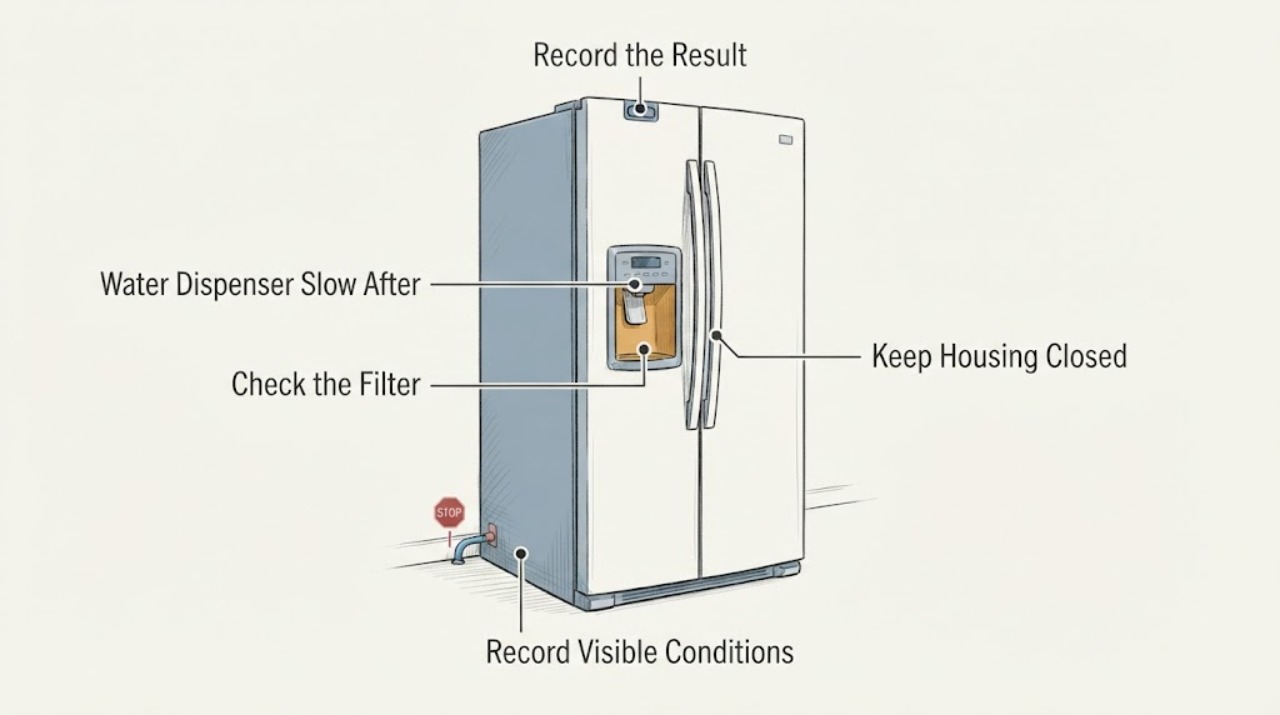
Work through in order
Diagnostic checks
Use only checks that match the exact appliance or system and its official guide.
-
Check 1
Record the sequence before changing anything else: the complete MSD2254VEY00 model, the old and new filter identity, when the filter was installed, whether the cartridge clicked or seated as the model instructions show, and whether the dispenser became slow immediately or only after several uses.
Expected result: The slowdown began immediately with the new filter, began after a delay, or the filter identity/fit cannot be confirmed.
Next step: Use Maytag's model-based documentation lookup and the exact filter instructions to confirm fit before further handling. In a rental, retain the old filter and photos for the maintenance request.
Stop if: Do not force, cross-thread, overtighten, puncture, or keep cycling an uncertain filter into the housing.
Why this matters
Why: An immediate change tied to the cartridge makes seating, compatibility, restriction, or trapped air more plausible than a coincidental refrigerator failure. An uncertain filter identity or fit cannot safely support a replacement choice.
-
Check 2
Flush the water system using a sturdy container and the Maytag procedure: hold the dispenser for five seconds, release it for five seconds, and repeat until flow is steady. Continue only for the quantity specified by the exact filter or manual; Maytag's general guidance says the required amount varies, commonly between one and four gallons.
Expected result: Flow becomes steady after air clears, the water spurts or remains slow, or a leak appears at the filter area during the flush.
Next step: If flow improves and there is no leak, discard flushed water as directed by the filter/manual and monitor. If flow remains slow or water leaks steadily, stop the dispenser and ice maker and notify the landlord or qualified service provider.
Stop if: Do not continue dispensing into a flooded area, leave an active leak unattended, or use a container that cannot be held securely.
Why this matters
Why: Improvement as air is expelled supports post-installation air as a contributor. Persistent slow flow after the model-directed flush needs a restriction or supply-path decision; a steady leak is a separate water-damage concern.
-
Check 3
If there is no active leak and the exact model instructions permit the comparison, note dispenser flow with the new filter installed, then remove the filter only as instructed and make a brief comparison. Do not leave the system in bypass as a substitute for filtered water, and stop immediately if the housing or connection leaks continuously with the filter out.
Expected result: Flow noticeably increases without the filter, stays slow both ways, or the filter area leaks with the filter installed or removed.
Next step: Reinstall or replace the filter only according to the exact model guidance when the housing is dry and sound. For a leak, stop using water/ice and provide photographs to the landlord or service provider; do not select a valve or housing from the symptom alone.
Stop if: Do not operate with a known continuous leak, loosen fittings, pull the refrigerator forward, or work near wet electrical areas.
Why this matters
Why: A clear increase without the filter supports a clogged, restricted, or incorrectly seated cartridge. Slow flow in both states points more toward household pressure, a kink, a shutoff, or another water-path restriction. A continuous filter-area leak points to a seal, head, housing, valve, or connection that needs service rather than a simple low-flow adjustment.
-
Check 4
From the accessible front or side only, look for a fully open water shutoff, a visibly kinked supply line, a recent apartment plumbing or filter change, and any water at the connection. Do not move the refrigerator or loosen a fitting to inspect behind it.
Expected result: The accessible line is kinked or wet, the shutoff is not fully open, building water service recently changed, or the line and connection are dry.
Next step: In a rental, report the observation to the landlord/property manager and ask a qualified person to assess the supply. Do not turn up pressure, alter a regulator, disconnect plumbing, or move the refrigerator yourself.
Stop if: Stop if water is spraying, a fitting is seized or actively leaking, water reaches an outlet or wiring, or locating the line requires moving the appliance.
Why this matters
Why: A kink, partly closed shutoff, or low building pressure can reduce flow independently of the filter. A dry accessible line does not rule out a concealed restriction or refrigerator-side fault.
-
Check 5
Compare the dispenser symptom with the ice maker and the rest of the apartment's cold-water supply without dismantling the refrigerator. Note whether ice is also slow or hollow, whether another faucet has weak flow, and whether an RO system or recent plumbing work serves the refrigerator.
Expected result: Only filtered dispenser flow is slow, both dispenser and ice production are affected, or other apartment fixtures also have low flow.
Next step: Give the maintenance request this comparison and ask for a supply-pressure and refrigerator water-path assessment. Do not infer a failed inlet valve, tank, or dispenser assembly without model-specific service evidence.
Stop if: Do not perform plumbing pressure adjustments or internal electrical/water-valve tests as a tenant.
Why this matters
Why: A filter-specific change favors the cartridge or filter interface. Dispenser and ice symptoms together make pressure or a shared supply path more plausible; weak flow elsewhere makes a property-side condition more likely than a dispenser-only fault.
-
Check 6
Prepare the service handoff: photograph the rating plate, filter and housing area, any drain pan or floor moisture, and the dispenser stream; write down the flush amount and result, the filter-in/filter-out comparison, and whether the leak continues when the dispenser is idle.
Expected result: The evidence shows only temporary slow flow, a repeatable filter restriction, a continuous leak, or an unresolved pattern.
Next step: Send the record to the landlord/property manager and request qualified Maytag or appliance service when the flow remains slow, the filter area leaks, or the issue returns after the exact flush and fit checks.
Stop if: Do not authorize a part replacement based only on the timing of the filter installation or a generic diagram for another model.
Why this matters
Why: A time-linked record helps separate air and filter fit from pressure, supply-line, housing, seal, or valve issues. It also prevents a provider from treating a rental plumbing condition as a confirmed refrigerator part failure.
Use your observations
Decision map
Find the observation that best matches what you see, then follow the next safe action.
-
PATH 01Next step
What you see
The flow was normal before the new filter, became slow immediately after installation, improves during the Maytag flush, and there is no continuing leak.
Do this next
Complete the exact filter's flush requirement, then monitor. If the flow falls again, repeat only the model-directed fit check and request maintenance rather than forcing the cartridge.
Why this path and its safety boundary
Why it matters: Trapped air or an installation/fit issue is more likely than a sudden unrelated dispenser failure.
-
PATH 02Next step
What you see
With the filter installed the dispenser is slow, but with the filter removed under the exact model procedure the flow noticeably increases and the housing remains dry.
Do this next
Use only the exact model-compatible filter guidance, reinstall or replace the cartridge as permitted, and flush it. Do not choose a valve or housing until the filter result is resolved.
Why this path and its safety boundary
Why it matters: The filter or its seating is restricting flow. Maytag's comparison procedure supports this interpretation, but it does not identify whether the cartridge is clogged, incompatible, damaged, or incorrectly seated.
-
PATH 03Next step
What you see
Flow remains slow with and without the filter, ice production is also affected, another fixture has weak flow, or the accessible supply line is kinked or the shutoff is not fully open.
Do this next
In the rental, report the findings to the landlord/property manager and request a qualified plumbing/appliance assessment. Do not adjust building pressure or move the refrigerator.
Why this path and its safety boundary
Why it matters: A shared supply restriction, low household/building pressure, or line condition is more likely than a filter-only fault. Maytag lists 30–120 psi as the range for most such refrigerators and 40–80 psi as typically optimal.
-
PATH 04Safety boundary
What you see
Water continues to leak from the filter area while the filter is installed or removed, the leak returns while idle, or water reaches the floor, drain pan, outlet, or wiring.
Do this next
Stop using the dispenser and ice maker, protect the floor without moving the refrigerator, and notify the landlord/property manager promptly for qualified service. If water reaches electrical components, keep clear and use the property's emergency maintenance process.
Why this path and its safety boundary
Why it matters: This is a water-damage and possible electrical-area risk, not a normal consequence to manage by leaving the filter out. A seal, filter head/housing, connection, line, or valve may require service, but the symptom does not select the part.
Safety stop: Do not loosen plumbing, remove the housing, pull the refrigerator, or keep dispensing to locate the leak.
Helpful context
Understand the symptom
The filter-change timing is useful, but it is not a diagnosis
Maytag's own troubleshooting path starts with the filter because a clogged or incorrectly installed cartridge can reduce dispenser flow. It also says that air enters the water system after a filter change and should be flushed out. That makes a newly slow dispenser worth checking at the filter first, but it does not prove that the cartridge is the only problem. A flow improvement with the filter removed is evidence of restriction at the filter or its fit; slow flow with and without the filter shifts attention toward pressure, a kink, a shutoff, or another water-path issue.
Treat a steady filter-area leak separately
A steady leak around the filter housing is not explained by the dispenser simply being slow. Maytag says to inspect the filter, head, housing, sealing surfaces, and O-ring for damage or poor seating, and to give a continuing filter-area drip quick attention. In the exact-model community report, the dispenser flowed better with the filter removed but the writer also reported a continuing leak around the filter area; the replies did not establish a verified repair. Use that pattern to give the landlord or service provider better evidence, not as proof that an inlet valve, housing, or seal is the failed part.
Rental-apartment boundary
The refrigerator's water pressure is partly a property plumbing condition. In a rental, keep the refrigerator where it is and avoid changing a shutoff, building pressure regulator, reverse-osmosis connection, or supply fitting without the landlord's approval. Send a written maintenance request with the MSD2254VEY00 model, the date and filter identity, whether flushing changed the flow, whether flow changes with the filter removed, and photographs of any water under the filter area. That lets maintenance decide whether the issue belongs to the cartridge, the refrigerator, or the apartment's water connection.
Only after diagnosis
Potential parts
- compatible refrigerator water filter cartridge
Consider this only if the filter-in/filter-out comparison shows a restriction and the cartridge is confirmed to be clogged, damaged, or incorrectly seated under the exact model instructions.
Confirm the complete MSD2254VEY00 model and the filter manufacturer's fit information; do not select a cartridge by appearance or a generic refrigerator series. - water-filter housing seal or O-ring
Consider only after qualified inspection finds a flattened, cut, missing, or otherwise damaged seal that explains a filter-area leak.
The exact housing and seal arrangement must be confirmed for MSD2254VEY00; a persistent leak may instead involve the head, housing, line, or valve.
When checks do not resolve it
Need a professional?
Request landlord/property maintenance or qualified Maytag/appliance service for a continuous filter-area leak, water in the drain pan or on the floor, water near electrical areas, persistent slow flow after the exact flush and fit checks, or an inaccessible supply restriction.
Safety scope: Do not raise building water pressure, alter a regulator or shutoff, loosen wet fittings, pull the refrigerator by its tubing, remove the filter housing, open panels, or work near wet electrical components. Do not leave a continuous leak running, and do not treat bypass operation as a permanent repair.
Have this ready
- Provide the complete model MSD2254VEY00, filter identity and installation date, photos of the filter/housing and moisture path, flush quantity and result, filter-in/filter-out flow comparison, ice-maker and other-fixture symptoms, and the rental contact/approval boundary.
Common questions
FAQ
Why did the Maytag MSD2254VEY00 dispenser become slow after installing a filter?
Maytag identifies a clogged or incorrectly installed filter as a possible cause, and trapped air after replacement can also affect dispensing until the system is flushed. Compare flow under the exact model procedure, but treat a continuous filter-area leak as a separate service issue.
How long should I flush the refrigerator after changing the filter?
Maytag's general guidance uses five seconds dispensing followed by five seconds released, repeated until flow is steady, and says the required total varies by filter, commonly one to four gallons. Use the exact filter or manual's amount for this MSD2254VEY00 rather than treating one generic volume as universal.
Is a little water after using the dispenser normal?
Maytag says one or two residual drops immediately after dispensing can be normal and recommends holding the container under the outlet briefly. A steady drip, water at the filter housing, or water that returns while idle needs prompt attention.
Should a renter increase the water pressure or replace the inlet valve?
Not based on slow flow alone. Maytag lists pressure, shutoff, line, filter, and other water-path causes, and a filter-flow comparison does not identify a valve by itself. In a rental, report the evidence to the landlord and do not change plumbing, move the refrigerator, or replace a part without qualified approval.
Read the exact guide
Official sources
- Maytag refrigerator water dispenser is slow after water filter install.Reddit r/appliancerepair · Opened the exact Reddit post named in research results. It identifies Maytag MSD2254VEY00 and the rental/filter-change sequence, but community replies do not establish a verified repair or part diagnosis.
- Appliance Manuals and LiteratureMaytag · Opened Maytag's manual portal to support retrieving the exact MSD2254VEY00 documentation instead of copying a procedure from a related refrigerator.
- What to Do if the Water Filter is Damaged or Dripping - Product HelpMaytag · Opened Maytag's official leak guidance to distinguish a steady filter-area leak from temporary dispenser drops and to support visual seal/housing checks; it does not identify a failed part for MSD2254VEY00 without inspection.
- Does the Water Filter Need to be Replaced? - Product HelpMaytag · Opened Maytag's official filter troubleshooting page for refrigerators with dispensers; it supports the filter-in/filter-out comparison and the filter-change flow branch but is not a complete MSD2254VEY00 service manual.
- everydrop Water Filter Questions - Product HelpMaytag · Opened Maytag's official filter FAQ to corroborate flushing after replacement and model/filter fit lookup; it is not an exact MSD2254VEY00 manual.
- How to Flush the Water System in a Refrigerator - Product HelpMaytag · Opened Maytag's official flushing guidance to support post-filter air removal, variable flush volumes, and the normal-versus-continuing drip distinction; exact model instructions take precedence.
- Ensuring Correct Water Pressure - Product HelpMaytag · Opened Maytag's official pressure guidance for the shared-supply branch; it gives a brand-level range and requires model-specific installation instructions for final recommendations.
Community feedback
Share a repair observation
Share a plain-text repair observation. Accepted observations are published automatically; this page may take a moment to update.