
On this page
Start here
Quick answer
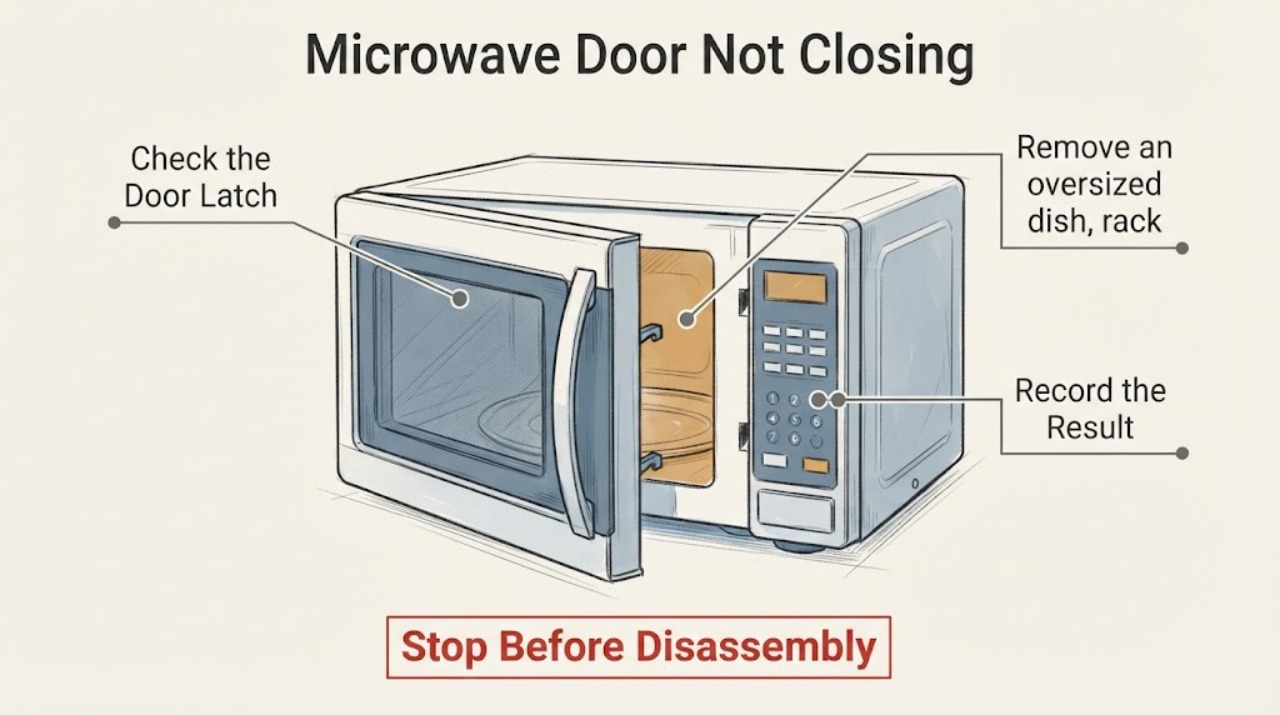
If a microwave door will not close, stop using it until it closes firmly and latches without force. Remove only an obvious dish, rack, packing piece, or residue blocking the latch/contact area; a bent door, damaged hinge/latch/seal, or persistent misalignment needs manufacturer service. FDA warns against operating a microwave whose door is not firm or is damaged.
Work through in order
Diagnostic checks
Use only checks that match the exact appliance or system and its official guide.
-
Check 1
Inspect door, hinge, latch, seal, and cavity edge without forcing or bending anything.
Expected result: The door is bent, hinge/latch/seal is loose or damaged, or closure is not firm.
Next step: Do not operate; contact manufacturer or qualified microwave service.
Stop if: Stop if there is a safety hazard or internal access would be required.
Why this matters
Why: FDA treats this as a radiation-safety concern.
-
Check 2
Remove an oversized dish, rack, packing material, or visible residue; wipe/dry only the contact area.
Expected result: The obstruction clears and door closes, or it still binds.
Next step: If it still binds, stop and arrange service.
Stop if: Stop if there is a safety hazard or internal access would be required.
Why this matters
Why: These are Whirlpool’s external closure checks; persistent binding leaves alignment/interlock trouble.
-
Check 3
With oven unused, confirm it sits level and door closes with normal pressure and latch engagement; do not run it if questionable.
Expected result: Closure is normal or requires lifting/slamming.
Next step: Do not operate until repaired if inconsistent.
Stop if: Stop if there is a safety hazard or internal access would be required.
Why this matters
Why: Normal closure may resolve setup; inconsistent engagement is a safety boundary.
-
Check 4
Record any door/open display message and model; never bypass the interlock.
Expected result: Message clears after opening/closing or returns with no obstruction.
Next step: Leave unused and provide model/message to service.
Stop if: Stop if there is a safety hazard or internal access would be required.
Why this matters
Why: A recurring indication may be interlock/control failure.
Use your observations
Decision map
Find the observation that best matches what you see, then follow the next safe action.
-
PATH 01Next step
What you see
Dish, rack, packing piece, or residue blocks latch
Do this next
Remove/clean it and verify firm closure once.
Why this path and its safety boundary
Why it matters: External obstruction is likely.
-
PATH 02Next step
What you see
Door/hinge/latch/seal is damaged
Do this next
Do not operate; obtain qualified service.
Why this path and its safety boundary
Why it matters: Radiation-safety condition may be compromised.
-
PATH 03Next step
What you see
Door appears normal but warning returns
Do this next
Do not bypass; arrange service.
Why this path and its safety boundary
Why it matters: Interlock/control fault remains possible.
Helpful context
Understand the symptom
How to read the result
If a microwave door will not close, stop using it until it closes firmly and latches without force. Remove only an obvious dish, rack, packing piece, or residue blocking the latch/contact area; a bent door, damaged hinge/latch/seal, or persistent misalignment needs manufacturer service. FDA warns against operating a microwave whose door is not firm or is damaged.
When checks do not resolve it
Need a professional?
Do not use a microwave with a door that does not close firmly or has hinge, latch, seal, bend, or interlock damage. Arrange qualified service.
Common questions
FAQ
Can I run it if the door nearly closes?
No. FDA requires firm closure and no damage.
Can I adjust a bent hinge myself?
No. Use manufacturer or qualified service.
Read the exact guide
Official sources
- Microwave OvensU.S. Food and Drug Administration · microwave door safety
- "Door" Or "Open/Close" - Error Code - Countertop MicrowaveWhirlpool · microwave door obstruction
Community feedback
Share a repair observation
Share a plain-text repair observation. Accepted observations are published automatically; this page may take a moment to update.