
On this page
Start here
Quick answer
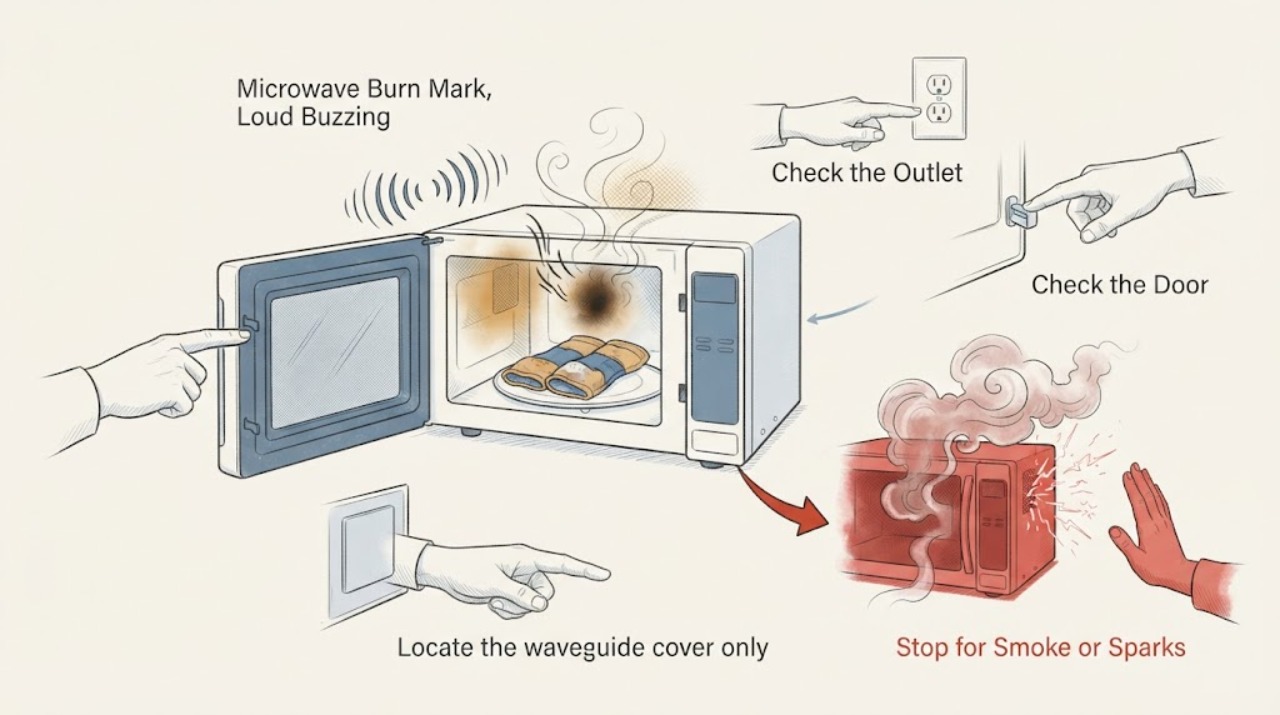
Stop using the Panasonic microwave after a burn mark, loud buzzing, or burning smell, and do not run the salt-filled knee warmer again as a test. Panasonic says it does not recommend heating non-food therapeutic bags because overheating can make them smoke or catch fire; its microwave support guidance says to unplug the oven when there is smoke, fire, or a burning smell. After the oven is fully cool and unplugged, remove the warmer and clean only accessible food or residue from the cavity, glass tray, and roller ring. Do not operate the oven if the waveguide cover is missing or damaged, if the cavity or door is visibly damaged, or if abnormal noise or smell remains. Do not remove the outer cover or try to diagnose the magnetron, inverter, or other high-voltage parts.
Work through in order
Diagnostic checks
Use only checks that match the exact appliance or system and its official guide.
-
Check 1
Stop the microwave and remove the salt-filled knee warmer from service. If the oven is still smoking, smells strongly of burning, or has an active fire, stop operation and unplug it only if the plug and outlet can be reached safely; do not restart it to reproduce the noise.
Expected result: The smoke or smell stops after power is removed, or smoke, heat, sparking, or an active fire continues.
Next step: Keep the oven unplugged and arrange Panasonic or qualified microwave service. If there is an active fire or the plug/outlet is hot or damaged, leave the area and use the site's emergency procedure rather than touching the appliance.
Why this matters
Why: Panasonic directs owners to unplug when a microwave has fire, smoke, or a burning smell and does not recommend therapeutic heating bags because overheating can cause smoke or fire. Continued symptoms mean the event cannot be treated as a one-time food odor.
-
Check 2
After the oven is fully cool and disconnected from power, remove the warmer, glass tray, and roller ring. Inspect the accessible cavity, door area, tray, and ring for loose salt, fabric, food particles, oil, liquid, soot, or a mark that is raised, cracked, blistered, or through the surface.
Expected result: Only removable residue is present, or the mark involves the cavity coating, door/seal area, or an interior cover.
Next step: Clean only loose, accessible residue with a soft damp cloth and the model's approved mild cleaner. If the surface is damaged, the door/seal area has a burn mark, or the waveguide cover is affected, leave the oven unplugged for model-specific service.
Why this matters
Why: Panasonic lists food particles and oil spills as possible sources of burning odor and says the cavity, glass tray, underside, and roller ring should be cleaned. A damaged interior surface or cover is outside ordinary residue cleaning and cannot be identified safely from a photograph alone.
-
Check 3
Locate the waveguide cover only as shown in the exact Panasonic operating manual; do not remove, scrape, cut, repaint, or substitute it. Check visually, with power disconnected, whether it is present, intact, and free of a burn-through or loose edge.
Expected result: The cover is missing, visibly damaged, loose, or the model manual does not make the part and inspection point clear.
Next step: Do not operate the microwave. Provide the full model number and a description or photograph of the mark to Panasonic support or an authorized technician; do not order a generic cover or open the outer cabinet.
Why this matters
Why: Panasonic says the waveguide cover protects internal electronic components and strongly recommends not operating without it because continued use can cause a short, corrosion, safety hazard, or further damage.
-
Check 4
Check the door, latch, seal, and accessible power plug without energizing the oven. Look for a door that no longer closes squarely, a damaged seal, abnormal heat at the plug, or evidence that the outlet or cord was affected.
Expected result: The door or seal is damaged, the plug is abnormally hot, the oven gives abnormal smells or sounds, or the accessible exterior appears normal after the event.
Next step: If any abnormal condition is present, keep the oven disconnected and arrange service. Even if the door and plug look normal, do not resume microwave operation after a burn mark and loud buzzing until the model-specific safety assessment is complete.
Why this matters
Why: Panasonic lists abnormal smells or sounds, worn or improperly closing latches, an abnormally hot AC plug, and electrical shock as reasons to stop using a microwave immediately. A normal-looking exterior does not clear an oven that already produced buzzing and a burning smell.
-
Check 5
Record the full Panasonic model number, the knee warmer's material and care instructions, the selected power/time, whether the warmer was damaged, and the exact location of the mark. Send those details to Panasonic support or a qualified appliance technician instead of testing another bag or a cup of water in the oven.
Expected result: The model and warmer instructions are available, or the model and damage scope remain unknown.
Next step: Use the model information to obtain the correct service path and replacement guidance. Keep the microwave out of use while the mark, abnormal noise, or odor remains unexplained.
Why this matters
Why: Panasonic says to follow the specific operating manual and the heating-bag manufacturer's instructions, but the supplied event has already exceeded a safe test condition. A loud buzz and burn smell do not prove a magnetron, inverter, waveguide, or cavity failure without service inspection.
Use your observations
Decision map
Find the observation that best matches what you see, then follow the next safe action.
-
PATH 01Next step
What you see
Smoke, burning smell, sparking, or loud buzzing is present during or after the event.
Do this next
Stop operation, unplug only if safe, keep the oven out of service, and arrange qualified Panasonic microwave service. Do not run another test load.
Why this path and its safety boundary
Why it matters: Panasonic treats smoke/fire/burning smell and abnormal smells or sounds as stop-use conditions; the symptom does not establish a safe component-level diagnosis.
-
PATH 02Next step
What you see
The knee warmer is scorched or smoking, while the oven has only removable residue and no visible damage to the cavity, door, or waveguide cover.
Do this next
Dispose of or handle the warmer according to its own manufacturer's safety instructions, clean only accessible residue after unplugging, and obtain Panasonic guidance before any future microwave use.
Why this path and its safety boundary
Why it matters: The bag itself may have overheated, but Panasonic still does not recommend non-food therapeutic bags and the prior abnormal event has not been cleared as safe for this oven.
-
PATH 03Next step
What you see
The waveguide cover is missing, cracked, burned through, loose, or the burn mark is on a cavity or door/seal surface rather than loose residue.
Do this next
Leave the microwave unplugged and contact Panasonic support or an authorized technician. Do not scrape, paint, cut, tape, or substitute a generic cover.
Why this path and its safety boundary
Why it matters: Panasonic says not to operate without the waveguide cover and requires model-specific operating information for that part; the mark may involve a safety-critical surface.
-
PATH 04Next step
What you see
The oven remains clean but still has an abnormal odor or sound, the plug becomes hot, the door does not close correctly, or the same symptom returns.
Do this next
Keep power disconnected and provide the model number and event details to Panasonic service. Do not remove the outer panel or attempt high-voltage testing.
Why this path and its safety boundary
Why it matters: Panasonic says these conditions warrant immediate stop-use and service; cleaning did not resolve the safety issue.
Helpful context
Understand the symptom
Treat the event as a safety stop, not a normal microwave noise
The assigned event combines a non-food therapeutic bag, a burn mark, loud buzzing, and a burning smell. Panasonic does not recommend heating therapeutic bags because overheating can produce smoke or fire. The symptom combination does not identify one failed internal part, so the useful first decision is whether the oven can be safely taken out of service and inspected while unplugged.
A visible mark needs a model-matched safety decision
A mark may be residue from the overheated warmer or food, or it may involve a cavity surface or waveguide cover. Panasonic says the waveguide cover protects internal electronic components and that the oven should not be used without it. Because no exact Panasonic model was supplied, do not assume that a mark can be sanded, painted, cut, or covered with a generic sheet.
When checks do not resolve it
Need a professional?
Request Panasonic or qualified microwave service after this event because the oven produced a burn mark, loud buzzing, and burning smell while heating a non-food therapeutic bag. Service is especially necessary if the waveguide cover, cavity, door, seal, plug, or outlet appears damaged, or if odor/noise remains after safe cleaning.
Common questions
FAQ
Can I keep using this Panasonic microwave if the burn mark is small?
Not after the oven also made a loud buzzing sound and produced a burning smell. Panasonic says to stop and unplug for smoke, fire, or burning smell, and to stop using the oven when abnormal smells or sounds or other safety concerns remain. Have the exact model assessed before reuse.
Does the burn mark prove that the magnetron or inverter failed?
No. A mark may be residue, damage to an interior cover or surface, or another fault. Panasonic's guidance does not support identifying a magnetron, inverter, or other internal component from the visible mark and noise alone.
Does Panasonic recommend microwaving a salt-filled knee warmer?
Panasonic North America does not recommend placing non-food therapeutic heating bags in its microwaves because overheating can cause smoke or fire. Follow the warmer manufacturer's instructions for any approved heating method and do not use this damaged bag as a further microwave test.
Read the exact guide
Official sources
- Troubleshooting - Physical problem with your Microwave Door, Cavity, Cabinet, Tray (Turntable) or other physical piecesPanasonic North America · Used for the visible burn-mark decision only: identify the waveguide-cover boundary without prescribing removal, replacement, or a generic repair. The page does not establish that every Panasonic model has the same cover location.
- Is it okay to use therapeutic heating bags that are used for muscular pain relief in my microwave oven?Panasonic North America · Directly applicable to the assigned Panasonic microwave condition because the task identifies a non-food therapeutic knee warmer filled with salt. The page does not define a model-specific repair or prove the cause of the burn mark.
- Troubleshooting Questions for Safe Usage and Operation of Microwave OvensPanasonic North America · Panasonic consumer microwave safety guidance used for the assigned event's stop-use, accessible-cleaning, and service boundaries. It is intentionally not used to diagnose a particular internal component or model-specific cavity part.
Community feedback
Share a repair observation
Share a plain-text repair observation. Accepted observations are published automatically; this page may take a moment to update.