
On this page
Start here
Quick answer
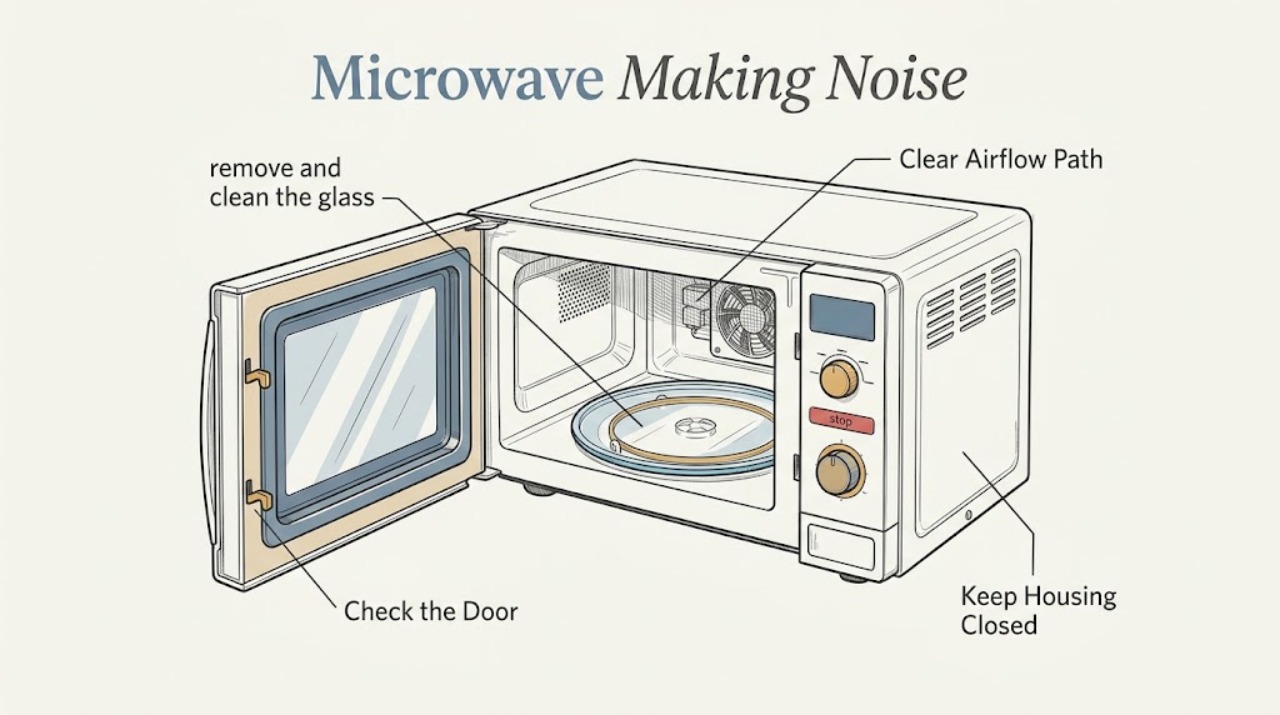
Some Panasonic microwave sounds come from the turntable, roller ring, cooling fan, or normal airflow. Clean and reseat the tray and roller ring, keep food and cookware from touching the cavity, and identify whether the sound is a brief operating sound or a loud buzz. Stop using the oven for a persistent loud buzz, arcing, smoke, or a fan that fails to run.
Work through in order
Diagnostic checks
Use only checks that match the exact appliance or system and its official guide.
-
Check 1
With the oven unplugged, remove and clean the glass tray, roller ring, and cavity floor; reinstall the ring and tray in their correct positions.
Expected result: The noise disappears or changes with tray movement, or it remains when the tray path is clean.
Next step: Use lighter, evenly distributed cookware and keep it clear of the walls; arrange service if tray noise persists.
Why this matters
Why: Panasonic links tray noise to excess weight, incorrect seating, contact with the cavity, or a dirty roller path.
-
Check 2
Run a short test only with the door closed and a microwave-safe water load, listening for whether the noise is tied to the turntable, fan airflow, or the heating interval.
Expected result: The sound occurs only as the tray rotates, only after heating, or as a persistent loud buzz.
Next step: Stop use for a persistent loud buzz and arrange service; do not run the oven empty.
Why this matters
Why: Tray or fan timing narrows the source; Panasonic specifically treats loud buzzing that remains on another direct outlet as an operating problem.
-
Check 3
Inspect the cavity and door area from outside for metal trim contact, burnt residue, arc marks, a damaged waveguide cover, or food touching the wall.
Expected result: A contact or residue is visible, or the cavity is intact but the noise continues.
Next step: Remove only a loose, accessible food or cookware obstruction; stop and arrange service for arc marks or waveguide damage.
Why this matters
Why: Panasonic says metal contact, residue, or a damaged waveguide area can create arcing and a safety hazard.
-
Check 4
Note whether the cooling fan runs after a long or repeated cooking session and whether it stops as the appliance cools; never reach through the door or open the housing.
Expected result: The fan runs briefly after cooking, does not run, or runs continuously when the oven is idle.
Next step: Stop use and contact Panasonic service for a missing or abnormal fan response.
Why this matters
Why: Panasonic says a cooling fan may continue briefly after cooking, while a fan that does not operate or runs when not in use indicates an operating problem.
Use your observations
Decision map
Find the observation that best matches what you see, then follow the next safe action.
-
PATH 01Next step
What you see
Noise follows the rotating tray and disappears after cleaning or reseating it
Do this next
Keep the ring and tray clean and correctly seated; do not operate without a rotating glass tray.
-
PATH 02Next step
What you see
A loud buzz persists on a direct dedicated outlet
Do this next
Stop use and arrange Panasonic service rather than opening the cabinet.
-
PATH 03Next step
What you see
The noise accompanies arcing, smoke, a damaged waveguide cover, or a fan that does not run
Do this next
Unplug the oven and obtain authorized service.
Helpful context
Understand the symptom
Identify the sound before blaming a part
A scraping sound that follows tray rotation is a different path from a loud electrical buzz or a fan that does not run. Listen only from outside the closed oven and stop for arcing or smoke.
When checks do not resolve it
Need a professional?
Contact Panasonic service for persistent loud buzzing, arcing, smoke, a damaged waveguide cover or cavity, a fan that does not run, or noise that remains after a clean tray-path check.
Common questions
FAQ
Why is my Panasonic microwave making a scraping sound?
Unplug it and clean and reseat the glass tray and roller ring. Check that cookware and food do not touch the cavity walls. Persistent tray noise needs service.
Is a humming fan after cooking normal?
Panasonic says a cooling fan may continue briefly after extended or repeated cooking. A fan that does not run, runs while idle, or accompanies a loud buzz needs service.
Read the exact guide
Official sources
- Panasonic - Troubleshooting - Microwave power, fan or motor problems.Panasonic · Panasonic microwave noise, fan, and motor symptoms
- Panasonic - Troubleshooting - Physical problem with your Microwave Door, Cavity, Cabinet, Tray (Turntable) or other physical pieces.Panasonic · Panasonic microwave physical and turntable noise symptoms
Community feedback
Share a repair observation
Share a plain-text repair observation. Accepted observations are published automatically; this page may take a moment to update.