
On this page
Start here
Quick answer
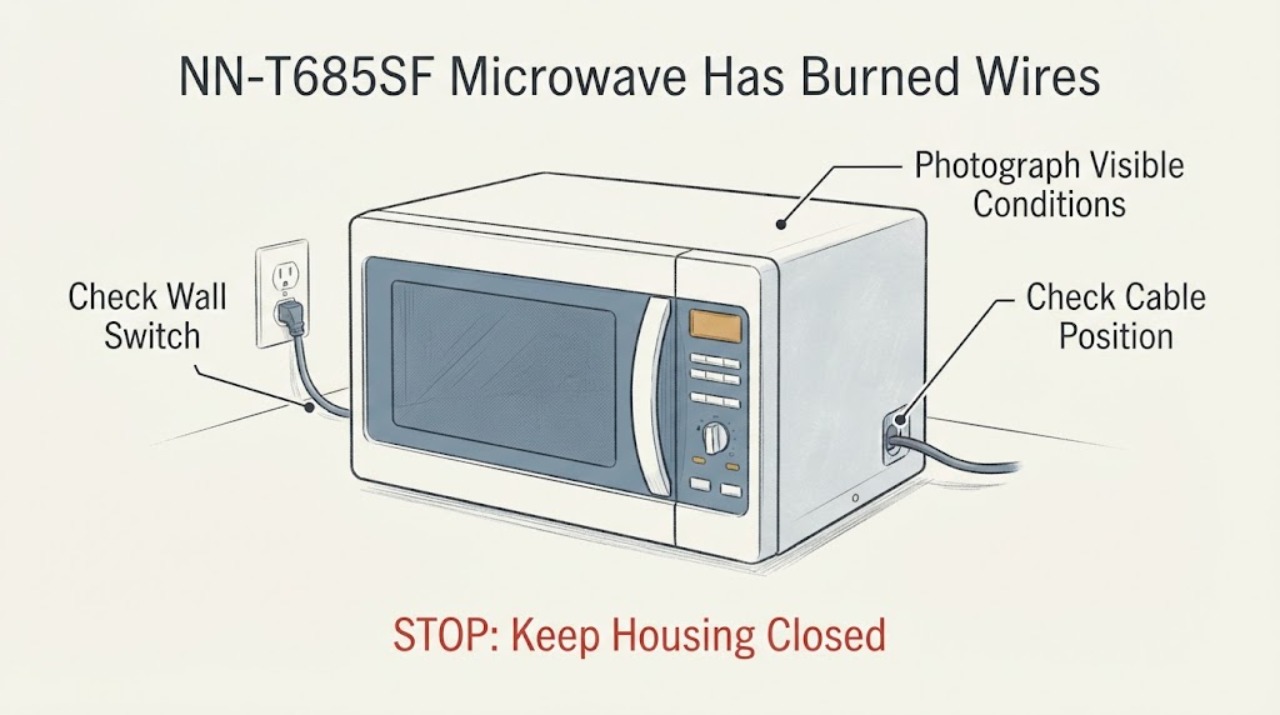
Do not use a Panasonic NN-T685SF microwave after seeing burned wires, a burning smell, smoke, abnormal heat, or a hot plug. If it is safe to reach, unplug it; if there is active smoke or fire, keep the door closed and cut power from a safe location. Panasonic's NN-T685S operating instructions say not to remove the outer panel and to have repairs performed only by qualified service personnel. The opened Panasonic safety page likewise says to unplug an oven with a burning smell, smoke, or fire and obtain service. Do not open the cabinet, reconnect a burned wire, run a heating test, discharge a capacitor, or guess that a magnetron, transformer, diode, or fuse is the cause.
Work through in order
Diagnostic checks
Use only checks that match the exact appliance or system and its official guide.
-
Check 1
Stop using the microwave immediately. If there is no active flame and the cord or plug can be reached without touching heat, smoke, or damaged material, unplug it; otherwise switch off the circuit from a safe location. Keep the door closed if material inside the cavity is burning.
Expected result: There is active smoke or flame, only a lingering odor remains, the plug or cord is hot/damaged, or the appliance is quiet and disconnected.
Next step: For active fire or smoke, leave the area and use local emergency procedures; do not reopen the door to inspect. For a disconnected unit with no active fire, leave it out of service and arrange qualified Panasonic or appliance service.
Why this matters
Why: Panasonic directs the user to unplug an oven with a burning smell, smoke, or fire, and its NN-T685S manual directs the user to keep the door closed and disconnect power if material inside ignites. A hot plug, damaged cord, or repeated breaker trip is an electrical stop-use condition.
-
Check 2
After the unit is safely de-energized and cool, make only an accessible visual record: photograph the model/serial label, the outside of the appliance, and any visible cavity scorch, food residue, or spill without removing covers or touching wiring.
Expected result: The damage is only food residue in the cavity, a door/cord/plug is damaged, burned wiring is visible behind a cover, or no damage can be seen from safe access.
Next step: If the issue is limited to accessible residue and there was no electrical smell or burned wiring, tell service exactly what was observed before any future use. If wiring, insulation, the plug, door, or cabinet is burned or damaged, do not clean inside covers or attempt a test run; provide the photos to service.
Why this matters
Why: Panasonic's support page allows checking food particles and spills when addressing a burning smell, but the NN-T685S manual says damaged ovens and wiring-related repairs require qualified service. A clean cavity does not clear an appliance with reported burned wires.
-
Check 3
Do not remove the outer panel, reconnect or cut a burned wire, bridge a fuse, test a capacitor or transformer, or run the microwave empty or with a cup merely to reproduce the smell. Do not tamper with the door interlocks or sealing surfaces.
Expected result: A repair guide, person, or online comment suggests replacing a wire, fuse, magnetron, diode, transformer, capacitor, or waveguide cover without a qualified inspection.
Next step: Decline the improvised test or component swap and arrange qualified service. Keep the unit disconnected until it has been inspected and repaired or safely retired.
Why this matters
Why: The opened Panasonic manual expressly prohibits outer-panel removal and directs repair to qualified personnel; it also warns against tampering with door safety components. A visible burned wire does not identify the high-voltage or microwave-safety failure.
-
Check 4
When contacting service, provide the exact label text NN-T685SF, serial number, purchase region, the time and operating mode when the burning occurred, whether the oven was heating, whether the breaker tripped, and whether there was smoke, flame, abnormal sound, or a hot plug.
Expected result: The suffix and serial are readable, the label is missing or inconsistent, or the reported symptom includes smoke/fire or only an odor.
Next step: Send the label and evidence to an authorized Panasonic service channel or qualified microwave technician. If the model cannot be confirmed, do not substitute a different NN-T685 manual for repair instructions.
Why this matters
Why: The public manual cover identifies NN-T685S while the task carries an NN-T685SF suffix, so service must confirm the exact regional variant before selecting documentation or parts. Symptom timing and safety signs determine the urgency, not a guessed wire function.
Use your observations
Decision map
Find the observation that best matches what you see, then follow the next safe action.
-
PATH 01Next step
What you see
There is active smoke or flame, or the microwave is still energized with a burning smell.
Do this next
Keep the door closed, cut power only from a safe location, leave the area if needed, and use local emergency procedures. Do not reopen or restart the oven to obtain more evidence.
Why this path and its safety boundary
Why it matters: This is an immediate fire/electrical safety event, not a troubleshooting opportunity.
-
PATH 02Next step
What you see
The oven is disconnected, there is no active fire, and the only accessible finding is food or a spill in the cavity with no reported electrical odor or burned wiring.
Do this next
Tell qualified service exactly what was found and wait for a safety decision before operating the unit. Do not use a heating cycle as a cleaning or confirmation test.
Why this path and its safety boundary
Why it matters: Panasonic lists food particles and spills as possible contributors to odor, but that observation does not clear a microwave that was reported to have burned wires.
-
PATH 03Next step
What you see
Burned wiring, melted insulation, a hot/damaged plug or cord, abnormal sound, or a repeated breaker trip is visible or reported.
Do this next
Keep it disconnected and arrange qualified microwave service. Do not open the outer panel or replace a component based on the visible wire alone.
Why this path and its safety boundary
Why it matters: The appliance has an electrical damage indicator that Panasonic's manual places outside user adjustment or repair.
-
PATH 04Next step
What you see
The oven appears normal from outside but the reported burned-wire event cannot be verified or the NN-T685SF suffix does not match the available NN-T685S documentation.
Do this next
Leave the appliance out of service until a qualified technician verifies the exact model and condition. Do not substitute another model's service procedure.
Why this path and its safety boundary
Why it matters: The exact damage and regional model scope remain unresolved; absence of a visible mark does not prove the microwave is safe.
Helpful context
Understand the symptom
Burned wiring is a stop-use condition
Burned wires indicate heat or electrical damage, but the visible wire is not enough to identify the failed circuit. The exact public Panasonic manual opened for the NN-T685S family says not to operate a damaged or malfunctioning oven and directs adjustment and repair to qualified service personnel. Its safety instructions also say not to remove the outer panel. Treat the assigned NN-T685SF suffix as a service-identification detail, not as permission to inspect the high-voltage compartment.
Separate cavity residue from internal wire damage without testing the oven
Panasonic's support guidance distinguishes a burning smell or smoke from ordinary food residue: it advises stopping use, then checking the cavity and door area for food particles or spills only as an external/accessible observation. That check does not make it safe to reheat food to see whether the odor returns, and it does not authorize opening the cabinet to inspect wires. With a reported burned wire, a technician must determine whether the visible damage is accompanied by other electrical or microwave-safety faults.
Provide the model and evidence to qualified service
The Panasonic manual identifies the NN-T685S family and records a model and serial number on the appliance; the assigned task uses NN-T685SF. Photograph the label and the burned area only from a safe, de-energized exterior or accessible cavity position, record when the smell or smoke occurred, and tell service whether the oven stopped heating, tripped a breaker, or had a hot plug. Do not send a technician a proposed part diagnosis based on the wire color or location.
When checks do not resolve it
Need a professional?
Call qualified Panasonic or microwave service immediately for burned wires, smoke, fire, burning smell, hot or damaged cord/plug, abnormal sound, a repeated breaker trip, door/interlock damage, or any unresolved electrical damage. Keep the unit disconnected and do not open the cabinet.
Common questions
FAQ
Can I replace the burned wire myself if I know where it goes?
No. Panasonic's NN-T685S instructions prohibit outer-panel removal and direct repairs to qualified service personnel. A burned wire can indicate damage elsewhere, and a microwave can retain hazardous energy after it is unplugged.
Should I run the Panasonic microwave once to see whether it still heats?
No. After burned wiring, smoke, fire, or a burning smell, leave the oven disconnected. Reproducing the event can increase fire, shock, and microwave-safety risk and does not identify the failed component.
What if I only smell burning but cannot see a burned wire?
Stop use and unplug the oven if safe to do so. Panasonic advises service when a burning smell persists after the accessible cavity and door area are clean; do not remove the outer panel to search for the source.
Does the NN-T685S manual prove it applies to NN-T685SF?
The opened manual cover identifies NN-T685S, while the assigned topic carries the NN-T685SF suffix. Treat the documents as a safety-family reference only and have service confirm the exact suffix and region before selecting parts or procedures.
Read the exact guide
Official sources
- Operating Instructions - Microwave Oven Model NN-T685SPanasonic Canada Inc. · Opened Panasonic Canada manual for the NN-T685S family. It supports the stop-use, no-outer-panel, qualified-service, door-interlock, and fire-safety boundaries; it is not used to infer a burned-wire component diagnosis for the NN-T685SF suffix.
- Troubleshooting Questions for Safe Usage and Operation of Microwave OvensPanasonic North America · Panasonic North America safety page used for the immediate response to burning smell, smoke, fire, hot plug, and unresolved odor; it directs users to the model manual and service rather than internal diagnosis.
- Panasonic ManualsPanasonic North America · Official lookup path used to confirm the exact NN-T685SF regional documentation before any model-specific service or parts decision.
Community feedback
Share a repair observation
Share a plain-text repair observation. Accepted observations are published automatically; this page may take a moment to update.