
On this page
Start here
Quick answer
A burning smell together with an unusual high-pitched sound during defrosting is a stop-use symptom, even when the food is the only item being heated. Panasonic says to unplug a microwave when there is a burning smell, smoke or fire; after it is disconnected and cool, you may inspect and clean only visible food residue, spills, the glass tray and roller ring. Do not open the cabinet, touch the door interlock, run another test with bananas, or diagnose the magnetron or high-voltage parts. If the smell or abnormal sound returns, or the oven is clean but the symptom persists, arrange qualified Panasonic microwave service.
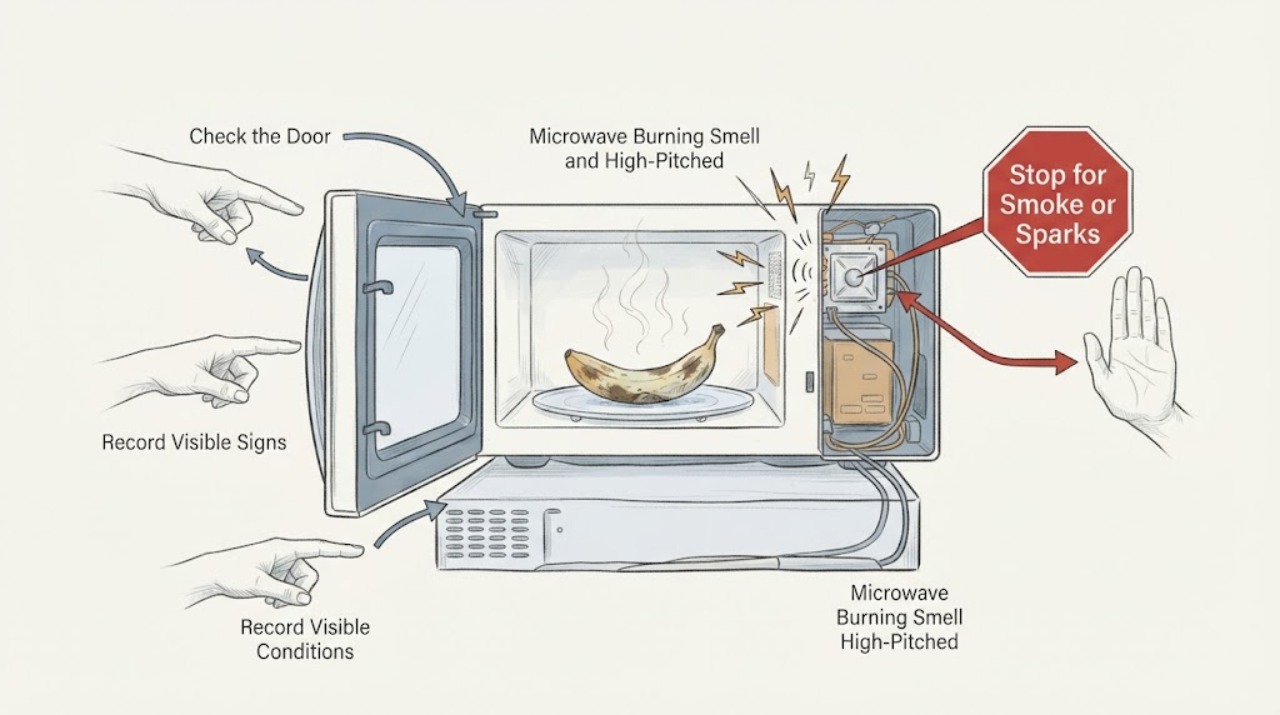
Work through in order
Diagnostic checks
Use only checks that match the exact appliance or system and its official guide.
-
Check 1
Stop the microwave immediately, unplug it or isolate its circuit only if that can be done safely, and leave the door closed while the cavity cools. Do not restart it to see whether the high-pitched sound comes back.
Expected result: There was only an odor, or there was smoke, flame, sparking, a hot plug, a damaged cord, a door problem or another abnormal electrical sign.
Next step: Keep the microwave disconnected. Smoke, flame, sparking, a hot plug or damaged cord requires emergency or qualified service attention; do not continue to the cleaning checks until the appliance is safe.
Why this matters
Why: Panasonic directs owners to unplug the oven for burning smell, smoke or fire and recommends immediate stop-use when abnormal smells or sounds, electrical shock, hot plugs or worn latches are present.
-
Check 2
After the unplugged microwave is cool, inspect the cavity, door area, glass tray, underside of the tray and roller ring for visible food particles, liquid or oil spills and loose burnt residue. Remove only accessible residue using Panasonic's mild, non-abrasive cleaning method; do not remove panels or reach behind the waveguide cover.
Expected result: Burnt food, liquid or oil is visible, the tray or roller ring is dirty or damaged, or the cavity is clean with no visible explanation.
Next step: Clean only visible, user-accessible surfaces and let them dry. If the tray or roller ring is damaged, use the exact model manual or authorized parts path; do not substitute an unknown tray or run the oven without the specified tray.
Why this matters
Why: Panasonic says food particles and spills can create burning odors and directs cleaning the cavity, tray and roller ring. A clean cavity does not rule out an internal electrical or high-voltage problem.
-
Check 3
Record the exact model number, the selected defrost mode and weight/time, whether the banana was covered or in a microwave-safe dish, when the sound began, and whether the smell remained after cooling. Do not repeat the banana test or run the oven empty to isolate the sound.
Expected result: The model and settings are available, the food was directly on the tray or in an unknown container, or the sequence cannot be reconstructed.
Next step: Provide the model and event sequence to Panasonic or qualified microwave service. Do not infer a component or choose a part from the sound description.
Why this matters
Why: Panasonic says defrost charts and controls are model-specific and that food can heat unevenly during defrosting. The record helps service distinguish an application issue from an appliance fault, but it cannot make an abnormal odor safe to reproduce.
-
Check 4
If there was no smoke or visible damage and the cavity is clean, compare the report only against the exact operating manual's defrost instructions; do not make another heating run. Panasonic's general defrost guidance says to use a microwave-safe dish, minimum time/power, turn or rearrange food and allow standing time, but the correct chart varies by model.
Expected result: The original run used an unverified setting or container, or it followed the exact manual and still produced the smell and high-pitched sound.
Next step: Do not operate the microwave again until qualified service has cleared a persistent odor or abnormal sound. Do not use metal, foil, an unknown container or any improvised load to test it.
Why this matters
Why: A model-specific defrost procedure can prevent uneven heating, but correct settings do not explain away a burning smell or abnormal sound. The symptom remains a service issue if it persists after the unit is clean and disconnected.
Use your observations
Decision map
Find the observation that best matches what you see, then follow the next safe action.
-
PATH 01Next step
What you see
Visible banana residue, oil, liquid or burnt food is found in the cavity, on the glass tray or under the roller ring, and there was no smoke, flame, sparking or electrical warning.
Do this next
Keep the oven unplugged, clean and dry only the user-accessible parts, and arrange service if the abnormal sound or odor remains. Do not run a confirmation cycle.
Why this path and its safety boundary
Why it matters: Panasonic identifies food particles and spills as possible sources of burning odor, but the sound still cannot be diagnosed from the residue alone.
-
PATH 02Next step
What you see
The cavity, tray and roller ring are clean and dry, but the smell or high-pitched sound occurred again or remains after cooling.
Do this next
Leave the microwave disconnected and request qualified Panasonic microwave service. Do not open the cabinet or order a magnetron, diode, capacitor, inverter or control part.
Why this path and its safety boundary
Why it matters: Panasonic says persistent odor after cleaning requires service; an abnormal sound with odor is beyond safe user-level diagnosis.
-
PATH 03Next step
What you see
The door does not close or latch correctly, the plug is unusually hot, the cord is damaged, the oven sparks, or the turntable or fan behaves abnormally.
Do this next
Do not use the microwave. Keep it disconnected and arrange qualified service without testing the door switch or internal wiring.
Why this path and its safety boundary
Why it matters: Panasonic lists these as safety or operating concerns that require immediate stop-use, not a food-preparation adjustment.
-
PATH 04Next step
What you see
There is smoke, flame, active sparking, a burning electrical smell, or any need to remove the cover or access high-voltage parts to continue.
Do this next
Leave the area if needed, disconnect power only when safe, contact emergency services for active fire, and have qualified service inspect the unit before any reuse. Do not open the case or attempt a repair.
Why this path and its safety boundary
Why it matters: The condition may involve fire, shock or microwave-energy hazards and exceeds consumer troubleshooting.
Helpful context
Understand the symptom
This symptom is not a food-only troubleshooting invitation
The task supplies Panasonic as the brand but no model number. Panasonic's general safety guidance applies the same stop-use boundary across its microwave range, while defrost controls and time charts remain model-specific. A banana can overheat or burn, but a high-pitched sound plus a burning smell cannot be safely attributed to food without an inspection; it also does not prove a magnetron, capacitor, inverter or control fault.
Keep the cabinet closed
Microwave ovens contain hazardous energy even when a cooking cycle is stopped. Do not remove the outer cover, defeat or lubricate the door interlock, probe the cavity, or perform live tests. Disconnect power only by the normal plug or breaker if it can be done without approaching smoke, fire or a damaged cord; otherwise leave the area and contact emergency help.
Common questions
FAQ
Could the banana alone cause a burning smell?
Overcooked food or residue can create an odor, and Panasonic tells users to inspect and clean accessible food particles and spills. A high-pitched sound at the same time means you should not run another test to prove that explanation; persistent odor or abnormal sound requires service.
Can I run the microwave empty to locate the high-pitched sound?
No. Panasonic warns that operating without food or liquid can heat the cavity abnormally and damage the magnetron. Keep the microwave disconnected and have the abnormal sound assessed.
Can I remove the cover or test the door interlock?
No. Do not open the cabinet, defeat or test the interlock, or touch high-voltage parts. Panasonic's guidance sends persistent odor and safety concerns to qualified service and says the exact operating manual is needed for model-specific information.
What should I do after a burning smell or smoke?
Stop use and disconnect power if it is safe. If there is fire or active smoke, leave and contact emergency services. After the appliance cools, do not use it again until qualified service has cleared the cause.
Read the exact guide
Official sources
- Troubleshooting Questions for Safe Usage and Operation of Microwave OvensPanasonic North America · Opened Panasonic's official safety page. It directs unplugging for burning smell, smoke or fire; checking accessible food and spills; stopping use for abnormal smells or sounds, hot plugs, damaged latches or electrical shock; and using service when odor persists.
- Attention How to care and clean the Microwave OvenPanasonic North America · Opened Panasonic's official care page. It supports removing debris, steam cleaning with water, mild dish-soap wiping and drying, without opening the cabinet.
- How to use the Auto or Turbo Defrost feature on the Microwave OvenPanasonic North America · Opened Panasonic's official defrost guide. It states that exact charts are model-specific and gives general guidance to use a microwave-safe dish, minimum time/power, turn or rearrange food and allow standing time.
Community feedback
Share a repair observation
Share a plain-text repair observation. Accepted observations are published automatically; this page may take a moment to update.